‘Master Gardener’ – Paul Schrader Does Some Meticulous Gardening

Alright! We are back in Paul Schrader land with his latest film, “Master Gardener.” Just as with “Taxi Driver” and “First Reformed” among other films, it focuses on a loner who keeps a journal and is struggling to deal with a past which was never less than traumatizing. Some directors tend to make the same film over and over again, but I always enjoy seeing Schrader doing so as he always has an interesting angle on this, and “Master Gardener” is no exception.

Joel Edgerton stars as Narvel Roth, an infinitely meticulous horticulturist who is employed at Gracewood Gardens, a beautiful estate owned by Norma Haverhill (Sigourney Weaver). Judging from the blooming flowers featured in the opening credits, this is an individual who takes his job ever so seriously as he clearly revels in bringing a garden and the flowers in it to exquisite life. There is even a scene where Narvel invites his fellow workers to smell the soil they have been working on endlessly. Watching this, it made me wish this film came with one of those scratch and sniff cards like those Odorama cards John Waters used for “Polyester.” I would love to have smelled what these characters were taking in as it might just give new meaning to the word “organic.”

Norma, who it turns out is having an affair of sorts with Narvel, has invited her wayward step-niece, Maya (Quintessa Swindell), to become his apprentice. While Maya may be a wealth of trouble at home, she slides into her new job with what seems like relative ease. But, as you can expect, nothing will stay sane for our main characters as revelations of who they are will truly eventually come to the surface whether everyone is prepared for it or not.

Looking at Narvel and hearing how he talks, it is tempting to think he has been a dignified individual since birth, but he eventually takes off his shirt to reveal two things: he has spent a lot of time at the gym, and he has a plethora of tattoos of swastikas and other neo-Nazi images covering his body which indicate he has had a racist past which he is trying to get past. It would have been enough if Narvel had just one swastika tattooed on him to indicate he was once a white supremacist, but the fact he has so many reminded me of a scene from Martin Scorsese’s “Cape Fear” remake in which Robert Mitchum looked over Robert De Niro’s heavily tattooed body and said, “Jesus! I don’t know whether to look at him or read him.”

This revelation brings about complexities as we wonder if Norma and Maya are aware of Narvel’s sordid past. Looking at this, I kept thinking Narvel would reveal the truth of his past existence to both women in an intelligent fashion. But if he did, would this film have such rich dramatic tension?

Gardening and horticulture never struck me as something which could be captured in a cinematic way as it can seem rather boring. It is a credit to Schrader and company that “Master Gardener” makes gardening seem far more immersive than it might be to some. Like I said before, I would love to smell this garden Narvel is cultivating because it is clear no one can cultivate one the way he can.

Schrader also makes the characters and their situations all the more dramatic by pointing out how different their ages are to one another. Now I have long since learned to NOT ask any women their age as serious bodily harm is likely to occur and deservedly so, Norma being almost twice Narvel’s age and Maya being close to half of his. Taboos are bexploited for dramatic effect as certain things are not quickly accepted in today’s culture, but here we may need to look more closely at what is going on.

Looking at Joel Edgerton’s resume, I wonder if I have given him enough credit as an actor. He has played a variety of roles in the “Star Wars” prequels, “The Thing” prequel, “The Felony” and “The Gift” among other films. Each has shown him going from playing good guys to villains with relative ease, and that is a gift many in his field would love to have. While it might seem like Edgerton is playing Narvel as a far too reserved, it becomes clear why this is the case as he nails this character’s complexities perfectly from start to finish.

Sigourney Weaver is a very welcome presence here. As Norma, she gives off a very regal vibe which makes her seem like a peaceful individual, but her play on words reveals someone whose anger is just simmering beneath the surface. I also love how she makes indigent sound like a four-letter word.

Quintessa Swindell does very interesting work as Maya. We learn a lot about this character before she appears onscreen, and Swindell makes Maya into something more than a mere cliché or stereotype that many might expect her to be. As we find Maya becoming involved with a man who is at least a decade older than her, Swindell comes to hold her own opposite Edgerton in their scenes together to where it becomes clear who has the upper hand in this relationship.

When it comes to Schrader and his films, he typically works with the bare minimum of budgets, and I am always impressed with what he accomplishes with them regardless of how tight they are. The cinematography by Alexander Dynan is quite lovely, the music score by Dev Hynes fits the material just fine, and kudos to those who gave Schrader the money to make this one as indie films like these do not get as much support as they once did.

How does “Master Gardener” compare to Schrader’s other works? Hard to say as there are many I still need to watch. This one does not quite reach the cinematic heights of “First Reformed” or “Affliction,” but this one reminds me of what a compelling voice he still is in cinema. Perhaps the conclusion left me wanting more as it did not quite fill my cinematic bloodlust, but maybe that was because I was expecting the wrong kind of movie. Whereas many of Schrader’s films end in an orgy of violence, this one concludes in a way which gives a certain piece of dialogue from “Natural Born Killers” an infinite amount of meaning, “Love beats the demon.”

Perhaps the loners who inhabit Schrader’s recent works have found reasons to not end their lives in an intensely dramatic and fatal fashion as the women they encounter give them a reason to live on. While the writer of “Taxi Driver” and “Raging Bull” might be treading through familiar territory, it is clear he has found how love can alter one’s destiny. This makes “Master Gardener” stand out in a memorable way as it defies certain expectations which I never should have brought into the theater in the first place.

Moreover, this film makes me view gardening and cultivating in a whole new light. I really enjoyed the specifics Schrader gives us when it comes to certain flowers as few other writers could these details down so perfectly. Perhaps I should visit the local flower or garden shop to truly appreciate the plants and their smells which are on display here.

I am glad Schrader is still making films in this cinematic climate. There always needs to be something outside of the mainstream.

* * * ½ out of * * * *
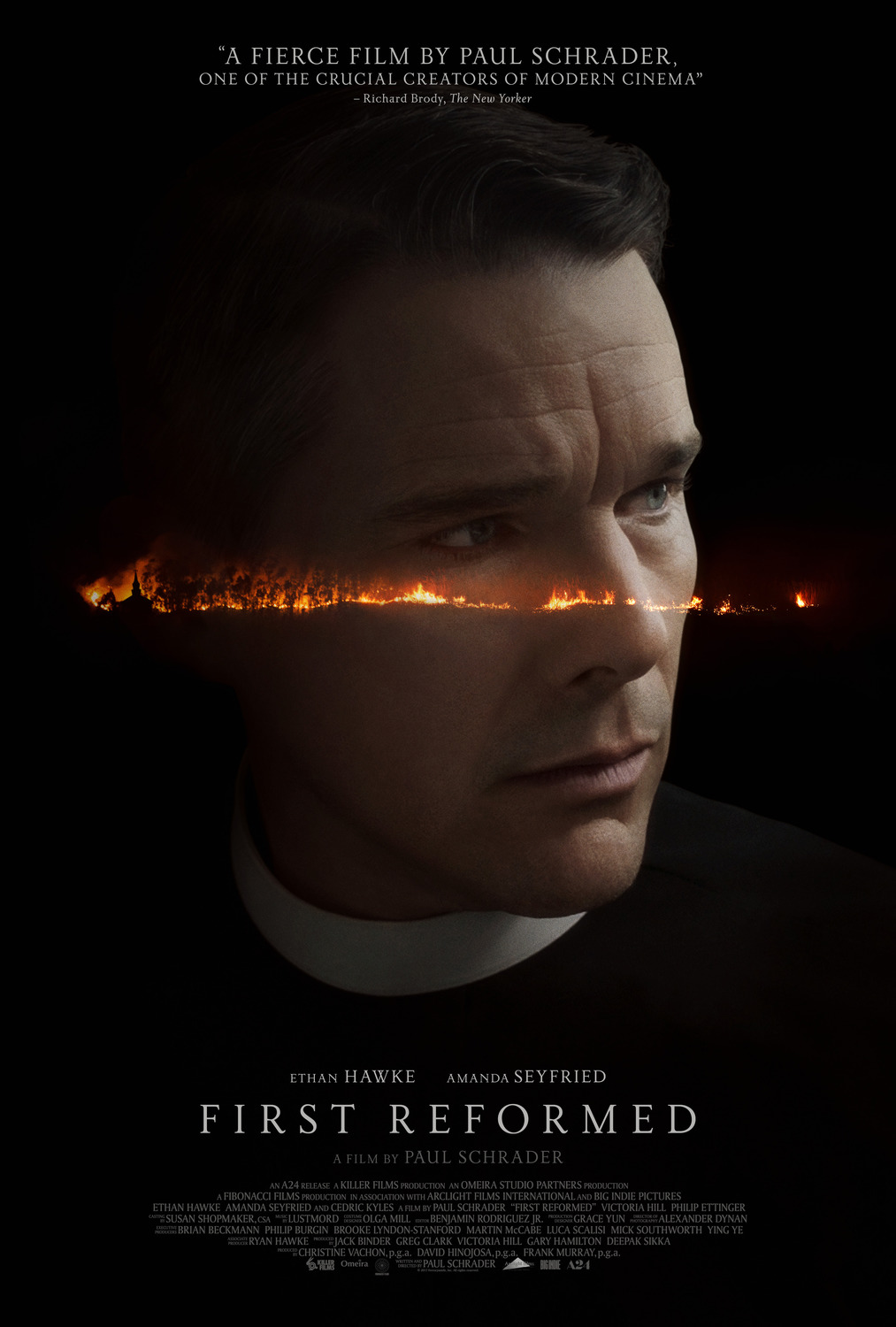
‘First Reformed’ Could Very Well Be Paul Schrader’s Filmmaking Masterpiece

First Reformed movie poster

I remember taking a film class on the works of Alfred Hitchcock, and the instructor talked about how filmmakers often make the same movie over and over again. This is certainly the case with Paul Schrader as “First Reformed” marks his return to the “God’s lonely man” story or, as he would describe it, the “man in a room” stories. Whether it is Travis Bickle in “Taxi Driver,” Julian Kaye in “American Gigolo,” John LeTour in “Light Sleeper,” Wade Whitehouse in “Affliction” or Carter Page III in “The Walker,” Schrader has always been attracted to the lives of men trapped in their own bubble of solitude as they desperately try to find some meaning in life which will rescue them from the crippling isolation and despair which threatens to envelop them.

With “First Reformed,” you could say Schrader is offering his audience variations on a theme here as not everything is as predictable like us movie buffs might expect. But more importantly, he gives us one of the very best movies he has made in years as his exploration of a man in spiritual crisis remain as powerful as ever, and it features excellent performances from its very talented cast as well as a deeply thoughtful screenplay which succeeds in taking us to hell and back. While Schrader has not always had the technical brilliance which Martin Scorsese continues to possess, “First Reformed” shows us the cinematic leaps and bound he has made over the years, and he does it with a story which highlights the eternal conflict between our belief in God and the inescapable realities we can no longer lie to ourselves about.

Ethan Hawke plays Toller, a former military chaplain who works as a priest and provides sermons to a small congregation at the First Reformed Church in upstate New York. We learn he had a son whom he encouraged to enlist in the military, and that he was killed six months after arriving in Iraq. The tragedy of his son’s death destroyed his marriage, and he bemoans how he sent his only child into a war which had no moral justification. With his role at First Reformed Church, he looks to redeem himself in the eyes of not just everyone around him, but in God’s as well.

One of Toller’s regular attendees is Mary (Amanda Seyfried) who is expecting a baby with her husband, Michael (Philip Ettinger). Mary is eager to welcome this baby into the world, but Michael, however, does not share her enthusiasm and thinks it would be better to terminate the pregnancy. Mary asks Toller to counsel Michael to see if he can relieve her husband of his ongoing depression, and it is during their talks that Toller discovers Michael is a radical environmentalist who has long since been convinced of how global warming is destroying the earth, and that time has already past for humanity to effectively reverse the damage. Things become even more tense when Mary invites Toller over to her house to show him something Michael had hidden from her, a suicide vest.

Revealing more of the story from here would be criminal as it would spoil an already immersive cinematic experience which holds you in its grasp from the get go. What you should know more than anything else is this: global warming is real and is an even bigger threat to this planet than ever before. None of this is lost on Toller as he finds himself sympathizing with Michael to where he doesn’t realize how Michael’s despair is infecting him to an increasing degree. As much as he wants to help Michael, Toller finds himself questioning if God can ever forgive humans for what they have done to the planet. As “First Reformed” shows, this will either not be the case, or that forgiveness may come in another and unexpected form.

The brilliant conceit of “First Reformed” is how it deals with the crisis of faith in regards to an environmental issue which continues to get worse and worse with each passing year. Even Toller has to admit how Michael’s fears are becoming a quicker reality than many would want, or even care, to admit, and this leaves him in a state of conflict which pulls him into a dark place which offers no easy exit. Toller feels compelled to do something about this continuing environmental disaster, but he finds himself caught up in a personal struggle which has him drinking an endless amount of alcohol to drown his troubles away. Many see the suffering of an alcoholic as being someone who is too afraid to live and too scared to die, and Toller clearly fits this description as he cannot lie to himself about the apocalyptic path humanity is on.

When it comes to Schrader, his work as a writer typically outshines what he pulls off as a filmmaker. While his sometimes collaborator Martin Scorsese continues to show a filmmaking mastery few others can come close to equaling, Schrader has to make do with whatever is available to him, and this sometimes shows in embarrassing ways (for example, check out the terrible special effects in “Dominion: A Prequel to The Exorcist”). His films have long since been relegated to the independent film realm which thrived in the 1990’s but came to suffer inescapable blows to where you were more likely to see his films on your iPhone instead of the silver screen.

With “First Reformed,” however, Schrader gives us one of his best films ever as everything about it feels perfect. The acting is superb, the cinematography by Alexander Dynan is both beautiful and appropriately haunting, and the music of Lustmord helps to accentuate the conflict between hope and despair shown here. Considering how this film was shot in just 20 days on a budget of $3.5 million dollars, this makes what he accomplished here all the more commendable.

Ethan Hawke has long since proven to be one of the best actors of his generation, and his performance as Toller ranks among his finest. Seeing Hawke trying to hold his sanity together as his faith continually gives way to despair is fascinating to watch as his actions come to speak much louder than words can. Amanda Seyfried beautifully underplays her role as an expectant mother who is trying to come to grips with an increasingly dangerous world she wants to welcome her baby into, and she is such a luminous presence here. Even Cedric Kyles, better known as Cedric the Entertainer, shows up here as Reverend Joel Jeffers, a man who has to balance out his duty to God with the pressing issues from corporate entities that do not want anything to get in the way of profit. Church is a way of life for many people, but make no mistake, it is also a business for others.

“First Reformed” is far and away one of the best films I have seen in 2018, and it may very well be Paul Schrader’s filmmaking masterpiece. It ends on a rather ambiguous note as not everything is wrapped up in a neat and tidy fashion, but with a film like this we are left with more questions than answers and for a very good reason. Schrader seeks to test the faith and beliefs of his audience in an effort to wake them up about climate change and global warming as we have long since become complacent with our elected officials doing little to nothing about reduce the damage it has wrought.

I also have to say that if Hawke had performed a certain action in the film’s last few minutes, I would have been waiting for him to say “corn nuts.” If you have ever seen the cult classic “Heathers” starring Winona Ryder and Christian Slater, you will know what I mean.

* * * * out of * * * *