‘The Color Purple’ Movie and 4K Review
The following review was written by Ultimate Rabbit correspondent, Tony Farinella.

This was my first time having the pleasure of sitting down to watch “The Color Purple,” directed by the legendary Steven Spielberg. This is a director who has never been afraid to tackle any type of film project.  When watching this film, his trademark heart is clearly on display.  What makes it stand out and be as memorable as it is, though, is the terrific acting, especially from Whoopi Goldberg and Oprah Winfrey.  “The Color Purple” is based on the novel by Alice Walker, which I have not read, so my film review will be solely based on the film itself. I have no frame of reference to compare it to, and I think that is more than OK. Too often, people get caught up in comparing films to books, and in the end, they are two totally different mediums.  You will never be able to cover everything from the book because you are limited by the running time of the film.

The film takes place from 1909 to 1943 in Georgia where we are introduced to Celie Harris (Whoopi Goldberg), a young teenager who already has two children, a boy and a girl, because she was raped by her father. Her father took the children from her and has essentially sold them off for profit.  Celie wonders where her children are and worries about them constantly, as any mother would when they are abruptly taken.  She was also married off, thanks to her father, to Albert Johnson (Danny Glover), an abusive man who makes her do anything and everything for him.  He beats her, forces her to have sex with him, and controls every aspect of her life. In his eyes, this woman serves one purpose and one purpose only, which is to take care of him. She even has to call him “Mister.”
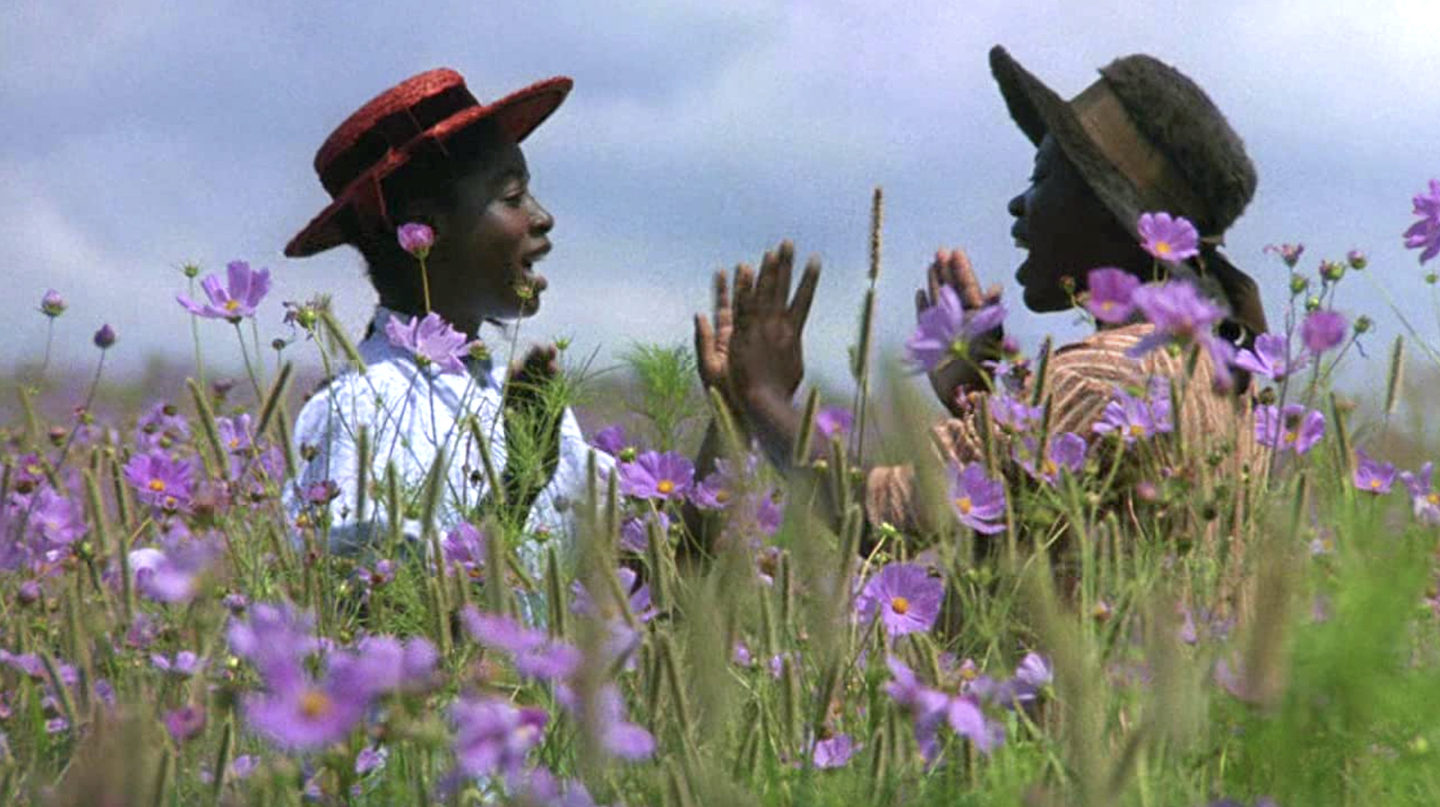
During this time, she was separated from her sister, Nettie, played by Akosua Busia. When Albert came looking for a wife, he was initially interested in Nettie, but their father would not part with her and insisted on Celie going with Albert.  Celie is often told she is too skinny and ugly.  She sees inspiration in the strong-willed Sofia, played by Oprah Winfrey.  Sofia is not one to take guff from anyone in her life, but you wonder how long this will last before she is beaten down by the rampant racism she experiences.  We get to know another woman named Shug Avery, played by Margaret Avery, a flamboyant performer who has Albert Johnson’s full attention. Even though Shug comes with some baggage, she seems to know how to hold her own and capture the attention of men while remaining independent and tough. Celie is hoping to receive some letters from her sister Nettie, but she starts to wonder why they never show up and if her sister is even alive after they were separated.

“The Color Purple” covers a great deal of time and because of the amount of time it covers, four decades, it makes sense that the film is 153 minutes. This was one of those films where I rarely noticed the running time because it was a prime example of good old-fashioned Hollywood craftsmanship. When film critics and fans say things like, “They don’t make ‘em like they used to,” in my eyes, they are talking about films like this one, which was released in 1985.  It’s a drama made by adults for adults.  This is a serious subject matter, but it’s handled with Spielberg’s trademark warmth, tenderness and care. Because we spend so much time with Celie on her journey, we can’t help but root for her to overcome her circumstances.  We get to know her and the women close to her as they have made an impact on her life.
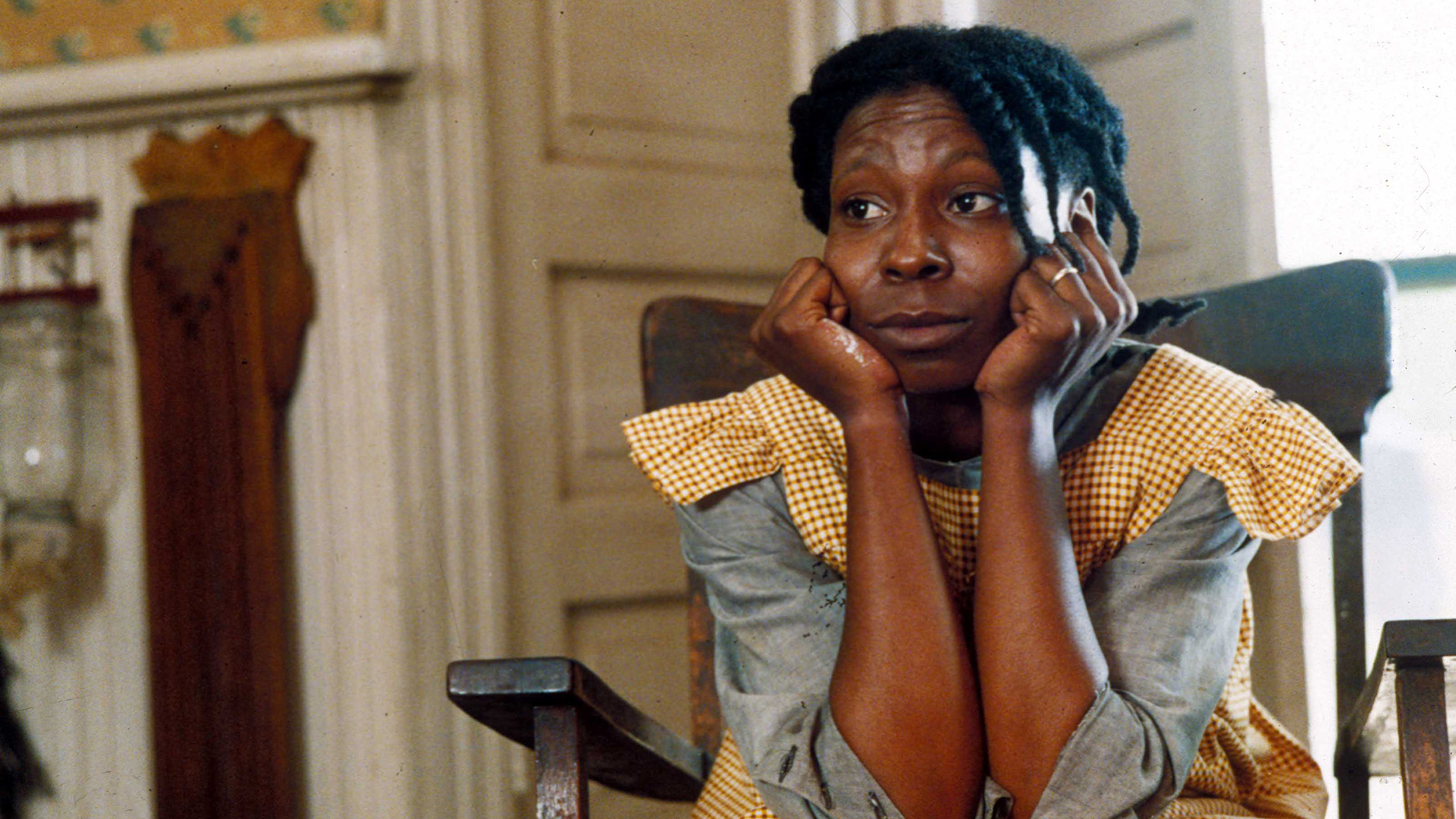
The film is incredibly patient in allowing things to slowly build up to its climax without ever feeling like it’s taking too long to get there. Goldberg is tremendous here.  She expresses a plethora of emotions on her face without ever overacting or doing too much. You can look in her eyes and see the pain and heartache of her character.  It’s a terrific performance, and I think people forget what a great actress she is when given the chance to show off her range of emotions. Of course, she won an Oscar for “Ghost” in 1991.  However, this is clearly the film she should have won an Oscar for, with all due respect to Geraldine Page.

“The Color Purple” does sometimes go off the beaten path with its narrative plot and, at times, it can spend too much time with one character in a specific time and place instead of sticking with Goldberg and her character’s story.  I was very, very close to giving this film four stars, especially because of the emotional weight which was incredibly powerful.  It earns the tears of the audience here by allowing things to build up and develop.  Winfrey is also really, really good here and earned an Oscar nomination for her performance in this film along with Avery.

One of the biggest criticisms of this film is that it was directed by a white director in Steven Spielberg. This is a film populated with a cast which is 95% Black.  I can see why audiences would take issue with that, but Spielberg is wise to stay out of the way of the material and the actors.  Even though some of his familiar touches are here, as mentioned earlier, it doesn’t feel like a typical Spielberg film.  He is sensitive to the story, and he does a terrific job of allowing the performances of his cast and the story itself to take center stage.  He’s more in the background here and, for once, it isn’t a bad thing.

* * * ½ out of * * * *

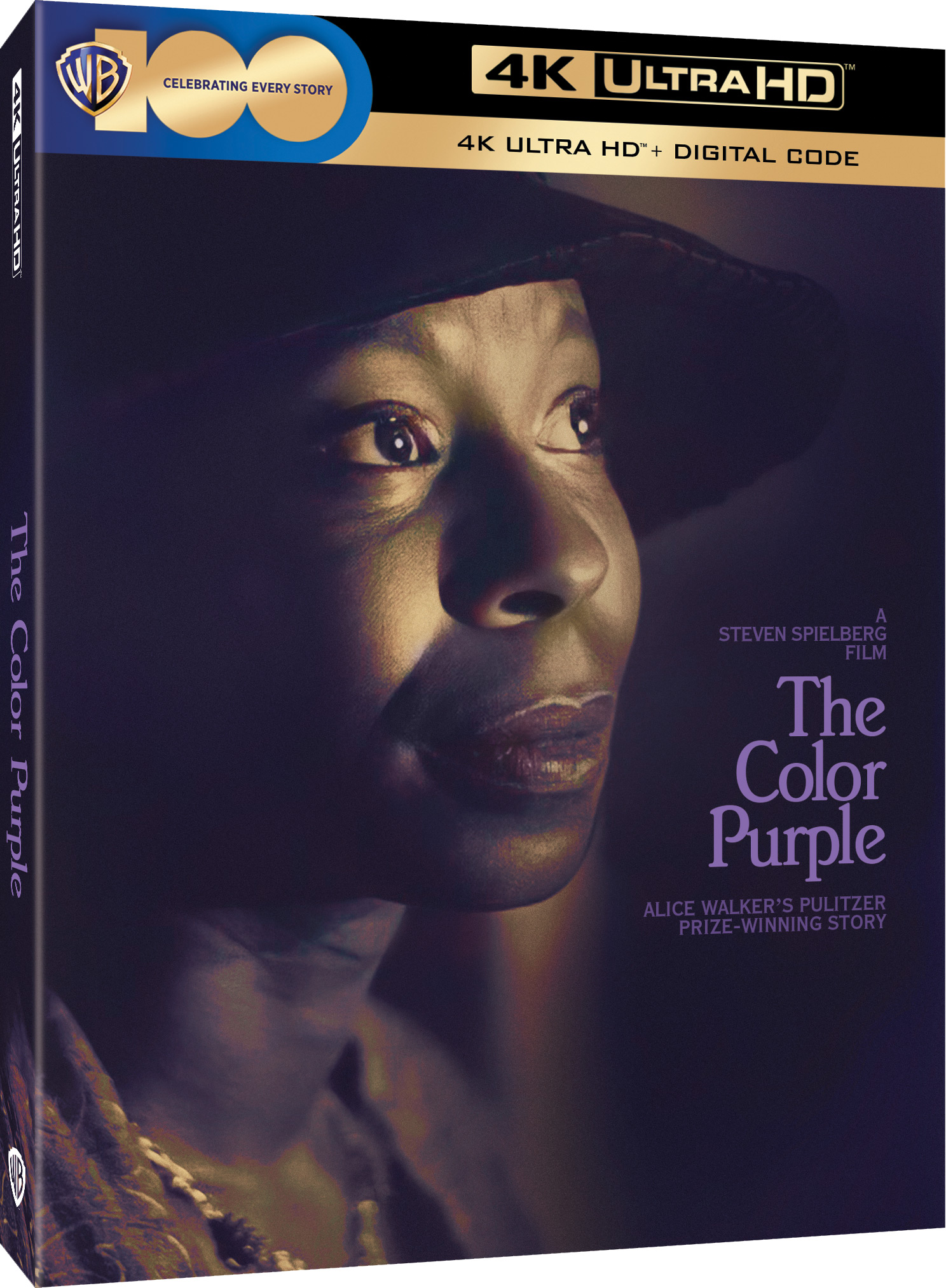
4K Info: “The Color Purple” is released on a single 4K disc from Warner Brothers Home Entertainment.  It also comes with a digital copy of the film.  The film is rated PG-13 and has a running time of 153 minutes.

4K Video/Audio Info:  This is another top-notch transfer from the folks over at Warner Brothers Home Entertainment. The HDR here really shines in some of the outdoor scenes which are lively and colorful.  It has a cinematic feel to it while also cleaning up the picture as well.  The audio track is also really solid, as this is a dialogue heavy film, and it’s easy to understand everything that is being said with a clean and crisp audio track here. Subtitles are included in English, Spanish and French.

Special Features:

Conversations with the Ancestors: The Color Purple from Book to Screen

A Collaboration of Spirits: Casting and Acting The Color Purple

Cultivating a Classic: The Making of The Color Purple

The Color Purple: The Musical

Teaser #1

Teaser #2

Trailer

Should You Buy It?

If you read my 4K reviews (and thank you if you do), you know what a big proponent I am of film history and preservation. In the year 2023, Warner Brothers has done their job in going through their extensive catalogue of films and bringing them to 4K and making them look bigger and better than ever.  There are a ton of important films in the Warner Brothers library that have received their day in court this year. In order for them to continue doing their job, we need to support their restorations of classic cinema, especially when they are done in such a magnificent manner, leaving no stone unturned. “The Color Purple” pops off the TV here and looks better than it ever has, thanks to this 4K transfer.  It sounds great as well. The film itself is an important piece of cinematic history that shows off great acting and tells a vital story with a great cast of actors and one of the best directors of all-time. At its current price point, which is around $23, this is a day one purchase on its December 5th release date.

**Disclaimer** I received a copy of this film from Warner Brothers to review for free.  The opinions and statements in the review are mine and mine alone.
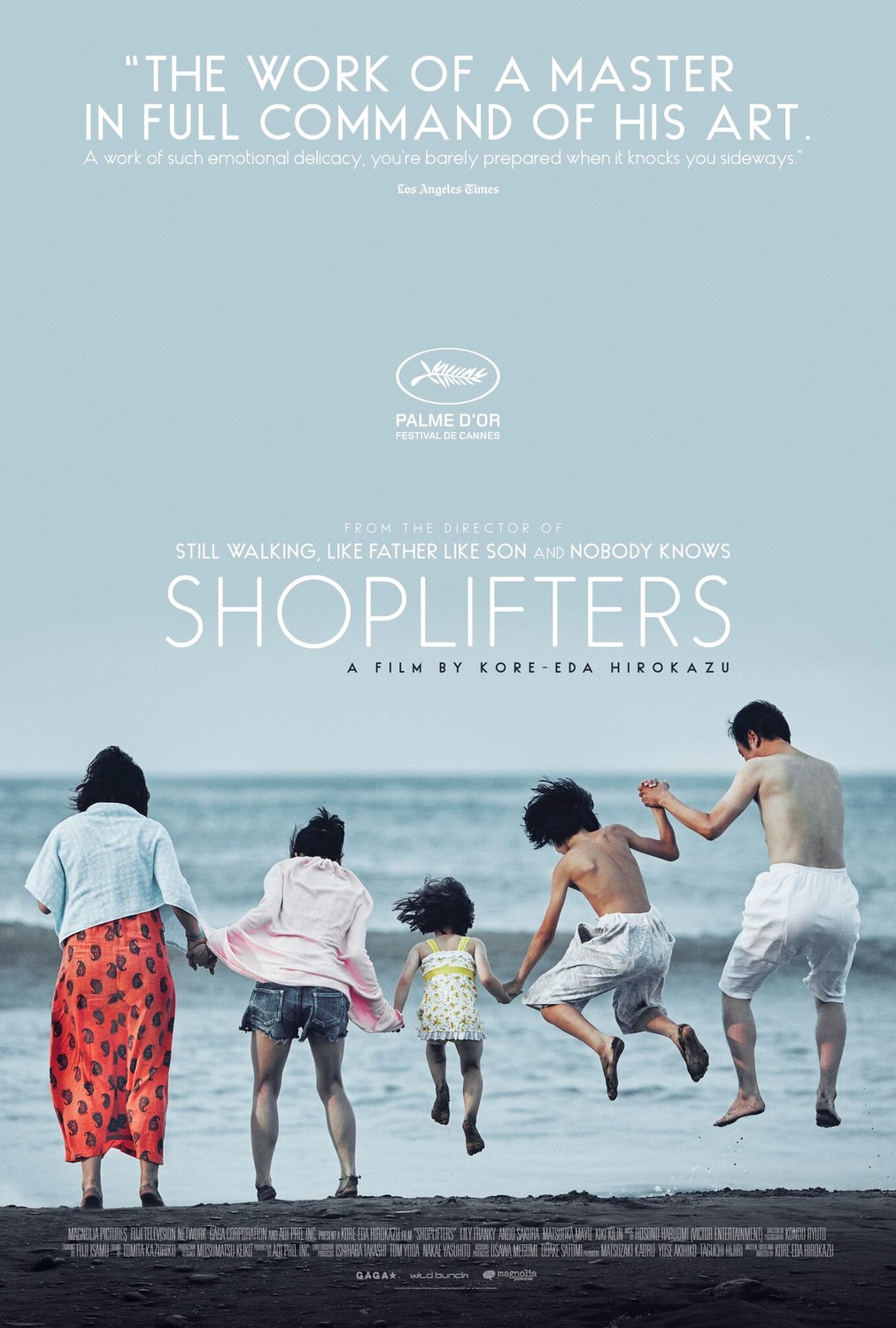
‘Shoplifters’ is an Emotional Rollercoaster and One of the Best Movies of 2018

Shoplifters movie poster

Hirokazu Kore-eda’s “Shoplifters” is one of the most emotionally resonant movies I have seen in 2018, and it is a real gem in a cinematic year dominated by, big surprise, superhero blockbusters and endless sequels. The hope and warm emotions which emanate from it feel like the kind I have not been witness to on the silver screen in ages, and the movie dares you to ponder what the word family really means. While many see families being bound by blood, “Shoplifters” suggests there is more to it than that.

Things start off with Osamu Shibata (Lilly Franky) arriving at a supermarket in Tokyo, Japan, and we will eventually see how this movie got its name. With him is the young Shota (Jyo Kairi), and they use hand signals with each other to indicate when the coast is clear to take what they want and need. Put aside the fact no parent or adult figure should ever be teaching a child to steal; these two have an effective system which leads to them obtaining the goods they need without going through the checkout line or setting off an array of alarms. More importantly, it shows the strong connection between these two, and it is not one which is easily formed.

Upon arriving home, we see they with several other people in a cramped apartment which was made for two people at best. Among them are Osamu’s wife, Nobuyo (Sakura Ando), who works an unforgiving and low-paying job at a local laundromat, their daughter Aki (Mayu Matsuoka) who performs sex shows for anonymous customers, and grandmother Hatsue Shibata (the late Kirin Kiki who steals every scene she is in) whose residence they all reside in. Everyone here is suffering through an unsteady economy dominated by recession, so these characters are forced to steal items such as food and clothes in order to get by. Yes, Hatsue does have her late husband’s pension to fall back on, but it is never enough to fulfill their needs.

Then on one cold evening as Osamu and Shota are returning after another successful day of shoplifting, they come across Yuri (Miyu Sasaki), a 5-year-old homeless girl sitting all alone by herself. As the temperature decreases rapidly, and you could do a drinking game for every time a character says “it’s cold,” they decide to take her home for the night. With their apartment overcrowded, Nobuyo suggests they return Yuri home, but a visit to her residence reveals her parents are abusive to one another and to Yuri as well. As a result, Osamu and Nobuyo find themselves informally adopting her.

What struck me most about “Shoplifters” is how genuine its emotions feel. From a distance, the description of the plot might make it seem something along the lines of “Three Men and a Baby” or maybe even “Raising Arizona,” both of which featured characters who become parents in unorthodox ways. But Kore-eda is not out to manipulate our emotions for a single second as he lets life unfold before us in a way which feels real and unpredictable. No one appears to be acting here, and every single actor inhabits their roles to where you are seduced into the movie’s wonderful atmosphere with what seems like relative ease.

The affection everyone in the small apartment has for Yuri feels wonderful and hopeful to take in, and her presence has a profound effect on them all. The scene where Nobuyo and Yuri burn the 5-year-old’s clothes in an effort to start fresh in life speaks volumes. The two share scars of past abuse, and Nobuyo cuddles her and says how people show their love for one another through hugs, not violence. If there has been a more genuinely sweet scene in a 2018 movie, I missed it.

As for the others, Osamu and Nobuyo find an intimacy in their relationship which has eluded them for far too long, and Aki yearns to get closer to one of her customers as she can no longer keep him at a distance. Shota slowly begins to bond with Yuri to where he feels comfortable calling her sister, but this later leads him on a journey to find himself in a way which will have inevitable consequences for everyone that we don’t really see coming.

Revealing more of what happens in “Shoplifters” would be criminal, but I can tell you the last half is truly devastating as everything we thought we knew about these characters is turned upside down. One of Kore-eda’s masterstrokes as a writer and director is he never judges the characters, and as a result, neither did I. Even as the local news reports of Yuri’s disappearance, Osamu and Nobuyo justify their actions by saying they did not kidnap her since they never asked for a ransom. It’s a weak defense to be sure, but seeing the connection these characters have with one another deeply moved me to where I actually found myself giving them a pass which I never would have in real life.

With “Shoplifters,” Kore-eda aims to look at what makes a family. While we collectively believe it is blood which makes a family, he wonders if there is more to a family than that. At a key moment, one of the characters says if having a baby automatically makes you a parent. Well that goes without saying, but considering the love and affection these characters grace Yuri with, I had a hard time finding enough of a reason to separate her from them.

Kore-eda was also influenced by the Japanese recession, and he uses this to deal with the declining social statuses many are forced to deal with in the country. Then again, “Shoplifters” could be about any country where greed continues to wreak havoc due to corporations valuing the size of their profits over the rights of the workers who helped get them those profits. We Osamu trying to get whatever work he can, and the work he gets never pays enough. Nobuyo’s job offers her a pathetically low wage, and then later we get a scene where her boss forces her and her co-worker to decide amongst themselves who should get fired when it is determined there is only enough money to keep one of them on the payroll.

“Shoplifters” is a movie which will stay with you long after you have watched it. I was deeply moved by it from start to finish as its humanity really made me appreciate the value of family in a way no other movie has in a long time. We are at a point where there are far too many movies to keep up with, but this is one I highly recommend you check out above others. This one took me for quite the emotional ride and left me fully wringed out by its end, and the experience was one of the most rewarding.

* * * * out of * * * *

Exclusive Interview with Barry Crimmins and Bobcat Goldthwait about ‘Call Me Lucky’

It was very sad to learn Barry Crimmins passed away on February 28, 2018 at the age of 64. Crimmins was diagnosed with cancer only a month earlier, but the disease spread through his body very rapidly. He was an American stand-up comedian, a political activist and satirist, a writer and a comedy club owner, and his comedy predated that of the late Bill Hicks. He brought the comedy scene in Boston to a new level of prominence after forming the city’s two clubs, The Ding Ho and Stitches. He has long since earned the respect of fellow comics like Bobcat Goldthwait, Steven Wright, Paula Poundstone, Kevin Meaney and many, many others who continue to sing his praises, But the thing is, I was only just getting to know him just a few years ago.

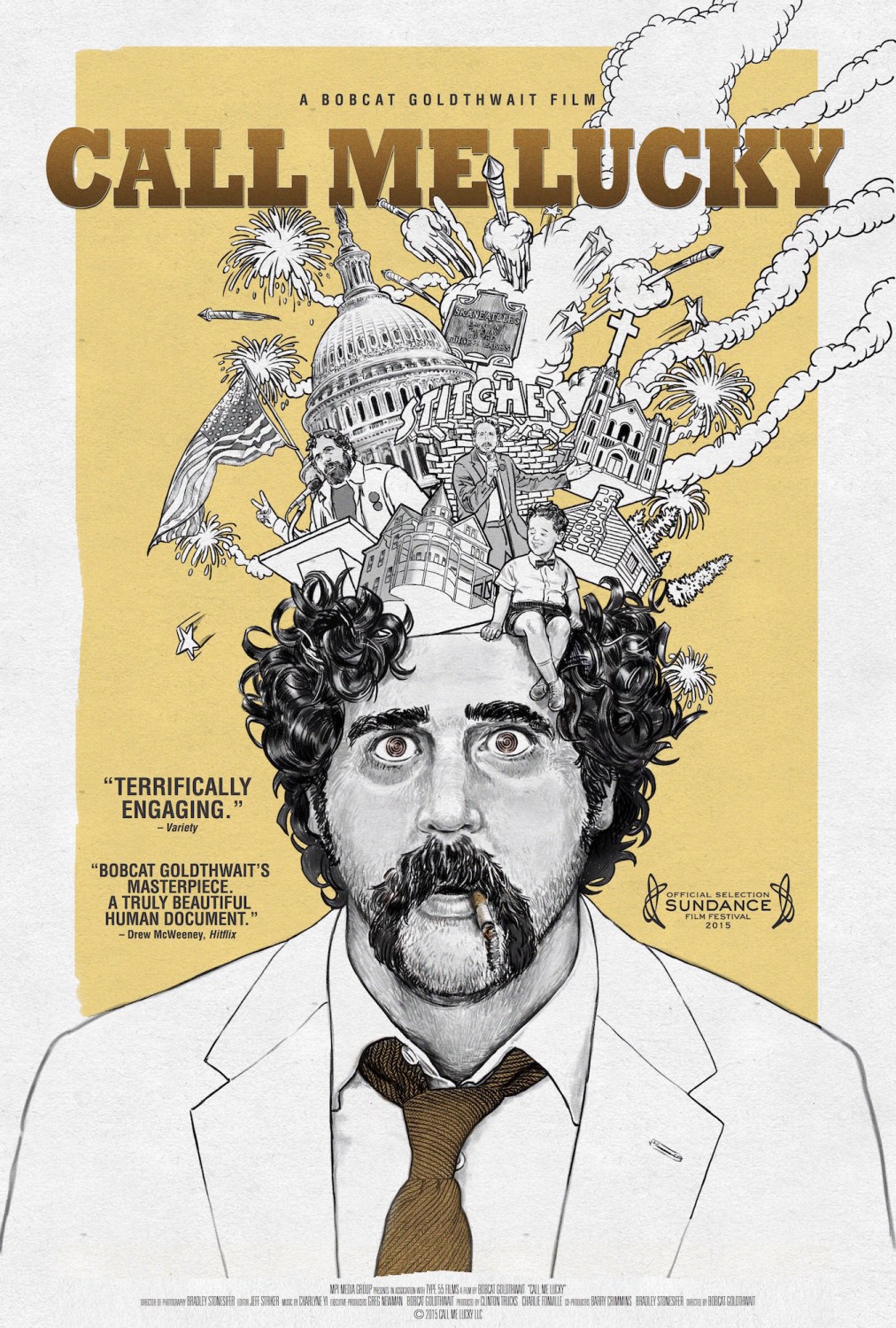
Call Me Lucky poster

Despite Crimmins having done so much work, many people today, myself included, had never heard of him before. This changed in 2015 with Goldthwait’s acclaimed documentary “Call Me Lucky” which chronicled Crimmins’ beginnings as a comic in New York to his work in the present as a political activist. The documentary also reveals how Crimmins was a victim of sexual abuse as a child, and we even see him revisit the scene of his abuse in an effort to come to terms with what he went through. For years, he was an anti-pedophilia activist, and he went out of his way to expose pedophiles on the internet in the 1990’s before turning his evidence over to the FBI. In 1995, he testified before Congress about the need to enforce child pornography laws more than ever before.

In 2017, Crimmins married Helen Lysen, a photographer and font designer, and she was with him when he passed away peacefully. She shared the news of his death and wrote, “He would want everyone to know that he cared deeply about mankind and wants you to carry on the good fight. Peace.” Indeed, his death is a real loss as we need voices like his as the political climate we are currently dealing with in America continues to grow more volatile as days go by.

I was fortunate to talk with Crimmins and Goldthwait while they were doing press for “Call Me Lucky” a few years ago. To this interview, I wore one of my “They Live” t-shirts as I figured Crimmins was a fan of John Carpenter’s 1988 cult classic which remains one of the most politically subversive movies ever made. It turns out he had not seen it, but Goldthwait certainly did, and I hope he got Crimmins to check it out before he passed away. I am certain he would have enjoyed it immensely.

They Live Obey t-shirt

Please check out my exclusive interview with Crimmins and Goldthwait above. “Call Me Lucky” is now available to own and rent on DVD, Blu-ray and Digital.

Rest in Peace Barry.