The Fourth Noble Truth

the-fourth-noble-truth-movie-poster

Watching “The Fourth Noble Truth” quickly reminded me of how much I personally benefit from doing meditation, and of how I need to get back into the habit of doing it on a regular basis. It’s very beneficial as it allows your brain to have a rest from all the thoughts and concerns which constantly run through it, and it helped me during a time where I suffered deeply from anxiety and depression. Gary T. McDonald’s film explores meditation from a Buddhist perspective as two people come together while searching for true happiness, and the end result feels emotionally honest about a topic some would be loath to take seriously.

Before we get to the movie’s opening title, we are introduced to movie star Aaron Redmond (Harry Hamlin) who does a Jack Nicholson and bashes another person’s car with a golf club. This is all it takes for the audience to see that this guy has serious anger management issues, and the movie wastes little time in showing him driving out to the home of a Buddhist meditation teacher named Rachel (the lovely Kristen Kerr) as it is part of his sentence for being convicted of road rage.

The way Aaron sees it, he has everything a person could ever want, so how can he be the least bit unhappy? Rachel, however, is not impressed with his bad boy movie star persona and sets about teaching him each of the noble truths while guiding him through meditations. However, his constant flirtations end up getting the best of her, and they end up spending the night together. From there they are both forced to reassess their life choices or risk losing the love and happiness they strive for.

In case you are wondering what the four noble truths are, they express the basic orientation of Buddhism which says this worldly existence is fundamentally unsatisfactory, but there is a path to liberation from repeated worldly existence. The truths are as follows:

Life is full of psychic suffering, such as stress, angst, discontent, and unhappiness.

The cause of this suffering is desire. Not the fleeting kind, but a clinging or attachment for things like material possessions, people, and validation.

If you end these fixations, you will stop suffering.

You end suffering by walking the Eightfold Path, which is a way of life embodying these virtues:

Right Understanding

Right Intention

Right Speech

Right Action

Right Livelihood

Right Effort

Right Mindfulness

Right Concentration

The Buddha taught that developing the virtues of the fourth noble truth is the key to happiness. Of course, getting to the last truth is always the hard part.

I liked how Hamlin’s character evolves throughout the film. His skepticism over meditation is understandable as most people, including myself, come into it with a lot of doubt over if it will do them any good. Also, getting the handle of meditation takes some time because you are bound to start off feeling like you’re not doing it right. His character of Aaron refuses to take meditation seriously at first, and he is mostly interested in getting the judge in his case off his back more than anything else. But while he appears to be confident in being the man he is, we can see from the start he is one seriously unhappy dude.

Hamlin has been around for a long time, and my generation knows him best for his roles in “Clash of the Titans” (the original, not the remake) and the TV show “LA Law.” These days he is better known for his work on the shows “Mad Men,” “Glee,” and “Shameless.” At 63, he still has an effortless charisma about him which makes him perfect for this role of an over the hill celebrity who has yet to realize material possessions do not equal happiness.

I’m not familiar with Kristen Kerr’s work, but she left quite the impression on me as Rachel. When we first meet her, she appears to be a master in the ways of meditation and has reached a great place in her life where everything seems balanced. But as the movie goes on, she comes to see how uncertain she is of whether or not she has reached the fourth noble truth as she makes the biggest mistake a meditation teacher can make.

It should go without saying how nobody is perfect, but this threatens to do a disservice to Rachel as she quickly realizes the errors of her ways. Kerr makes Rachel a fascinating character as a result because we really root for her to hold onto her bearings and not give up on her pursuit to achieve happiness. It’s never an easy road as life is full of endless trials and tribulations, and we come out of this movie relieved Rachel has not lost her way. Kerr is a wonderfully appealing presence from start to finish, and she makes us believe in the benefits of meditation in a way few other actors could.

McDonald’s previous directorial credits include “The Sea Wolf” and the documentary “Rape/Crisis,” movies I have yet to see. He does a commendable job of taking this relationship story and makes it feel down to earth and not the least bit contrived. When Aaron and Rachel fall for one another, I thought the movie was going to shoot itself in the foot and lose all credibility, but their relationship serves to give “The Fourth Noble Truth” more complex issues to explore. What I admired most was how the movie explored meditation and the relationship issues these two characters experience to where it feels emotionally honest in a very satisfying way.

In some ways, “The Fourth Noble Truth” is somewhat undone by its understandably low budget, and I hate to say that because movies like these are forced to deal with whatever resources they can get a hold of. I could see this script being done as a play onstage, so it doesn’t feel as cinematic as a movie should. But despite its flaws, it serves as a nice introduction to what meditation can do for your own well-being. It’s not meant to be an instructional manual on meditation, but if it were then it wouldn’t be as effective.

“The Fourth Noble Truth” is coming in well below the radar amidst all the big blockbusters which threaten to occupy our local multiplexes at the expense of everything else. My hope is more people get exposed to it on the big screen long before it becomes available on DVD, Blu-ray and Digital.

* * * out of * * * *


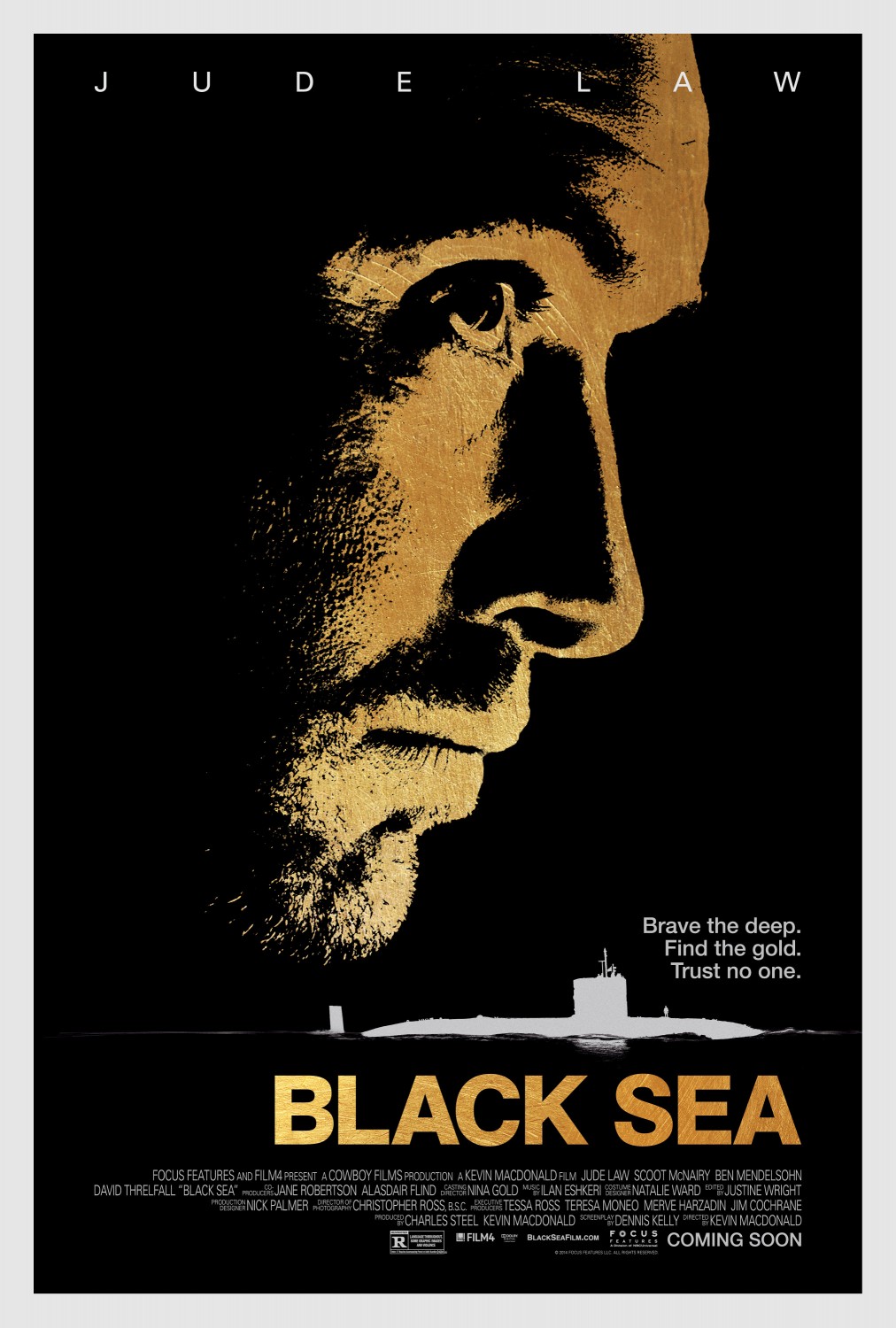
Black Sea

black-sea-poster

When it comes to submarine movies, I feel the genre peaked early on with Wolfgang Petersen’s “Das Boot” which proved to be as claustrophobic as movies get. Others have come close to equaling its visceral power, but there’s no topping it. I went into “Black Sea” knowing this would be the case, and that helped a lot because this movie proved to be a lot more intense and nail-biting than I expected it to be. It doesn’t break any new ground, but it is a gritty thriller which doesn’t let up.

Jude Law stars as submarine Captain Robinson who, as the movie starts, has been laid off from his salvage job which leaves him with few prospects for future employment. It turns out he’s not the only one as his friends and colleagues have been kicked out of their jobs as well, and it serves as an annoying reminder of how companies spend more time firing employees than they do hiring them.

But Robinson soon gets offered a job by a shadowy backer who tells him about a World War II submarine that has sunk to the bottom of the sea and which contains an enormous wealth of gold. Seeing how it offers him and his colleagues more than enough to quit any day job they can hope to get, he commandeers an old and fairly decrepit submarine from the Cold War days to get at the gold hidden miles below the surface. But in addition to avoiding detection from the Soviets as he travels below their radar, he has to contend with the fragile relations between the crew members as they come from different places and don’t have enough trust in each other to make this mission run smoothly.

What makes “Black Sea” an especially effective thriller is that the depths of the ocean prove to be every bit as threatening as the twisted psychology of the submarine’s passengers. Everyone on board has their own selfish motives, and those motives have to contend with the dangers they have to endure on a ship way past its prime. It doesn’t take long before you start to wonder what’s going to kill these men first; the crushing depths or their own paranoia.

“Black Sea” was directed by Kevin Macdonald, a filmmaker who has gone from making documentaries like “Touching the Void” and “Marley” to unforgettable dramas like “The Last King of Scotland” and 2013’s underrated “How I Live Now.” He doesn’t have much to work with in terms of originality, but he makes effective use of the claustrophobic setting to where our nerves are effectively fried throughout. Macdonald also gives equal attention to the human element as the characters drive the action more than you might think. Even though some of the characters’ decisions become rather silly towards the end, he makes you empathize with them to a certain extent. These days, who can’t relate to being laid off or jumping at the opportunity to make a fortune? People will do anything to survive these days.

It’s interesting to see Jude Law in a role like this where he portrays a hard scrabble worker who looks like he needs a good long shower on a regular basis. I’ve gotten so used to seeing him as this handsome man onscreen to where it threatened to make me forget what a great actor he is. While his Scottish brogue gets a little too thick at times, he fully inhabits his role of a man who is more in love with the sea than he is with his own family. Law is also surrounded by a terrific cast which includes Ben Mendelsohn (terrific in the criminally overlooked “Starred Up”), Scoot McNairy, David Threlfall and Konstantin Khabensky who each imbue their roles with a lot of grit and desperation. It helps to have actors this good in a movie which on the surface might seem run of the mill.

At this point, I don’t think it’s even possible to reinvent the submarine movie genre. Where else can you go with it after movies like “Das Boot,” “The Hunt for Red October” and “Beneath” to name a few? All you can hope for is that it can be done well and keep you on the edge of your seat, and “Black Sea” manages to do that more than you might expect. Sometimes that’s all you need a movie to do.

* * * out of * * * *

Exclusive Interview with Olga Szymanska on Marcin Wrona’s ‘Demon’

It was very sad to learn of Polish director Marcin Wrona’s passing on September 18, 2015. He committed suicide before a screening of his latest film, “Demon,” the last in a trilogy which began with “My Flesh, My Blood” and “The Christening.” Like those two films, “Demon” deals with the nature of evil and a fate the protagonist is forced to deal with. Itay Tiran stars as Piotr (a.k.a. Python) who is on the verge of getting married to the beautiful Zaneta (Agnieszka Zulewska) and moving into a family home which has survived from one generation to the next. But on the day of his wedding, Piotr suddenly becomes possessed by a spirit which will no longer remain silent, and what should be a joyous day soon turns into the wedding from hell as the past will no longer remain buried.

While Wrona is no longer with us, his “Demon” is a tremendously well-made horror film which allowed him to leave his mark on the world of cinema, and it provides us with an interesting take on the Jewish legend of the dybbuk. It is a beautifully filmed movie with incredible vistas and an all-encompassing darkness as a bad situation gets even worse, and that’s not just because the wedding guests have drunk far too much vodka. Watching “Demon” also reminds us of the power of ambiguity as not all questions are answered here, and this forces the viewer to think more deeply about what they have just witnessed.

I got to speak with Olga Szymanska, the producer of “Demon” and Wrona’s widow, while she was in Los Angeles to promote the film. I applaud her for supporting her late husband’s work while dealing with a loss which is still hard for many to accept. She talked about what went into the making of “Demon,” how it relates to Wrona’s previous two films, if she was ever worried about people not understanding the legend of the dybbuk, and of how Wrona and his cinematographer Pawell Flis gave the film such a striking look.

Please check out the interview above, and be sure to check out “Demon” which is playing at the Nuart Theatre through September 15.

demon-movie-poster

AN ULTIMATE RABBIT NOTE: This video interview was updated in 2023 to add certain visual elements and to avoid copyright issues which never intended or inferred.

Exclusive Interview with Eva Husson about ‘Bang Gang (A Modern Love Story)’

Bang Gang (A Modern Love Story),” just by looking at its trailer, seems like the French version of “Kids,” but that’s not even remotely true. Based on a true story, a fact we don’t discover until the end credits, it follows a group of ordinary teenagers who live in the suburban neighborhoods of France and participate in sex parties they refer to as “bang gangs.” In the center of the sexual shenanigans is the beautiful George (Marilyn Lima), one of the main organizers of these parties and who experiences some intense inner turmoil. After being spurned by her would-be boyfriend Alex (Finnegan Oldfield) who goes after her best friend Laetitia (Daisy Broom), George begins feel increasingly isolated from everyone around her even as the parties become increasingly reckless. In short, this story will not end well. Or will it?

This movie marks the feature film directorial debut of Eva Husson whose previous credits include the short films “Hope to Die” and “Those for Whom It’s Always Complicated.” Many consider her one of many directors to emerge from the world of music videos, but she will be quick to silence you on that. Born in France, Husson earned an M.A. in English literature from the Sorbonne, and she would later move to America to pursue an M.F.A. at the American Film Institute. She did make some music videos along the way, but her focus has always been on writing and directing feature films.

With “Bang Gang,” Husson has pulled off an impressive debut filled with strong performances by a mostly non-professional cast, and she is aided by the lush cinematography of Mattias Troelstrup as well as the atmospheric music score by White Sea.

I got to talk with Husson while she was in Los Angeles to promote “Bang Gang (A Modern Love Story” which she described as “a movie about teenagers falling in love in the midst of a sexual apocalypse.” She explained how she pulled off the long tracking shot at the movie’s beginning which lasts for several minutes, why she put the term “based on a true story” at the movie’s end instead of the beginning, and she pointed out how the project was inspired by stories involving American teenagers and not French ones. She also spoke of why she had her cast watch Paul Thomas Anderson’s “Boogie Nights” and Lars Von Trier’s “Melancholia” before the film shoot began.

Please check out the interview above. 

AN ULTIMATE RABBIT NOTE: This video interview was recently updated to eliminate any copyright issues which were never intended, and to make it available to the widest audience possible.

Bang Gang poster