‘Iron Man’ Got the Marvel Cinematic Universe Off to a Strong Start

M Payoff 1sht

The 2008 summer movie season started off with a bang with the long-awaited release of “Iron Man” which starred Robert Downey Jr. as the egocentric weapons maker turned world protector, Tony Stark. It also marked the beginning of the Marvel Cinematic Universe which brought its many characters to the silver screen with great success, and this one still remains one of the best to come out of it.

“Iron Man” starts with Tony traveling through the Afghanistan desert with a military convoy that gets attacked by terrorists. Tony flees the hummer transporting him and almost gets killed by one of the missiles he designed. When he comes to, he is being held captive in a cave and kept alive by an electromagnet attached to his torso which keeps the shrapnel inside his body from going to his heart. The terrorists, led by Raza (Faran Tahir), force Tony to build them one of his most destructive missiles on pain of death, but he instead takes the parts they give him and creates a bulletproof suit which allows him to escape in spectacular fashion.

When he gets back to America, he has a press conference where he states he will turn his company from a weapon making factory into one that doesn’t promote endless destruction. Having seen the damage he has done to others, he is now determined to protect those from the weapons he created. As for the iron suit which saved his life, he works at perfecting it into something strong and indestructible. On top of giving him the ability to fly, it also allows him to get back at those who took advantage of his destructive creations.

“Iron Man” is a tricky movie to make because it is the type meant to set up this particular superhero and then move on to the inevitable sequels which never come out soon enough. It is a credit to director Jon Favreau that the characters are as interesting as the action is exciting. Unlike other comic book adaptations, this story feels much more grounded in reality and doesn’t have characters that don’t seem real. Unlike Peter Parker in “Spider-Man 3,” here we have a superhero who doesn’t waste his time feeling sorry for himself on a regular basis.

But the real masterstroke of “Iron Man” is the casting of Downey Jr. as Tony Stark. He is without a doubt one of the best actors working in movies today, and it is impossible to picture anyone else in this role. When he first appears, he clearly acts like the man Weird Al Yankovic sang about in “I’m Such a Groovy Guy.” Both brilliant and sexy, it’s tempting to believe Downey Jr. is playing himself, but that assumption would be unfair. He makes Tony’s transition from selfish egomaniac to world protector almost seamless and never less than believable. Inside that cool and ever so confident exterior, there lies a man who is taking his life and company in a direction which may completely kill it.

Seriously, Tony is one of coolest comic book heroes to appear in movies for the longest time. Most of the comic book heroes we have grown up with are emotional wrecks and understandably so. Batman saw his parents murdered in front of him, Superman only got to see his parents at that Crystal Palace as he lost his human father earlier than he should have, and Spider-Man lost his uncle when he was murdered. But Tony isn’t necessarily waylaid by emotional disasters the way those characters were. While many of us want to spit on those who look like they had everything handed to them on a silver platter, Tony more than earns his place in society and you never doubt his abilities to create extraordinary things.

Also, Tony has quite the lifestyle most guys envy. He has one hell of a mansion up in the hills of Malibu that has the most incredible view, and his personal jet is equipped with a pole that comes out of the floor for his very lovely stewardesses to take advantage of. I saw this movie in a theater with some friends of mine, and one of them leaned over to me and said, “This is the only way to live!”

In retrospect, this character is a relief after watching those other male superheroes who turn into whiny crybabies that remind me too much of myself. Female superheroes don’t fall into this category much, so that should make you wonder which gender is truly the stronger one.

The rest of the “Iron Man” cast is perfectly chosen. When the movie came out, Jeff Bridges was one of the most underappreciated actors working in movies (this has since changed). His character of Obadiah Stane, one of the main heads of Stark Industries, is a slimy corporate executive whose outer exterior projects a man of kindness and trust Tony relies on. That trust is utterly betrayed when Obadiah files an injunction against Stark to gain control of his company and put it back in the direction it was going before Stark started changing his ways.

Unlike Tony, Obadiah has no creativity or brilliance to rely on. All he has are selfish desires and a misplaced loyalty to Stark’s father who helped build the world’s first atomic bomb. Although he has the makings of another villain whose sole interest is world domination, Obadiah represents those who are too easily threatened by the winds of change. Bridges, like Downey Jr., gives Obadiah dimensions you wouldn’t necessarily expect a character like this to have. This is not just some one-dimensional bad guy like others, and it is a credit to Bridges’ brilliance that he makes this very clear.

Also, on board is Gwyneth Paltrow who is a wonderful presence as Tony’s longtime assistant, Virginia “Pepper” Potts. While it might seem weird for her to play someone’s assistant, she imbues Pepper with beauty, smarts, intelligence and heart which Tony more than depends on his life for. She also shares great chemistry with Downey Jr., and their relationship is key as those inevitable sequels would prove. Paltrow also has one of the movie’s best lines as she meets up with a Vanity Fair writer Tony made out with the night before:

“So, you just spend your time taking care of everything Tony asks you to do?

“I take care of all duties that Tony asks of me to do. That includes taking out the garbage.”

We also have Terence Howard as Tony’s military consultant and close friend, Jim Rhodes. Jim is the one who tries to keep Tony grounded in reality, but he never quite succeeds. Howard is great here if he a bit underused here, and this is the second movie I have seen where he plays a character constantly giving press conferences (“The Brave One” was the other one).

The movie has many great action scenes which you come out of feeling justified in saying, “that’s cool man!” When Iron Man fights off terrorists in a war-torn country, he finds very creative ways to dispatch his enemies that are too good to reveal here. Also, there are scenes where Tony is testing out different parts of the suit. This can usually be seen as the boring set up part for the superhero, but these moments make you jump out of your seat because you find yourself laughing harder than you usually do.

With “Iron Man,” Downey Jr. who gives us something more than the average super hero. He gives us one with brains, smarts and, most importantly, a soul. It doesn’t matter if you have great special effects if you don’t have the story or the characters to match up with it. “Iron Man” has that, and it set the bar high for the comic book movies which followed in its wake.

* * * ½ out of * * * *

‘Cloverfield’ Lives Up to the Hype

Cloverfield

The fact that “Cloverfield” is any good is something of a miracle. This movie was released in January, a month where Hollywood tends to dump all their crappy movies because they have no idea of where else to put them. Plus, this is a movie which could have easily collapsed under the height of anticipation and expectation which preceded it with its brilliant marketing strategy. We all saw the brilliant teaser trailer showing the severed head of the Statue of Liberty being thrown down into the middle of Manhattan. We didn’t see the title for the film until months later, and we couldn’t stop thinking about it. This trailer was analyzed like it was the equivalent of the Zapruder film which captured the Kennedy assassination, but now the movie is finally here and has gotten 2008 off to a strong start.

“Cloverfield” takes place in the city of New York which has seen its fair share of destruction on and off the big screen. It starts off with some color bars on the screen and there is a message stating the footage we are about to see is from the area “formerly known as Central Park.” Those are ominous words indeed, and it leaves us in a state of suspended tension as we already know something very bad is going to happen. We first meet Rob Hawkins (Michael Stahl-David) as he is filming the apartment of the woman he just slept with, Beth McIntyre (Odette Yustman). We see them hanging out in Coney Island throughout, but the movie then jumps ahead to a month or so later when Rob is about to leave New York for a new job in Japan. It turns out Beth and Rob never really hung out with each other again after the great day they had, and the time they had together is always on their minds. But just as they try to sort out their personal issues, the earth shakes beneath them and, of course, all hell breaks loose.

The movie does take its time getting started which is not a bad thing as it takes time to establish the main players and their backgrounds. The script doesn’t flesh them out completely, but they are fleshed out enough to where you do care about them. The big surprise party thrown for Rob is filled with people who look like, at the very least, got a callback for one or more of the shows on the CW network. It would have been nice to see the filmmakers add more ordinary people into this party who did not have the perfect body or such Noxzema clear faces, but anyway.

What makes this monster film particularly effective is how it is told from the ground view. We are there with the people as they experience this disaster firsthand, and the characters are not just simple clichés who look and feel like they belong in a typical watered-down sitcom. This is what drove me nuts about Roland Emmerich’s “Godzilla.” Like Steven Spielberg’s “War of the Worlds,” it is not caught up with the military as they make decisions on how to destroy this enormous beast. It is more concerned with people like you and me and how we might struggle to survive in this situation. The adrenaline keeps running high as Rob and a few others make their way through the decimated city to get to Beth who is trapped in her high-rise apartment.

Another key factor is that “Cloverfield” doesn’t show us the monster right away, and this as a result makes the thought of the monster becomes more terrifying than anything else. We do get to see the monster eventually, but not in its entirety until the latter half. I would love to describe the monster to you, but I’d rather you discover it for yourself as I really don’t want to spoil the surprise. Nothing will compare to the first time you watch this movie.

The movie is also dominated by the shaky cam work which threatens to become an overused method of filmmaking these days. For those of you who have serious motion sickness problems, don’t sit too close to the screen. As for myself, I actually dealt with it just fine. I was starting to think I might have reached my limit with shaky camerawork after watching “The Kingdom,” and it fails in comparison to the brilliant camerawork accomplished in “The Bourne Ultimatum.” But here, it’s fine and it keeps you on the edge of your seat.

“Cloverfield” is not exactly brilliant filmmaking, but it does get the job done and with no real music score might I add. We don’t get to hear a score until the end credits where Michael Giaachiano composed a piece of music which serves a tribute of sorts to the monster movies of the past. Credit, however, should go to director Matt Reeves who directs his first movie here since “The Pallbearer” which was made back in 1996. He keeps the action grounded enough to where we have no problem following the characters even if their situation is not entirely probable. Anyway, we go into a movie like this to have a good time, not to think too hard about everything going on.

* * * ½ out of * * * *

‘Gonzo: The Life and Work of Dr. Hunter S. Thompson’ Digs Deep Into His Life

gonzo-the-life-and-work-of-dr-hunter-s-thompson poster

I felt like I could never figure Hunter S. Thompson out. Whenever I saw films based on his work, he seemed like some crazed lunatic living in a world of his own creation and madness. After watching “Gonzo: The Life and Work of Dr. Hunter S. Thompson,” I feel like I now know what he was all about. Hunter was as patriotic as any American can get, and while he always seemed to be losing his mind, no one can deny he was a true visionary. At the very least, he was never boring.

This documentary was directed by Alex Gibney who managed to get many people to talk on camera about Hunter who, whether they loved or hated it, had to admit to feeling the upmost respect for all he did. The fact Pat Buchanan participated in this documentary is a big surprise considering how Hunter described him as a “half-crazed Davy Crockett running around the parapets of Nixon’s Alamo.” The writings of Dr. Thompson are featured throughout, and the documentary is narrated by Johnny Depp who played the eccentric author in Terry Gilliam’s film version of “Fear & Loathing in Las Vegas.”

Hunter is credited with creating Gonzo journalism, a style of reporting where reporters involve themselves in the action to such a degree to where they become central figures in their own stories. He would take on assignments like covering a motorcycle event, and then he would veer off into something else like the death of the American dream. Through his writing, he got at the ugly heart of the matter and exposed it for all its misleading falsehoods.

“He was a reporter with a wild imagination.”

-Tom Wolfe

“He was not afraid to express himself in sometimes shocking ways.”

-President Jimmy Carter

We see Hunter take on his first big assignment when he meets the Hell’s Angels in California which he looked up to as the last outlaws in the world. This relationship, however, turned sour when he witnessed them gang bang a woman at their party. The group later suspected Hunter of trying to profit off of what he wrote, and they beat him severely. This whole experience ended up shaping him as a writer as he looked beyond the façade sold to the public on a regular basis.

One of the most interesting parts in this documentary is how it shows Hunter’s love of America and his sadness over the death of one of his favorite politicians, Robert Kennedy. It is made abundantly clear how Hunter so wanted to believe in the hope of a better future. His sadness only deepens when he is witness to the beatings at the Democratic convention which took place the same year Robert died, and he berated the Democrats for not doing their part to put an end to the violence.

I got a huge kick out of the section where Hunter runs for Sheriff of Pitkin County, Colorado, as it showed how visionary he was as he had all these plans for revitalizing the town of Aspen. He called for the decriminalization of drugs for personal use, but he also wanted to keep a ban on trafficking as he was no fan of people profiting off of them. Furthermore, he wanted to tear up the streets and replace them with grassy pedestrian malls, he proposed placing a ban on tall buildings being built as they obscured his view of the mountains, and he wanted to rename Aspen “Fat City” in an effort to deter investors who wanted to commercialize the city. Of course, Hunter lost the election which was no real surprise to him, but his run for the office was never ever forgotten.

“Gonzo” also does a great job of looking at the various relationships Hunter had throughout his lifetime. We get a look at his marriages and learned what it was like living with him. To know Hunter was to tolerate him. Perhaps the most interesting relationship documented here is the one between Hunter and artist Ralph Steadman who created some of the most insane drawings which accompanied Hunter’s feverish writings in Rolling Stone magazine. It is interesting to learn Steadman was actually a conventional artist whose work was no different from anyone else’s. But then Hunter turned Steadman on to drugs, and his work evolved into what he is best known for. There is a great moment where we see Steadman at work, and he has this utterly insane look on his face as if he is gleefully possessed. Who knows what would have happened to him had he never met Hunter.

Perhaps the most important section of “Gonzo” is when Hunter supports George McGovern’s run for President of the United States. McGovern was the democratic nominee running against incumbent President Richard Nixon. The Vietnam War was raging on, and hundreds of young American lives were being snuffed out day after day. McGovern sought to put an end to the Vietnam war which the whole country had since gone against. Hunter had a vicious hatred of Nixon, and he saw the possibility of Nixon going on to a second presidential term as a possible death blow to this country.

As important as this section of the documentary, it was a bit overlong and could have been shortened. It gets redundant as we clearly get the message of Hunter’s disillusionment with politics in general. Fortunately, “Gonzo” picks up in the last half as we see how Hunter became trapped by his fame to where his work suffered as a result. But the McGovern section is still important, especially when Hunter is interviewed in the documentary and says this, “I desperately wanted to put an end to that senseless war [in Vietnam]. I’m sick and tired of old men dreaming up wars for young men to die in.”

Sound familiar? No wonder Hunter got depressed when George W. Bush got elected and the World Trade Center was attacked on September 11, 2001. Hunter wrote about those events as if he knew exactly what they would lead to, another war overseas with America striking back in revenge mode. This was all another depressing example of how history repeats itself.

For the most part, “Gonzo: The Life and Work of Dr. Hunter S. Thompson” does an excellent job of making you understand him better and of where he was coming from. We need people like Hunter, people who challenge authority and get us riled up about the way the country is heading. His suicide, other than being very selfish and hardly noble, robbed us of a powerful voice we need in times when politicians continue to deepen the divide between the rich and the poor. Hunter was a crazy man at times, and he was also proof that if you take enough drugs, they will completely mess up your head. But you had to love him because he was never boring and always fearless. It is likely there will never be another man like him.

* * * ½ out of * * * *

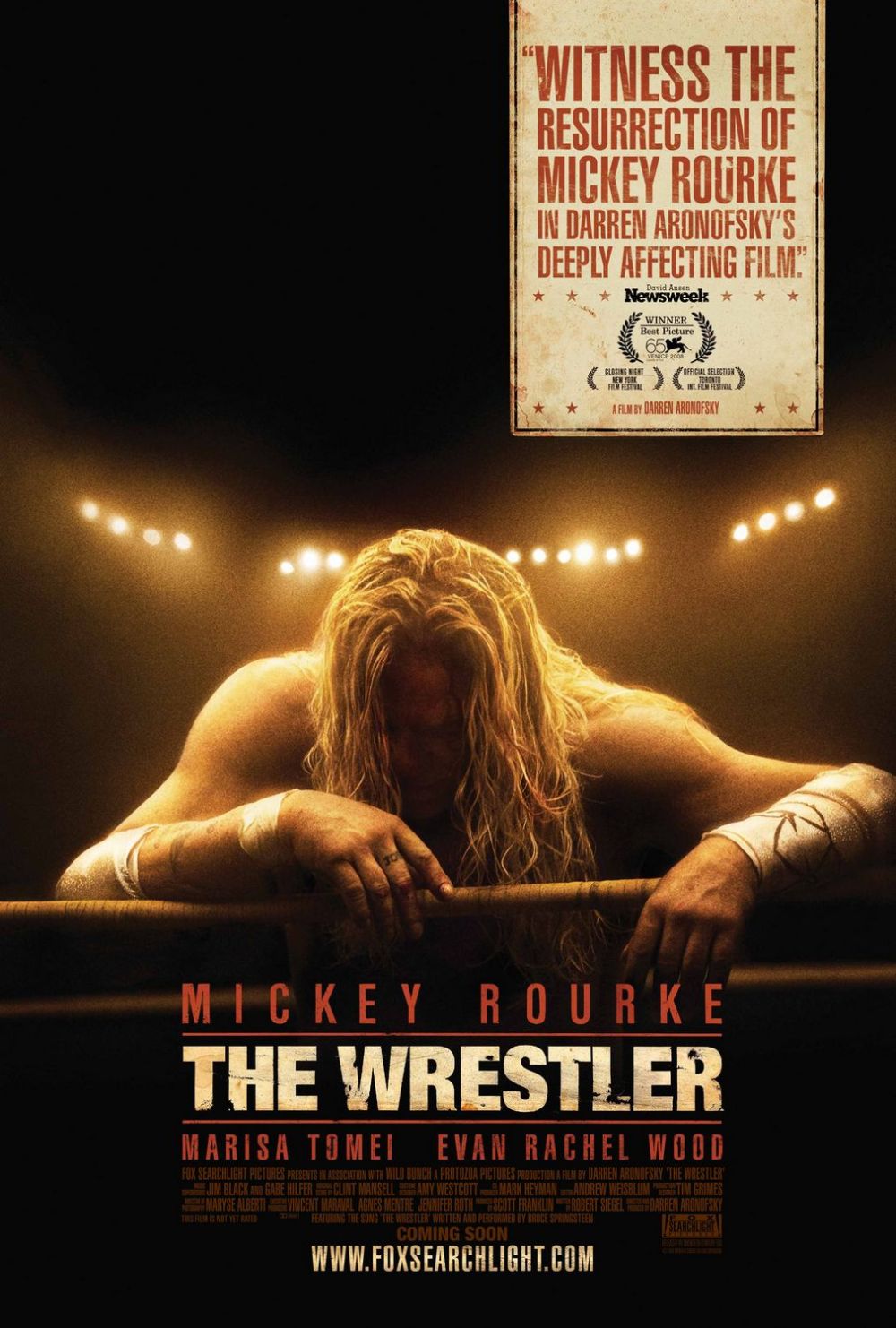
Witness Mickey Rourke’s Career Resurrection in ‘The Wrestler’

untitled

The Wrestler” is kind of a cross between “Rocky” and “Raging Bull” in that it deals with a man looking to continue making a name for himself long after his five minutes of fame, and who seems to be more at home in the ring than outside of it. Darren Aronofsky films this movie with a rough edge, and he doesn’t hide away from the harsh reality Randy “The Ram” Robinson, played by Mickey Rourke, and the rest of the characters inhabit. It also marks another in a long line of movies with characters hanging on by a little thread to their financial existence.

After one of his more vicious fights involving staple guns and barbed wire among other things (there is no flinching on the details here), Randy suffers a serious heart attack and later finds himself waking up in a hospital bed after an emergency bypass surgery. The doctor tells him that to wrestle again will kill him, and he is forced into retirement and ends up finding work at the deli counter of a local supermarket for whatever hours he can get. Despite his fame and the attention he gets in his trailer park home from the kids who live there, Randy’s life is a lonely one, and he has practically no close personal connections to lean on.

What goes on from there might seem predictable, but this is not your typical redemption story with everything turning rosy at the end. As his mortality looms over him heavily, Randy tries to get closer to those around him with limited success. Marisa Tomei gives a great performance here as Cassidy, a stripper who is very friendly to Randy while working at her club. Like Randy, she is also past her prime in her profession, and she doesn’t draw the big numbers like she used to. The two of them are relics of the 80’s, and their happiest days have been trapped in that time which was brought to an end by the advent of Kurt Cobain and Grunge which all but vanquished the days of long haired heavy metal icons. Ironically, as perfect as they seem together, it is their individual professions which keep them apart. The rules they are sworn to follow are also the ones they struggle with, and in the end these rules define who they are.

Years after her Oscar win for “My Cousin Vinny,” Marisa Tomei remains of the more vastly underrated actresses working today. Since her win, she has given great performances in movies like “In the Bedroom” and “Before the Devil Knows You’re Dead.” She continues to make leaps forward as an actress, and yet she remains at the fringes of fame. Perhaps she feels more comfortable doing independent films as they give her the best roles. All the same, part of me wishes she would get more respect because it doesn’t feel like she ever gets enough of it.

Evan Rachel Wood also co-stars as Randy’s long estranged daughter, Stephanie. They share some of the movie’s most emotionally raw and poignant moments together as Randy tries desperately to salvage any sort of connection he may have left with Stephanie. They share a nice walk together at the New Jersey shoreline where they reminisce about memories long gone, and Randy apologizes for not being there for her at all. Wood’s role is largely a reactive one, and she meets Rourke every step of the way when onscreen with him. Long after her emotionally searing performance in “Thirteen,” she is still not afraid of delving into the raw emotions held on to by the characters she plays.

Aronofsky is still best known for the mother of all anti-drug movies, “Requiem for a Dream” which was filmed with so many extreme camera moves and quick edits to where we were left with whiplash as we exited the theater. “The Wrestler,” however, does not have any of those flourishes. Instead, Aronofsky shoots the movie in a simple hand-held fashion and in 16mm to capture the rough and tumble realm these wrestlers exist in, and he makes you feel all the devastating hits, cuts and bruises these men are made to endure in the ring and when they are thrown outside of it as well. Like Paul Thomas Anderson, Aronofsky makes you experience the movie instead of just watching it passively.

I also loved how Aronofsky captured the camaraderie between these fellow wrestlers when they get together. We see them sharing the moves they will use with one another, and they always have the outcome figured out long in advance. We see the doctors attend to all the inflicted, let alone self-inflicted cuts, they get in the ring, and he makes you feel all the cuts which have long since torn away at their once perfect bodies. Aronofsky has never done things the clean way, and his work in “The Wrestler” continues this tradition unapologetically.

“The Wrestler” is not Aronofsky’s best movie (“Requiem for a Dream” still holds that title), but it is further proof of how he is one of the most exciting filmmakers working in this day and age. Some may have lost sight of this with “The Fountain,” but they shouldn’t after watching this. But in the end, this movie is really all about Rourke and how he and Randy interweave with one another to where you cannot tell if he is just acting or if he is just being the character.

Rourke makes you feel his character’s pain, both physical and emotional, throughout the movie. There is never a moment in this film where he fakes an emotion, and this is a performance coming straight from the heart. With his heartbreaking confession to his daughter, he takes what could have been a clichéd scene and fills it with pure emotion. It’s almost like he the actor is apologizing for not being better as an actor, and for squandering his potential with a lot of crap movies. Rourke has earned my forgiveness ever since he played Marv in “Sin City,” and his performance in “The Wrestler” completes what is a well-deserved comeback.

For those of you who have read my review of Clint Eastwood’s “Gran Torino,” you’ll remember how I talked about how certain parts need an actor whose face and body show a rough and tumble history, and that they have suffered through life’s most intense challenges. Rourke is not the pretty boy he used to be, but this makes him perfect for this role other than the fact he can still be a brilliant actor. Rourke sells the fact his character has a massive heart attack and that his body has been badly beaten (Rourke did briefly take up boxing when his acting career was almost gone). He sells how Randy now wears a hearing aid and glasses to read most things given to him. He also sells the fact he is deserving of another chance as a lead actor, and he knows he better not screw things up this time around.

“The Wrestler” is one of the most exhilarating and exhausting character pieces I have seen in some time. The movie is nothing short of a great triumph for its lead actor and its director, and it is topped off by a great theme song from Bruce Springsteen himself (who else could have done it?). In 2008, it was hard to think of another performance which could have been even more brilliant than Heath Ledger’s in “The Dark Knight,” but Rourke manages to top him here, and that was no easy feat.

* * * * out of * * * *

Denny Tedesco and Company Look Back at ‘The Wrecking Crew’

The Wrecking Crew poster

The Wrecking Crew” joins the company of great documentaries like “Standing in the Shadows of Motown” and “20 Feet from Stardom” as it puts the spotlight on a group of musicians who have been in the background for far too long. The title refers to studio and session musicians based in Los Angeles, California who played anonymously on many famous records back in the 1960’s. During a decade dominated by The Beach Boys, The Mamas & The Papas and The Monkees among others, they were the ones who recorded the music we came to love so much.

“The Wrecking Crew” was directed by Denny Tedesco whose father, Tommy Tedesco, was a legendary guitarist who played with this group of unsung musicians. Tedesco started filming this documentary back in 1996 when he discovered his father was diagnosed with terminal cancer as he wanted to get as much of his father’s musical history on film for the record. From there, it became a celebration of musicians whose work resulted in the creation of many great songs. In addition, Tedesco succeeded in getting many interviews from stars like Cher, Nancy Sinatra, Mickey Dolenz, Glen Campbell and Dick Clark who shared their memories of The Wrecking Crew and of what they brought to the world of music.

A press day for “The Wrecking Crew” was held at The Professional Drum Shop in Hollywood, California, a famous location where George Harrison once bought a pair of drums for Ringo Starr. Joining Tedesco was The Wrecking Crew’s drummer Hal Blaine who came up with the group’s name, and its keyboard player Don Randi. While the documentary started playing at film festivals in 2008, it did not receive a theatrical release until 2015 due to the incredibly difficulty of licensing music for its inclusion here. I asked Tedesco how the documentary evolved from when he started shooting it in 1996 to when he finally got a rough cut together.

Denny Tedesco: Format wise, we started shooting in film, 16mm, because I wanted to be a filmmaker. My wife Susie and myself, she’s a commercial producer, had better access to the film cameras, but we also liked the idea of film. But years later I started to go to video out of necessity, and I realized that was much easier because now what I missed with film is a lot of great interviews. With film, you’ve got to have a whole film crew. When we started cutting I knew the beginning, I knew the middle and I knew the end, but when the first 30 minutes of the film were cut another director saw it and said, “Why are you cutting it like this?” And I said, “What do you mean?” Because I wasn’t gonna be part of this film at all. I was the director and I wanted to keep myself out of it. He said, “You’re crazy not to be a part of this. You have access that none of us have. What you’re cutting, we couldn’t do this. You should go the other way.” And that’s when I decided that I would try and introduce the film as myself and that this is the reason why I started the film; my dad’s passing away and I said this is the story of my father and his extended family, The Wrecking Crew, and that’s how I introduce all of these guys.

Tedesco, Blaine and Randi said all the musicians originally came from jazz backgrounds, but that they eventually found themselves playing rock and roll music as they could make more of a living this way. We get to meet each of these musicians, and one who stands out in particular is Carol Kaye not because she is the only female member of The Wrecking Crew, but because she is a truly gifted bass player. Randi himself described Carol as being very innovative and that she has a great ear for music, and she gave us all a respect for the bass guitar we should have today.

Hal Blaine: I have to make mention right here about Berry Gordy who was actually a neighbor of mine. We used to laugh at the limo that used to pick up this little, tiny child to take him to school every day. Eventually there were people out there saying they did all the Motown records, and we knew that they didn’t. We knew that we had done a couple, three maybe, but there were some people who claimed they did all of them. They will be nameless at this point. Berry Gordy, not very long ago, did an interview and mentioned the fact that the very first hits came out of his garage where he had a little studio, and then he became Twentieth Century Fox’s head of musical engineering. We did the first few (songs) like “Baby Love” and a couple of things and it was an amazing time, and I was shocked to hear Berry Gordy actually do this. Not coming clean, but just to clear up things.

Randi also shared a sobering story about The Funk Brothers, Detroit based musicians who performed the backing music to the majority of Motown recordings from 1959 until 1972 when the company moved to Los Angeles.

Don Randi: When we all went into the Musicians Hall of Fame in Nashville, The Funk Brothers were there and The Wrecking Crew was there. We all went in at the same time and I sat with The Funk Brothers and they had me crying because there weren’t no contracts and they didn’t get the residuals. These guys are old and they don’t have that… Those guys worked their butts off for Berry, and when they first came out on the first date I did for them they went to pay us with cash, and I said, “Wait a second, we don’t do this.” And they said, “Well that’s the way we do it in Detroit. We pay cash.”

Well, hopefully all these musicians will get the respect they deserve when audiences watch “The Wrecking Crew.” It is a great celebration of the music we grew up on and of the artists who created it in the first place. While this documentary might look like it is riding the coattails of similar ones, it stands on its own and sheds a light on a piece of musical history we all need to know more about.

Danny Tedesco: All these other docs, thank God they came out. Thank God they laid the ground work and thank God they were successful. And I’m so happy because there is always another story. I tell people there’s so much information out there. You could interview your parents and you would get a great story and they should. There’s so much knowledge out there and I’m so glad that these different musicians… I’m lucky that I got them in their youth. If I had to do this documentary today, forget it. A lot of guys are gone and memories are maybe not as sharp.

The Wrecking Crew” is now available to own and rent on DVD, Blu-ray, and Digital.

‘The Hurt Locker’ Raises the Bar on Seriously Intense War Movies

The Hurt Locker movie poster

Kathryn Bigelow’s “The Hurt Locker” is one of the most intense war movies I have ever seen. It follows an elite Army EOD bomb squad in Iraq assigned with the task of disarming IED’s, or explosive devices designed to create the most damage possible. Chris Hedges was once quoted as saying war is a drug, and this perfectly the movie we are about to witness. Every time these soldiers go out into the field, it’s either life or death, and no one has any idea how it will turn out. We get to view things from the soldier’s perspective, and the result is a film of wished it was.

The movie stars Jeremy Renner as Staff Sergeant William James, a highly experienced bomb technician who takes over a bomb disposal team after its previous leader is killed in combat. Aside from William, the team is also made up of Sergeant J.T. Sanborn (Anthony Mackie) and Specialist Owen Eldridge (Brian Geraghty) who are immediately taken aback by William’s seemingly reckless tactics. From the moment he steps onscreen, it is clear William finds much more excitement in this most dangerous of jobs than any human being should ever be allowed to experience. It ends up being more important for him than anything else in his life, including raising a child his girlfriend just gave birth to.

When this movie was released, it was already past the point where Bigelow should have gotten her due as one of the best action directors working in movies today, and “The Hurt Locker” may very well be her masterpiece. As I walked out of the movie theater, my nerves still jangling from this intense experience, I was just waiting for someone, anyone to say they never realized a woman could direct an action movie so effectively. It’s like I was almost daring someone to say this. For those of you who are surprised at seeing a female director pull this off, I got a few things to tell you about: “Near Dark,” a vampire-western hybrid, “Blue Steel” with Jaime Lee Curtis, “Point Break” with Keanu Reeves and Patrick Swayze, “Strange Days” with Ralph Fiennes and Angela Basset and directing from a script by ex-husband James Cameron, and the vastly underrated “K-19: The Widowmaker” with Harrison Ford and Liam Neeson. Bigelow directed all of these movies. She didn’t start yesterday folks!

By using four or more hand-held 16 mm cameras, Bigelow gives “The Hurt Locker” a documentary feel which makes it seem all the more real. You are down in the dirt and heat with these troops as it sears away at their bodies during their tour of duty. Their current tour lasts about a month, but when this movie is finished, it will certainly feel like a long month. Bigelow also shows the majority of the action from the soldiers POV and, like them, we are not able tell for sure whether the Iraqis staring at them from a distance are friendly or if they are terrorists waiting to push a button to set off a bomb which could very well be under our feet. She is clearly more interested in seeing how American troops survive in a land overwhelmingly hostile to their presence. Every moment these soldiers are out there is a matter of life and death, and the unpredictability of it all keeps them on their toes and at full attention 100% of the time.

The script was written by Mark Boal who also wrote the script for Paul Haggis’ “In the Valley of Elah,” another film dealing with the Iraq war and its effect on those who fought in it. Boal also spent some time in Iraq embedded with a real military bomb squad which became the source of this screenplay. What makes this unique among other Iraq war movies is it’s, thank god, not concerned with the politics of it all. Neither Boal nor Bigelow are interested in getting into a debate over whether or not we should have invaded Iraq, but instead in getting the detail to the letter of how this army squad does its job, and they appear to have captured this line of work perfectly. There is an authenticity here we cannot and should not question in the slightest.

Jeremy Renner is perfectly cast as William James, a military sergeant who seems to have gotten far past the realm of fear. The way the movie is designed, it could have tumbled into the clichés of “Top Gun” with Renner “grinning like an idiot every 15 minutes”. The fact it doesn’t descend into the kind of a film you’ve seen a hundred times is a credit not only to the filmmakers, but the actors as well. Renner gives us a character who is not entirely trustworthy, but not without a soul. His character perfectly personifies what Hedges talked about when he said war is a drug. He succeeds in showing us without words what effect this war has had on him. It has given him a strong sense of being alive he has not previously experienced anywhere else. But at the same time, he soon realizes how destructive it is not only to himself, but to others around him.

Another great performance comes from Anthony Mackie who plays Sergeant J.T. Sanborn. He is actually one step away from wearing that bomb suit William wears, but the more he comes close to human life lost so horrifically in this war, the more it brings him into full view of the things he really wants in life. What William takes for granted, Sanborn wants for himself. This could have been a role where Mackie could have easily become that drill instructor who is by the book and one dimensional. But instead, he gives us a character who is almost intimidated by what his new leader is able to accomplish as he is angered at his insubordination.

It’s amazing to see what Bigelow pulled off with “The Hurt Locker.” With a budget of only $11 million, she made a movie more intense, exciting, and thrilling than male directors could have made with multimillion budgets. The answer is not to give audiences tons of special effects with no discernable story or characters, but to give us a movie which draws us in emotionally no matter what the budget is. Perhaps if Hollywood ever bothered to realize this, then maybe there wouldn’t be so many bad movies or unnecessary remakes constantly being hurled at us.

* * * * out of * * * *


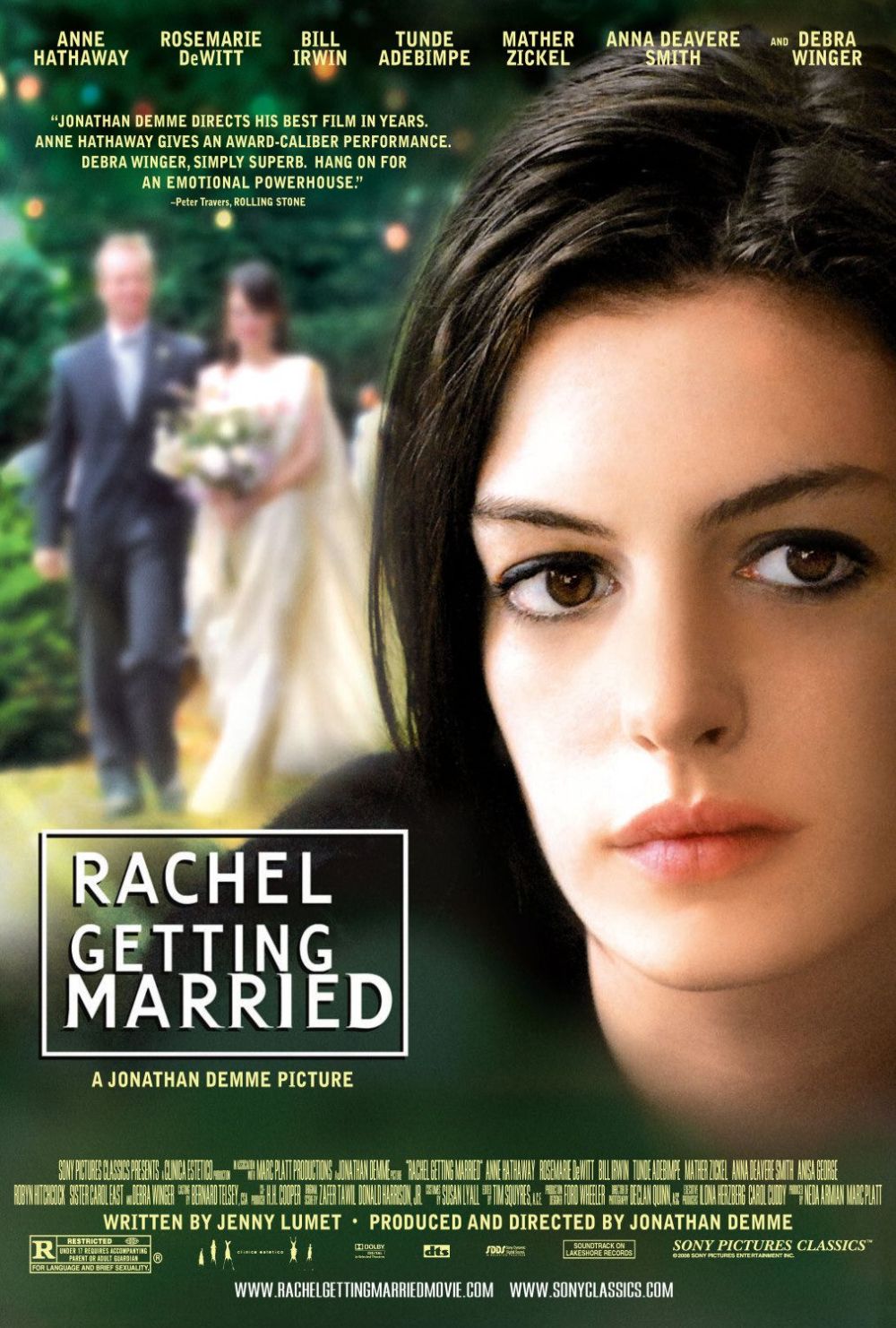
‘Rachel Getting Married’ is one of Jonathan Demme’s Best Films

Rachel Getting Married movie poster

One of the many things I have discovered about life is it is really easy to hate someone or be angry at them. As negative an emotion as it is, there is an unmistakable power from it which really makes you feel alive. At the same time, it is much harder to forgive that person for what they have done to you. You get so sick of someone getting the best of you to where you desperately don’t want to look like the fool. But eventually, it should become clear that the one person you really need to forgive most is yourself. This can be much harder than forgiving someone else, but it is necessary as it keeps you from sinking into the hideous swamp of bitterness which can eat you up. But can you forgive yourself when you have done something horrible and can’t you wipe away the cloud hanging over your existence because of what you have done? I would like to believe the answer is yes, but others may disagree.

Rachel Getting Married” is a movie about forgiveness, and the rough road people travel to get to it. It is also a movie about family and togetherness, and the joy of life. It almost moved me to tears the same way “Lars and the Real Girl” did as it deals with the saddest of things while surrounding itself in an atmosphere of love and much-needed togetherness. This is one of Jonathan Demme’s best movies as well as one of the very best of 2008. I really loved “Rachel Getting Married” and found myself wanting to hug all the characters in it. It is a movie of raw emotions, and I love seeing movies with this kind of power more often than not.

Anne Hathaway gives a phenomenal performance as Kym, the wild child of a Connecticut family who gets a vacation break from her current rehabilitation facility to go home for her sister Rachel’s wedding. It doesn’t take long to get an idea of how much of a “bad egg” she appears to be to everyone around her. As she goes into a convenience store to get a Pepsi, the female cashier behind the counter says, “Didn’t I see you on ‘Cops?’”

Kym is a full-blown drug addict and has been for several years, and while her family is happy to have her home, there are also raw emotions simmering just below the surface and waiting to come out into the open. We feel this tension from the very start, and it is illustrated in Hathaway’s face as we see her feeling like the wallflower at a party. While everyone is happy for the bride and groom, she is sullen and lost in a moment she cannot escape from. As the movie goes on, we come to see the reason for her self-destructive behavior and why she acts the way she does. I will not mention what it is here as it might take away from the emotional impact you will experience watching this movie.

This movie feels a lot different from others Demme has made in the past. He filmed the movie with high definition cameras to capture the movie on a more intimate level, and it feels like he really let the actors loose from start to finish. It is handheld camerawork going on here, so this will probably drive those who couldn’t stand all the shaky camerawork in “The Bourne Ultimatum” or “Cloverfield” crazy. While some people may experience motion sickness from this, I had no problem with it as the camerawork helped illustrate the emotionally fragile ground the characters are walking over, and how easily everything could come tumbling down.

What is so great about Demme’s direction is how he makes us feel like we really are attending the wedding along with these characters and sharing in the joys and sorrows of everyone involved. These characters feel so real, and it is so great to see no Hollywood artifice on display here. There have been so many big Hollywood movies dealing with families and marriage, and I find myself increasingly avoiding them. But the actions in “Rachel Getting Married” never felt staged for a second, and I loved that. Everyone in this movie feels like people we know from our own lives, and it connects us all the more strongly to what they go through.

“Rachel Getting Married” also, like all of Demme’s movies, has a very eclectic mix of music in it from the offbeat to the international. His movies don’t just have their own signature look, but their own significant sound. One character makes beautiful use of a Neil Young song as he sings it to another person. The audience I saw this with at Landmark Theaters in West Los Angeles were as silent as the characters onscreen during this moment, and I’ll never forget that.

I also loved how the soon to be married couple is an interracial couple, and no one ever brings this up at all. I guess none of the characters see it as an issue worth addressing. Hallelujah!

The script was by Jenny Lumet, and she gives her characters a vibrancy which elevates it from the couples we usually expect to see in movies like these. Her screenplay does tread familiar scenarios and storylines of the addict trying to go straight, but it finds its own voice and way of saying things to where everything feels fresh and new.

Demme always brings out the best in all the actors he has ever worked. There are many great performances to be had here, not just Hathaway’s. Rosemarie DeWitt plays Rachel, and she is a wonderful and real presence to be had in this movie. She goes from being so happy to seeing her sister Kym to being utterly exasperated and strung out that she is at home. It is clear that Rachel wants Kym to be well, but she constantly worries Kym will ruin the wedding in one way or another. Both Hathaway and DeWitt work really well off of each other as two sisters desperate to connect with one another despite the emotional damage between them. There’s a touching moment where Kym comes back from a rough night, and Rachel washes her clean in the shower as if she is washing her sins down the drain.

I also really liked Bill Irwin as Paul, Kym and Rachel’s dad, who is so happy to see his daughters under one roof, while at the same time harboring scars which will never fully heal. We also have Debra Winger, an actress we don’t see much of these days as the girls’ mother, Abby. She has great scenes with both daughters as she allows us to see beneath her seemingly calm exterior to the distrust she has had for Kym after all this time. The big scene between Hathaway and Wagner where the truth comes to a head is riveting and painfully raw as they each try to come to grips with the tragedy they both had a part in but are hesitant to take full responsibility for.

“Rachel Getting Married” is not just a triumph of acting, but also of writing and direction. All three elements come together to create a powerfully moving film about the flawed and fragile nature of humanity, and of the struggle for forgiveness. The movie has a very improvisatory feel to it and, despite the serious nature of the film, you cannot help but feel everyone had such a great time making it. You feel like you are with these families every step of the way, and you revel in their celebration of two families coming together as one. The reception near the end of the movie is one of ecstatic joy and happiness, even while some have wounds which take them out of the present.

But the person who carries this movie from beginning to end is Hathaway. Many see this as her escape from those “Princess Diaries” movies as she rids herself of the ever so clean image we have had of her. Truth be told, she has been doing this already with “Brokeback Mountain” and “Havoc,” but this should fully complete her transition to becoming an adult actress. All the Oscar talk she has been getting is justified. Kym is not an easily likable character, but Hathaway gives her a heart and soul and makes you care deeply about Kym all the way through. The moments where Hathaway does not say a word, her face does the acting and reveals a very uncomfortable soul trying to fit into a place which was once her home. She does brave and amazing work here, and she proves to be a dramatic force to be reckoned with.

“Rachel Getting Married” further shows how brilliant Demme is in getting to the wounded humanity of all the characters he observes. There is not one moment which feels faked in this movie, and it never really falls victim to any clichés that could easily tear it apart. This is another movie you don’t watch as much as experience, and I am always on the lookout for those. It also kept reminding me of the song “To Forgive” by The Smashing Pumpkins which kept playing in my head throughout:

“Holding back the fool again
Holding back the fool pretends
I forget to forget nothing is important
Holding back the fool again.”

Funny, I thought Billy Corgan was saying “forgive” instead of “forget.”

* * * * out of * * * *