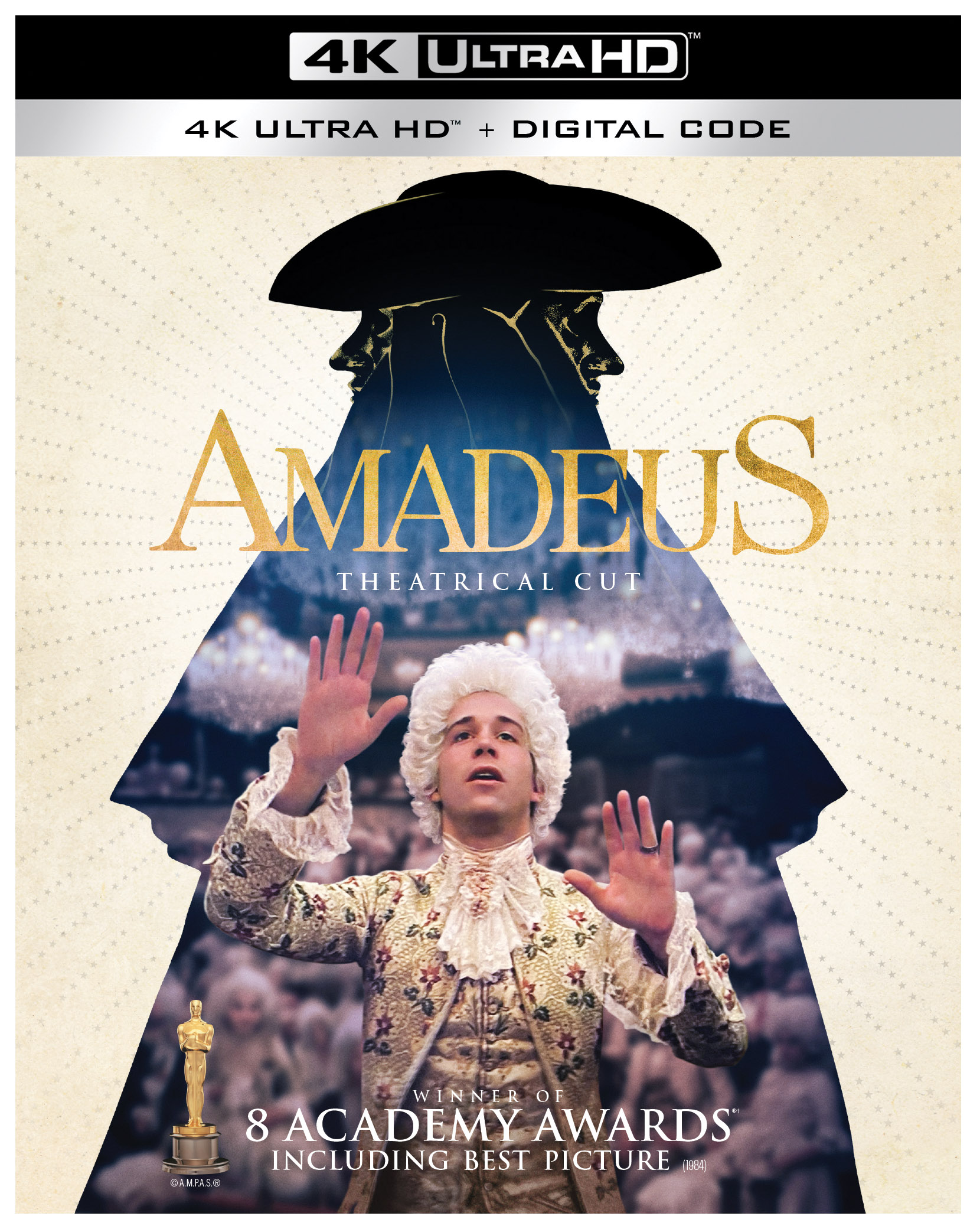
‘Amadeus’ Movie and 4K Review
The following review was written by Ultimate Rabbit correspondent, Tony Farinella.

There is a lot to like about physical media, especially when it is in the 4K format. There are the special features, the audio and video quality and, of course, the fact that you own the movie.  This means you never have to worry about a streaming platform taking it down and then having to hope your local library has a copy you can check out. It’s on your shelf, and you can pick it up and pop it in your player whenever you want to watch it.  Another positive is the fact that films like “Amadeus,” a Best Picture winner, can be discovered for the first time by a new set of eyes. In fact, this was my first time watching the film.

The reason “Amadeus” was not a film I had previously seen is because I thought it would be a boring, stuffy period piece. After sitting down to watch it, I am reminded of the old expression, “Don’t judge a book by its cover.” Even though I do not consider “Amadeus” a classic and did not fall in love with it after one viewing, it was an important film worth seeing and also worthy of my time.  I think the minute we start to become close-minded to art, we really lose our sense of self. This film deserves its day in court just like any other important and historical motion picture ever released.
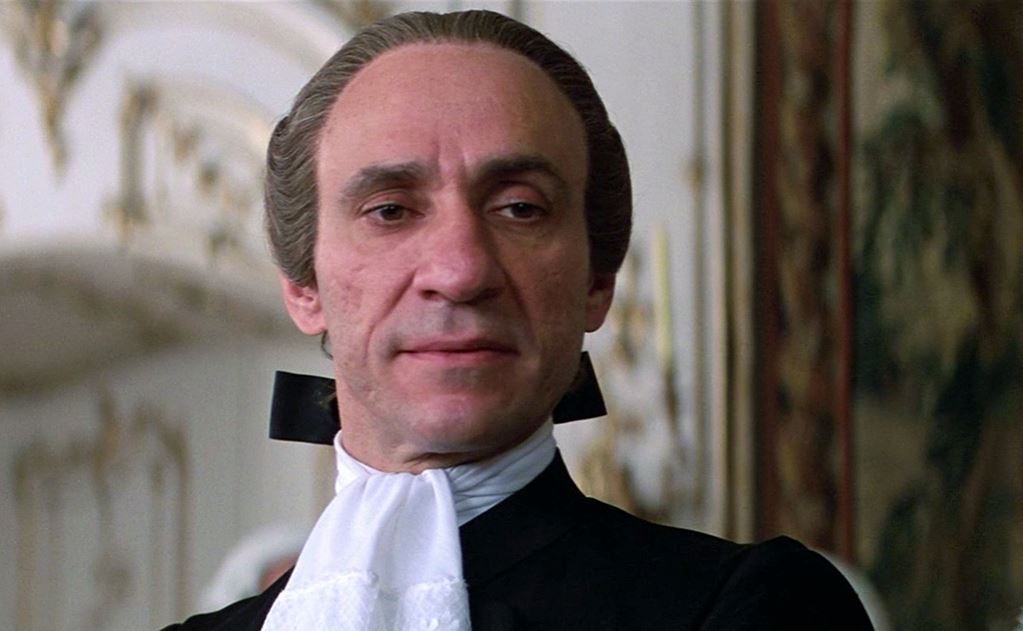
This film begins by introducing us to Antonio Salieri (F. Murray Abraham), a composer who has been put into a mental institute after an attempted suicide. A Catholic priest named Father Vogler (Richard Frank) is looking to get to the bottom of things, especially after Salieri says he is responsible for the death of Wolfgang Amadeus Mozart. While it has been over three decades since Mozart passed away, Father Vogler thinks it is a tremendous burden to carry. He sees how it is weighing on Salieri, which is what led to his suicide attempt.

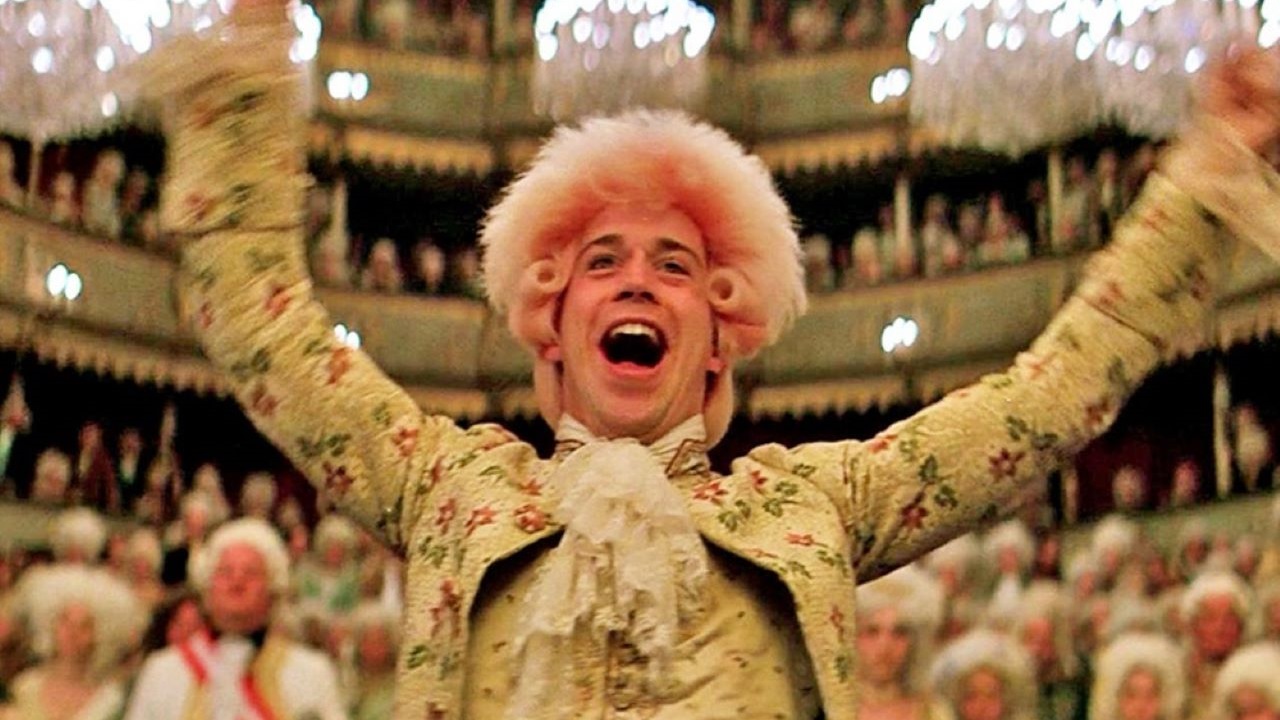
From this point, the film is told from Salieri’s point-of-view as he shares how he was both envious and enamored with the work of Wolfgang Amadeus Mozart (Tom Hulce). He did not, however, think much of Mozart the person whom he found to be boorish, aloof and uncouth.  Still, he cannot deny the genius the man possessed and how he would make magic happen with his music. It was something Salieri himself was never able to achieve in his own career, and he sees it as a sin that God would give all this skill and talent to someone like Mozart. As a result, this creates a complicated relationship between the two men.
The film is fascinating in the way it explores genius and what makes someone possess the ability to do something which truly makes a positive impact on the world. There are often two lines of thinking when it comes to someone who has had enormous success or is a once-in-a-lifetime talent: it has either come naturally to them, or they have had to work very hard to hone their talent. Now, of course, there is also luck involved. It is also how you handle success if you continue to work hard at what you do, and that you don’t become complacent with your past success.

Throughout the film, no matter what is thrown Mozart’s way, he finds a way to make it work for him. This is even when Salieri is deliberately trying to sabotage him, especially when he hires Lori (Cynthia Nixon) to lend a helping hand to Mozart, as he has a wife and a child. The reason he hired Lori is to get inside information on Mozart and to stay one step ahead of him.  The thing that separates Salieri from Mozart is the fact that no matter how annoying or obscene Mozart is, he has a gift. It is a gift that will always rise to the top and make him memorable and one-of-a-kind. It is that envy and jealousy which drives Salieri mad.
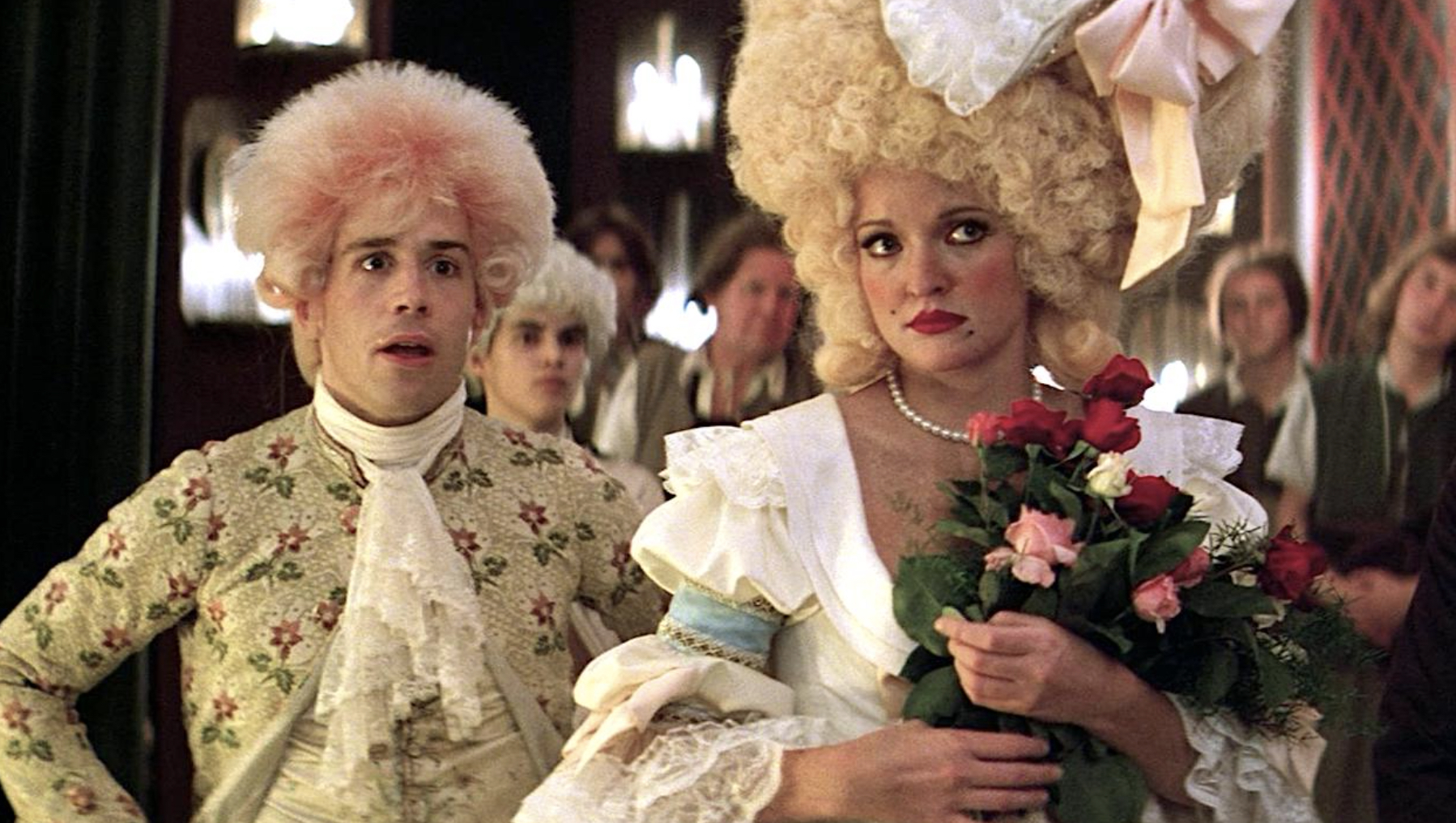
Milos Forman was the director behind “Amadeus,” and it was a big project for him to take on. From the set pieces to the musical numbers to the sheer magnitude of the story, it is a big Hollywood production, and he’s up to the challenge of making this movie look and feel big.  It is the kind of big-screen Hollywood movie that used to run the movie industry back in the day. I miss big movies like this as they play very well on the big screen. They also pop on 4K as well. As to how historically accurate the film is, I cannot begin to tell you as, I must confess, I have not studied the history of Mozart.

The performance of F. Murray Abraham as Antonio Salieri is nothing short of brilliant. His face shows the torment of a man who has had to live in the shadow of Mozart his whole life, and it has clearly done a number on him. His performance reflects this, and he also knows when to rein it in and play the character in a more low-key and understated way.   He was utterly captivating here from start to finish. In many ways, even though the film is called “Amadeus,” and it is about Mozart, it feels like Salieri’s story.  It is easy to see why Abraham won Best Actor at the Academy Awards.

Tom Hulce must perform a balancing act of portraying Mozart as someone the audience can relate to while also being over-the-top and goofy. He does a solid job here, but I was much more interested in Abraham’s performance.

“Amadeus” is a film which was a little too long for my liking, as I would have trimmed about 20 to 30 minutes from the running time of 160 minutes, but it is still a well-acted, entertaining, and monumental Hollywood film. I admired and respected it, but I did not love it or connect with it on a deeper level. It is a film I am happy to have watched, but I found the third act to be its most compelling and intriguing. The scenes I liked the most dealt with the characters of Mozart and Salieri as human beings. When the film was a character study of the two men, it captivated me. I would have liked more of the human element of the story and less of the long-drawn-out musical scenes.

* * * out of * * * *

4K Info: “Amadeus” is released on a single disc 4K from Warner Brothers Home Entertainment, and it comes with a digital copy as well. The film has a running time of 160 minutes and is rated PG. Keep in mind; this is the theatrical cut of the film. I have read there is a director’s cut of the film, which is rated R and includes twenty minutes of extra footage. I think it would have been nice to include it here, but I am not sure what transpired to where this was not able to happen.

4K Video Info: I truly enjoyed this 4K transfer, as it showed the film as I imagine it was meant to be seen. The film is over forty years old, and it looks very cinematic with a very thematic look to it. This is not a perfect HDR transfer, but it’s not supposed to look flawless. It looks like how the film was intended to look, considering its release date.

4K Audio Info: I would have liked a Dolby Atmos track here, as this seemed like the perfect film to receive this treatment. As it stands, the audio is very sharp, clear, and the dialogue is easy to understand. Subtitles are included in English, Spanish and French.

Special Features:

The Making of Amadeus (New)

Amadeus: The Making of a Masterpiece

Should You Buy It?

I will let you in on a little secret—I do not read or watch reviews before I am going to review a film myself. I do not want to be influenced by what anyone has to say, good, bad, or indifferent. Now, I am aware certain films have overwhelmingly positive, mixed or negative reviews, but I do not read the content of them. I do think a lot of people like me have put off watching “Amadeus” for the same reasons I mentioned earlier in my review. I can see why the film might not be easily accessible to a newer audience today. Still, I think modern audiences will be pleasantly surprised, just like I was when I sat down to watch “Amadeus.”  It is a period piece, yes, but it’s done in a way where you get to understand the characters, what makes them tick, and why they do the things they do throughout the course of the movie. My two issues were the run time and the fact that I wanted to spend more time with the two main characters together. Overall, it is a good film, but I do not think it is a great one. As far as the 4K is concerned, it looks terrific even though the audio would have benefited from a Dolby Atmos track. There is also a new special feature here.  If you are fine with the theatrical cut, which I imagine many fans of the film will be, this is a day one purchase, especially with the Oscars this weekend. If you are a first-time viewer, I think you might want to rent it digitally first before committing to buying it.

**Disclaimer** I received a copy of this film from Warner Brothers to review for free.  The opinions and statements in the review are mine and mine alone.
‘The Terminator’ Movie and 4K Review

The following review was written by Ultimate Rabbit correspondent, Tony Farinella.

The Terminator,” directed by James Cameron, is celebrating its 40th anniversary this year. Because of this, Warner Brothers released the film on 4K for the very first time.  This has been one of the most anticipated 4K releases in years.  James Cameron released a number of his movies this year on 4K, including “Aliens,” “True Lies” and “The Abyss.”  Many YouTubers and physical media collectors have expressed mixed opinions on the transfers of these releases, and it has caused a lot of debate in the physical media community. Cameron himself has come out and expressed his frustration with their criticism and even suggested they move out of their parent’s basements.

As far as the film itself, “The Terminator” opens up by introducing the audience to a cyborg (Arnold Schwarzenegger) who has been sent back in time from 2029 to 1984 to eliminate Sarah Connor (Linda Hamilton). To the untrained eye, he looks like a regular human being with his flesh, his ability to talk, and his ability to enter a room without really drawing a lot of attention to himself. Standing in the Terminator’s way is a soldier by the name of Kyle Reese (Michael Biehn).  He’s also from the future, and he has one job and one job only, which is to protect Sarah.  The Terminator’s job is to stop at nothing to eliminate Sarah because her unborn son, John Connor, is going to be the one to attempt to stop the machines from taking over after a war in the future begins.

The battle between humans and machines is one we are still battling in today’s world, especially with the introduction of artificial intelligence.  Will machines become so powerful that humans will be rendered useless and unnecessary? Cameron was way ahead of himself with 1984’s “The Terminator.”  This is a movie with big ideas and big characters.  Arnold Schwarzenegger as the Terminator is fantastic with his movements, his screen presence, and his aura.  Whenever he is on screen, you are completely captivated by him as an audience member to where you can’t keep your eyes off him.  Linda Hamilton is terrific at walking that tightrope to where she’s seen as tough but also a little vulnerable.  Michael Biehn also turns in a stellar performance as Kyle Reese.  It’s a hard role to pull off, as Kyle needs to talk about the future in a way that will not only convince Sarah he’s telling the truth but also win over the audience.

I might be in the minority on this one, but my one issue with “The Terminator” is the love story between Sarah and Kyle.  It is why I can’t give the film a perfect rating, even though I absolutely love it.  The love story feels unnecessary when all of this is going on in Sarah’s world.  In a film where I was able to suspend my disbelief for almost its entire running time, the romance came completely out of left field for me.  Besides that, there is a lot to like about this film.  It has a ton of great supporting work from actors such as Lance Henriksen, Paul Winfield, Dick Miller, and Earl Boen. Los Angeles is a character in this film, especially late at night. In many ways, “The Terminator” felt like Michael Mann directed a sci-fi thriller.  It’s a moody and dark film with an underbelly of seediness and gloom and doom.

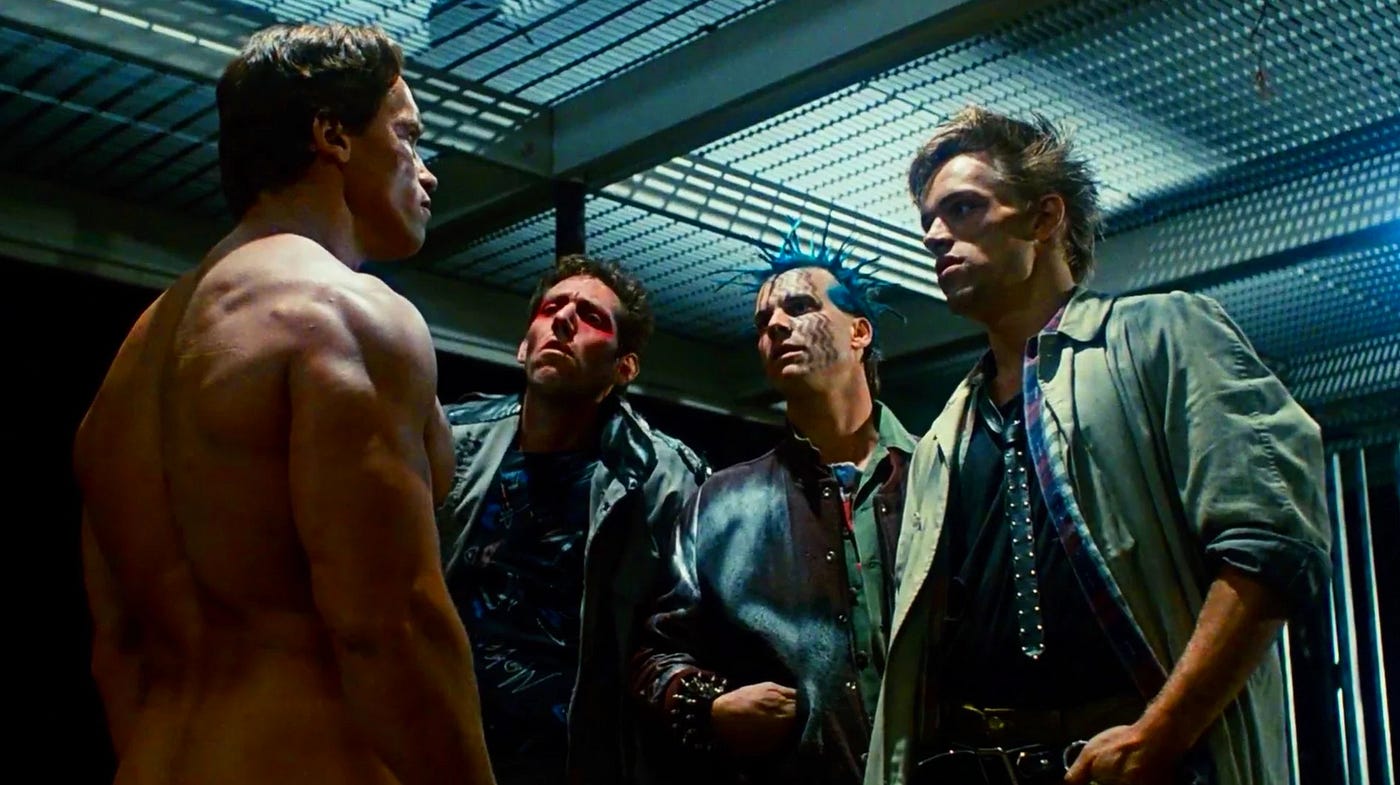
I also felt as though “The Terminator” had a sense of humor about itself without being too jokey.  When the Terminator himself encounters some street punks while he’s naked, it allows Cameron to have a little fun with his premise.  He is wise to not make the film too silly or goofy, however, as then it would be a completely different film altogether.  The comedic moments come more from the way people react to the Terminator and how he reacts to them.  Because he is so laser focused on killing Sarah Connor, he doesn’t have time for pleasantries.  He is a man on a mission and will eliminate anyone and anything in his way.  This film is able to feel like a big budget Hollywood blockbuster and a gritty, down and dirty independent film at the same time.  It was made for $6.4 million, but it looks top-notch and has a sense of danger to it as well.  “The Terminator” is an almost perfect film.

* * * ½ out of * * * *

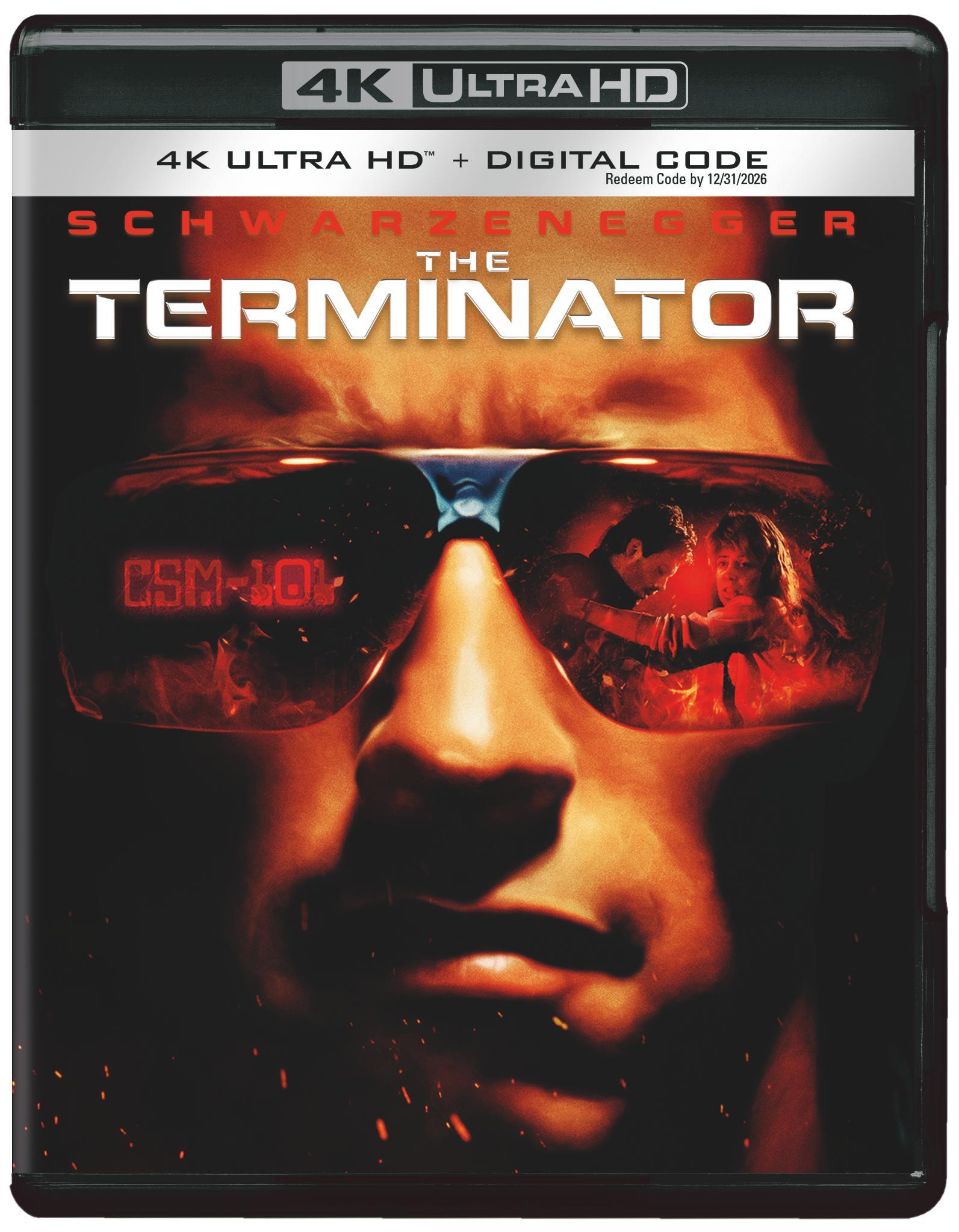
4K Info: “The Terminator” is released on a single-disc 4K from Warner Brothers Home Entertainment.  It comes with a digital copy of the film as well. The film has a running time of 107 minutes and is rated R for intense sequences of sci-fi action violence throughout, some sexuality/nudity, and strong language. You can get this film either with a 4K slipcover or a 4K steelbook.

4K Video Info:  Warner Brothers released this film on Dolby Vision HDR. It is a clean-looking transfer that doesn’t take any chances and doesn’t really need to when you consider its original source material. I thought the majority of the film looked impressive and it had a very cinematic feel to it. I don’t think there are too many things you can find wrong with this 4K video transfer.

4K Audio Info: The Dolby Atmos track is really good here.  This is a film filled with a lot of action, explosions and big moments.  Those scenes sound impressive and make for a good at-home theater experience. It wasn’t too loud or boisterous, but it made its presence known. Subtitles are included in English, Spanish and French.

Special Features:

Deleted Scenes with Optional James Cameron Commentary

Creating the Terminator: Visual Effects & Music

The Terminator: Closer to the Real Thing

Unstoppable Force: The Legacy of the Terminator

Should You Buy It?

This is one of the greatest sci-fi/action films of all time, despite my issues with the love story between Sarah and Kyle.  It comes with a stand-out 4K transfer which includes Dolby Vision and Dolby Atmos.  This is the best “The Terminator” has looked, and it looks much better than the failed “Terminator 2” 4K release from Lionsgate a few years back.  It seems like they have found a happy medium when it comes to James Cameron and his 4K transfers.  They know how to make the most out of the 4K format without changing it too much to where you don’t recognize the film you love. Much like the prior Blu-ray release, the special features are lacking, which is a disappointment. Overall, though, if you love movies, you have to have “The Terminator” on 4K in your collection.  It is a must-own, whether you get the 4K slipcover or the 4K steelbook.   It’s a revolutionary film that holds up incredibly well on repeat viewings.  This one comes highly recommended.

**Disclaimer** I received a copy of this film from Warner Brothers to review for free.  The opinions and statements in the review are mine and mine alone.
‘A Nightmare on Elm Street’ Movie and 4K Review

The following review was written by Ultimate Rabbit correspondent, Tony Farinella.

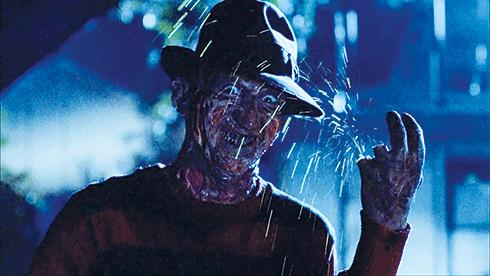
It’s hard to believe “A Nightmare on Elm Street” is celebrating its 40th anniversary this year. When legends of the horror genre are discussed, Freddy Krueger is one of the most talked about names that comes up in conversation.  It all started with the original, which was directed by horror icon Wes Craven. It was a film that was wise to not overuse its main antagonist in Freddy Krueger, played by Robert Englund. In fact, the reason why some of the sequels were not as well-received was because they overused Freddy and turned him into a stand-up comedian with silly one-liners.  In the first film, he’s chilling, scary, and intense.  The film is also aided by a strong supporting cast including Johnny Depp, Heather Langenkamp, and John Saxon.

One of the strongest aspects of “A Nightmare on Elm Street” is the fact it focuses on dreams and how Freddy Krueger attacks his victims in their sleep.  When we sleep, we let our guard down and assume we will be protected and safe. Even if we have a nightmare, we are confident we will wake up and return to our normal lives.  Freddy is looking to attack young teenagers when they are at their most vulnerable. It’s an ingenious idea and one of the biggest reasons why this is such a successful film.  The main characters also have to deal with the stress and anxiety that comes from trying to stay awake and fight for their lives in their dreams.

The film opens up with Tina (Amanda Wyss) having a nightmare about a man who is trying to kill her in her sleep.  The man has knives for fingers, a dirty old hat, and wears a filthy red and green sweater.  Because of these recurring nightmares, she has two of her friends and her boyfriend sleep over to make sure nothing will happen to her. Her friends are Glen Lantz and Nancy Thompson, played by Johnny Depp and Heather Langenkamp. Tina’s boyfriend is named Rod Lane, and he’s played by Nick Corri. When Tina ends up murdered in her sleep with blood all over the place, the police are quick to point the finger at Rod.  However, he claims there was another person in the bed with them, which seems not only highly unlikely but also highly unusual. After Rod ends up in prison, Nancy decides it is time to protect herself.

Heather Langenkamp, as the take-no-prisoners final girl Nancy, is absolutely brilliant here.  She’s smarter than her parents, and she’s also one step ahead of Freddy Krueger.  Her father, played by John Saxon, is a police officer who is just trying to protect her. Her mother, played by Ronee Blakley, is having a tough time dealing with this situation and spends way too much time drinking and avoiding reality. Glen Lantz is wily, intuitive and quick on his feet, even if he doesn’t always believe Nancy. Because he loves her, he’s willing to help out and do whatever he can to make her feel safe and secure.

Wes Craven was usually one step ahead of his peers in the horror genre, and “A Nightmare on Elm Street” was no exception.  He not only created an original horror villain, he also gave him an interesting backstory as well.  He also respects teenagers enough to give them a voice in this movie. They are not stupid or vapid.  They are resilient, tough, and they are trying to protect themselves, even if the results don’t always work out in their favor. 

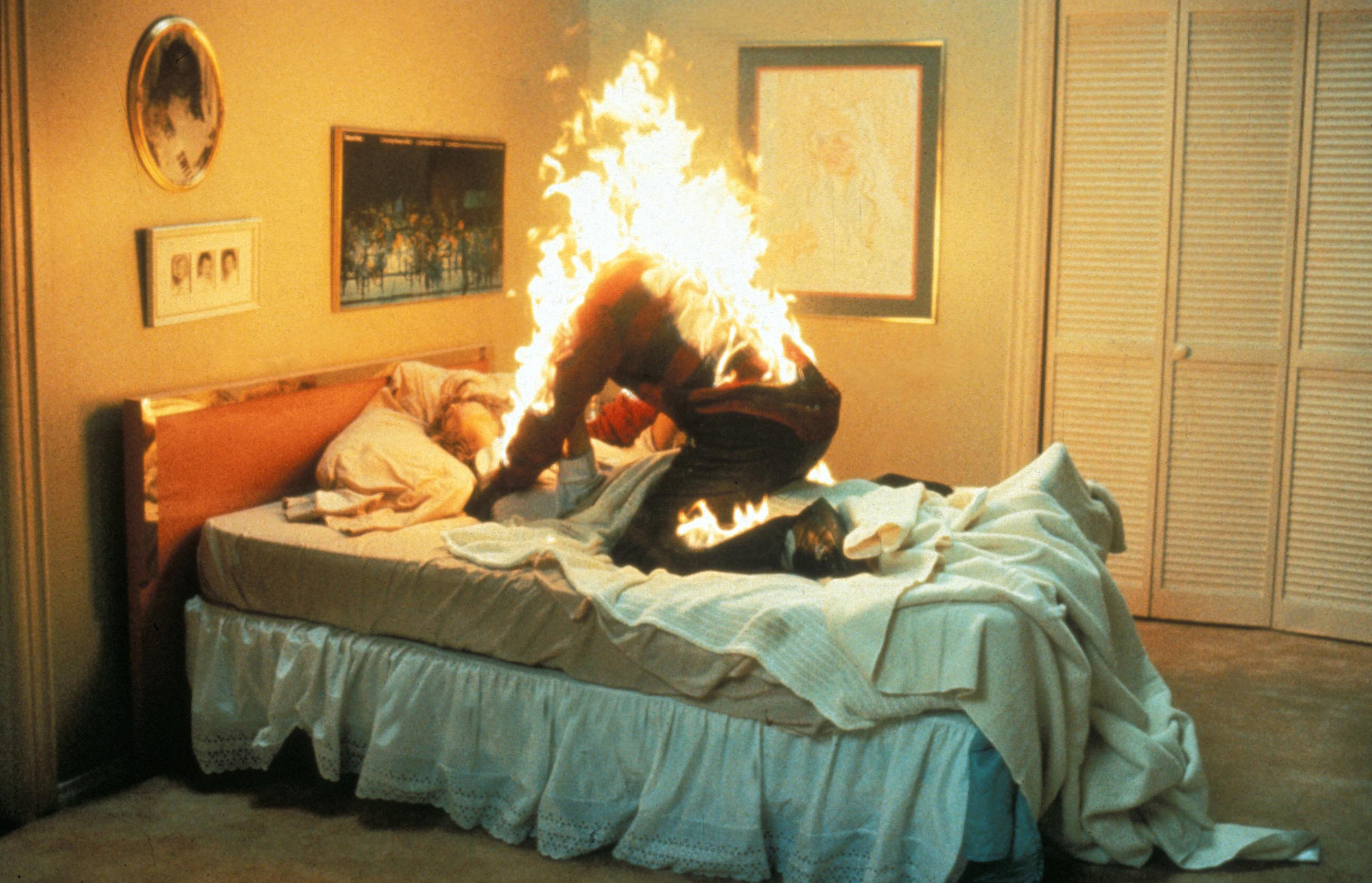
Even with the parents, some are divorced and have their own complex issues they are dealing with. This is why they have difficulty seeing what’s right in front of them.  He gives his characters, good and evil, layers to them.  It makes the plot and the film mean that much more when we spend time with them, get to know them, and understand their motivation.  When it comes to the bloody scenes, he also knows how to leave your jaw on the floor as a viewer, as he builds up the tension until it explodes on screen, sometimes literally!

There is so much to like about “A Nightmare on Elm Street,” from the top-notch acting, the chilling score, the intense gore, and of course, Freddy Krueger himself.  This is my favorite Freddy here as he’s terrifying without being over-the-top.  My main issue with the film is the ending. I understand it, but I don’t like it.  They build up to this big payoff and it ends with sort of a wink at the camera, which seems like it comes from another movie. For a serious and intense horror film, it ends in a rather silly fashion.  Still, I love “A Nightmare on Elm Street” and consider it a great horror film. If only it had a better ending.

* * * ½ out of * * * *

4K Info: “A Nightmare on Elm Street” is released on a single 4K disc from Warner Brothers Home Entertainment.  It has a running time of 91 minutes for both the theatrical cut and the uncut version. I’m not exactly sure what the difference is between the two cuts, as I didn’t notice anything out of the ordinary.  It might have a little more blood in it, perhaps. It is rated R for strong bloody horror violence and gore, language, drug use, and some sexuality/nudity.  There is a digital copy of the film included as well. You can either buy the 4K slipcover version of this movie or a 4K steelbook as well.

4K Video Info:  This is a FANTASTIC looking 4K release from Warner Brothers Home Entertainment.  The picture is so clear and vivid. It looks fantastic and it’s one of the best 4K releases of 2024. When they decided to release this movie on 4K, they really made sure to clean it up and give it the full 4K experience.  As someone who has owned this film on DVD, Blu-ray and now 4K, I can confidently say this is, far and away, the best this movie has ever looked on home video. The HDR is eye-popping.

4K Audio Info:  The Dolby Atmos soundtrack was also an excellent choice.  It really makes for a great at-home theater experience for viewers, as they get to become emotionally invested in the film and really get lost in it.  There are also subtitles in English, French, and Spanish.

Special Features:

Ready Freddy Focus Points

Commentary with Wes Craven, Robert Englund, Heather Langenkamp, Ronnie Blakely, Robert Shaye, and Sara Risher.

Commentary with Wes Craven, Heather Langenkamp, John Saxon, and Jacques Haitkin.

Alternate endings

The House that Freddy Built: The Legacy of New Line Horror

Never Sleep Again: A Nightmare on Elm Street

Night Terrors: The Origins of Wes Craven’s Nightmares

Should You Buy It?

HELL YES. This 4K of “A Nightmare on Elm Street” was released smack dab in the middle of spooky season. If you consider yourself a true horror fan who loves to own horror films on physical media, this is a day one purchase without question. It looks and sounds terrific on 4K.  I’ll also add this: If enough copies of this film are purchased by consumers, there is a good chance we will see more “Nightmare” films in 4K.  This is the original classic, and it comes with a terrific slipcover and an A+ audio and video transfer. Even though the special features are from the previously released Blu-ray, they are still worthwhile and interesting.  I wasn’t sure what to expect from this release when I put it in my 4K player, but I was over-the-moon while watching it.  It’s not a true Halloween viewing experience if you don’t watch “A Nightmare on Elm Street” during the month of October.  Fans have been waiting patiently for it to be released on 4K, and they have been rewarded. This release comes HIGHLY recommended.

**Disclaimer** I received a copy of this film from Warner Brothers to review for free.  The opinions and statements in the review are mine and mine alone.
‘Purple Rain’ Movie and 4K Review

The following review was written by Ultimate Rabbit correspondent, Tony Farinella.

When it comes to Prince’s music, I’m a fan, but I wouldn’t say I listen to his albums religiously.  I respect his contributions to the music industry, and I can certainly appreciate and admire the amount of effort and passion that goes into his performances.  He gives it his all when he’s on stage. Because of this, I was curious to see “Purple Rain” for the first time, especially since it was getting a 40th anniversary 4K release.  I love movies about music, so I thought it would be a film that resonated with me as a movie and music fan. I went into “Purple Rain” with high hopes, and I thought it would be a film that would make a powerful impression on me as a first-time viewer.  Even though I’ve seen a lot of movies, there are always a number of them which have slipped through the cracks throughout the years.

Prince stars as The Kid, a front man for a band called The Revolution, and he has a lot of talent, energy and love which shines through in every performance. However, he’s not exactly happy with his life. When he comes home, he sees his father constantly abusing his mother, so his one outlet for his anger and frustration is music.  When he’s on that stage, he bares his soul to the audience. His performances take place at the First Avenue Night Club. The other two acts that perform there are The Time, led by Morris Day, and also Dez Dickerson and his band The Modernaires. It’s a competition every night to see which band can leave the biggest impression on the audience.

In addition to his problems at home, two members of his band, Wendy and Lisa, played by Wendy Melvoin and Lisa Coleman, are not happy with The Kid, as they feel as though their contributions to The Revolution are not being taken seriously.  It is all about The Kid and his vision. There is also a new female musician who has come into First Avenue from New Orleans named Apollonia (Apollonia Kotero) who catches the eye of The Kid.  He is falling hard and fast for her, but he wonders if he can maintain a relationship with her because of his troubled life at home. Will the sins of the father soon become his own sins as well? Apollonia is also getting offers to start an all-girl band from Morris.

“Purple Rain,” sad to say, was a big dud for me. The songs and the music are great in.  From “Purple Rain” to “When Doves Cry” to “Let’s Go Crazy”, the film has some fantastic musical numbers in it, and they really come to life on screen.  When the movie isn’t on stage, however, it suffers in a big way.  The characters are written with very little thought behind them.  The Kid wants to play music and be successful.  His father is a wifebeater. His mother just seems to be there to get beaten up by the father. Apollonia is just there to be an object of desire.  All of this feels very self-serving for Prince. Yes, it is his movie, but there is little to no story here and the plot is paper thin.

For a movie that is almost two-hours long, the music can only sustain the viewer for so long, especially if we don’t care about the people that are on stage performing the music.  When there is a dramatic moment near the end of the film with The Kid’s father, why should we care?  Yes, his performance of “Purple Rain” is powerful and the song is fantastic, but everything leading up to that moment has shown him to be a no-good woman abusing jerk who is selfish.  Purple Rain really needed to get into the nuts and bolts of this character’s mindset in order for us to fully invest ourselves in his story arc. As an actor, Prince is rather lifeless and bland on screen as well.  He’s not a good actor. If they wanted to just make this a Prince concert film, it might have worked. As a narrative film, there is a lot to be desired here.

With “Purple Rain,” I kept waiting for the musical scenes to return as the scenes outside of First Avenue were incredibly run-of-the-mill.  This film needed more balance.  They needed to make The Kid’s life outside of First Avenue a lot more complex and well-written. This way, when he performs on stage, the impact is felt in a more powerful way by the viewer.  I’m not being a contrarian here, but I really don’t understand why this film is so popular.  If I want to listen to Prince’s music, I can listen to it whenever I want to on my iPhone.  I watched “Purple Rain” for an interesting story that would be enhanced by the music.  The story didn’t need to be great or out of this world.  It just needed to have a little more meat on the bones.  All of the attention went to the musical numbers, and the acting scenes are simply there to fill up the movie.  “Purple Rain” left me feeling very underwhelmed.

* ½ out of * * * *

4K Info: “Purple Rain” is released on a single-disc 4K from Warner Brothers Home Entertainment in honor of its 40th anniversary.  The film has a running time of 111 minutes and is rated R for sexuality, some nudity, language, and some violent content.  It comes with a digital copy of the film as well.

Video Info:  For a 40-year-old film, I thought “Purple Rain” looked good but not great on 4K.  It would have definitely been enhanced by a Dolby Vision transfer.  I was hoping they would have gone that way with this release.  As it is, it’s still a solid 4K transfer.  I haven’t seen the film on Blu-ray, but I didn’t notice anything wrong with this transfer.  I also didn’t notice anything that really stood out either.

Audio Info:  For a movie that relies heavily on music, it is of the utmost importance to have good sound on this 4K release.  I’m glad to report they were up to the task with the audio here.  It’s crystal clear and all of the music has a punch to it without being too loud or aggressive. Subtitles are included in English and Spanish.

Special Features:

Commentary by director Albert Magnoli, producer Robert Cavallo and cinematographer Donald E. Thorin

First Avenue: The Road to Pop Royalty – featurette

Let’s Go Crazy – music video

Take Me with U – music video

When Doves Cry – Music Video

I Would Die 4 U/Baby I’m a Star – music video

Purple Rain – music video

Jungle Love – music video

The Bird – music video

Sex Shooter – music video

Should You Buy It?

If you are a diehard Prince fan and you love his music and this movie, this is a no-brainer here.  You will be very happy with “Purple Rain” on 4K.  They also imported the special features from the prior Blu-ray release onto this one as well. The music sounds great with this 4K release, and it is a solid visual offering from Warner Brothers as well. If you are watching this for the first-time and are only a casual fan of Prince, I don’t think there is much of a movie here.  I tolerated the first 90 minutes, and it was tough to sit through as it plods along with no character development whatsoever.  The characters are one-note and thinly-written. “Purple Rain” was really tedious and laborious to sit through, and I expected more from a movie that was so critically acclaimed and well-received.  This one is for diehard Prince fans only. If you are one of them, you will love this flick. For everyone else, you can pass on checking this out, as there’s nothing groundbreaking or out of this world here.

 **Disclaimer** I received a copy of this film from Warner Brothers to review for free.  The opinions and statements in the review are mine and mine alone.
A24 to Re-Release ‘Stop Making Sense’ in Remastered 4K, and I Cannot Wait

Like any other year, 2023 has brought with it a lot of exciting news about the many movies coming our way very soon. But news of one movie really piqued my interest, and that was of A24 acquiring the worldwide rights to the classic 1984 concert film “Stop Making Sense.” directed by the late, great Jonathan Demme, it is set to be remastered in 4K and will be released in theaters sometime before the end of the year.

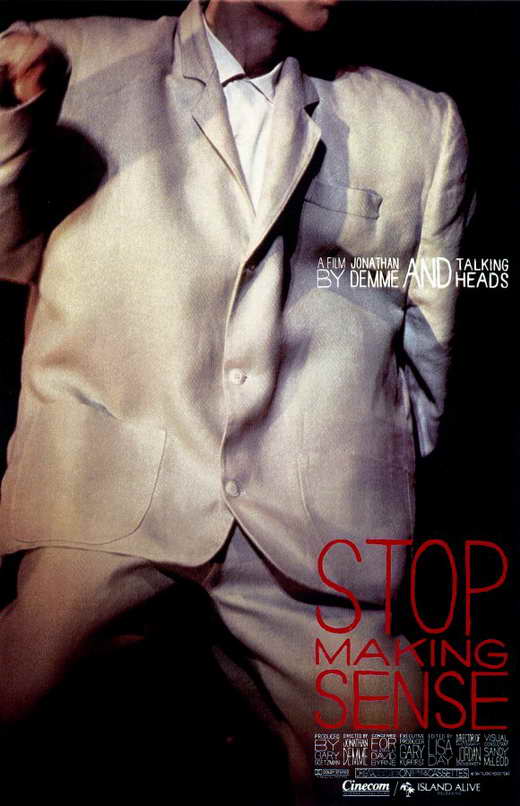
A24 has since premiered a promo trailer for the film’s re-release which features David Byrne showing up at a dry cleaner establishment to pick up a piece of clothing which sure enough turns out to be the big suit he wore in the latter half of the concert, starting with the song “Girlfriend is Better.” He is pleased to receive it and is quick to put it back on once he arrives at his apartment. To see that it still fits is not a surprise in the slightest and, like everyone else, I look forward to see him rocking and rolling in it yet again.

The only thing which bothers me about this rerelease trailer is that it does not feature the other members of Talking Heads: Chris Frantz, Jerry Harrison and Tina Weymouth. Surely, they too are excited about this classic concert film, right? The likelihood of these four ever reuniting remains astronomical, but it would have been nice to see these three featured in this trailer as well even if they were forced to film their appearances separate from Byrne’s.

What I love about “Stop Making Sense” is that it is a motion picture you cannot watch sitting still. Whether you are viewing it on VHS, DVD, Blu-ray, your local theater or in 4K, Demme makes you feel like you are watching the show along with those lucky patrons at the Pantages. I did get the chance to see on the silver screen at an arthouse theater in Orange County while I was a student at UC Irvine. The crowd in that theater, however, was quite small, so I hope the next crowd I see it with when it arrives back on the silver screen before the end of 2023 is much, much bigger. Seriously, this film is a great and exhilarating experience to take in with groups of people, and I cannot wait to do so in the near future.

Check out the promo trailer down below.

No, I Haven’t Seen It Until Now: ‘Paris, Texas’

Until this past week, the only Wim Wenders film I had ever seen was “The Million Dollar Hotel.” That one was a fascinating motion picture which dragged at times but still had moments that held me in a grasp few other filmmakers could ever hold me in. When all is said and done, the one thing we can all agree on is that it had a terrific soundtrack by U2, and that Mel Gibson should have kept his mouth shut during the film’s press day when he was caught saying it was “boring as a dog’s ass.” This proved to be one of the many times Gibson was obligated to apologize for saying something he never should have said.

But whether you consider “The Million Dollar Hotel” one of Wenders’ best or worst, films, you have to admit “Paris, Texas” shows him working at his filmmaking best. I caught a screening of it at the Nuart Theatre in West Los Angeles as this was a film crying out for me to watch it not at home, but on the silver screen in a darkened theatre. Knowing of its reputation as a Palme d’Or winner at the Cannes Film Festival in 1984 and having a beautifully subdued music score by the great Ry Cooder, I knew I was in  for quite a unique cinematic treat.

We open on the driest of deserts in West Texas to find a drifter named Travis Henderson (Harry Dean Stanton) wandering aimlessly while trying to find some water to drink. After passing out in a nearly empty saloon, he awakens in a clinic where a German doctor cannot get a single word out of him. Frustrated, the doctor calls a phone number Travis just happens to have on him, and it is answered by his brother, Walt (Dean Stockwell), who lives out in Los Angeles. It turns out Tavis disappeared without a trace four years ago, leaving behind his wife Jane (Nastassja Kinski) and their son Hunter (Hunter Carson). Why did Travis just up and leave? Well, much of “Paris, Texas” is dedicated to figuring this out, and the answers are never made easy to come by.

The first thing I have to say about “Paris, Texas” was how amazing and mesmerizing it was. Not once could I take my eyes off the screen as Wenders captured a Texas which was at once beautiful and haunted by a past its characters want to, but cannot, recapture or escaoe. It is also an unforgettable time capsule of life in the 1980’s in America as the story takes place in a time when you needed maps instead of GPS to find your way from one place to another, smoking was allowed on airplanes, and regular unleaded gasoline was only $1.07 a gallon (shit). But while things have changed a lot since then, the themes this film deals with still have a lot of resonance in this day and age.

For a moment, I thought Harry Dean Stanton and Dean Stockwell would go on the same kind of road trip Tom Cruise and Dustin Hoffman went on in “Rain Man,” and this was especially the case after we see their characters suddenly get off a commercial airplane and instead travel back to Los Angeles by car. “Paris, Texas,” however, speeds things up and has the two arriving in Los Angeles where Stanton’s character slowly starts to acclimate to civilization and his new environment while trying to reintroduce himself into his son’s life.

Stanton has gone on record in saying “Paris, Texas” is his favorite film out of all the ones he has done, and his performance as Travis may very well be the best of his career outside of “Repo Man.” His face is like a well-trodden landscape which says so much, and it is important to note this as Stanton does not say a single word for the first 26 minutes. It is fascinating to watch him act in a childlike manner as he sits in the backyard of Walt’s home while watching the airplanes fly in and out of Burbank Airport with a pair of binoculars. I also loved the interaction between him and Hunter as he slowly gains the trust of a long-lost son who, very understandably, is not quick to connect with him.

Dean Stockwell was on the verge of quitting acting and going into real estate when he got cast in “Paris, Texas,” and his performance shows how lucky we were that his talents were not robbed from us. What a shame it would have been if we did not get his Oscar-nominated performance in “Married to the Mob” or his co-starring role in the television series “Quantum Leap” had he not appeared here. In this film, he is the audience surrogate as, like him, we are desperate to figure out what Travis has been through in the four years he has been missing. Moreover, Walt must figure out how to deal with how he and his wife Anne (played by Aurore Clément) consider themselves the real parents to Hunter while trying to help Travis make a connection with someone whose life he was always supposed be a part of.

As for Hunter Carson, the son of this film’s co-writer, L.M. Kit Carson, he is perfect for something like this. “Paris, Texas” is a film which demands its actors inhabit their roles naturally rather than act or perform them, and Hunter is a kid who was clearly not brought up by stage parents thank goodness. He simply exists here as any other young child would which makes his scenes with the other actors even more authentic and moving, and this is especially the case in this film’s final moments which are as emotionally moving as one would expect them to be.

But the scenes which had me mesmerized the most were the ones between Stanton and Nastassja Kinski where Cooder’s score was not needed as their acting with one another via a one-way mirror and a telephone proved to be as subtle and intense as any onscreen acting I have ever witnessed. It is always a gift to be held at attention by two wonderful actors who give their roles every ounce of their being, and this is no mere exception in the slightest.

And when it comes to Kinski, who looks so much different than she did in “Cat People,” we do not see her appear onscreen until 53 minutes into this film. And yet somehow, her character Jane’s presence is felt deeply throughout. It is said Kinski wrote a diary for Jane, and it shows how deep into this character she got as her first appearance shows us someone who has lived a long beyond her years, and she was still quite young when “Paris, Texas” was filmed. Watching her react to what Stanton is telling her proved to be utterly enthralling as I wanted Jane to realize something which was right in front of her, and it makes Kinski’s performance all the more inspired.

Now on one hand, I am tempted to say how shameful it is that I did not watch “Paris, Texas” years ago. By that, I do not mean when it came out in 1984 as I was only nine years old back then and not about to take in the impact the Ronald Reagan Presidential years had on the world at large. I am thinking more of when I was in college and watching “A Clockwork Orange,” “Full Metal Jacket,” “Apocalypse Now” and “Taxi Driver” which took my moviegoing to a whole other enthralling level. “Paris, Texas” is a motion picture that does not play by any cinematic rules as it keeps you waiting and longing for certain things to happen, and in a good way. It also dares to leave story threads hanging in an ambiguous fashion which, while some will feel frustrated by this, will make the more adventurous viewers think deeply about what they just saw.

As for myself, I have a lot of Wim Wenders films to catch up on like “Wings of Desire,” “Pina,” “Buena Vista Social Club” and “Until the End of the World.” For what it is worth, I have seen the American remake of “Wings of Desire” which is called “City of Angels,” and it came out in 1998 and starred Nicolas Cage and Meg Ryan. That remake broke my heart, and it makes me wonder if the original will do the same. Perhaps I am afraid to find out.

* * * * out of * * * *

No, I Haven’t Seen It Until Now: ‘Cannonball Run II’

Copyright HAG ?2008

I remember almost renting “Cannonball Run II” on VHS from Nino’s TV and Video in Thousand Oaks when I was a kid. I enjoyed the first “Cannonball Run” movie a lot and watched it many times, and these days I rate it as an Ultimate Rabbit guilty pleasure. But when I presented it to my dad as the movie I wanted to rent for the weekend, he looked at me and said, “Are you sure you want to rent this? It’s really awful.” This shook my courage in renting movies for a time as I began to doubt my taste in film. As a result, I put this one back on the shelf even though its poster looked ever so cool.

Well, while my dad’s pleas failed to keep me from renting the Clint Eastwood comedy “Every Which Way But Loose,” it did keep me from checking out “Cannonball Run II” for many years. But at a time when I should have been watching such films as “Tar,” “The Banshees of Inisherin” and “Black Panther: Wakanda Forever,” I found myself watching this 1984 sequel as it was available to view for free on You Tube (with ads of course). And though I was not expecting a good movie in the slightest, I was stunned at just how amazingly atrocious this follow up was as everyone involved cannot even bother to give the proceedings a mere 50% of their energies.

This sequel starts off with the Sheik Abdul ben Falafel (Jamie Farr) being berated by his father (played by Ricardo Montalban) for losing the Cannonball Run race last year. Having embarrassed the Falafel family (you read that family name correctly), Abdul’s father orders him to win another Cannonball Run in order to restore the family name. The problem is, there is no Cannonball Run race happening that year, so Abdul is told to buy one, and the grand prize is a million dollars.

From there, “Cannonball Run II” begins its arduous task of reintroducing characters from the original as well as introducing a whole bunch of new ones who could only dream of being as funny as Roger Moore was when he played  Seymour Goldfarb, Jr. In fact, Hal Needham, who returns to direct this misbegotten sequel, spends more time with these characters than he does with the race itself.

Burt Reynolds is back as J.J. McClure, and he looks like he can save this motion picture with his charisma and sexy mustache. Dom DeLuise also returns as J.J.’s partner Victor Prinzi and his alter ego of Captain Chaos. These two always look to be having the time of their lives when they work together, but the fun they have does not translate over to the audience as it did for me in the original. This is especially the case when you watch the outtakes which play over the end credits, and you wonder what made the cast enjoy themselves endlessly as their laughter speaks more of a desperation to make this sequel worth watching.

When it comes to racing partnerships, there are a few changes. Jackie Chan is joined this time in his Mitsubishi car by Richard Kiel who plays his driver, Arnold. Doctor Nikolas Van Helsing (Jack Elam), J.J. and Victor’s partner in crime previously, is now working with Sheik Abdul to keep his ulcer in check. And Susan Anton and Catherine Bach are here to replace Tara Buckman and Adrienne Barbeau as those sexy women behind the wheel of a Lamborghini. Still, as Snake Plissken kept saying in “Escape From L.A.,” the more things change, the more they stay the same.

In directing “Cannonball Run II,” I had to wonder what was going through Needham’s mind. Was he just telling a cast which included Shirley McClaine, Dean Martin, Marilu Henner, Sammy Davis Jr., and Tony Danza among others to just go out there and be funny? If so, it did not work to anyone’s advantage as everyone looks to be either phoning it in or trying way too hard to put a smile on our faces. And if you thought the stunts from the original were lacking, the ones here are generic and pedestrian at best.

The only decently funny moment for me was at the beginning with Ricardo Montalban who plays his role as if he is not in on the joke in the slightest. Heck, he even makes the word falafel sound vaguely amusing in a way Bill O’Reilly only thinks he can. Perhaps if the rest of the cast had followed suit, this sequel might have been slightly better than it ever could have hoped to be.

I also keep thinking Needham and company kept looking at this sequel and its making to where he believed he could solve anything and everything in post. There’s a subplot involving mobsters which goes nowhere and has actors like Abe Vigoda being cast just for old time’s sake. And, yes, there is an orangutan driving a car, but he can only hope to be as memorable as Clyde was in “Every Which Way But Loose.”

So much time is spent on such overly broad character moments that Needham and his collaborators kept forgetting there was a long-distance race involved in this movie’s plot. As a result, they brought in Ralph Bakshi to animate the race’s climax in order to give it some momentum, but it doesn’t do much to speed things up, especially after a cameo with Frank Sinatra who plays himself. And yes, it is ever so easy to tell that Sinatra filmed his scenes in a studio by his lonesome. Not once do we see him and actors Reynolds, DeLuise and others in the same scene together.

“Cannonball Run II” will at best be remembered as a footnote in history for the following reasons: it marked Frank Sinatra’s final role in a theatrical motion picture, it is the final action stunt comedy for Reynolds following such films as “Smokey and the Bandit” and “Hooper” among others, it was the last film for Dean Martin, Molly Picon and Jim Nabors who is essentially parodying his character of Gomer Pyle. Other than that, this one is a certifiable waste of 108 minutes out of your life.

What is my excuse for wasting my precious time with “Cannonball Run II?” I will treat that as a rhetorical question. Still, its poster does looks really cool.

½* out of * * * *

Underseen Movie: ‘Cloak & Dagger’ – Only in the 1980’s …

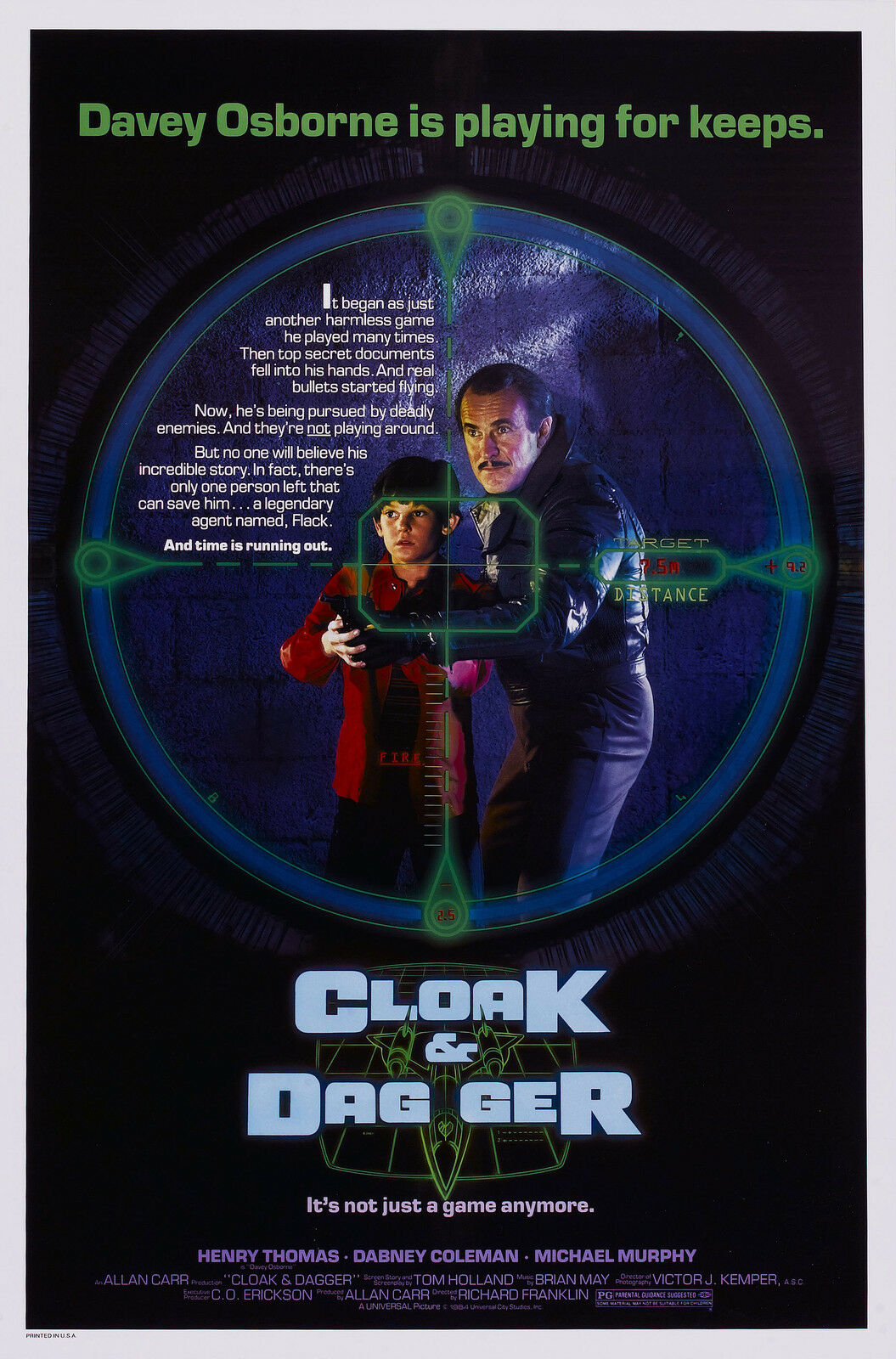
I first watched “Cloak & Dagger” back when I was nine or 10 years old, having recorded it on VHS when it premiered on channel 13, which was then known as KCOP in Los Angeles. From there, it became one of the many movies like “Bullitt,” Airplane” and “Star Trek IV: The Voyage Home” which I would watch a least a hundred times and never get tired of. Henry Thomas, in one of his post-“E.T.” movies, stars as Davey Osborne, an 11-year-old boy who escapes from reality into the world of Cloak & Dagger, a role-playing video game which features the exploits of the spy Jack Flack. Bored with life and yearning for a real adventure, Davey and his next-door neighbor Kim (a precocious Christina Nigra) embark to downtown San Antonio where he inadvertently witnesses a murder and gets hold of a video game cartridge of the Cloak & Dagger which is later revealed to contain top secret information. Davey’s wish of a real adventure comes true, but it soon becomes a reminder of what Augustus Hill once said on the HBO drama series “Oz:”

“Be careful what you wish for brother. Be very, very careful…”

Naturally, most people don’t believe Davey when he tries to explain what happened, and this includes his father, Hal, who loves him dearly but worries about him excessively as his son’s overactive imagination seems to constantly be getting the best of him. Once again, we have a movie which continues the theme of parents not listening to their kids until it is much too late. Then again, if parents did listen to their kids, a movie like this would not exist.

We also discover Davey is still grieving the loss of his mother who had recently passed away which quickly explains his constant escapes into a fantasy world. These elements combine together to make Hal believably dubious of his son’s claims, making it all the easier for the bad guys to try and capture him, and they are not about to show him mercy just because he is not yet a teenager.

I still vividly remember the “Cloak & Dagger” television ads just as it was coming out. Back then, this movie looked a little too scary for someone of my tender age to sit through, and my brother had already scared me off from seeing “Gremlins” although this was for reasons I would not discover until years later. Once the film made its television debut where all the “good stuff” was edited out, it seemed easier to take in.

Plus, seeing Henry Thomas with a gun excited me to no end. For once, the children were going to defend themselves without the help of adults! Now please keep in mind, I was a little boy playing with water guns back when this film was released (much to chagrin of my parents), so my mindset was, shall we say, somewhat different.

For a PG-rated movie, “Cloak & Dagger” is actually pretty brutal! You have adults shooting at kids, Davey ends up shooting a bad guy to death, another character looks like they got shot in the eye, and a kid almost gets run over by a van. You would not see anything like that in a PG rated movie these days (PG-13 movies are a different story), and this includes a cold-blooded villain telling Davey just how much he is going to enjoy blowing his kneecaps off. Looking at a movie like this today, my response to it would be, “only in the 1980’s…”

But for what it’s worth, “Cloak & Dagger” doesn’t glamorize real life violence and succeeds in making a distinction between the world of make believe and the finality of death in real life in a way which can only be rendered in a PG-rated motion picture. The movie is really more of a coming-of-age story in which Davey comes to discover how these imaginary adventures he constantly engages in are nothing compared to the violence waged in real life as certain actions render a solution which is permanent in inescapably brutal ways. Davey also comes to realize this even before reaching the age of puberty, so you know his teenage years are going to more torturous than what the average adolescent is forced to endure.

Thomas’ performance as Davey Osbourne was proof his excellent performance in “E.T.” (one of the best ever given by a child actor) was no fluke. You never catch him acting, and everything he does comes from a believable and natural place. Even as the movie heads into the inescapable territory of illogic which is typically inescapable in 80’s action movies, Thomas remains the emotional center of the story and keeps us watching to the very end. It’s hard enough to ask a pre-teen to carry any feature length movie on their shoulders, but Thomas had long since proven to be a true professional in doing so.

The other big actor here is Dabney Coleman who, back in the 1980’s seemed to be in every other movie. He plays Davey’s Air Force father, Hal Osborne, as well as his imaginary hero Jack Flack whom Davey sees as a more appealing version of his dad. Coleman is great in both roles, and you really have to appreciate his performance as Hal because it could have been your typically clichéd one-note daddy character. Throughout, he rides a good balance between being the disciplinarian and the sympathetic father who remembers what his life was like as a kid. Like his son, Hal wanted to be a hero too.

However, Coleman is clearly having more fun playing superspy Jack Flack who may not be as smooth or as dashing as James Bond, but is still very clever in his own mustached way. All that’s missing is a patch over one of his eyes, but Kurt Russell already beat him to this in “Escape From New York.” Seeing the actor reacting to his performance as Hal is good for a few laughs as Flack never stops deriding the man’s lack of belief and faith in his son.

When it comes to the bad guys, they are the typical one-dimensional types you usually find in 1980’s movies, but that’s just fine here. Eloy Casados plays Alvarez as your mainly stone-faced henchman; the kind of guy who smirks more than he smiles, and not just because he’s in a foul mood. In fact, a guy like him is typically never really happy about anything. I also love how he shoots at Davey from only a few feet away and STILL COMPLETELY MISSES HIM. He would have made a great stormtrooper.

Then you have Haverman who is played by former professional football player Tim Rossovich. With his strong body and build, he’s like the Incredible Hulk as a bad guy, except he doesn’t turn green and rip off his clothes whenever he gets pissed (his jeans do look a little tight on him though). The door is locked? This guy just smashes right through it as if it were no big thing, and it got to where I was just waiting for him to say:

“HAVERMAN SMASH!!!”

But the main baddie here is Rice, and he is played by Michael Murphy in a truly chilling performance. Murphy, still a few years away from playing the spineless mayor of Gotham in “Batman Returns,” gives you the perfect kind of bad guy you love to despise with every fiber of your being as he makes you believe Rice would think nothing of killing a kid who stood in the way of his ultimate goal; delivering government secrets to spies. Man, I remember wanting to see him get his just desserts as soon as he appeared onscreen.

When it comes to scene stealers, Christina Nigra wins the prize as Davey’s non-imaginary friend, Kim. Her sassy attitude makes for some great moments, especially when she informs her mother that Davey’s father is not her type. She does get annoyed with Davey when he takes things a little too far, but even she comes to admit he is never ever boring. Nigra also holds her own in front of the airport police chief as he smokes a cigarette in very close proximity to her. You don’t even see her complaining about the smoke. Maybe the anti-smoking campaigns hadn’t reached her school yet.

There are a couple of other familiar faces to be found here including the late Robert DoQui whose subdued performance as Lt. Fleming is the polar opposite of the hard-nosed and law enforcement chief we saw him portray in the “Robocop.”. William Forsythe also shows up as Davey’s other friend Morris and, seriously, he doesn’t look like he has aged a day since 1984. Even Louie Anderson appears for less than a minute as a hygienically challenged taxi cab driver who offers to give Davey a ride to the airport but only if he gives him $15 dollars in advance.

“Cloak & Dagger” marked the second collaboration between director Richard Franklin and screenwriter Tom Holland. Their previous film together was the eagerly awaited sequel “Psycho II,” and while this film offers them a change of pace, it still proves to be pretty intense. That they managed to find a balance between the real and imaginary worlds Davey Osbourne inhabits is fairly remarkable as it could not have been the least bit simple.

So much has changed in the world since “Cloak & Dagger” first came out, and it now seems astonishing just how dark it was compared to the movies that come out today with a PG rating. It was made back when you didn’t need a plane ticket to get through security screening, and you could hang out with your loved ones at the gate before their plane took off. You could smoke on airplanes back then as well. What hasn’t changed or weakened through the passing of time are the performances of Thomas and Coleman. Both are a reason why this film managed to find such a large audience on video after it failed to do so in movie theaters.

Of course, these days I have to wonder what a “Cloak & Dagger” sequel might look like. While certain questions were easy to answer back in the 1980’s, everything these days feels far more complex. There’s no doubt Davey Osbourne would be severely traumatized by his experiences here, and perhaps he and Kevin McCallister from “Home Alone” can join forces as they both defeated their antagonists in very painful ways.

Once again, only in the 1980’s could a movie like this have been made.

* * * ½ out of * * * *

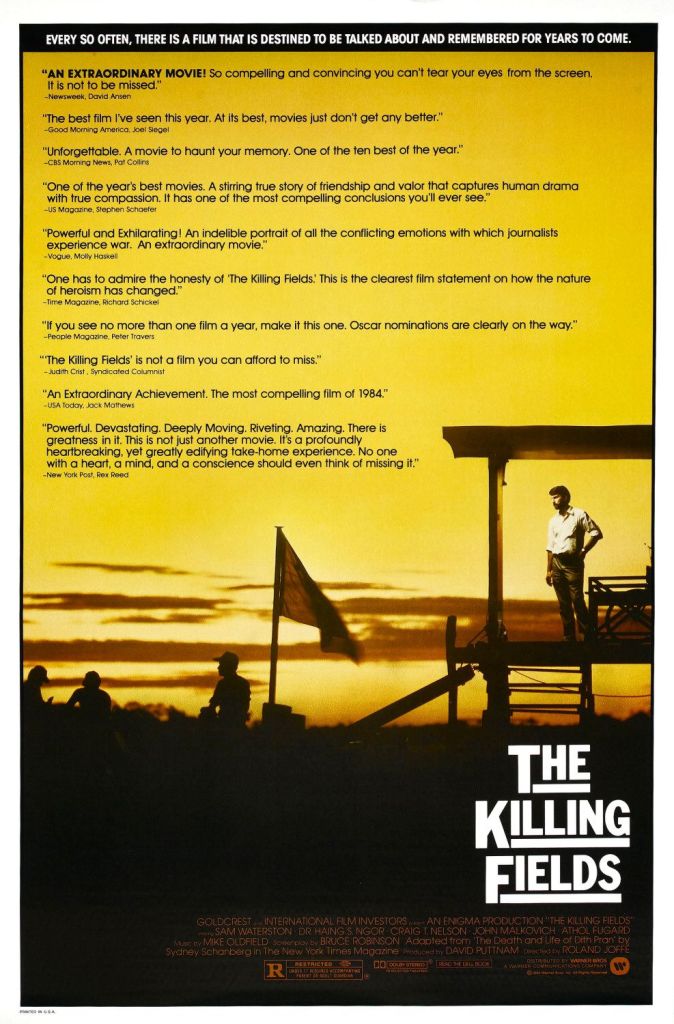
No, I Haven’t Seen It Until Now: ‘The Killing Fields’

I remember renting this film from Netflix a few years ago and telling my friends what I was about to watch. I got a good dose of jaws dropping open and many of the same responses:

“Oh, that’s a fun one!”

“Go into it with a strong stomach. There are scenes in it that will pulverize you!”

“Not a fun movie!”

I remember hearing a lot about “The Killing Fields” when it was first released back in 1984, but it took me until recently to finally sit down and watch it all the way through. From a distance, it looks like another in a long line of movies about the Vietnam War and of the terrible damage it left in its wake. But in actuality, it takes place in Cambodia when the country is in the midst of a civil war with the Khmer Rouge regime; a result of the Vietnam War spilling over the country’s borders. It is based on the memoirs of award-winning American journalist Sydney Schanberg who was a correspondent for The New York Times, and of how he spent years reporting the endless fighting and bombing which took place in Cambodia and Laos. Along with photographers Jon Swain (Julian Sands) and Al Rockoff (John Malkovich), he works to capture the reality of this horrific situation as it escalates into something far worse, and before the United States military can sanitize what is being presented for public consumption.

But as much as “The Killing Fields” is about what happened in this conflict, it is really at its heart a story of friendship between Sydney and his translator, Cambodian journalist Dith Pran. Together, they work to get to the unvarnished proof of the situation and risk their lives in many instances. In the process of escaping Southeast Asia with their lives, Schanberg helps Pran’s family escape, but as the Americans get ready to leave, they are forced to give up Pran as the new regime wants all Cambodian citizens to be returned to them. This leads to a guilt ridden Schanberg spending as much time as possible searching for Pran through humanitarian services and government officials. While he does so, we watch Pran being subjected to forced labor under the “Year Zero” policy the Khmer Rouge initiated to destroy the past and start a new future.

The scene where Dith Pran stumbles upon the corpses left to rot in the Cambodian fields is where the movie gets its name, and these images will never leave my mind. In that moment, director Roland Joffé captures the vicious and evil nature of Pol Pot, Cambodia’s answer to Adolf Hitler. What happened in these fields is no different from what the Nazi’s had done to the Jews during World War II. But what’s even worse is this same kind of ethnic cleansing is still being exacted in different parts of the world today. Some might foolishly think the events of “The Killing Fields” have no real relevance to what we are suffering through today, but nothing could be further from the truth. In fact, with this movie, we get depressing proof of how history repeats itself.

What gives “The Killing Fields” even more emotional heft is that Haing S. Ngor, who plays Dith Pran, went through the same ordeal as did his real-life counterpart. It is impossible to watch Ngor here without knowing he shared a horrifyingly similar experience as he had to convince the soldiers he was an uneducated peasant. Had they realized Dith was really an intellectual and a reporter, he would have been killed right on the spot. Ngor was not a professional actor when he got cast, so he doesn’t act as much as provide an undeniably human face of what Cambodians were forced to endure when the Khmer Rouge came to town, and he gives what is undoubtedly one of the bravest performances I have ever see. Forget the Oscar; Ngor should have received the Purple Heart!

But as great as Ngor is, let’s not leave out the other actors whose work is every bit as good. Sam Waterston plays Sidney Schanberg, and this was long before he got involved in that long-running show with the overbearing “chung CHUNG” sound. Waterston does exceptional work capturing Schanberg’s relentless quest for truth and presenting it for all the world to see. Throughout, we see him stubbornly pursue whatever sources are available to him regardless of how it puts his life and the lives of those close to him in constant mortal danger. This later leads to a deep sense of guilt as he encouraged Dith Pran to stay with him even though he was at greater risk than anyone else in his circle. Waterston captures the complexities of a reporter who sees the importance of getting at the heart of a story as well as the large cost which becomes all too difficult to deal with.

In addition, we have John Malkovich in one of his earliest roles, and we see the unrelenting intensity he brings to Al Rockoff as he quickly recovers from an explosion which goes off right next him. Almost immediately, Malkovich jumps right back up to take as many photos as possible. Julian Sands also has one of his earliest roles here as fellow photographer Jon Swain, and this was long before he got stuck in those “Warlock” movies. Plus, you have Craig T. Nelson on board as Major Reeves, the face of the military officials who work to cover up American mistakes while maintaining whatever control they have left over an increasingly chaotic situation.

And then there is the late Spalding Gray who co-stars as the U.S. Consul, and his experience of making “The Killing Fields” ended up inspiring his one-man monologue “Swimming to Cambodia.” Hence, another career was born thanks to this movie which led to many more immensely entertaining monologues performed by him until he left us ever so tragically.

Looking back, it’s surprising to see “The Killing Fields” marked the feature film directorial debut of Roland Joffé. From watching this, I figured he had been directing motion pictures already for decades. Nothing on display here ever feels like it was staged or overly rehearsed. Joffé makes you feel like you are watching a very in-depth documentary which no one else could have pulled off, and that is saying a lot.

Joffe was also aided greatly by Director of Photography Chris Menges, who won an Oscar for his work here, as he captures a land and a time which is anything but sentimental. Composer Mike Oldfield, best known for composing and performing “Tubular Bells,” also provides an original sounding film score which heightens the horror and unrelenting chaos consuming Cambodia and those unlucky enough to be stuck there.

All these years later, “The Killing Fields” remains an immensely powerful cinematic achievement, and I wonder if people still think about it as much as they did back in the 80’s. Ngor, who won the Best Supporting Actor Oscar (I was rooting for Pat Morita who was nominated for “The Karate Kid“), was murdered during a robbery in downtown Los Angeles outside his home in Chinatown. Knowing he survived the horrific fate which consumed and destroyed the lives of many Cambodians only to have his life cruelly ended in such an utterly senseless crime makes watching this film today seem all the more tragic.

As for Joffé, he went on to direct “The Mission” with Robert DeNiro and Jeremy Irons which received critical acclaim. But then he helmed the dreadfully miscalculated adaptation of “The Scarlet Letter” which changed the end of the book and added more sex to it for all the wrong reasons. Then he went on to direct “Captivity,” a movie so blatantly unwatchable I turned it off after less than 20 minutes. You look at “The Killing Fields” and then at “Captivity,” and you wonder what the heck happened to this guy.

I am really glad I finally took the time to watch “The Killing Fields” long after its original release in 1984. Even if its Best Picture montage give away the film’s ending, it did not take away from the experience of watching it. This proved to be not just a great directorial debut, but a great collaboration of artists who completely sucked you into the reality of a place and time many of us would never want to experience up close. So many years later, this is a cinematic masterpiece which forces you to experience what people go through. There’s no way to come out of “The Killing Fields” without being deeply affected by it.

I desperately tried to resist using this cliché, but I have to say it; they don’t make movies like this anymore. With Hollywood’s constant obsession with comic book and superhero movies, let alone the latest unnecessary remake, you have to wonder if we will ever see a movie like “The Killing Fields” ever again.

* * * * out of * * * *

Underseen Movie: Alan Parker’s ‘Birdy’ Starring Nicolas Cage and Matthew Modine

Birdy” is a great movie and a deeply felt character study about two young men who grow up together, and who are forever changed by the war they are drafted into. The movie is based on a book by William Wharton which chronicles two characters who are thrown into World War II. For the film, it was changed to Vietnam as the screenwriters, Sandy Kroopf and Jack Behr, wanted to work with their own youthful experiences. The story starts out with the two main characters who are now out of the Vietnam War, but who are forever scared by it permanently. In the end, they see all they have is each other.

Events move back and forth in time as we first see Nicolas Cage’s character of Alfonso “Al” Columbato coming out of the hospital following a bomb explosion which seriously disfigured his face. Bandaged like a Frankenstein creation, or like Michael Myers at the beginning of “Halloween 4,” he is no longer the ladies’ man we see getting to first base in scenes from his past. From there, Al travels to another army hospital where Birdy (Matthew Modine) is holed up in a cell not saying a word. After the damage the war has done to him, Birdy (we never learn his real name) has seemingly accomplished what he has set out to do – to become a bird in his own mind.

“Birdy” then shifts to their high school years in Philadelphia when Al and Birdy first met. While they initially seem like complete opposites, we come to see they want the same thing in life: to fly away from their problems. With Al, he has an abusive father to deal with who thinks nothing of smacking his son around when he screws up, and being on the high school wrestling team helps him deal with his utter frustration of not being able to stand up to him. With Birdy, he has a tough as nails father who is nowhere as sympathetic and understanding as his janitor father, and who is always taking away the baseballs that the kids unintentionally keep batting into her yard. Both Al and Birdy keep coming up with schemes to make money while hoping for an escape from their meager existence. But when it comes to flying away, Birdy is a far more literal about it.

Al really represents Birdy’s strongest link to the outside world as he falls deeper and deeper into his obsession with birds and in wanting to fly like one. He never shows much interest in anything you expect teenagers to indulge themselves in like girlfriends, making out, or being normal. One of the funniest expressions Birdy has is when he talks about how bad he feels for women as they have to have breasts which they just have to carry around and how they flop all over the place. I can’t think of anyone else who would make such a ridiculous argument, man or woman.

The scenes in which Birdy spends time with a beautiful yellow canary he gets and names Perta are some of the most memorable to found here. This is not just some National Geographic special you are watching as we see him studying birds ever so closely, almost making love to them. There is one amazing sequence where he dreams he is flying like a bird and director Alan Parker shoots the scene from a bird’s eye view as we go around people and fly over cars and then way up into the sky above. All this done to the instrumental version of Peter Gabriel’s “Not One of Us,” and this is one first movies to make use of the Skycam which is used to incredible effect.

While all this may make this movie sound like a nostalgic journey to the past, it is really a very hard-hitting movie which has its funny and nostalgic moments and also many awkward and painful ones. Seeing Birdy going to a prom, only because his mom threatens to get rid of his birds if he doesn’t, is painful in terms of how much we know he doesn’t want to be there, and you feel for his date who has the biggest crush on him. Hell, I would have killed to date the girl he goes out with! And seeing at the start how these guys are now at living in a time where they are forever changed, we know they are on an emotional descent which may permanently rob them of what is left of their humanity.

Seeing these two actors early on in their careers reminds you of just how talented they are. Cage’s role of Al is one of my favorites of his as we see him as a fun-loving guy, and then as a frightened war veteran who is terribly uncertain of what lies ahead for him. Having to spend so much of this movie in bandages could seem so limiting to many actors, but not to Mr. Cage. Before production began, it was said he had his wisdom teeth removed and without Novocaine. Learning this really made my mouth hurt! Talk about suffering for your art! Still, it did make his performance feel rawer and more genuine, and I still look forward to seeing more work from him like this even as he continues to dwell in the direct to video realm.

Modine has an especially hard role to play because he could have played it far too broadly, but he makes Birdy’s love for birds seem so real to where it is perfectly understandable why he has since withdrawn from reality. When we see him at the hospital, he is almost completely speechless and has to convey how he feels through his eyes, something actors need to learn if they want to be great at their job. This is one his best performances as well, and it led him to a career where he has played many different roles, and he continues to do so.

This is one of Parker’s best movies, and it stands alongside his strongest efforts including “Midnight Express” and “Mississippi Burning.” With “Birdy,” he has not just made some simple antiwar movie about how unnecessary and brutal war is, but of the bond of friendship and how it can never be completely broken, especially when you are in need. In essence, the scars, both physically and mentally, which have been inflicted on these two men bring them together because it seems like no one else can ever truly understand them. The heart of this movie is in the way these two men lean on each other, and how they recognize each other’s strengths. Parker gets this and makes it the main thrust of this excellent motion picture. In the end, most of his movies deal with people in a place which seems so alien and unwelcome to them, and of the rough and tumble journey to get back to the land of the living.

And, of course, I cannot complete this interview without mentioning Peter Gabriel’s film score as it has provided me with a soundtrack I never get sick of listening to. While it may seem weird to compose music to a period movie with electronic instruments, his music fits perfectly into the themes Parker deals with here. Like the characters, it is in its own world and dwells in both the beauty and pain of life. The music is cribbed from a lot of Gabriel’s other albums (which he has he freely admitted to many times), and it would have been interesting if he did include some of the lyrics to the songs used here like “Wallflower” as they illustrate the mental health obstacles these two men have to overcome.

Seriously, I love “Birdy,” and when the name Alan Parker comes up, this is one of the first movies of his I think of. It also contains one of the best endings of any movie I have ever seen, and you have to watch “Birdy” all the way through to the end in order to fully appreciate it. Trust me, it is worth the trouble, and it makes this Grand Prix Spécial du Jury prize winner from the Cannes Film Festival all the more unforgettable.

* * * * out of * * * *