‘Jaws’ Remains a Thrilling Experience Decades After its Release
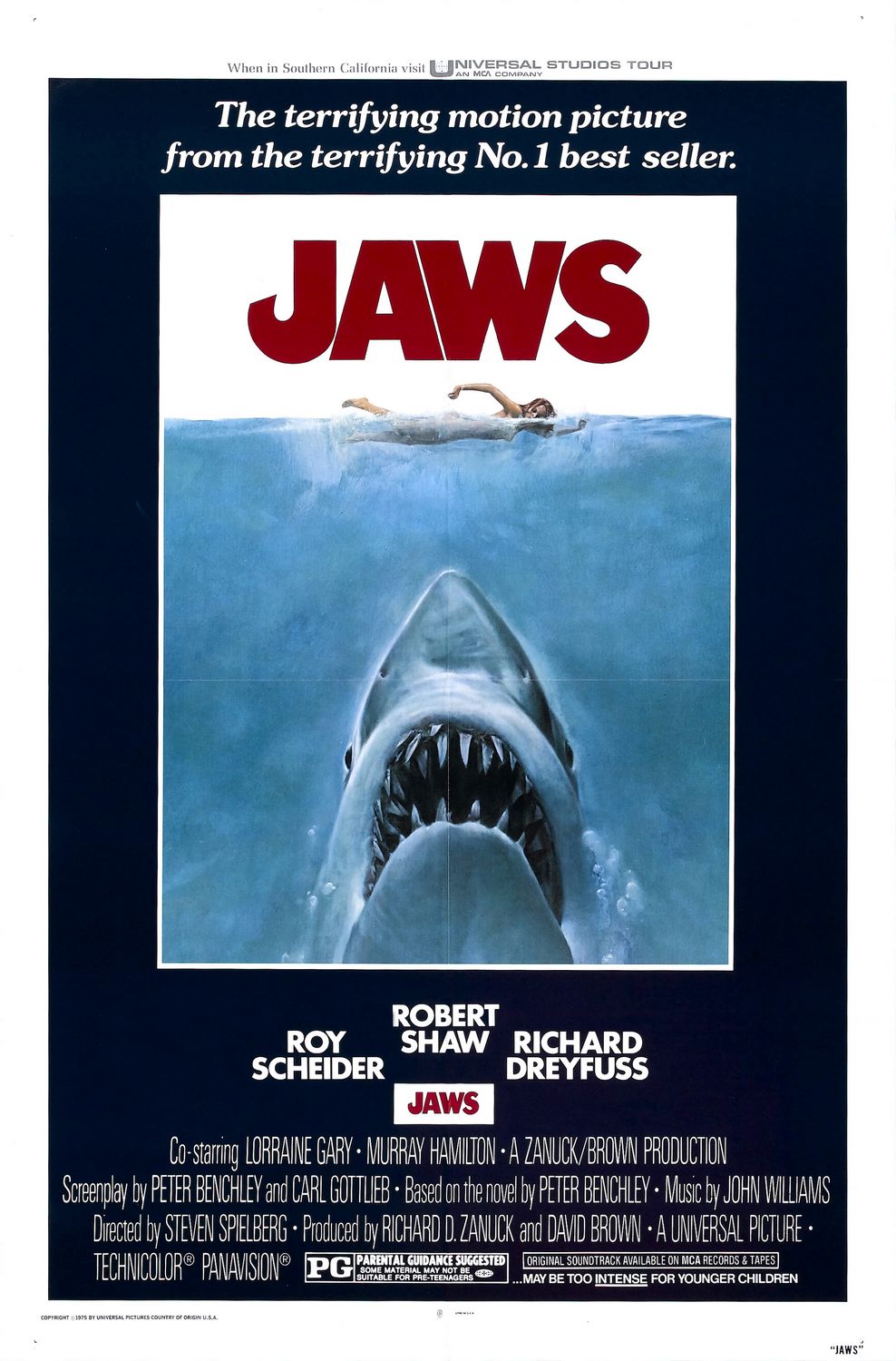
Jaws movie poster

Steven Spielberg’s “Jaws” is one of those movies I thought I watched a few years after it came out, but in retrospect I had only seen bits and pieces before finally watching it all the way through. It came out in 1975 a couple of months before I was born, and I can still vividly remember people talking about it while in a carpool to school. One of my kindergarten buddies kept telling me about all the blood the great white shark ends up spilling, and what he said made me NOT want to see “Jaws” for the longest time.

I do remember seeing certain scenes from “Jaws” for the very first time, and those moments remain forever burned in my conscious mind. When ABC presented its network television premiere of the movie, I remember those giant red letters coming out at me from the TV screen, and it was enough to have my hair standing on end. It was also the first time I saw little Alex Kintner getting dragged down to his bloody death, a very frightening image to be featured in any movie, let alone one with a PG rating.

Years later, I was watching an episode of “At the Movies” with Gene Siskel and Roger Ebert where they were talking about Spielberg’s movies in general. This was when I first saw the scene where Roy Scheider is throwing chum into the water, and the great white shark ends up rising out of the water which leads Scheider to tell Robert Shaw, “You’re gonna need a bigger boat.” This appearance of the shark scared me to death back then, and I felt exactly like Scheider’s character did as he slowly backed away from the boat’s rear.

A few years later, “Jaws” was again showing on television, and it was one of the few motion pictures shown unedited on television. Most movies, when they make their network television debut, are edited for content, but “Jaws” is so highly regarded to where it had to be shown with all the good parts intact. It was then I got my introduction to when Richard Dreyfuss was exploring Ben Gardner’s boat and Gardner’s head pops out of the hull. This proved to be another sequence which almost stopped my heart.

By the time I reached junior high school, I was already fully aware “Jaws” ended with the shark getting blown up. In fact, I had seen all the sequels by then and watched those other great white sharks bite the dust in their individual ways. Heck, I remember my brother renting “Jaws 3” on videotape, and we watched the shark getting blown up by a grenade and parts of his teeth getting thrust out at us with those 3D effects which never translated to the small screen.

While watching the last half of “Jaws” at a friend’s house all those years ago, I was truly astonished at how thrilling the movie was. I figured knowing the movie’s ending would rob it of any suspense or tension Spielberg managed to generate for audiences back in 1975, but man was I wrong. Seeing Dreyfuss trapped in the shark cage while the great white makes an effort to “reach out and touch someone” by attempting to smash through those metal bars had me begging for someone to kill it. Watching Scheider trying to keep his head above water as the boat sank had me wondering how the hell he was going to make it back to shore in one piece as his character hates the water.

I eventually rented “Jaws” on VHS in the days before Blockbuster Video became a dominant force in the video rental market. Seeing the movie in its entirety was a great experience, and it’s still one which I cannot ever get sick of watching. Even though I knew certain moments were coming, the anticipation of them still had me on the edge of my seat.

Having watched “Jaws” so many times before its Blu-ray release, the thing which keeps bringing me back to it is the human element. What Spielberg does best here is give us characters who are human and not mere clichés. Whether you’ve ever lived on an island like Amity or not, we know its inhabitants up close and why they depend on the summer months for their very lives.

Now while Spielberg did have problems with the mechanical shark which he named after his lawyer, he did have tremendous luck with his cast. What I love about Scheider, who plays Police Chief Martin Brody, is he doesn’t act the part as much as he becomes it. Those who read my reviews know I love talking about actors who inhabit their roles more than act, and Scheider proved to be one of those actors who did this very effectively. Brody is not out to be the hero, and he is like any other husband and father who just wants to keep his family safe. Scheider also makes you admire this ordinary police chief as he faces his fear of water so he can to put an end to the shark’s reign of terror.

Dreyfuss proves to be endlessly entertaining as Matt Hooper, a man whose love of the ocean and the animals inhabiting it keeps him from ever becoming a cynical bastard. Even after all these years, Dreyfuss is so much fun to watch as he shares his shark expertise with Scheider’s character and endures constant battles with Robert Shaw’s Quint who thinks this oceanographer is a little too domesticated to be sailing the ocean with him.

Speaking of Shaw, he has always struck me as one of those actors who proved to be as tough as the characters he played. This must be why he inhabits Quint so effectively, and his performance is one of the most unforgettable I have ever witnessed. Quint proves to be very hard to get along with, but then he goes into his long speech regarding his experiences on board the USS Indianapolis and of what happened after it sank. This monologue still gives us all chills every single time.

It’s the strong human element which makes “Jaws” work so phenomenally well as we come to care deeply about these characters and their hairy predicament. This could have been one of those pictures which lived or died on the quality of its special effects, and here they really could have been a detriment here more than anything else. The stories behind the making of this movie have long since become legendary as the filmmakers dealt with endless obstacles in making anything about the shark work.

But I also love how what worked against “Jaws” actually helped it in the long run. Dreyfuss loves to joke about how he kept hearing crew members saying “the shark is not working” on their walkie talkies, but it turned out the less we saw of the shark the better (something the sequels would quickly forget). “Jaws’” overall effectiveness came from the terror of what we didn’t see as opposed to what we did see. Many may prefer to see the monster, but the lack of its appearance forces our imaginations to go into overdrive, and this makes the monster so infinitely frightening.

“Jaws” is also aided tremendously by John Williams’ unforgettable music which still freaks us out whenever we hear those “dum-dum-dum-dum” sounds. So much attention is placed on this part of his score, however, to where other parts of it don’t get the praise they deserve. The music where Brody’s son mimics his dad’s every move at the dinner table is beautiful, and the same goes for the end theme which is mournful of what’s been lost and yet thankful this ordeal has finally come to an end.

This was the first movie to make $100 million at the box office, and that forever changed the way movies were made and distributed. As a result, many blame Spielberg for putting an end to the thoughtful, character-driven movies of the 1970’s, but that’s not fair. “Jaws’” success got Wall Street interested in the money which could be made from movies, and this proved to be the death knell to 70’s filmmaking. If Wall Street had looked more closely at the success of “Jaws,” they’d see how it focused as much on its characters as it did on the shark.

“Jaws” inspired a lot of filmmakers like Robert Rodriguez, Kevin Smith and Eli Roth, and it is bound to inspire many more in the future. Many have even gone on to name their companies after famous lines of dialogue like A Bigger Boat and Bad Hat Harry. It says a lot how “Jaws” is as powerful today as when it first came out in 1975, and I hope movie studios remember this if they ever foolishly decide to remake it, and heaven forbid this ever happens.

* * * * out of * * * *

Warren Beatty Searches for the Truth in ‘The Parallax View’

The Parallax View movie poster

par·al·lax

–noun

  1. The apparent displacement of an observed object due to a change in the position of the observer.
  2. Astronomy. The apparent angular displacement of a celestial body due to its being observed from the surface instead of from the center of the earth (diurnal parallax or geocentric parallax) or due to its being observed from the earth instead of from the sun (annual parallax or heliocentric parallax). Compare parallactic ellipse.
  3. The difference between the view of an object as seen through the picture-taking lens of a camera and the view as seen through a separate viewfinder.
  4. An apparent change in the position of cross hairs as viewed through a telescope, when the focusing is imperfect.

American Psychological Association (APA):

parallax. (n.d.). Dictionary.com Unabridged (v 1.1). Retrieved March 04, 2008, from Dictionary.com website: http://dictionary.reference.com/browse/parallax

I always wondered what the word parallax meant, let alone in relation to this movie. This would have come in handy during those damn SAT’s I took so many years ago. It would have brought my scores up a bit. As for what my scores were…Well, you can just figure it out on your own.

The Parallax View” is a thriller from 1974 directed by Alan J. Pakula and starring Warren Beatty. I saw it as a double feature with another Pakula thriller, “Klute.” I even remember my mom asking me to record this particular movie on the family VCR back in the 1980’s. I did succeed in getting the whole movie on tape as opposed to all those car races my dad and my brother asked me to record for them from time to time. Anyway, it’s a good thing I didn’t see this movie right away when I recorded it for my mom. They probably edited it down and cut all the good parts out.

The movie starts with an assassination of an assassination of a U.S. Senator on the Space Needle in Seattle, Washington. The movie then jumps ahead three years later to see the far-reaching circumstances this assassination has on those closely involved in it. Warren Beatty plays Joseph Frady, a reporter eager to get at the truth surrounding the assassination, and to find out why so many who were in the vicinity of the assassination have been dying. Many have been reported as dying from an embolism of some kind, but there are too many coincidences between all those dead which makes it impossible to believe they simply just died. Beatty’s character may not be able to prove it, but they were murdered. But by whom?

The movie opens with Frady getting a visit from a female friend who is convinced she will be murdered. She comes up with newspaper clippings of others present at the senator’s murder and how they died. But Frady dismisses her concerns as mere superstition, and that she cannot possibly be in danger. A couple of minutes later, we see her in the morgue, dead from an apparent overdose. This gets Frady up and running to finding out the truth as to why these people are being killed off. This drives his boss Bill Rintels (Hume Cronyn) to a lot of anxiety and irritation as he cannot get himself to believe all that is going on. Meanwhile, Frady risks life and limb literally to discover the truth behind everything. But like everything else, the truth will have a big cost.

Turns out all roads lead to The Parallax Corporation, a business which hires highly anti-social people and trains them to be assassins, and their targets usually tend to be politicians and government figures that stand in the way of making policy or a good profit. The movie escalates the tension to a high level as Beatty’s character puts himself in the most dangerous of positions. One of the most tension filled scenes comes when he realizes one of the Parallax assassins has put a bomb on board a plane with yet another politician, and Beatty boards the plane in an effort to find a way to get everyone off the plane before it detonates.

What I have come to discover about the late Alan J. Pakula is how he brought a lot of intelligence and reality to the movies he made, and there was never anything overly exaggerated in his direction. This seemed to ground the majority of his films in a world so real to where they come across as highly subversive. There is no hyper kinetic editing here, nor is there an overpowering score or adrenaline inducing sound effects. There is only the state of the world and of what’s really happening around us instead of what we are led to believe.

This movie is now over thirty years old, and yet its themes are not out of place in today’s society. The scenario of one man against the system, or of a person getting to the truth regardless of the consequences has been done over and over again. We have had “Michael Clayton” which starred George Clooney as a fixer at a law firm who suddenly develops a crisis of conscience that forces him to go against all the corruption which has engulfed the later part of his life. It’s thrillers like “The Parallax View” which gave movies like “Michael Clayton” a reason for being.

Beatty is perfectly cast here as this downtrodden reporter who is eager to not be as selfish as he has been for most of his life. The movie does not ride on his good looks to sell itself, but on the intelligence of Beatty’s performance as well of those around him. If you can’t believe Beatty in this role, then the movie is not going to work. I’m not sure of how many people today can recognize what a great actor Beatty can be if you give him the right material.

These days, we know that our government and the corporations are up to something which goes completely against what we were originally taught to believe in. What’s scary is when “The Parallax View” was first released, nothing much was different. It just keeps going on and on, and it’s almost like we are in denial about it. The question is, can we get at the truth of the matter and prove it to everyone who bothers to listen? Furthermore, can we do it in a way which doesn’t suck us into a trap that makes us look like a bad person to the rest of the world? This movie seems to say this is not really possible, but it doesn’t mean we shouldn’t try, and we can’t simply give up.

“The Parallax View” is an excellent thriller which is definitely worth a watch. Coming out of one of the truly golden ages of cinema, the 1970’s, it is an underrated work which didn’t get the same-sized audience of Pakula’s other movies like “All the President’s Men.” If you like his work as a director, you should check this out.

Just remember, the truth is out there…

* * * ½ out of * * * *

Ridley Scott’s ‘Alien’ Remains an Exceptionally Intense Experience

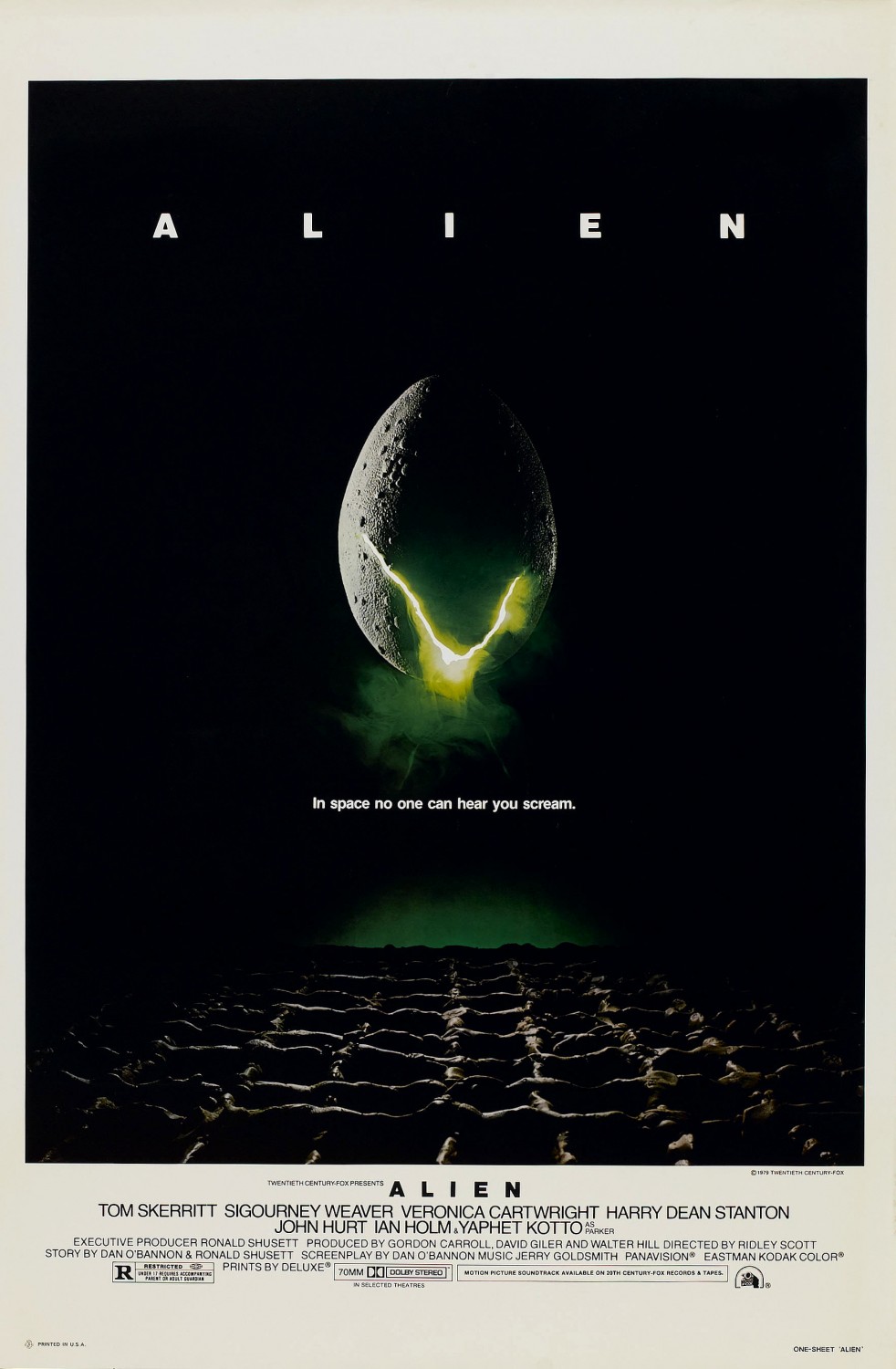
Alien movie poster

In regards to horror movies, “John Carpenter’s The Thing” ranks highest on the list of my all-time favorite movies in general. However, if you were to ask me what I consider to be the scariest movie ever, the first that quickly comes to mind is Ridley Scott’s “Alien.” Now considered a classic haunted house kind of movie, it freaked me out far more than I had expected it to. These days, if I come across someone who hasn’t seen “Alien,” I would be desperate to take the time and watch it with them just to see the look on their face. What may seem like a harmless old science fiction movie still has the power to unnerve and creep up on its audience when they least expect it.

Now when I say that this movie freaked me out more than I expected it to, there are a number of reasons why: I ended up seeing James Cameron’s sequel “Aliens” beforehand, so I already knew Ellen Ripley (played by Sigourney Weaver) was the sole survivor from the original. When I watched “Alien” for the very first time, it was back in the days of VCR’s and VHS tapes, and the one I obtained from my favorite video store was a fairly old copy which showed a bit of wear and tear. When it came to watching it, I got consigned to my parents’ bedroom as they had already called dibs on the big television in the family room which was connected to a “super cool” stereo system. The TV set in their bedroom was tiny by today’s standards. As I remember, it was a 13-inch set which was already on its last legs after years of use. This one didn’t have any surround sound system to enhance the experience, so I just tried to be happy I had a TV to view it on at all.

Having said all this, “Alien” still had my hairs standing on end throughout. Even though I knew who would live and die, the suspense and tension were extreme throughout, and you never ever felt safe on board the spaceship Nostromo. I can still remember hiding my eyes and would be turning the volume down at certain points because my heart threatened to stop beating a few times. Imagine if I had watched it for the first time on a big screen TV with surround system, or better yet, in a movie theater when it originally came out! I wouldn’t have slept for days! Some movies play better on the silver screen than on your television, but “Alien” appears to work on either format with the same degree of success.

There are many different reasons why Scott’s film remains such an effective sci-fi horror classic to this day. For me, it starts with the characters and how down to earth they are. While other outer space movies have characters who revel in the wonder of what’s out there, all the workers on the Nostromo treat their dark habitat as just another office job they take to get by. When we meet up with them, they are on their way back to Earth and just want to be home already. The writers also gave the actors dialogue which was never too heavy on the technobabble and hearing the characters talk about how they deserve full shares for the work they did defines them as blue collar workers. These are not brilliant scientists looking to discover new planets; they’re just people working for the man. The time Scott takes in introducing all these individuals pays off by the time we are given a visceral introduction to the alien of the movie’s title.

Now let’s talk about this alien which was designed by H.R. Geiger, a Swiss surrealist artist. I can’t really compare it to other movie creatures I’ve seen in the slightest because it looks so frighteningly unique in its construction. Its mouth hides an additional set of jaws that lunges out at unsuspecting victims as if they are “faster than a speeding bullet.” Furthermore, there is something quite phallic about that jaw in how it juts out at you without warning or of any thought of the damage it is about to inflict. Its lethal penetration is highly unnerving in how it reminds the viewer of what we all agree constitutes a serious and unconscionable violation to the human body.

But one of Ridley’s most brilliant moves with “Alien” was in not showing the creature fully. We only got glimpses of it throughout the film until the end, and even then we weren’t entirely sure of all that we saw. It was all up to our imaginations to figure out what kind of a threat this creature is. This added immeasurably to the film’s infinite suspense and unending tension. Plus, with the spaceship Nostromo designed to look all dark and shabby with not much light to be found in certain sections, this made it easier for the creature to hide. When it leaped up at the cast member about to meet his maker, it was completely unexpected and defined the jump out of your seat moment for me.

As the movie goes on, we get to an even more frightening aspect; of how corporations can put profits above their workers so coldly. When Ripley discovers the Nostromo crew was made to pick up an alien organism to bring back for further study and that they were expendable, it only further demonstrates just how much alone everyone is on the ship. To realize the company which has employed you couldn’t care less about your existence makes you fully aware of your immediate surroundings, and the instinct to survive becomes stronger than ever. Of course, are cynicism today has us expecting this from any corporation we work with, so we’re more prepared for this than the Nostromo crew was.

A lot of credit also goes to the late Jerry Goldsmith for creating a music score which adds subtly to the action, or at least until the film’s last half hour when the realm of outer space feels even smaller than before. His music touches on the tension inherent in each character without becoming melodramatic, and at times it sounds like invisible ghosts hovering over the unprepared crew waiting to strike. Also, the use of silence in certain scenes makes it even more frightening as we are reminded of how unsettling things can be when our surroundings become far too quiet for comfort.

All of this leads to one of the most intense climaxes in cinema history as we are fully aware of time running out. Just when you think the movie’s over, there’s still another horrendous challenge to overcome. It’s in the movie’s last minute where you can finally breathe a much-needed sigh of relief. Even if you know how of this movie will end, it is still an intensely riveting experience that never lets up for a second. The look in Ripley’s eyes as she makes her way to the escape shuttle perfectly mirrors our own emotions as she is forced into a situation which leaves her with no other options to consider.

I still have very vivid memories of seeing this movie on that unspectacular little television set in my parents’ bedroom while they enjoyed something on Masterpiece Theater with more advanced technology. As the beginning credits began to roll, I was convinced that sitting through this would be a piece of cake. Coincidentally, I also felt the same way about the original version of “The Texas Chainsaw Massacre” when I rented it through Netflix. “Alien” remains one of the most truly terrifying experiences I have ever had watching a movie either on the big screen or the small one. To this day, it remains an effectively scary movie which has lost none of its power. Now if 20th Century Fox had fully realized how all these elements had added to make such a great movie, those hopelessly pathetic “Alien vs. Predator” films might have actually been worth watching.

* * * * out of * * * *


Veronica Cartwright Looks Back at the Chestburster Scene from ‘Alien’

Veronica Cartwright in Alien

While Veronica Cartwright was at New Beverly Cinema to talk about “The Right Stuff,” filmmaker Brian McQuery couldn’t help but ask her a question about another famous movie she starred in, “Alien.” Specifically, he wanted to know more about the “chestburster” scene which is one of the film’s most horrifying moments. The story behind this scene has been told over and over again throughout the years, but Cartwright was still willing to talk and clear up a few things about it.

Legend has it neither Cartwright nor the other actors in “Alien” had any idea of what exactly was going to erupt from John Hurt’s chest. Cartwright, however, said the actors had read the script and knew something was supposed to come out of there. Also, she and Sigourney Weaver had a scene where they were supposed to know what it looked like, but they had no clue what they were going to be talking about. As a result, they visited the studio where the infant alien was being built.

“A few weeks earlier we had gone down and seen the little mockup of that little penis guy with the tail, but it wasn’t working at that point,” Cartwright said of the alien. “It was sort of a gray thing and the artists were saying ‘oh his teeth will be like this and he breathes…’ It was just like a little puppet thing that came out.”

Then came the day when the chestburster scene was shot, and Cartwright described it as though she had just filmed it yesterday.

“We’re all upstairs in the dressing room and they take John (Hurt) down, and for four hours we never saw John. John was having his false chest made,” Cartwright said. “When we were told that we could come down to the set, the entire set was dressed in plastic, everybody’s wearing raincoats, and there were big buckets of this awful stuff that smelled like formaldehyde. It stank and you gagged when you first went in there.”

“So, here’s John packed in this thing, and they had four cameras so that they would get everybody’s reaction,” Cartwright continued. “What happens is that they cut the t-shirt so that the puppeteer could push the thing through, so we all start leaning forward because you’re just fascinated to see what’s going to happen. One of the effects guys told me, ‘oh you’ll be getting a little blood on you,’ and I said, ‘oh okay.’ Not thinking, I leaned right into it. I had a jet pointed at my face, and it just shot me square in the face. It was unbelievable, and then I backed up and (in the dailies, it’s the most hysterical thing) my knees hit the back of a set piece and I flipped upside down to where you can see my cowboy boots sticking up above. I did not expect to get shot with a full blast of blood.

Veronica gets sprayed in Alien

Cartwright pointed out that the scene was done in just one take, and McQuery replied how her reaction looked “really real!” The audience at the New Beverly laughed loudly in agreement with him.

“Years later I worked with that same guy and he said, ‘sorry about that!’ How rude,” Cartwright said.

Looking back, Cartwright described “Alien” as being a very “sweaty” movie because the cast would come on the set in the morning and get covered in glycerin from a pumper. She described this as being “so gross,” but that in the end it was an experience.

While she was primarily at New Beverly Cinema to talk about “The Right Stuff,” the audience was glad McQuery asked Cartwright about the making of Ridley Scott’s classic 1979 film. Just when you think you have heard the definitive story about a classic movie scene, one of its participants comes around to inform you of one or two details you might have missed.

Photos courtesy of 20th Century Fox