‘American Gangster’ – One of the Many Great Films from Ridley Scott
What is it about gangsters which makes them so inescapably attractive? We have had so many movies about them over the years, and they just keep on coming at us like those greatest hits albums Aerosmith keeps releasing over and over again. Is it because they have such great power and generate such intense fear around everyone, even those they love the most? I think these characters tap into our darkest desires, the ones we would never openly admit to. We would love to have people look up to us and fear us. Seriously, let’s be honest. But if only we did not have to pay the consequences for such devious actions…
Gangster movies are among some of the best to watch. “The Godfather” trilogy is one of the most enthralling gangster sagas ever and, yes, I do include the third one. Michael Corleone’s descent from innocent family member to a vicious and cold-hearted crime lord is a grand tragedy. “Scarface” came out back in the early 1980’s, and now it is more popular than ever. And then there is “Goodfellas,” the penultimate Martin Scorsese film on which remains my all-time favorite, and which opened me up to the many things motion pictures can do.
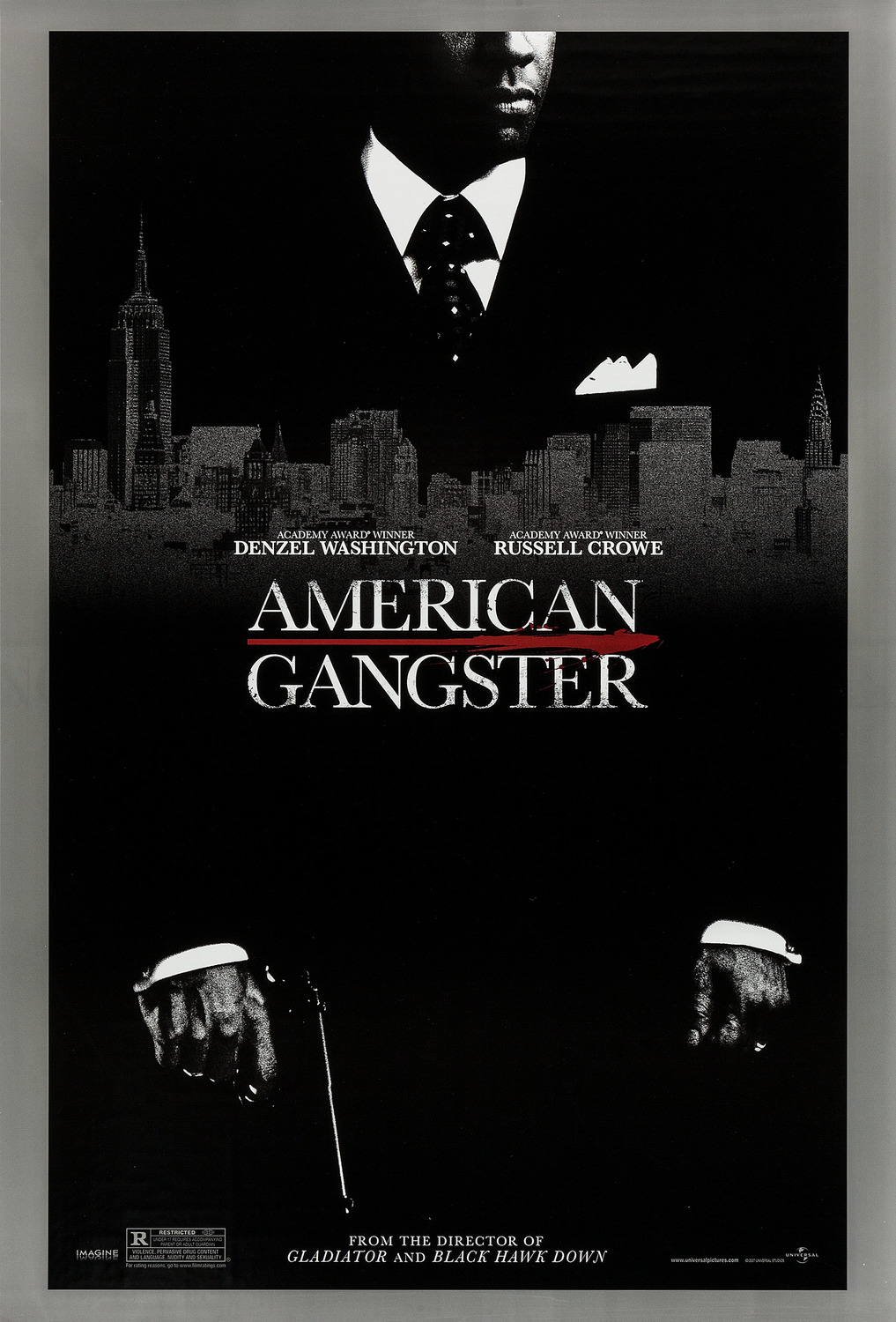
And then there is “American Gangster” which comes to us from director Ridley Scott. This film proves to be a cross between “The Godfather” and “The French Connection” as it follows the rise of Frank Lucas (Denzel Washington) who becomes New York’s biggest supplier of heroin, and Richie Roberts (Russell Crowe), the cop who is doggedly on Frank’s tail. The events portrayed here takes us back to the 1960’s and the 1970’s as these men go about their business, and it looks at how they eventually collided with one another.
“American Gangster” doesn’t really bring anything new to the gangster genre as we can see the trajectory the film is going to take as soon as the words “based on a true story” appear. But what it does offer is another brilliant piece of filmmaking from Scott who keeps his eye focused on his two main characters and the world around them with tremendous detail. As a result, he takes what could have been an average gangster movie and turns it into a character study of two men living in an utterly corrupt world.
The two main characters are interesting stories in contradictions. Frank Lucas (Denzel Washington) is, on the surface, a devoted family man. He ends up buying a huge house for his mother, Mahalee (Ruby Dee), and takes her to church every Sunday, and he gets all his brothers involved in his business. The brilliance of Washington’s performance is how he almost makes you forget what his business is: drug dealing. There are some scenes where we see the effects of his product and how it ruthlessly destroys the lives of others. It is enough of a reminder to remind us of just how dangerous Frank is. While he goes to church to worship in the name of God, this not prevent him from performing such heinous deeds.
Then you have Richie Roberts (Russell Crowe), whose name seems to spell out law-abiding police officer in capital letters. Richie’s first act we see is him turning in a million dollars of drug money to the police department. While Richie does the right thing, his co-workers end up wanting nothing to do with him as a result. He says he is a cop bound by a strong moral code, and yet he cannot resist cheating on his wife, Laurie (Carla Gugino), and jeopardizing the custody battle for his young boy by sleeping with a dozen women in the New York area. While he is married to the law, he is not married as much to his family as he thinks.
We follow these two alpha males as they go on their separate journeys through a world which has seemingly lost all sense of law and order. We see how complicit the police department is in drug dealing. Through Frank’s character, we see how drugs are a big money-making business for the Army as he travels to Saigon to get his product from the vast fields of vegetation. What Scott accomplishes here is what Steven Soderbergh accomplished with “Traffic;” he shows how the drug trade, however illegal, is such an integral business in everyone’s lives to where it can never simply disappear. Watching “American Gangster,” you have to wonder where the center between right and wrong is. Beyond that, you come to wonder if there is any center at all.
This all reminds me of a George Carlin routine from his “Class Clown” album:
“Keep it in the black! Show a profit! Keep it in the black! Keep it in the black! Never mind your soul! Never mind your bank account! Keep it in the black! BUSINESS AS USUAL GOING ON!”
Scott sucks us completely into the look and sounds of past decades as we go from the urban jungles of New York to the trenches of Southeast Asia in a way we have only read about. I love watching movies which suck you into a time and place to where you are not watching a movie as much as you are experiencing one. To quote Walter Cronkite, you are there.
The screenplay was written by Steven Zallian, and he remains one of the very best screenwriters working in movies Steven Spielberg has credited him for taking the unfilmable stories and making them possible to bring to cinematic life. “American Gangster” was based on the article “The Return of Superfly” by Marc Jacobson, and Zallian succeeds in taking elements which could have been utterly predictable and has made them feel fresh here.
Washington continues to be one of the very best actors working, and you can tell he is having a blast playing bad guys as much as he does portraying good guys (if not more). As Frank Lucas, he creates a character who is in many ways noble in how he holds family so close to where you can see how seductive he is in bringing them all into a realm of immorality. He makes you never doubt how dangerous Frank is, and there are moments where he is so unpredictable in his actions to where he becomes infinitely frightening. This is especially the case when he confronts another character played by Idris Elba, and it results in once of the most unforgettable, let alone brutal, scenes this film has to offer.
Crowe gives us a character in Richie Roberts who is not entirely brave, but also not altogether cowardly either. While Richie may not always be the bravest of cops, he is certainly the most morally strong one to be found here. And this is even though he constantly fails to be a faithful husband. I never ever see Crowe coasting through any of his roles, and he certainly doesn’t do that here.
There are other great performances to be found here as well. Ruby Dee plays Frank’s mother, Mahalee, and she is the moral force Franks needs to listen to here. Mahalee is not blind to what Frank is really doing, but she makes it abundantly clear there is a line he cannot cross. Another great performance is given by Josh Brolin who plays the corrupt and threatening Detective Nick Trupo, a man who seems to have no problem with drug trafficking as long as he can profit from it. His character threatens to become as bad as Frank and in the last half of this film, he looks to have no soul left for salvation.
The climatic scene comes when Frank and Richie are face to face in an interrogation room, and it is a great scene which reminded of when Al Pacino and Robert De Niro faced off against one another in Michael Mann’s “Heat.” They both communicate the realities of the world they are in as they see it, and neither is willing to give up on what they intend to accomplish. The fact Richie gets the upper hand almost seems amazing, considering how just about everyone around him is complicit in drug trade. So many cops and judges look to be so easily bought, and this case ended up bringing down an insanely high number of law enforcement officers. And when we watch Frank in the film’s final scene, we wonder if anything has changed at all.
“American Gangster” proves to be one of the many great movies directed by Ridley Scott. And yes, I do include “Prometheus.”
My man!
* * * * out of * * * *
 The Ultimate Rabbit