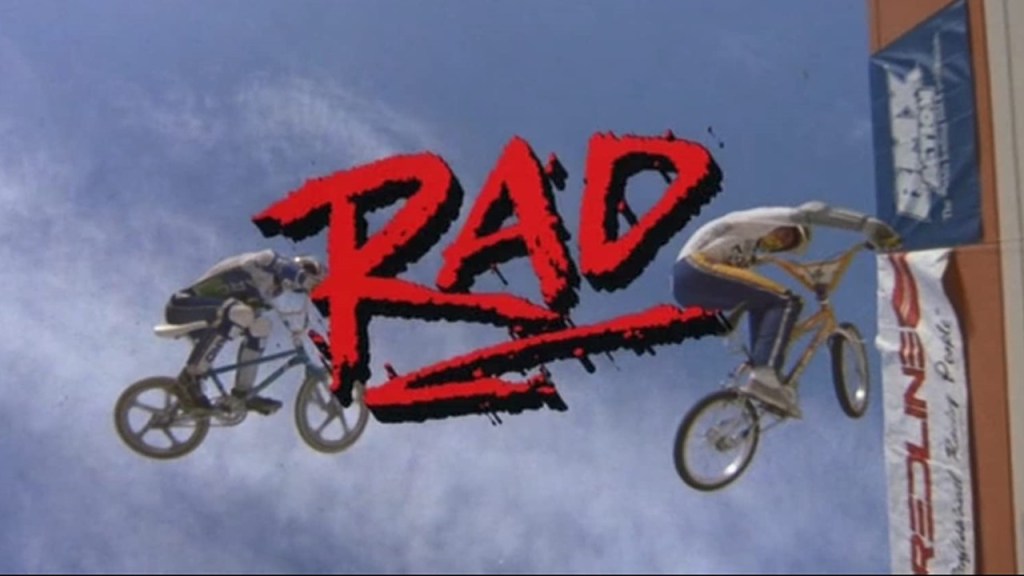
Anybody remember the 1986 sports movie “RAD?” If you were a BMX fan or a bicycle fan in general back in the 1980’s, you certainly do. Directed by the late Hal Needham, it stars Bill Allen as Cru Jones, a highly talented BMX racer who looks to compete in the Helltrack race. If he is victorious, he will become famous, win $100,000 dollars and get a new Chevrolet Corvette. The only thing is, his mother expects him to take his SATs to get into college, and it is on the same day as the race. Will he defy his mother and race, or will he take the test? Oh, come on, you already know the answer!
“RAD” got the kind reception many of Needham’s films did back in the 1980’s: the critics hated it, and it is one of those rare movies on Rotten Tomatoes to have a 0% rating. Nevertheless, it has long since gained a cult following which remains strong to this very day. And at the very least, it is a far better motion picture than Needham’s previous effort, “Cannonball Run II.”
While it was released on VHS and laserdisc and became a top-rental for two years after it was unleashed in theaters, “RAD” has long been out of print and never been made available on DVD. Who owned the rights to it? Hard to say. Some say Talia Shire, who plays Cru’s mother, had the rights, but this was never confirmed. The only way to find the movie was to look on websites like eBay where the VHS tape is being sold for quite a bit of money.
So, it was to my utter shock today when I discovered that “RAD” is now finally getting an official home video release nearly 35 years after it debuted. Vinegar Syndrome will be releasing the film exclusively on their website in the Blu-ray and 4K Ultra HD formats, and it comes with a plethora of special features which include the following:
• Newly scanned & restored in 4k from 35mm original camera negative
• Limited Edition 3D Lenticular (front) and Holographic (back) Slipcover
• Brand new commentary track with actress Talia Shire and Robert Schwartzman
• Brand new video interview with writer/co-producer Sam Bernard
• Multiple archival video interviews with the cast and crew
• Archival group commentary featuring multiple cast and crew
• Extensive behind-the-scenes stills and promo material
• Reversible cover artwork
• SDH English subtitles
Vinegar Syndrome has made it clear this special edition release is strictly limited, and they will not be repressing it in any format once it sells out. You can pre-order it now for $29.95 and it will be shipped out during the website’s Halfway to Black Friday Sale which takes place from May 22 to May 25. Trust me, this special edition release will sell out sooner than you think.
“RAD” may not be a major artistic achievement in cinematic history, but it still is a lot of fun to watch. The stunts are very impressive, and this film was made long before the advent of CGI, so nothing is faked here. Plus, you get to see Lori Loughlin, who plays Cru’s girlfriend Christian, at her most beautiful and long before she bribed the college admissions committee at USC to accept her two daughters. Ray Walston makes an appearance here, and there is even a great bicycle montage done to Real Life’s “Send Me an Angel.” What more could you ask for in an 80’s movie?
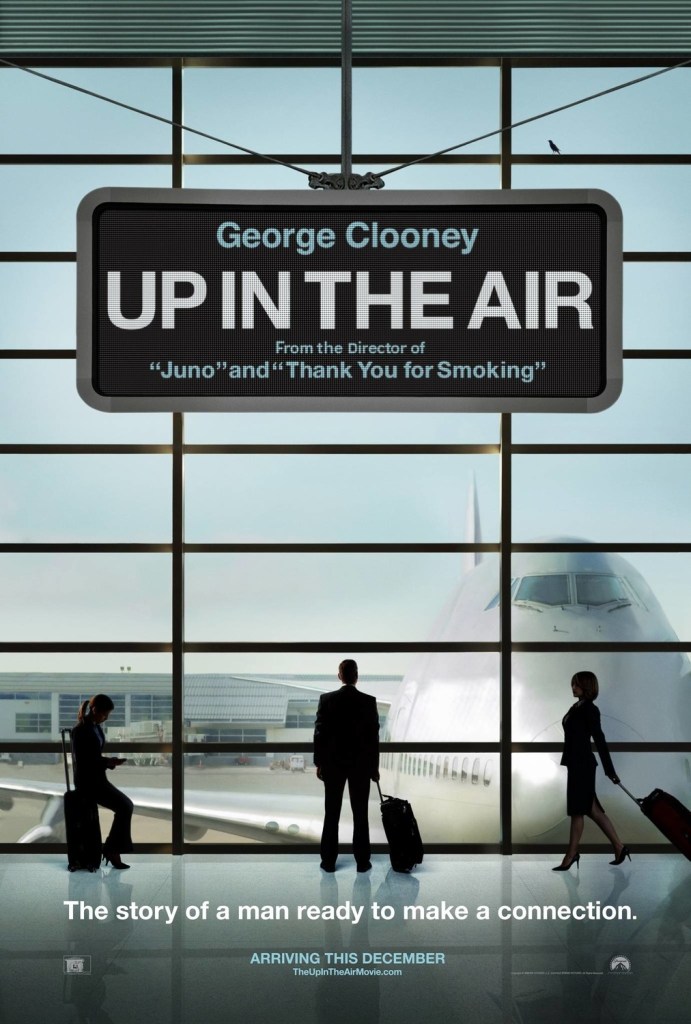
A life without many, if any, emotional attachments seems like an appealing lifestyle to many, especially for those who are ever so career minded. To not have to worry about kids because you don’t have any, and to not get involved in serious relationships with others leaves you with a lot of room to breathe in. But what happens when something comes along to shatter the façade of this lifestyle? Will you be able to handle it without reverting to your old ways? Will it make you realize just how lonely a person you truly are to where you have no idea how to alleviate this permanent state of solitude you are stuck in? One thing’s for sure, this kind of life is not meant to last forever, and eventually you will be greeted with an unexpected awakening. Hugh Grant got to play a character who lived this kind of like in “About A Boy,” and George Clooney came to play a similar one in Jason Reitman’s brilliant film, “Up in The Air.”
Based on the 2001 novel by Walter Kim, Clooney stars as Ryan Bingham, a man whose job is to travel all over the country to corporate offices to lay off employees. Companies hire people like Ryan so that their bosses can easily squirm their way out of this depressing part of the job (pussies). What he does feels a bit similar to the sad duty military officers or police officers have in telling families their husbands, wives or long-lost relatives have died. While Ryan is not informing anyone of a dead family member, the people on the receiving end don’t really react all much differently. Still, he sees his job as a service as he tries to make them see this is not the end, but simply the beginning of a new life. In addition, he also conducts conferences where he talks about “emptying the backpack” of attachments and things you don’t really need. Hence, the backpack is clearly symbolic of his life at this point for there is not much of anything inside of it.
The perks of this unappealing job? Well, it does allow him to travel on airplanes for over 300 days out of the year. He does have a puny one-bedroom apartment back in Omaha, Nebraska, but he is barely there. For him, the airports and airplanes feel like his real home, so his address truly is up in the air. Still, he has the same problem those seriously addicted to social media have; a serious fear of human contact. They say they don’t want any personal attachments in life, but it speaks of some deeper fear they may not be aware of consciously.
Clooney gave one of his very best performances in this film, and he has always been great at playing the world-weary man who has seen just about everything. From a distance, this almost seems like a walk in the park for him as this movie’s trailers have him flashing that famous grin of his every five minutes. But he brings a real depth to a really well written character, and despite the fact he plays a man none of us would want to meet ever, he makes Ryan Bingham likable and very sympathetic.
Ryan ends up capturing the attention of another corporate employee who spends more time in the air than in the office, Alex Goran. She is played by Vera Farmiga, and she is as great in the role as she is seriously sexy! The first scene between these two reminded me so much of the scene in “Jaws” where Robert Shaw and Richard Dreyfuss compare their scars as they show off all these executive cards and credit cards which they have earned from travelling so much and for staying in the same hotels. The chemistry between Clooney and Farmiga is instant, and it sells us on their budding relationship almost immediately. You want their characters to end up together as they are essentially the same person, although Alex puts it in another way:
“I’m like you with a vagina.”
Of course, there is a third wheel to balance things and give a little more perspective on the story. That third wheel is Natalie Keener, a recent graduate from Cornell University who has a lot of smarts, but who also has much to learn about the real world. Natalie is played by Anna Kendrick, and she is wonderful here. Natalie is here to prepare Bingham and his colleagues for a new way of firing employees; they will do it online from the comfort of their own offices. So basically, it makes a depressing piece of business all the colder. It also threatens Ryan’s way of life as he lives to be on a plane instead of his tiny dump of an apartment, and while there will always be change, his resistance to this change is very understandable.
With this development comes the road movie part as Ryan takes Natalie to different cities across the country to show her how he does his job, and of how the use of computers will detract from it and his frequent flier miles rewards. Kendrick does brilliant work in taking Natalie from being confident yet naïve to vulnerable and sad. None of the education she got could ever have prepared her for the unpredictability of a job which is never easy no matter how it’s done. Seeing her address a corporate meeting to her doing a drunken karaoke rendition of Cyndi Lauper’s “Time After Time” should give you an idea of the range she has as an actress.
Watching Clooney instruct Kendrick on how to pack her suitcase and leave stuff out she needs is hilarious as it reminds me of my parents constantly begging me to put everything in one suitcase when traveling. This way, I won’t have to check any luggage in. I don’t know about you, but I get so sick and tired of hauling a suitcase all over the place when I have my messenger bag to worry about already. Who packed this suitcase anyway? Okay, I’m getting off track here…
“Up in The Air,” was Jason Reitman’s third film and, along with “Juno” and “Thank You for Smoking,” he showed us how infinitely talented he is as a director. He even makes this movie even more authentic to those times of high unemployment by casting real people who have lost their jobs. This brings a lot more reality to the movie and reminds us of how unfair life can be despite our individual efforts to do the best job possible. Reitman also does not sell out the movie with a false ending where everything is wrapped up neatly. In fact, it proves to be far more devastating than I ever could have expected.
Reitman also populates the movie with other great actors who make as strong an imprint on the film as the leads do. Jason Bateman plays Bingham’s boss, Craig Gregory, and this role is the flipside of the manager he played in “Extract.” It turns out Bateman can be charming in one role and utterly smarmy in another with no problem. Amy Morton is also really good as Ryan’s estranged sister Kara, a woman suffering through her own midlife crises which her brother makes look like he is getting through it with no problem. Melanie Lynskey (great in both “The Informant!” and “Away We Go“) is a wonderful presence as Julie, Ryan’s younger sister who is about to get married. I was also surprised to see Danny McBride here in a slightly more dramatic role as Julie’s soon-to-be husband, Jim Miller. McBride definitely has some funny moments, but he really sells himself as a man who is not sure if he’s doing the right thing or not.
I also have to give a lot of credit to some actors who make the most of their respective cameos. Zach Galifianakis gives this movie one of its funniest moments as Steve, one of many fired employees whom Ryan has had to face. Looking at the things his character could have done had he been fired by his cowardly boss instead is hysterical. Then you have J.K. Simmons who gives his suddenly jobless character of Bob a morbid sense of humor as he manages to contain himself in his understandably pissed off state. When Ryan ends up making Bob see this is not an end but a beginning, Simmons takes this character from being depressed to being aroused with possibilities he thought were long since lost to him. Simmons is onscreen for only a couple of minutes, but he infuses his role with a dry sense of humor which makes his performance especially memorable.
Another thing I really loved about “Up in The Air” is how wonderfully complex the characters are, and this includes the ones who are only onscreen for a few minutes. We may have the stereotypical traits of each character nailed into our heads, but they keep revealing different parts of their personalities in ways which truly surprised me. Once we have these characters figured out, another layer is revealed which affects their relationships with one another quite deeply. I would love it if more movies allowed to have more multi-faceted characters in them instead of just succumbing to one-dimensional freaks who exist to annoy the hell out of you.
“Up in The Air” was far and away one of my favorite films of 2009, and it is interesting to watch it again years later during a time of a frightening global pandemic. On top of many worried about their health and toilet paper, this pandemic has left a record number of Americans out of work. This film was quick to remind me of what it was to suddenly lose a job and how to move on from there. It also has a cameo from Young M.C. who sings his hit song “Bust a Move.” He certainly has gained a lot of weight since the 1990’s. Then again, I should talk (sigh)…
WRITER’S NOTE: The following article is about a screening which took place back in 2011.
In the midst of promoting “Contagion” in Los Angeles, California, filmmaker Steven Soderbergh dropped by the Silent Movie Theater where Cinefamily was screening one of his earlier and most underrated features, “King of the Hill.” Not to be confused with the Fox animated series, the film follows 12-year-old Aaron Kurlander (Jesse Bradford) who is forced to fend for himself in Depression era America after his parents leave him alone at the Empire Hotel in St. Louis. Aaron is forced to grow up a lot faster than any kid should ever have to, and he desperately searches for ways to avoid eviction from the family’s apartment. Soderbergh thanked the sold-out crowd for coming to the theater, and he started off by saying, “Why aren’t you guys going to see ‘Contagion’? This film is never going into profit!”
“King of the Hill” was Soderbergh’s third film after “Sex, Lies & Videotape” and “Kafka,” and it was released back in 1993. Based on the memoir of the same name by A.E. Hotchner, it was given to him as a gift by a friend. At the time he was looking for something different than “Sex, Lies & Videotape,” and he found Hotchner’s story to be just what he needed. He did, however, describe it as a “tricky adaptation” since he only had a budget of $8 million and 48 days to shoot the film, and it was a period piece. On the upside, though, he said Universal Pictures, which released the movie through its Gramercy Pictures division, was “hands off” during the production.
Watching it again, Soderbergh described it as the one movie of his he might change aesthetically. He felt the prettiness of the picture would help counteract the harsher parts of the story, but now finds the film to be “almost too pretty.” Most of the conversation he had in pre-production involved the overall palette color which he and cinematographer Elliot Davis wanted to remain within a certain range. Were he to film it today, Soderbergh said he would go out of his way to make it “less commercial.”
Soderbergh recalled doing three preview screenings of his movie, none of which went well. When finished with the project, he admitted feeling somewhat dissatisfied as the movie’s ending did not seem entirely satisfactory to him. Whatever problems he had, they did not stop him from trying to adapt Hotchner’s follow up memoir “Looking for Miracles” which focused on the writer’s relationship with his brother. Sadly, Soderbergh’s hopes were quickly dashed when “King of the Hill” did not find an audience upon its release.
Regardless of his feelings, the audience was in agreement that “King of the Hill” is a great film, and it truly is one of Soderbergh’s best works. The director also found a big fan in Sid Sheinberg, the famous entertainment executive, who, soon after seeing it, introduced him to Lew Wasserman. It also made Soderbergh how that he didn’t enjoy writing as much as he thought, but he did continue writing screenplays for his films “The Underneath,” “Schizopolis,” and his remake of “Solaris.” This was one of five films he did after “Sex, Lies & Videotape” which he openly admitted “did no business,” but perhaps they will eventually.
“King of the Hill” is not currently available on DVD (not in America anyway) or Blu-ray, nor is it available to stream on Netflix. Soderbergh remarked this is because “cult flicks are not marketable right now” and that “no one buys DVD’s anymore.” But with this director being so highly regarded in Hollywood, hopefully this third film of his will get the digital release it deserves so fans can discover it for the great movie it is.
UPDATE: “King of the Hill” has since been released by the Criterion Collection in a DVD/Blu-ray combo pack. It features a new restored 2K digital film transfer, interviews with Soderbergh and Hotchner, movie trailers, and Soderbergh’s fourth film “The Underneath.” To find out more about this release, click here.
WRITER’S NOTE: This article is about a screening which took place back in 2012.
Filmmaker Phil Joanou was at New Beverly Cinema when the theatre showed two of his films: “Three O’Clock High” and the U2 documentary “Rattle and Hum.” While most of the evening was spent talking about “Three O’Clock High” as it had arrived at its 25th anniversary, Joanou did take some time to talk about how he was hired by U2 to direct their first music documentary (or rockumentary if you will). The story ended up becoming one of the strangest and funniest ones told on this evening.
Joanou was busy doing post-production on “Three O’Clock High” when his agent got him a meeting with U2 on the day before the band had to leave America for Ireland. They had already interviewed a number of directors already, but Joanou said they hit it off to where they asked him, “can you come to Dublin tomorrow?” He said sure, but he had to call the producer of “Three O’Clock High” to explain why he had to leave post-production on a little early. The producer apparently was not too happy about this sudden opportunity, but Joanou got to go anyway.
Once in Dublin, Joanou said U2 interviewed him for five days about directing “Rattle and Hum.” Where the story goes from there is not what you might expect as the band kind of left him hanging.
Phil Joanou: They would take me to a friend’s house and then Bono and Edge would leave and I would have dinner with the husband and wife. After that they took me to a wedding and they left me there as well. I’m there in Northern Ireland and I’m all by myself at an Irish wedding and I’m like, okay great! I don’t know anyone here. I had to figure out how to get home. So, they would do weird things like that to me. They’d drop me off at a bar and leave me. This went on for five days!
After all this craziness, U2 came up to Joanou and said, “alright, you can do the film.” Joanou said that to this day he still does not know what the criteria was for them hiring him, but he described making “Rattle and Hum” as being an “incredible experience.” Looking back, he described the Irish rock band as having taught him so much while being on the road and in the studio with them.
“Rattle and Hum” was greeted with a critical backlash when it came out as critics accused the band of being too grandiose and self-righteous. Watching it today, however, is a different experience as “The Joshua Tree” tour, as it is presented here, feels far more intimate than any tour they have done since. The musical numbers are exhilarating to watch, especially in black and white, and their journey through the American music scene gives us a number of unforgettable moments. But moreover, it was especially great to see it on the big screen for the first time in many years. Concert movies like these really need to be seen on the big screen to be fully appreciated.
“Re-Animator” may be the definitive Stuart Gordon cult classic, but his follow-up film entitled “From Beyond” is just as good. Like the former, it’s based on a short story by H.P. Lovecraft, whose love of horror and fantasy made him a unique writer in his field. “From Beyond” also represents the kind of horror movie Hollywood is not always quick to make: one with a vivid imagination and something other than your typical slasher fare. Were it made today, and assuming any studio would finance such a genre flick, it would probably go straight to Netflix or Shudder. Granted, this would not be a terrible fate, but movies like these are best experienced in a darkened movie theatre.
Jeffrey Combs stars as Crawford Tillinghast, a scientist who has created a ground-breaking machine called the Resonator. It is designed to stimulate the pineal gland which, for those who didn’t pay attention in science class (don’t worry, I didn’t either), allows subjects to see beyond normal, perceptible reality. Aside from getting, as one character says, an “orgasm of the mind,” they also see creatures unlike any others which inhabit the planet. Of course, when these same creatures proceed to attack Tillinghast and his sadomasochistic partner Edward Pretorius (Ted Sorel), we know things will not end well for anybody.
Pretorius ends up getting killed and Tillinghast is arrested and wrongly charged with his murder. But after meeting Katherine McMichaels (Barbara Crampton), who is utterly shocked after viewing Tillinghast’s brain scan which shows his pineal gland as larger than ever, she goes against her superiors and takes him back to the house to start the Resonator up again and confirm his story. From there pain and pleasure take on visceral new meanings even Pinhead from “Hellraiser” would never have thought of (seriously, such things are possible).
Gordon effectively finds the shock and awe in this story which gets at our conflicting desire to play it safe and yet still test our limits. These characters have no business reactivating the Resonator but, like them, their fascination over what they could happen is far more enticing than we would openly admit. He also brings much of the black humor from “Re-Animator” to this film as well, allowing us to take the story only so seriously. With antennas sticking out of heads and characters wearing bizarre costumes, you could almost call this his version of a David Cronenberg film.
All the actors in “From Beyond” remain incredibly underrated long after this film was released back in 1986. Combs is superb as a doctor who is even more of a loose cannon than “Re-Animator’s” Herbert West ever was, and you come out of this wondering why he isn’t a movie star. Barbara Crampton matches him scene for scene as McMichaels, who goes from being a person in control to one completely losing it with great abandon. Then you have “Dawn of the Dead’s” Ken Foree, who plays Bubba Brownlee (yes, this is his character’s name), the one man who has not completely lost his sanity. This is one of the many roles on Foree’s resume which quickly reminds us of what a bad ass he is and can be.
But one performance worth singling out is the late Ted Sorel’s as he dives head-first into the perverse nature of his character, Dr. Pretorius. Seeing him excited about the next ultimate drug makes him such a repellant character, yet Sorel still makes him so charismatic at the same time. Even when covered in makeup to where he looks infinitely slimy and mutated, the effects never upstage his excellent performance.
Gordon, working with a bigger budget this time, revels in the love he has for Lovecraft’s work, and this love can be seen all throughout “From Beyond.” He was never a guy who wanted to just churn out forgettable junk, but one who brings us to a horrifying place we may are compelled to visit against our better judgment. Scary movies are always fun to watch, but many of them are as imaginative as they claim to. “From Beyond,” however, is one of those movies and definitely worth your time. If you loved “Re-Animator,” you will enjoy “From Beyond” every bit as much.
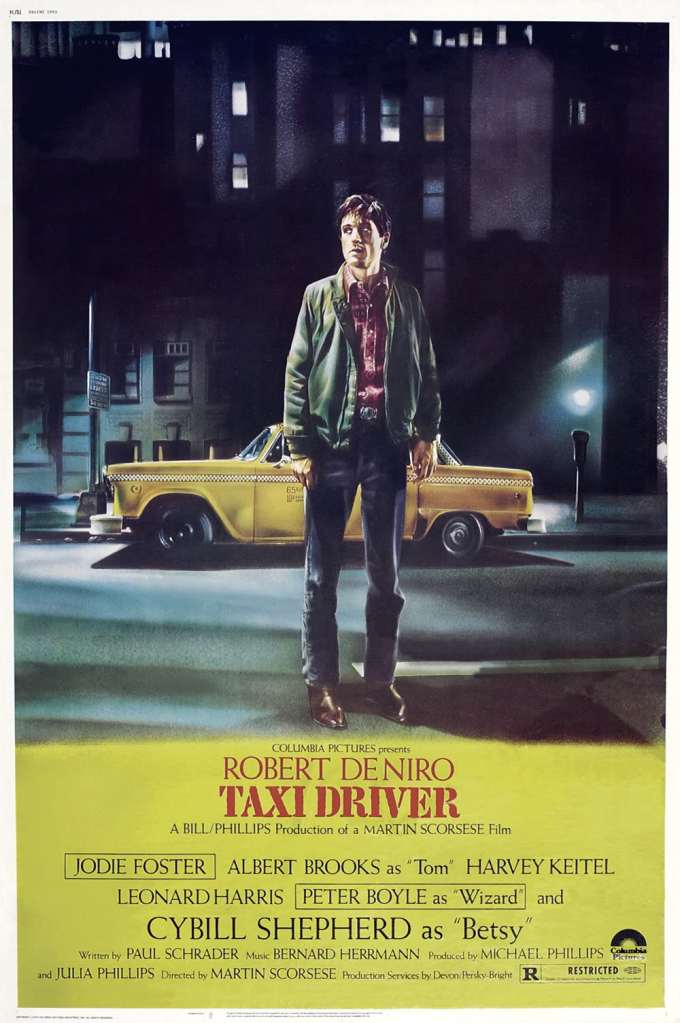
While “Goodfellas” introduced me to the filmmaking brilliance of Martin Scorsese and became my all-time favorite movie, it was “Taxi Driver” which really shaped the way I view movies today. Before seeing it, I always tried to avoid those movies which would make me sad or were too dark. This was a result of my parents having to carry me out of “Star Trek II” and “E.T.,” both of which I cried so hard over to where others wondered if I was okay. I promised myself I would never put my family through such embarrassing situations ever again, and this was especially the case with my brother who was constantly annoyed at my emotional outbursts.
Unlike “Goodfellas” which was immensely entertaining and had great comedic moments, “Taxi Driver” is dark, dark, dark. There is nothing the least bit glamorous to see here as we watch the main character of Travis Bickle (played by Robert De Niro) get continually sucked into a corrupted environment he deeply despises. I kept hoping for him to achieve sort of redemption and maybe, just maybe, have another chance with Cybil Shepherd’s character of Betsy whom he had a memorable first date with. But as we reach the movie’s bloody conclusion, I realized there was nowhere for Travis to go but down. While the reaction to his actions may have been surprising, we all know the truth about Travis and realize something will set him off again before we know it.
Once the end credits went up, my dad asked me what I thought about “Taxi Driver.” My initial reaction was it was not exactly enjoyable. My dad’s response to this has always stayed with me, “Not all movies are meant to be enjoyed. Some are meant to be experienced.”
Looking back, I see what he meant. Look, there are a lot of reasons to not make a movie about someone like Travis Bickle; he’s seriously nuts, not a good date if you want to go to the movies, and watching him lose his mind is painful. But the thing about “Taxi Driver” is people like Travis exist, and turning a blind eye to their existence does us no good. We need to understand why people do the things they do. It’s like what Roger Ebert said in his review of the film:
“Scorsese wanted to look away from Travis’s rejection; we almost want to look away from his life. But he’s there, all right, and he’s suffering.”
With “Taxi Driver,” I came to see how you need these kinds of movies just as much as you need the average escapist entertainment. Some movies need to shine a light on the darker parts of human nature to remind us we need to acknowledge we have a dark side and realize we have more in common with Travis Bickle than we would ever care to think or admit.
Since watching “Taxi Driver,” I have become completely open to movies which disturb me or take me on a journey I would not necessarily want to endure in real life. I can’t stand to watch films in a passive manner. I want to be moved by what I see, be disturbed and shaken, and even weep. Movies are too powerful an art form to be made just for the sake of entertainment. There are so many things about the human existence which deserve to be captured on celluloid, and I believe audiences crave these kind of cinematic experiences as they do the next Marvel movie.
“Taxi Driver” is my second favorite movie of all time, right behind “Goodfellas.” It is a movie I admire above so many others, and I still watch it from time to time. There are many I get sick of watching, but this is one I will never tire of sitting through.
WRITER’S NOTE: This article was written in 2011 when this screening took place.
One of the double features shown during American Cinematheque’s tribute to Michael Keaton was “Batman” and “Batman Returns.” When the actor was originally cast as Bruce Wayne/Batman, fans objected to it as he was primarily known for his comedic performances in “Mr. Mom,” “Night Shift,” and “Beetlejuice” among others, and they could not see him playing such a traumatized character. Of course, many forgot about his powerhouse performance in “Clean & Sober” which won him a Best Actor award from the National Board of Review. In retrospect, his portrayal of Batman is still the best in the movie franchise, and Christian Bale’s portrayal is a very close second.
While talking with Geoff Boucher at the Aero Theatre, Keaton said it was “Beetlejuice” director Tim Burton who wanted him to play Bruce Wayne and his alter ego of Batman. At that point, Keaton said he did not fully understand the comic book super world. It was through his introduction to Frank Miller’s books that he got some ideas as to how Burton’s vision would reflect Gotham City in a darker way than ever before. Keaton said Bruce Wayne turned out to be the key to getting into the character.
Michael Keaton: The coolest thing from the get-go is that he doesn’t have superpowers, there are no magical things. He is a hero of intuition and inventiveness and discipline. I always knew the way in was Bruce Wayne. It wasn’t Batman. It was never Batman. That was the key. The only reason to do it, really, was to come at all of this from this guy’s point of view.
When Keaton and Burton made “Batman” back in 1988-89, Keaton said there was nothing else like it before, and that there was no example for either of them to follow. Unlike the television series from the 1960’s, this was not going to be full of campy humor. The fact that “Batman” became such a landmark film in Hollywood history is something Keaton owes to Burton.
Michael Keaton: What Tim accomplished changed everything. It was hard. It was harder on Tim than anyone and he changed the way people look at those movies. That really is the case and the reason for that is the originality of Tim and the people Tim put together. Anton Furst was off the chart, Danny Elfman was perfect, bringing in Prince and Nicholson, all of it was just so right and so huge. The promotion of the movie was genius too. The look of the movie was a turning point too; you still see that around in different versions.
When it came time to start making “Batman Forever,” Warner Brothers wanted to take the franchise in a different direction. The executives wondered if everything really had to be so depressing, and Keaton said when he realized they were going to lighten things up, he dropped out along with Tim Burton. We all know what happened after they left, and no real explanation is needed here.
Keaton said he never really got around to seeing “Batman Forever” or “Batman & Robin,” but he said he did see most of “the one that starred Heath Ledger” (“The Dark Knight“). In describing Ledger’s performance as The Joker, he called it “crazy great,” and that the tone of the film is what he wanted the third one to be like. But by then the whole thing had become a big machine which was going to go on with or without him. Had he been in “Batman Forever,” Keaton is convinced he would have been horrible because he would not have been able to give the studio what they wanted. The sad thing is, he is probably right.
Michael Biehn and his wife Jennifer Blanc reappeared at New Beverly Cinema on September 11, 2012 to do another Q&A on his directorial debut of “The Victim.” It had been playing at the famed revival movie house since Friday, September 7, and Biehn and Blanc were determined to make as many appearances there as they could to promote their fun little grindhouse flick. This particular evening had Biehn talking about its making, another movie he was involved in which did not get much of a release, and there was also a big surprise in store for yours truly.
Biehn first made his presence known to the small audience on this evening when the end credits for “The Victim” began, and he ended up doing a running commentary as they played on how he got everyone’s picture on screen whether they were acting in the movie or working on it behind the scenes. He once again alluded to the fact he had such a low budget to work with, and he described how most films don’t have end credits like this one, nor are they as fun to watch.
Among the people in the audience was Brian McQuery who served as the movie’s assistant director, and Biehn pointed out how McQuery worked 4 or 5 days “for nothing.” Biehn said this was the result of a “friend helping out a friend,” and he got the audience to applaud McQuery for his selfless efforts.
During the Q&A, Biehn talked about when he worked with filmmaker William Friedkin on the movie “Rampage” and how the filmmaker kept calling everyone on his set “Moe.” Biehn ended up working on two movies with Friedkin and he remarked how no other actor has worked with him twice. It turns out no one saw “Rampage,” Biehn said, because Dino De Laurentis’ company, which produced it, ran out of money and was not able to give it a proper release. Biehn did say he liked “Rampage” a lot and thought Ennio Morricone’s film score to it was fantastic.
Biehn also pointed out how he got some of the best directing advice ever from Friedkin. When Biehn asked Friedkin where he decides to put the camera when filming a scene, Friedkin ended up telling him, “I just think of where I would like to see the scene from, and I put the camera there.”
Even after making “The Victim,” Biehn told the audience he does not consider himself a director as he “never had a feeling for the camera, lenses, angles or close ups.” This was the result of him always being so focused as an actor to where he never learned all that stuff. Although he said he is never going to be a great director, his directorial debut showed he is better and cleverer at this job than he gives himself credit for.
Blanc also went out of her way to say that Biehn is a “phenomenal director” and that she “always looks to him for audition help.”
Biehn went on to talk about how a movie needs to be in escrow before it even gets made, and this led to him discussing how he got the money to make “The Victim.” At the time he was recovering from a hernia operation and was on Vicodin when he took a meeting at a restaurant with some guys looking to finance a movie. They told Biehn how they wanted to work with him and that they had “a small amount of money” to make a film with. Biehn, in his drugged out state, told them he would do the project but only if he had total creative control over it. They ended up agreeing to this, and the next day Blanc told Biehn the check those two gave him had cleared. Biehn, now off the Vicodin, ended up saying out loud, “What the fuck?!”
Whatever the case, Biehn clearly put a lot of effort into making “The Victim” with the limited resources he had. He described how the film was shot most days from 6 a.m. in the morning to 6 p.m. at night, how he had to write the script and do pre-production in just three weeks, and all the driving scenes were shot on some guy’s driveway which had bushes on both sides. Biehn also said the character he plays is like him but “with a few problems.”
There were also days on set where he got so upset to where Biehn became like “William Friedkin, Michael Bay, James Cameron and Val Kilmer all together on their worst day.” Blanc said his temper tantrums among other behind the scenes fodder can be found on “The Victim’s” Blu-ray which will be released on September 18, 2012.
Ok, now I don’t brag about myself too much but this is something I have to talk about: I was sitting in the front row of the New Beverly taking notes down in my journal of what was being said during this screening, and Biehn saw me writing furiously and asked me, “Are you a reporter?”
“No,” I said (for some reason, I did not consider myself an official reporter back then).
“Oh, okay,” Biehn said. “You’re not gonna write a bad review of this, are you?”
I assured him I had already written my review of “The Victim,” and that it was good. Blanc then asked who I was and I told her my name and the websites I submit reviews to. It turns out she actually read my review and thought it was awesome, and she ended up coming over to give me a hug.
Biehn then asked his wife, “was it a good review?”
“It was fantastic,” she said.
Biehn then looked right at me with open arms and said, “come here!”
Who would have thought I would get a hug from the man who played Corporal Dwayne Hicks in “Aliens,” Kyle Reese in “The Terminator” and Navy SEAL Hiram Coffey in “The Abyss?” When things like this happen while you live in Los Angeles, it reminds you of how magical this town can be.
Michael Biehn dropped by New Beverly Cinema on September 7, 2012 where the theater was hosting the Los Angeles premiere of his feature film directorial debut, “The Victim.” Joining Biehn for a Q&A were his wife and co-star Jennifer Blanc, Denny Kirkwood who plays one of the police detectives, producer Lorna Paul and musician Randy Chance who provided some original songs for the movie.
The first question Biehn was asked was, of course, what finally persuaded him to step behind the camera and direct. Biehn replied he was “not all that aware of really low budget movies until he worked on ‘Grindhouse‘” with Quentin Tarantino and Robert Rodriguez. Those two directors ended up showing him a bunch of their favorite grindhouse/exploitation movies, and Biehn recollected of how he was on the set of “The Divide” one day and saw a crew member reading Rodriguez’s book “Rebel Without a Crew” in which he wrote about his first film, “El Mariachi.” Those elements are what finally got Biehn to direct as well as Blanc’s insistence in her telling him to direct. Then again, she also said, “you can’t bully him into anything.”
Biehn also stars in “The Victim” as Kyle, a loner living in a remote cabin in the woods. He said he kept thinking of “The Shining” and of how Stanley Kubrick made the hotel look so isolated out in the snowy wilderness. It was this feeling of isolation Biehn wanted to capture, and “The Victim” ended up being shot in Topanga Canyon, California which seemed to have the perfect look. He went on to say how Blanc’s mother was especially helpful as she lives up there and talked to all her neighbors about what was going to happen. Apparently, the residents of Topanga Canyon do not like it when filmmakers come to town and shoot their movies there, but Blanc’s mom ended up making things a lot easier as a result.
“The Victim” ended up being shot in 12 days, and both Biehn and Blanc said they were “not allowed to say how small the budget was.” They did, however, say it was “much lower than what it says on the IMDB website” ($800,000).” Biehn also joked about how the budget was “so low that there’s a lot about the movie I wish was different. ‘The Terminator’ had a budget of $6.5 million, and the budget on this one was about a tenth of that.”
As a result, the crew ended up doing 35 setups a day compared to the average Hollywood blockbuster which manages just 2 or 3. All the car scenes in the movie were shot in a single day on someone’s driveway out in the woods, and Biehn joked about how the crew had to keep “driving in circles all fucking day long.” They didn’t even have money to hire a stunt coordinator, and the scenes in the house between Biehn and Kirkwood had them fighting and trying not to hurt one another in the process.
Day one of production, Biehn said, was “all about sex” as he shot the sex scene between him and Blanc. He said this was because the script wasn’t finished yet and that they “had to shoot something.” This led Blanc to tell the audience Biehn’s niece worked on the film in the makeup department, and this was her first experience in the movie business. His niece ended up watching Biehn drop his robe and go onto the set stark naked, and she was apparently so freaked out by what she saw that she didn’t speak about it for days afterwards.
This led to another funny story of when one of Biehn’s sons came to the set and ended up being traumatized by the sex scene between his dad and Blanc. Biehn even said his son has not seen “The Terminator” sex scene he had with Linda Hamilton, and that scene was, as he put it, “essential to the plot.”
All this sex talk led Biehn to point out how one of the characters in “The Victim” ends up “losing their life over a blow job.” Women’s sexuality, he said, ends up giving them a lot of power over men, and this proved to be the case in real life for John Edwards and Elliott Spitzer among others. Biehn described being amused at how some men end up messing up all the good they have done in life by “blowing it all for some pussy.” Sadly, there is a lot of truth to this.
Another scene discussed was when Biehn’s character gets put in a choke hold. He ended up telling actor Ryan Honey to put him in a real choke hold and assured the actor he would tap him on the arm if it became too much. Biehn recollected he was “surprised at how fast it worked” and that he was “gonna be lucky” if he could tap out. After this, Biehn said he was in “la la land” for a while and remembered one of the producers saying they would not be trying this again.
One audience member asked how Danielle Harris (best known for her work in the “Halloween” movies) got cast as Mary. Blanc responded she and Harris are good friends and that Harris liked the script. Biehn said he always saw Harris playing “teenagers who are always running away from monsters, but here she gets to play a woman.” He also remarked at how Harris started out as an actress at a very young age and that she at times directs herself which made him see he did not have to tell her anything.
Before “The Victim” began its screening at New Beverly Cinema, Biehn made an announcement to the audience:
“If you don’t like fucking or fighting, get up and leave now,” Biehn said. “Don’t take any of what you see seriously. Think of this movie as being food like cotton candy; it doesn’t fill you up, but you will remember having fun eating it.”
The above description says it all, and we thank Michael Biehn and his colleagues for giving us a highly entertaining time at New Beverly Cinema.
Thanks to the Coronavirus (COVID-19), many movies including “No Time to Die” and “Fast & Furious 9” have had their releases delayed from seven months to a full year. As for the movie theaters, they are virtually empty or have developed a “social distancing” designed to keep audience members separated from one another (as if social media has not accomplished this already). Truth is, we would be better off staying at home and watching “Dolemite is My Name” or “The Irishman” on Netflix.
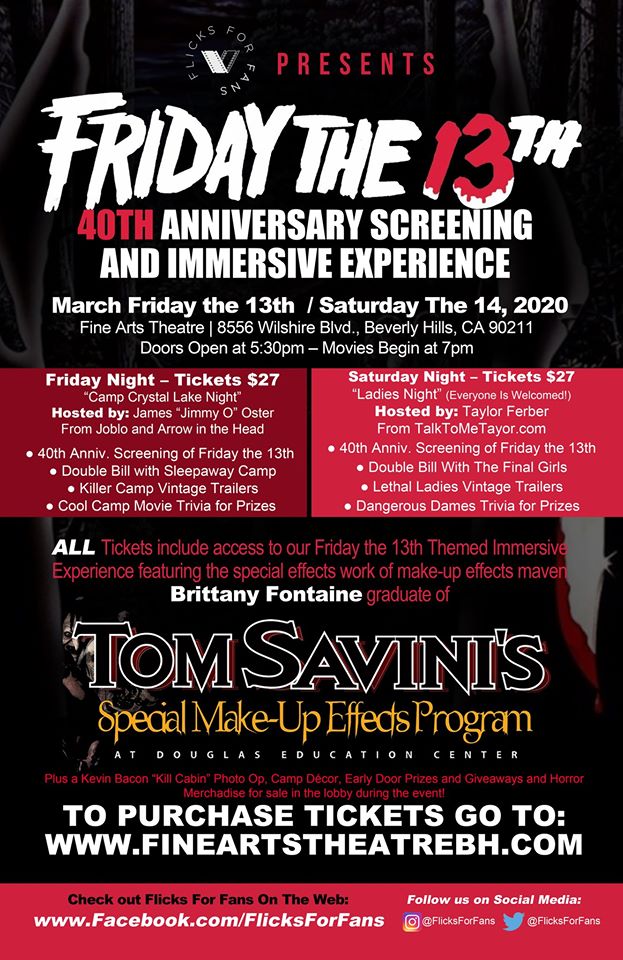
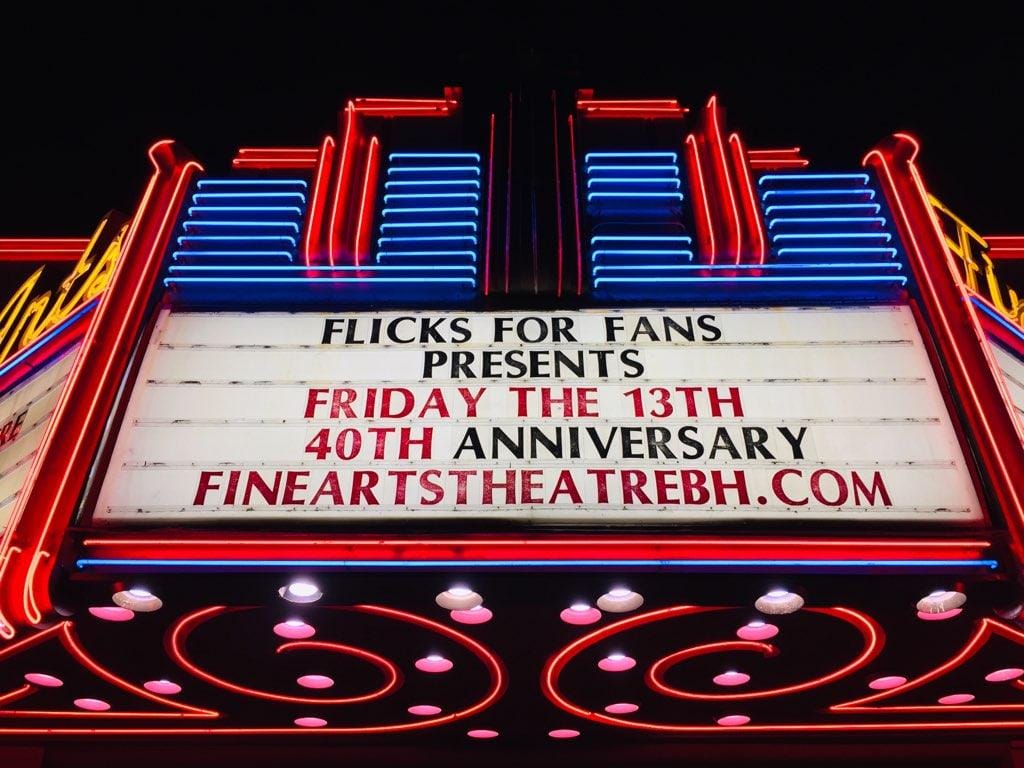
This epidemic, however, did not stop Flicks For Fans from screening “Friday the 13th” in honor of its 40th anniversary. That’s right folks, the horror classic which eventually gave birth to the hockey mask wearing icon known as Jason Voorhees has now reached its fourth decade and continues to thrill one generation of horror fans after another. The screening was held at the Fine Arts Theatre in Beverly Hills, California, and it played as a double feature with another slasher film, “Sleepaway Camp,” which has a twist ending M. Night Shyamalan would never have come up with on his own.
Hosting this momentous screening was James “Jimmy O” Oster, writer for JoBlo and Arrow in the Head, and he was shameless in admitting just how much he loves the “Friday the 13th” and its far bloodier sequels, and he thanked those of us who braved the pandemic to come here even as we are, as he put it, “facing Armageddon.” Those who did show up were careful to keep their distance from one another, but we were relieved to see the theater had an ample supply of Purell and toilet paper on hand.
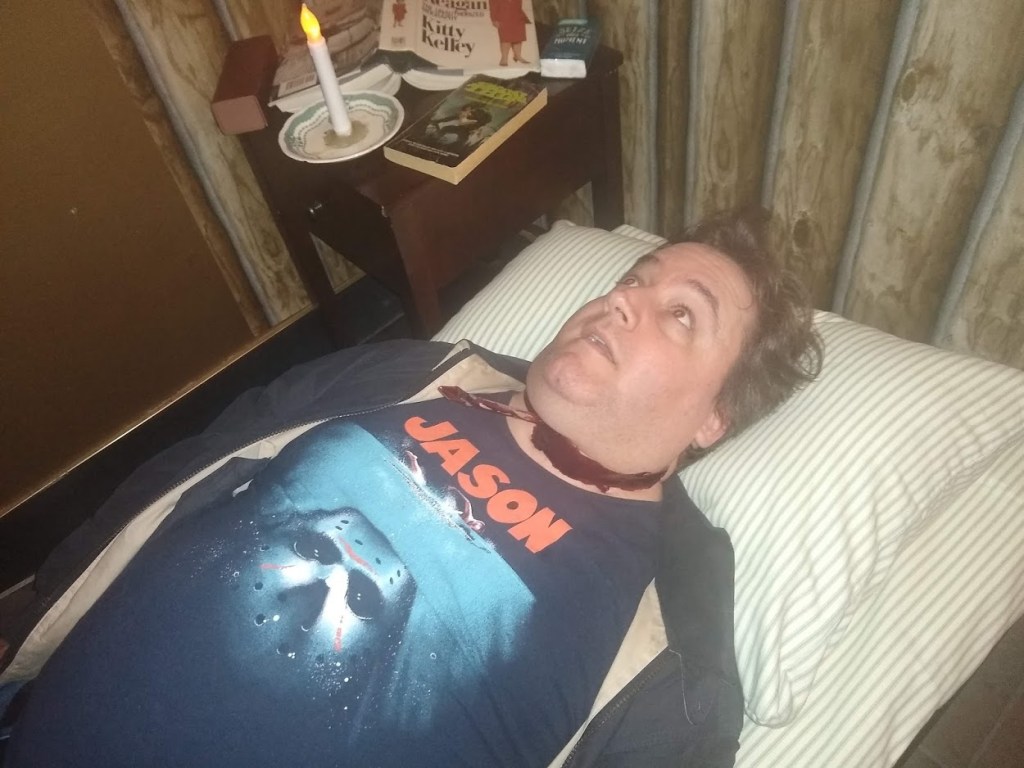
In addition, James and the Flick For Fans founder, Jason Coleman, took the time to make this cinematic experience all the more immersive. Fans got a chance to participate in the Kevin Bacon “Kill Cabin” photo op where you could get a picture taken while having a knife stick out of your throat. Both James and Jason did an excellent job of recreating the setting of Kevin’s infamous death scene to where it looked pretty much spot on. I did see, however, that they included a copy of Kitty Kelley’s “biography” on Nancy Reagan, and I am fairly certain this book was not featured in the 1980 film.
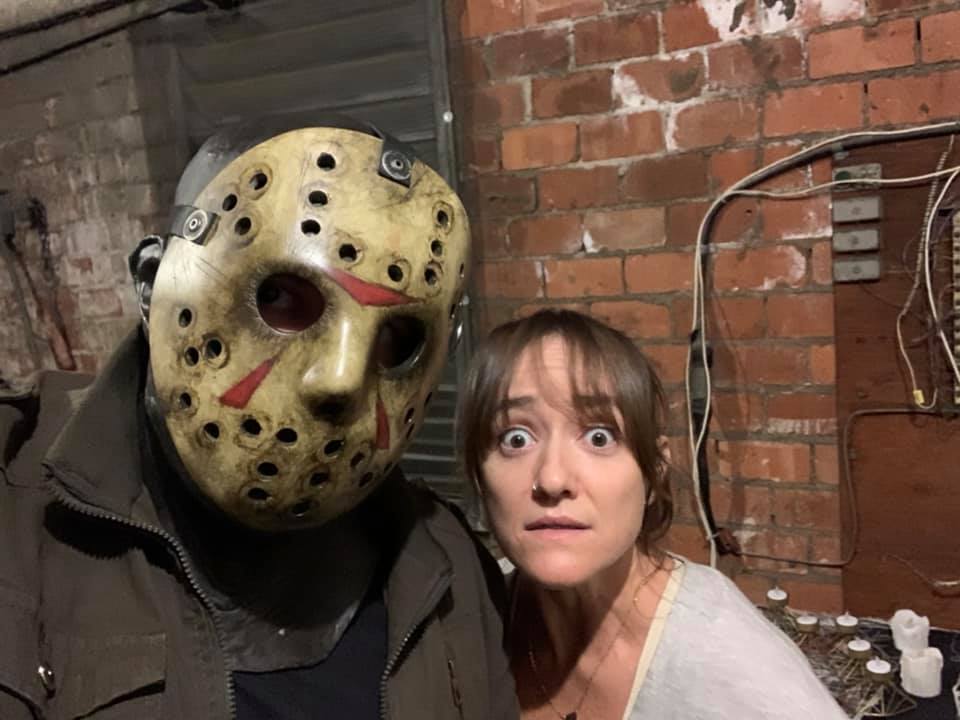
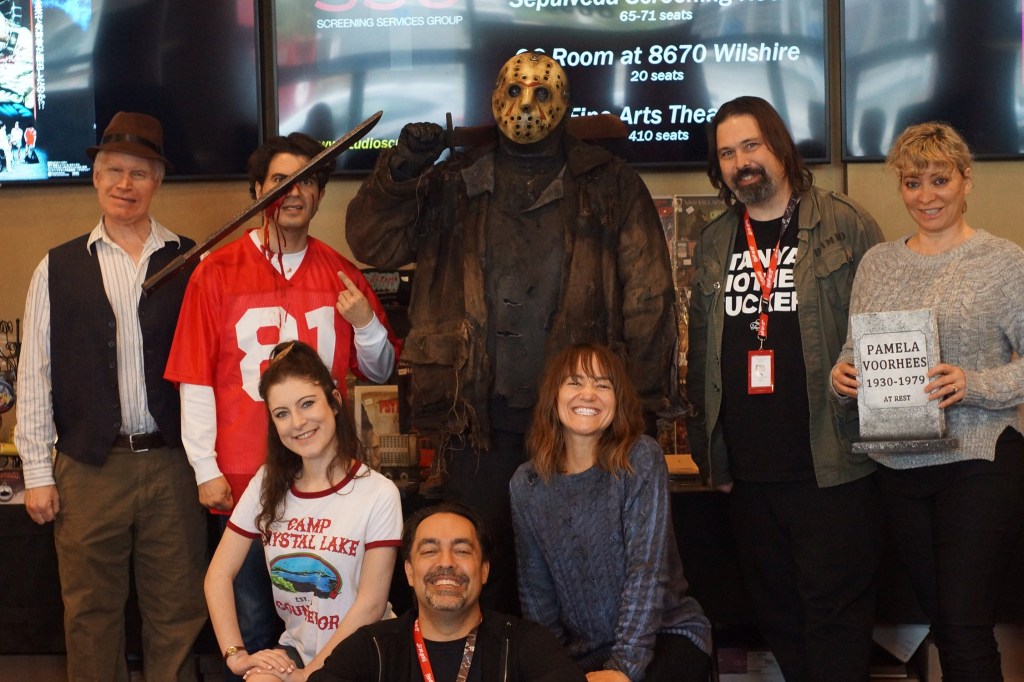
But the real “immersive experience” of this screening came as guests were brought to the back of the Fine Arts Theatre where actress Natasha Needles portrays a Crystal Lake camp counselor who takes audience members on an orientation for new counselors while trying to ease any concerns about the rumors we may have heard about “Camp Blood.” This orientation allows us to meet certain prophets of doom as well as a crazed parent who is a bit upset about her son drowning accidentally. There is also a wheelchair-bound man who has a machete painfully inserted into a certain part of his body. Judging from this man’s reaction to this unexpected injury, medical science has certainly come a long way since the 1980’s.
Special consideration should be given to Brittany Fontaine, a graduate of Tom Savini’s Special Make-Up Effects Program, for doing the special effects and make-up effects for the immersive experience.
“Friday the 13th” was preceded by a number of vintage trailers of 1980’s slasher flicks: “Don’t Go in the Woods,” “Madman” and “Just Before Dawn.” These are movies which feature young adults venturing into nature against their better judgment, making out with one another at the worst possible moment, and inviting death in ways which truly have them asking to be, at the very least, decapitated. And yes, they each have a prophet of doom warning others of a legend which must be taken seriously, but like scientists in the average disaster movie, their warnings are thoughtlessly ignored.
Also preceding the movie were some retro commercials featured as well. Suffice to say, laxative advertisements must have been far more lucrative 40 years ago.
But more importantly, this “Friday the 13th” screening was preceded by a video message from director Sean S. Cunningham which he made just for Flicks For Fans and this audience. In it, he thanked those in the audience for “braving the L.A. traffic” to be here (clearly this was made before Coronavirus became a global pandemic), and he paid tribute to all the actors who have played Jason over the years, among them Kane Hodder.
A big thank you to both James Oster and Jason Coleman and Flicks For Fans for putting this anniversary screening together and for making it all the more immersive. Furthermore, they deserve medals of honor for keeping it going even as we suffer through a global disease which will still be with us for some time. For some, it offered an opportunity to see “Friday the 13th” on the silver screen for the very first time, and the sound was jacked up to make all the screams more infinitely ear-piercing than ever before. A big thanks also goes out the employees of the Fine Art Theatre for all the Purell and toilet paper. It’s nice to know there was some place in Los Angeles which still had them.





 The Ultimate Rabbit