‘The Lone Ranger’ – Hi-yo Silver, What the Heck?
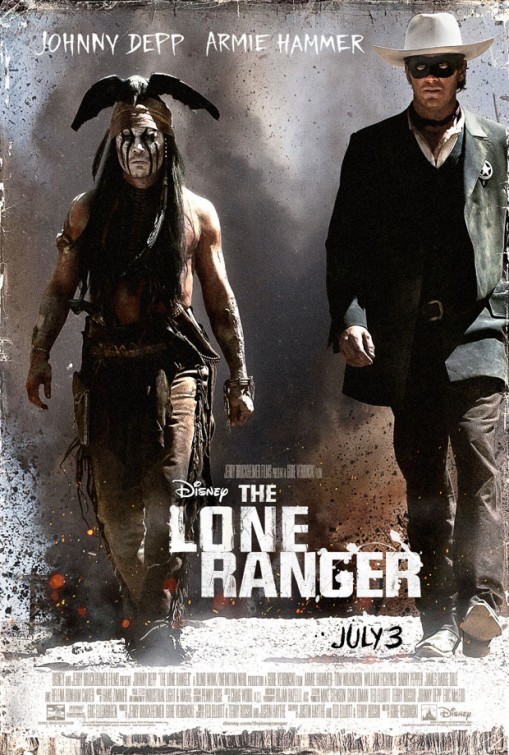
Like so many, I grew up watching “The Lone Ranger” on television and listening to the old-time radio show as well. John Reid, whether he was wearing a mask or not, was a paragon of justice, and seeing him and his faithful sidekick Tonto defeat the bad guys was always deeply satisfying. I was reminded of how much I liked this character while watching Gore Verbinski’s “The Lone Ranger” because I kept asking myself, who is this buffoon that has no business being around a horse during this movie?

Hollywood has had little luck in getting a respectful version of “The Lone Ranger” up on the silver screen, and this supposed 2013 summer blockbuster is the latest example. At two and a half hours, this film is a bloated mess which could have easily been shortened. It sticks its talented cast with a bland story, an uninteresting villain, and it can never seem to figure out if it wants to be a lighthearted adventure or a deadly serious film. Sadly, it is not until the last half hour when this “Lone Ranger” finally comes to life.

This “Lone Ranger” is yet another origin story about how this iconic character and Tonto first met and joined forces to bring justice to the American Old West. John Reid (Armie Hammer) is a lawyer and former Texas Ranger who joins up with his brother, Dan (James Badge Dale), to recapture the ruthless outlaw Butch Cavendish (William Fichtner) who has just escaped. In the process of tracking Butch down, John and Dan are ambushed by him and his law-breaking friends, and he mercilessly takes Dan’s life as well as another part of his body from him. John is assumed to be dead, but Tonto (Johnny Depp) finds his body and nurses him back to health so they can avenge Dan’s life and defeat Butch before he does more harm.

Look, I try to enjoy movies for what they are as opposed to what I want them to be, but I found myself wanting to see a much different version of “The Lone Ranger” because the iconic character is not given the respect he deserves here. I came out of this film feeling sorry for Hammer who is a very good actor and was terrific as the Winklevoss twins in “The Social Network,” but he is forced to portray John Reid as a buffoon and wimp who has no business trying to bring any bad guys to justice. Hammer has some funny moments, but the screenplay by Justin Haythe, Ted Elliott and Terry Rossio robs his character of many of the heroic qualities we love the Lone Ranger for having.

Come on, this is a movie about the Lone Ranger, so why not make it about the character we know him to be? Just like “The Green Hornet” which Seth Rogen and company really messed up, this is a film that blatantly forgets what makes its well-known characters so special. Regardless of the current controversies Hammer is currently enduring, his acting career has fared much better than Klinton Spilsbury’s did after he starred in ill-fated “The Legend of the Lone Ranger.”

As expected, Johnny Depp gets top billing even though he is playing the sidekick in this film because, well, he’s Johnny Depp. While he may be the best thing about “The Lone Ranger,” his performance is a bit problematic. Depp said he chose to play Tonto so he could right the wrongs of the past in terms of how Native Americans are portrayed in the media. While I really want to say he succeeded, I’m not sure he did. He is clearly having a lot of fun playing Tonto, but the character threatens to come off as a comical caricature than a believable Indian. I have no doubt that Depp has Native American blood in him, but it would have made much more sense to get a full-blooded Native American to play Tonto instead.

But in the midst of such comical mischief between the Lone Ranger and Tonto, we get to learn about Tonto’s backstory which involves tragedy and Native American genocide. It is at this point when the movie’s tone becomes completely erratic as it can’t seem to decide whether it wants to be funny or serious. While I would never dare to gloss over the damage we did to Native Americans, this grim history belongs in another movie and not this.

“The Lone Ranger” also starts off with another side story which has a young boy named Will (Mason Cook) visiting a San Francisco county fair where he runs into an elderly Tonto who proceeds to tell him about his adventures. The movie keeps coming back to these two time and time again, and this ends up slowing its already sluggish pace down to a grinding halt. These scenes could easily been cut out of the film because they really serve no good purpose and only make us wish this was much shorter.

William Fichtner remains one of the most dependable character actors working today, but he is unfortunately saddled with portraying a bore of a villain in Butch Cavendish. The character’s makeup basically spells out how this is one very bad dude who never visits the dentist, and it’s almost like Fichtner is letting the makeup do all the work. There’s really not much to this character other than he’s just another evil outlaw, and this gives Fichtner no real opportunities to make him the least bit interesting.

As for the other actors, Ruth Wilson gets to play Dan Reid’s obligatory love interest, Rebecca, and she is given little to do other than be in constant danger. Tom Wilkinson is a welcome presence as railroad tycoon Latham Cole, but it’s no surprise to see what his character ends up becoming. And while it is cool to see Barry Pepper as U.S. Calvary Officer Jay Fuller, his character is just another one of those clichéd corrupt military characters who is just asking to get beaten up. As for Helena Bonham Carter, she is wasted in a bit part as brothel madam Red Harrington. While I love seeing Carter pop up in one role after another, this movie does not deserve her.

Verbinski runs into many of the same problems which undid “Pirates of the Caribbean: At World’s End” as it goes on for far too long, contains characters we never fully care about, and it doesn’t take long for us to give up on trying to understand the plot. While he is indeed a talented filmmaker, and the first “Pirates of the Caribbean” movie really was fantastic entertainment, I thought after “At World’s End” he would rein things in more than he tried previously. That he did not accomplish this makes this cinematic experience all the more frustrating.  

Regardless, I have to admit that I loved the movie’s last half hour where Verbinski executes a number of brilliantly staged action sequences. Once the “William Tell Overture” music started blasting through the speakers, I found myself being immensely entertained. This was “The Lone Ranger” movie I wanted to see, the one where I was genuinely thrilled by this masked man’s crime fighting ways. This proved to be so much fun, but while this spectacle went on, I could not help but ask myself why the rest of this motion picture could not be this entertaining.

“The Lone Ranger” was not the worst movie of 2013, but it was still pretty close to being the biggest stinker of all. While it was not as boring as “The Great Gatsby” nor as abysmally bad as “The Hangover Part III,” this should have delivered far more bang for the buck. Westerns have taken a big hit over the years with poorly received duds like “Wild Wild West” and “Jonah Hex,” and this film is not going to help matters any. This was the first Lone Ranger movie in over 30 years, and now it looks like we’ll have to wait twice than long for the next one to be made.

Hi-Yo, Silver! Away from Hollywood!

* * out of * * * *

Exclusive Video Interview with Michele Ohayon About ‘Strip Down, Rise Up’

Pole dancing has long been associated with strip clubs, but it has since expanded from that realm to dance studios where it is taught as a form of aerobic exercise. Still, there is a strong stigma to this form of dancing as it most people refuse to see it as anything other than pornographic and debasing. But with the new documentary “Strip Down, Rise Up,” female instructors use pole dancing as a way to help women deal with traumas and body-image issues which have plagued people for far too long. Through sensual movement, the participants find themselves transforming to where they succeed in reclaiming their self-esteem and sexuality, and they find a power within themselves which can never be lost.

The director of “Strip Down, Rise Up” is Oscar-nominated filmmaker Michèle Ohayon, and her cameras capture a diverse group of women from various walks of life. Among them are Evelyn who has lost her husband and trying to deal with her grief, the successful businesswoman Patricia who is uncomfortable in her own skin, and the very brave Megan who was sexually abused and ended up testifying against her abuser. We also get to see instructors like Sheila Kelley, Amy Bond and Jenyne Butterfly whose methods differ from one another in fascinating ways.

Ohayon hails from North Africa, and she has said her films are largely about transformations. In addition to “Strip Down, Rise Up,” her work includes “Colors Straight Up” which is about at-risk youth in Los Angeles who turn their lives around through the performing arts, the hidden homeless women documentary “It Was a Wonderful Life” which had the privilege of being narrated by Jodie Foster, and the docu-comedy “Cowboy del Amor” about a cowboy who becomes a matchmaker. Her inspiration for “Strip Down, Rise Up” came about when she and her daughter attended a pole dancing class as a way to explore a new form of exercise.

I got to speak with Ohayon recently, and this marks my first ever video interview done via Zoom, so please bear with me as the video quality is a bit different from what we are all used to.

“Strip Down, Rise Up” debuts on Netflix on Friday, February 5, 2021. Please check out the interview above and be sure to check this documentary out when it drops.

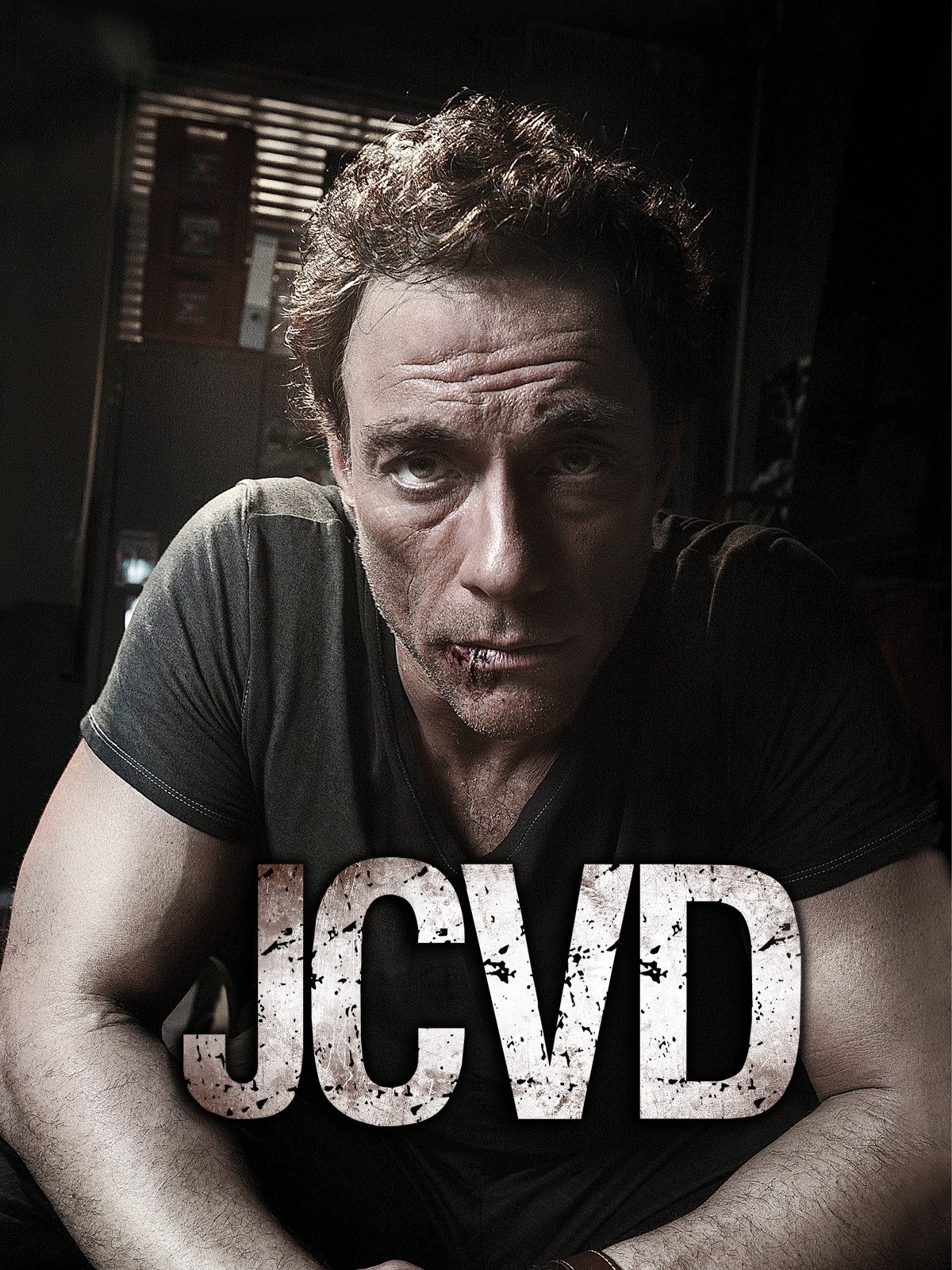
Underseen Movie: ‘JCVD’ – The Muscles From Brussels Lays Himself Bare

I have never really been a fan of Jean-Claude Van Damme. He has the moves, but he has never been much of an actor. I still vividly remember watching “Cyborg” with my brother and a friend of his on the family VCR years ago. My dad even watched it with us, and he could not stop bagging on Van Damme throughout the whole monstrosity which was made by those creative geniuses from Cannon Pictures. This is some of what he said:

“This is the single worst actor I have ever seen in my life! His face is completely immobile! He’s like Stonehenge!”

Oh, the memories! You’d figure after us seeing “Cyborg” that none of us would ever bother watching a Van Damme movie ever again, but he was everywhere for much of the late 80’s and early 90’s. “Bloodsport” was nothing extraordinary, but those fight scenes were pretty awesome.

“Death Warrant” was one I only saw because my best friend from high school wanted to check it out. It was alright, but this is probably being generous. I got a little pissed when that nerdy kid with glasses wanted to watch “Star Trek,” but the hot lady played by Cynthia Gibb did not want to bother. She would rather be screwing Van Damme’s character while he was taking a break from working undercover in a prison to catch a killer. Seriously, not all “Star Trek” fans are this geeky!

But following the commercial failure of “Universal Soldier: The Return,” Van Damme went from being a Hollywood star to being thrown into the hard to escape realm of straight to video movies, and he also went through drug problems and several divorces. I always wondered how people like him or Steven Seagal deal with going from big Hollywood action movies to direct to video crap which continues to define their careers to this day. I imagine they are not happy being in this movie star limbo. On one hand, they are still making a living, but at the same time I keep thinking they must miss where they were before Hollywood abandoned them in the wake of several box office disappointments.

“JCVD” is a fictionalized answer to this question, and is not your typical martial arts ass kicking epic. Van Damme plays himself, and we can what years of drugs, court battles, and many B movies, most of them lousy, have done to him and his face. As the movie opens, we see him arguing with the director of his latest movie, but the director is more interested in throwing darts at a postcard with the Hollywood sign on it then in listening to a man whose only distinction is getting John Woo to come to America and make “Hard Target.”

We see Van Damme at court fighting for custody of his daughter (played by Saskia Flanders), and his ex-wife’s attorney presents his movies as arguments against him as a person. They pile up so high to where he excuses himself to go to the bathroom while the titles are still being read off. His problems keep mounting as he can’t get cash out of the ATM, and his lawyer calls saying he still owes him money. Then his custody suit hits an impasse when his daughter says she doesn’t want to live with him because, whenever a movie of his is on television, she gets picked on by all the kids at school. Even worse, he just lost a film role to Seagal just because he offered to cut off his ponytail.

So, Van Damme heads back to Belgium to reconnect with his roots and where he came from (hence his nickname “The Muscles from Brussels”). He is still treated as a big star and a hero back home, and as a man who helped put the country and its people on the Hollywood map. But soon after, a hostage situation erupts at a nearby post office and, yes, all hell breaks loose. At first, it looks like he is robbing the post office, but events are seen from different perspectives, and it turns out he has arrived at the wrong place at the wrong time. This time, he can’t rely on his martial arts moves to get him out of this situation. Van Damme is not seen as an action hero here, but as a regular man who is caught up in a situation not of his making.

“JCVD” is presented as a comedy/drama hybrid, and while the tone is a bit uneven, there are some very funny moments. We see one of the robbers buddy up with Van Damme and talk to him about his movies, and he even gets him to show off one of his classic moves. While the other robbers couldn’t care less, this one wants his autograph. In the meantime, the townspeople have come out in force to support the fallen celebrity for what he is doing. In many ways, the movie is a look at the crazy nature of fame and a celebrity is forever trapped in a prison because of it.

The big question I had when I went out to see “JCVD” was this; has he gotten any better as an actor. Even Los Angeles Times film critic Sam Adams in his review of this movie said that “most of the acting in Van Damme’s films takes place below the neck.” Surprisingly, the answer is yes, he has. In fact, in “JCVD” he is really good playing a fictionalized version of himself. My dad’s description of him as “Stonehenge” does not apply to him here, and while he will never be Laurence Olivier or Sean Penn, this movie is a big step up for him creatively speaking.

The movie has one tremendous moment of pure raw emotion from Van Damme when he suddenly rises above the film set and starts talking directly to the audience. His monologue lasts for several minutes, and he talks about how he always wanted to be a movie star. All these years later, he feels as though he is being punished for it. Granted, he admits to his mistakes like taking drugs, and I felt like he is still paying a price for his usage even while he is staying clean. The star never fakes a moment during this scene, and the scene is alone worth the price of admission. Van Damme has said doing this movie was like therapy for him, and I have no doubt about that.

The concept of “JCVD” is by no means original. We have seen many movie stars play themselves and have jokes played at their own expense to show they have a healthy sense of humor about their image. But while we have them take this route like John Malkovich did in “Being John Malkovich,” I can’t think of any others who have put themselves on the line like this. I can’t see Chuck Norris doing this as I am certain he would rather do an action movie where Mike Huckabee is President and he has to rescue him from being held hostage by pro-evolution terrorists.

If there was one big problem I had with “JCVD,” it’s that its subtitles were at times almost impossible to read. The movie, directed by Mabrouk El Mechri, is shot in a grungy style which is very close to black and white but not quite. As a result, the subtitles which are presented in white lettering almost blend completely into the background, and I had to keep leaning forward to better see what was being said. Considering how many of my friends hate subtitles and would rather watch movies dubbed in English, this certainly does not help.

You really have to give Van Damme a lot of credit here. Not many action stars would even risk being seen like he is shown in “JCVD.” Here, he lays himself bare to show us the man he has become through many mistakes and bad movies. I came out of it with a renewed respect for him, and it makes me want to see him get better. “JCVD” is not a great movie, but it is fun and kept me enthralled throughout its running time. Where he goes from here remains to be seen, but hopefully some good will come out of his performance here.

* * * out of * * * *

Jason Reitman Talks With Luke Wilson About ‘Bottle Rocket’

WRITER’S NOTE: This article was written back in 2011.

Jason Reitman completed his guest programming at New Beverly Cinema with a screening of Wes Anderson’s directorial debut, “Bottle Rocket.” This film also marked the movie debuts of Luke and Owen Wilson, the latter who co-wrote the screenplay with Anderson. Before seeing this movie, Reitman admitted he was actually scared of becoming a filmmaker especially because he was the son of a famous one (Ivan Reitman). He did see all the great movies of the 1990’s like “Clerks,” “Slacker,” and he checked out all of Quentin Tarantino’s movies, but he said none of them had the same effect on him as “Bottle Rocket” did. For Reitman, this was the movie which made him want to direct films. And of discovering Anderson, he said, “This is the voice that I am going to follow forever.”

Joining Reitman for this special screening was actor Luke Wilson, and it was nice to see him take a break from all those AT&T Wireless commercials he has been doing endlessly. Ironically, the movie Reitman showed the same evening before it was “Breaking Away,” and Wilson said he is actually good friends with one of that movie’s stars, Dennis Quaid. Quaid was away in Hawaii so he was unable to attend the screening with fellow co-stars Dennis Christopher and Daniel Stern. This coincidence did, however, allow Wilson to talk about how Randy Quaid told Dennis he already made the family name and suggested he change his. Dennis ended up asking his brother, “How about McQuaid?”

Anyway, Luke told the audience Wes and Owen originally wanted to shoot “Bottle Rocket” guerilla style so they could shoot it cheaply as Richard Linklater had done the same thing with “Slacker.” However, they ended up meeting a producer who told them about the Sundance Film Festival and advised them to start off by making a short film they could take there. So they made the short and got it entered into Sundance, but nothing happened and they didn’t win anything for it. Despite that, they managed luckily to get hooked up with a producer named Polly Platt who had worked on such movies as “The Last Picture Show” and “Terms of Endearment” among others.

The project went on from there as Platt brought the Wilson brothers and Anderson to the attention of famed writer/producer/director James L. Brooks. Anderson ended up getting everyone to do a read thru of the script at some office in Texas during the summer. Turns out the air conditioning there wasn’t working all that well, and they were reading a screenplay which was two hundred pages long. Luke said he ended up sweating profusely throughout the whole read, and this made Owen glare at him as if to say, what the hell are you doing?

Luke also took some time to talk about Brooks who became one of the chief supporters of “Bottle Rocket,” and he described him as being very nice. However, he also said Brooks can immediately “cut to the truth and be painfully funny.” Of course, Brooks was going through problems of his own. While working on “Bottle Rocket,” he was also busy with his film musical “I’ll Do Anything” with Nick Nolte. For those who remember, it ended up getting released without any of the music as the movie tested poorly (and that’s being polite).

Reitman went on to talk about how he related to the voice of the film and how it had a “strange innocence” to it. Luke replied the film’s voice came from Anderson and Owen, but he said he never got the feeling he was working on anything special. Columbia Pictures, which distributed the movie, wanted to make “Bottle Rocket” but with different actors. When it was all shot and in the can, the studio didn’t like or knew what to make of it. Looking back, Luke said bluntly he was “stunned that the movie got made.”

When it finally came to making “Bottle Rocket” as a feature length film, Luke remarked Wes knew exactly how movies were made. He and Owen, on the other hand, did not. They didn’t understand certain jobs the crew on set had like the boom mike guy. Luke said he and Owen wondered out loud, “How can that guy just stand around like that?”

Also, Anderson did not want the actors to watch dallies of the day’s work, but this didn’t matter much because neither Owen nor Luke wanted to watch them anyway. Luke says he still doesn’t understand what compels actors to watch dallies as he feels it will likely mess you up in terms of how you go about developing your character.

The cast and crew also had the fortune of working with James Caan who had a bit role in “Bottle Rocket,” and Luke recalled he was going through a rough patch at the time, but that he did warm up to the rest of the cast during shooting. At one point Luke, Owen and Wes asked Caan what it was like working with the late Marlon Brando on “The Godfather.” To this Caan replied, “It’s like you guys working with me.”

“Bottle Rocket” did go through the rather unnecessary realm of test screenings. For a movie like this, it must have felt like a waste of time because this is not one which just sells itself to mainstream audiences, but the studio executives decreed that Anderson screen the movie for focus groups nonetheless. So, there was a test screening done in Santa Monica, and out of a crowd of 250 people, 75 walked out. The ones who stayed through the whole thing, as Luke remembered it, wrote nothing but shit about the movie. To date, it remains the one movie with the worst test screenings in the history of Columbia Pictures. Luke said he, Owen and Anderson were convinced they would never get to make another movie ever again.

Despite all that, “Bottle Rocket” did get discovered by audiences through cable, video and DVD. Luke says he still sees it on cable every once in a while, and Reitman remarked it became the “touchstone for those who want to make movies.” Martin Scorsese ended up naming it as one of the best movies of the 1990’s. Still, everyone involved with this little film had a hard time getting over it feeling like a failure. But when these guys got around to making the brilliant “Rushmore,” they found themselves re-energized and have since gone on to make one great movie after another.

Jason Reitman Talks With Dennis Christopher and Daniel Stern about ‘Breaking Away’

WRITER’S NOTE: This screening took place back in 2011.

Jason Reitman described the last double feature he presented as part of his guest programming at New Beverly Cinema by saying, “Whereas the last few movies I chose were sad in some respects, these two just make you feel good.” After dealing with the downfalls and missed opportunities which were major parts of “Shampoo” and “Boogie Nights,” he finished off his slate of favorites with “Breaking Away” and “Bottle Rocket.”

The first movie shown was “Breaking Away” which was directed by Peter Yates, the same man who made the Steve McQueen classic “Bullitt.” For years it has been considered one of the best sports movies ever made, and it’s also a movie where several young actors got their start together like in “Taps” or “Fast Times at Ridgemont High.” Among those actors were Dennis Quaid, Dennis Christopher and Daniel Stern. We even got to see a teenage Jackie Earle Haley in it, and he has since gone from career oblivion to critical acclaim for his performances in “Little Children” and “Watchmen.”

Reitman asked how many people in the audience were seeing this film for the first time, and many hands, including mine, immediately went up. To this he replied, “I am so jealous!”

On “Breaking Away,” Reitman described it as a movie you associate with watching with your father, and one which captures the lives of twenty somethings very well in the indecisions of where to go from high school; unsure of what to do with the rest of their lives. It’s also a great story about class wars in society; of those who have everything and those who never have enough. Upon looking for trivia about “Breaking Away,” Reitman found the film was originally two screenplays. One was called “The Cutters” which became the name of the people from the working-class environment, and the other one was about the bike race the characters train for.

Joining Reitman for this screening were Dennis Christopher who played the endlessly obsessive bike rider Dave Stoller, and Daniel Stern who played Cyril. Reitman usually had his guests hidden from sight before introducing them, but they were already in the theater giving autographs and posing for pictures which got posted on Facebook. Both Quaid and Stern also said they were so envious of those who were seeing this for the first time.

Reitman started off by asking them if they knew they were working on something very special. Stern was the first to reply:

“That was my first movie,” Stern said. “I had never been in a movie before, and so I thought they were all like that. There is a wonderful simplicity to the movie, to the script, to the way the movie was made and the way it comes across. It does have a lot of depth to it too. I look back at it thinking, that was just an incredibly unique experience. I didn’t know what I was doing, I didn’t know where the camera was, and I didn’t know anything about that!”

Christopher, on the other hand, had worked in movies before with acclaimed directors like Robert Altman and Federico Fellini, so he knew a bit about being on big sets. The experience of making “Breaking Away” proved to be a bit different though.

“The thing that really made it special was because after that horrible first day of being a big Italian impersonator, because they made me all dark and I had my hair slicked back, black shirt, a tight waistline, etc. He was supposed to look like a ‘Saturday Night Fever’ guy,” Christopher said. “He (Yates) wanted him to be that kind of Italian. And I thought, why the fuck did they hire me? I looked like Lily Tomlin would when dressed up like men! That’s exactly what I looked like! I was waiting for them to glue hair on my chest!”

“I was so shaken, and the next day I came onto the set and I just burst into tears,” Christopher continued. “I told Peter that I just can’t do this and he said I KNOW, I KNOW! And we had a big talk with Steven (Tisch, who won an Oscar for his screenplay) and Peter, and then the character evolved; the way he looked and the way he was. So for me that was the special thing of collaborating with a director who cared about what you thought. So, for me I thought whoa, this is amazing!”

Reitman then spoke for those who had this on their minds after Christopher spoke:

“So what you’re saying is that Robert Altman really doesn’t care…”

This got a big laugh from the audience.

After making all the changes with Christopher’s character and making it more like him, they reshot everything and had to wait three weeks to see how it all looked. For those who have seen this movie, you have to agree this was one of the smartest choices Yates made. If Christopher was forced to do an Italian impersonation, it probably would have wrecked the movie.

Reitman also asked Christopher and Stern what kind of bike riding they did before production began. Christopher replied he did the “regular kind” and was never involved in any bike competitions like his character. Stern, on the other hand, said he was not a bike rider which turned out to be perfect for his character.

This led Stern to tell everyone he didn’t even audition for “Breaking Away.” He came into the office to read for Yates, and he was on a phone call nearby and saw him. Once he got off the phone, Yates handed Stern a script and was asked to be on set in a short time.

Unlike a lot of the big productions he had previously been involved in, Christopher said this film was almost completely the opposite of them. They had a very small crew working on it, and there was no overabundance of trailers parked on every street corner.

Barbara Barrie played Dave Stoller’s mother, Evelyn, and she got nominated for an Academy Award for Best Supporting Actress. However, it turns out she was a little peeved when she read the script and found there was no big scene for her. Christopher even recalled her telling Yates quite loudly, “WHERE IS MY BIG SCENE?!” So Barrie, Tisch and Yates worked together and did an improvisation which led to that wonderful moment where Evelyn talks about getting her passport and how she always keeps it handy.

People did not expect much from “Breaking Away” while it was being made, but it turned out to be a surprising success which won many awards, and it even spawned a prequel television series in which Haley and Barrie reprised their roles for. Of course, like many movies adapted to television, it lasted only one season. Stern called it “the little engine that could kind of movie,” and he even came to this screening wearing his white “Cutters” t-shirt. Christopher said this and “My Bodyguard” were the first movies for kids which were taken seriously by adults, and he and Stern said people’s overall reaction to it today is still quite powerful.

Christopher also told the audience about when he took his dad, whom he was estranged from at the time, to see “Breaking Away” when it was first released. After it was over, he said his dad came out of it “ruined” and looked quite frail. His dad could not believe how great the movie was, and when people outside the theater asked Christopher for his autograph, he got in line with the others. His dad even acted as his security chief in getting people in the line to move along.

The Q&A ended with both actors asking Reitman, “Is this a good print of the movie we’re showing tonight?”

“We’ll see,”Reitman replied.

Reitman said he had previously seen “Breaking Away” on VHS and laserdisc but seeing it with an audience was something else. The nearly sold-out crowd at New Beverly Cinema really got into the proceedings and cheered loudly throughout. You came out of the theater agreeing with Reitman that “Breaking Away” was as good as reputation has long since suggested.

Underseen Movie: ‘Killer Joe’ – The WTF Movie of 2011

WARNING: DO NOT EAT FRIED CHICKEN BEFORE OR WHILE WATCHING THIS MOVIE.

William Friedkin’s “Killer Joe” got my vote for the WTF movie of 2012. It wallows in the sheer depravity of its deliberately idiotic characters without apology, and it is one of the most darkly hilarious movies I have seen in some time. Seriously, I would put this film on a par with “Bad Lieutenant: Port of Call New Orleans” and “Observe and Report” as they are equally fearless in the places they dare to take us. “Killer Joe” also marks the second collaboration between Friedkin and playwright Tracy Letts whose play “Bug” Friedkin previously adapted into a motion picture. With this film, neither is out to show the audience any mercy as they challenge them in a way most filmmakers don’t bother to these days, and it wears its NC-17 rating with pride.

The movie takes place in Texas and features some of the dumbest or, to be polite, the most dimwitted characters on the face of the earth. Chris Smith (Emile Hirsch) is a drug dealer who is in debt to his suppliers by several thousand dollars, and his solution is to have someone murder his mother as she has a $50,000 insurance policy. His father, Ansel (Thomas Haden Church), shows only the slightest moral opposition to this plan as he divorced Chris’ mother a long time ago and has since gotten married to the conniving Sharla (Gina Gershon), and Chris already has one person in mind to carry out this cold-hearted assassination.

That person is Joe Copper (Matthew McConaughey), a police detective who works as a hired killer on the side. Now Joe demands an upfront payment of $25,000 for his services, but Chris and Ansel can only pay him after receiving the insurance payout. As a result, Joe ends up taking a retainer to make up for that: Ansel’s daughter and Chris’ sister, Dottie (Juno Temple). As with all crimes based on greed, all the careful preparation cannot keep these characters from falling into the nasty realm of disaster. But long before the movie’s end, you will agree they have all earned the fate they ever so thoughtlessly brought on themselves.

If this seems like an unusual movie for Oscar winning director Friedkin to make, it shouldn’t. Friedkin’s movies in general, with the exception of “The Exorcist,” have never contained characters easily deserving of redemption. “Killer Joe” will be seen by many as a bold motion picture of his, but his movies show he has never passed judgment on any of the characters inhabiting his movies. He is also a brilliant filmmaker as he surrounds himself with a cast of actors who don’t easily judge their characters either.

McConaughey has been on a roll ever since he gave up making those dopey romantic comedies for movies like “The Lincoln Lawyer” and “Dallas Buyers Club.” With “Killer Joe,” he ends up giving one of the bravest and boldest performances of his career as Joe Copper is as immoral as characters can get. We never learn why he decided to get into this line of work while being employed as an officer of the law, but it doesn’t matter. McConaughey gives us a mesmerizing portrait of a character who is more than aware of how evil he is, and he is not about to apologize for it.

The other actors like Emile Hirsch and Thomas Haden Church deserve a lot of credit as they portray the dimwitted characters perfectly without ever just playing it for laughs. They play each character as being serious in what they say and do, and this makes us laugh uncontrollably at certain moments because we almost won’t believe how badly they screw things up. They also invest their characters with a history which shows on their faces and doesn’t need to be spelled out for the audience.

A special badge of courage, however, needs to go to Gina Gershon who plays Sharla as “Killer Joe” shows just how deep into a role she is willing to go. Her character thinks nothing of opening the front door without wearing anything from the waist down, and this is not to mention what McConaughey ends up making her do with a piece of fried chicken. Even as Sharla wears too much makeup to where her mascara runs down her face, making her look like the Joker from “The Dark Knight,” Gershon gives a truly fearless performance as someone who thinks she’s better than the people around her. But of course, Sharla finds out in the worst way possible that she is not.

The one person who really caught my eye though was Juno Temple who portrays the youngest child of the Smith family, Dottie. You may remember Temple as Selina Kyle’s street-smart friend from “The Dark Knight Rises,” and she makes Dottie a fascinating enigma. Her character is at times willfully innocent, seemingly naïve, but she actually becomes the only member of this trailer park family with anything resembling intelligence. Temple is utterly beguiling in “Killer Joe,” and I look forward to seeing more of her in the future.

“Killer Joe” was already earning infamy before its release with the MPAA giving it the dreaded NC-17. Did it earn this rating? Well, yes and no; this is certainly no movie to take your kids or impressionable teenagers to see. Then again, if “Killer Joe” were released by a major movie studio, it would have somehow gotten an R despite its content. Whatever you think this movie deserves the NC-17 rating or not, the hypocrisy of the MPAA remains maddening and never ending.

Friedkin has been leaving in the shadow of his most famous work for years as if no one would ever let him get past “The Exorcist,” “The French Connection” or even “Sorcerer” which is now being seen as the masterpiece it always was. The truth however is he has not lost his talent in setting up scenes which contain tremendous suspenseful impact. This is especially the case whenever McConaughey is onscreen because when he appears you know things are going to get really bad. Friedkin also is well served by his collaborators such as cinematographer Caleb Deschanel who finds a twisted beauty in such utter depravity, and composer Tyler Bates gives the most suspenseful and horrifying moments a strong atmospheric quality which makes the story all the more claustrophobic.

It’s hard to say where exactly “Killer Joe” ranks on William Friedkin’s long resume of work, but it is safe to say it is far more accomplished than his other works like “Deal of the Century,” “The Guardian” and “Jade.” With this film he gives willing audience members an experience they will not easily forget, and he directs Matthew McConaughey to one of the best and most explosive performances of his career. Those in the mood for the most disturbing of black comedies should not pass up “Killer Joe.” Just remember, it may be a while before you find yourself eating fried chicken again after you watch it.

* * * ½ out of * * * *

Dave Bautista on Playing Brass Body in ‘The Man with the Iron Fists’

WRITER’S NOTE: This interview took place back in 2012.

David Bautista has made a big name for himself during his time in World Wrestling Entertainment where he became a six-time world champion. Like many major athletes, he has since turned his attention to acting, and he gets one of his biggest roles in RZA’s “The Man with the Iron Fists” in which he plays Brass Body, one of the main antagonists and a mercenary who can turn his body into metal. This makes him almost completely invulnerable; much like Bautista seemed like whenever he was in the ring.

While at a press conference for “The Man with the Iron Fists” which took place at the House of Blues in Los Angeles, Bautista talked about what it was like making the movie. Co-starring alongside him was Cung Le who plays Bronze Lion and was also at one point a major kickboxing champion. Bautista was asked what it was like working with Le and if he had ever fought with him “in the cage.”

Dave Bautista: I never fought with him, but we actually trained a lot together in China (where the movie was made). I wish we had some scenes together. I’m determined in my life to do a movie with Cung Le just so I can get that fight scene with him just because he’s so dynamic and so intense. So, we never fought together but I picked up a lot of good things from him.

Bautista said he accepted the role of Brass Body without even reading the script and that the character originally only had one or two lines as it was more of a physical role. This soon changed once he was cast. The biggest challenge for him, however, was filming the fight scene between Brass Body and Blacksmith who is played by star and director RZA.

Dave Bautista: The fight scene itself took days and days and it was just a pain in the ass. It was cold, it was brutal, and RZA had those damn iron fists on and they were just killing my arms because he was hitting me. I had scratches and I was bleeding. We actually started the fight scene a few days after I arrived in China, and then we had to go back to it at the end and finish it because it was so drawn out. The two characters (the Blacksmith and Brass Body) were so strong and kind of invincible that we really didn’t know where to go with the fight scene. We really went without a plan and thought we could wing it and ad-lib and come up with stuff here and there, so that was really a challenge in itself.

One of Brass Body’s other big scenes comes when he viciously attacks one of the female characters, and Bautista said shooting it was “awkward.” He described himself as a “passive” person especially when it comes to women, and since this was essentially a “rape and murder scene,” it became very uncomfortable for him to do.

Dave Bautista: I kept coming out of character because my first instinct was to tell the actress, are you okay? But she actually made it a lot of fun for me because I had this little thong on and I was freezing because the set wasn’t heated. Even when I picked her up, I didn’t know where to touch her, so I picked her up and threw her over my shoulder and I’m trying not to grope her because I don’t want to make her uncomfortable. Then RZA stepped in and said ‘you gotta make it look more real. Grab her over her ass because it’ll help her out because it will cover some of her stuff up.

The actress Bautista was working with thanked him for doing her that favor.

In addition to wrestling, Bautista is also a skilled mixed martial arts fighter. The first martial art he learned was Kali which comes from the Philippines and emphasizes weapons-based fighting with sticks, knives and other weapons. When asked if he tried to influence his fighting style in this movie, Bautista replied he did to a certain extent but that it only went so far.

Dave Bautista: The stuff that we were doing just didn’t translate as well as we thought it would on film, so we had to switch it up a lot and bring Corey Yuen (the movie’s fight choreographer) in to help us through this. We wanted this to look like a traditional kung fu fight movie especially with the characters being so strong, but I did utilize a little bit of my Kali.

Those who have seen “The Man with the Iron Fists” can agree Bautista is perfectly cast as Brass Body as he truly comes off as a badass who cannot easily be defeated. When asked if he shares any similarities to his character and if he could offer advice to those of us who are not as athletically inclined as he is, Bautista’s response was actually quite surprising.

Dave Bautista: I never felt like I was invincible. Throughout my whole life I always felt like I was an underdog. It’s kind of hard to relate to a kung fu action hero. I was trying to stay in character to where he (Brass Body) would always feel invincible and how he would react when he realized he wasn’t invincible and started to break down. I tried to get that in my head and I tried to make it come out on film, but not being the best actor made it kind of a challenge for me. I wouldn’t be the best person to give advice on how to be invincible because I’ve never felt that way. Everything’s a challenge for me, but I’m a hard worker.

Before he concluded his time with us, Bautista was asked what his dream role is.

Dave Bautista: I hate to sound cliché but I’ve always wanted to do a vampire movie. Any kind of superhero stuff, that’s what I’m a fan of. I wouldn’t mind doing that, I just don’t see myself as a leading man type character. I like the drama; I just don’t know if I fit that type of role. But that’s the kind of stuff I like to watch though.

John Carpenter’s ‘The Ward’ – His First Film in a Decade, and Maybe His Last

Master John Carpenter described “The Ward,” his first feature length movie in ten years, best through a video message at the Toronto International Film Festival:

“’The Ward’ is an old school horror movie made by an old school director.”

It’s good to know this going in as Carpenter is not trying to reinvent the wheel or outdo all other horror releases out now. The plot of “The Ward” is as old fashioned as they come, and it allows Mr. Carpenter to exercise the skills he has perfected for many years. It’s not on a par with “The Thing” or “Halloween,” but in the end I didn’t care. For me it was an absorbing movie which kept me entertained throughout its running time, and it was far more entertaining than those summer blockbusters duds “Green Lantern” or “Bad Teacher.”

“The Ward” stars Amber Heard as Kristen, a young woman whom we first see her indulging in a little pyromania, and not the kind Def Leppard made an album about. The police pick Kristen up after she burns down an abandoned farmhouse, and she gets sent straight to the ward of the movie’s title. Her fellow patients are not necessarily the “Girl, Interrupted” type, and Angelina Jolie is nowhere to be found. The intentions of Dr. Stringer (Jared Harris) appear ambiguous at best, and dealing with the chief orderly and Nurse Lundt, both who are deadly serious, is no picnic.

Actually, let me segue here for a moment; Nurse Lundt’s name seems to rhyme with a certain derogatory word. Which one you say? Well… You can just figure that out on your own. I wonder if this was intentional on the part of screenwriters Michael and Shawn Rasmussen, or perhaps it is just the name of someone they knew from way back. Well, whatever the case, Lundt certainly gives Nurse Ratched a run for her money in the seriously mean category, but her voice is not as lovely as Louise Fletcher’s was.

Now this being a psychiatric ward, it is mandatory that a ghost is roaming the halls. Kristen first sees it while taking a shower and, of course, everyone says she’s a nut which is redundant considering she’s staying in a mental institution. Then again, the patients may know more about what’s going on than they initially admit. I hate to think they’ve spent all their time there without seeing at least one ghost, you know? Anyway, patients start to disappear one by one, and Kristen aims to find out what happened to them on top of escaping the ward before it claims her as its next victim.

Now whatever you think of Carpenter’s directorial skills these days, his efforts in generating suspense are still strong. Carpenter is smart to not reveal all the important plot details right away, and he holds you within his grasp throughout as he leaves you guessing or imagining what’s really going on. Even if you see the ending coming from a mile away, the journey to it was an entertaining one for me.

I was skimming through another review of “The Ward” online which said Heard was as believable a mental patient as Charlize Theron was a mine worker in “North Country.” Now what is that supposed to mean? That she’s too good looking to be in a psychiatric ward? Give me a break! Heard does good work here portraying a strong-willed protagonist you want to root for. She’s engaging and believable, and while others may see her as being miscast, I did not. By the way, I thought Theron was great in “North Country” and I utterly accepted her as a mine worker. And in case that one reviewer didn’t notice, both actresses were in “North Country” and played different versions of the same character.

Lyndsy Fonseca is very good as Iris, the first girl to befriend Kristen. She appears to be the most emotionally balanced of the patients, and Fonseca makes her character’s awareness all the more convincing. Mamie Gummer gives a good performance as Emily, and she gives Emily a complexity she might otherwise not have had. Danielle Panabaker makes her character Sarah the epitome of Carly Simon’s classic tune “You’re So Vain,” and she’s a kick to watch. And Laura Leigh rounds out this strong group of actresses by making Zoey a convincingly traumatized person whose escape from reality consists of her acting like a little girl.

In terms of horror, Carpenter still makes effective use of cheap scares. While they have been used to death by dozens of filmmakers, he always makes them count. This is especially the case with “The Ward’s” final scene which truly took me by surprise. I should warn you though that the movie has one of those pull out the rug from under you kind of endings which I am really sick of. However, Carpenter doesn’t telegraph the ending to us like others typically do, so I’m willing to let it pass this time.

If there’s anything missing from “The Ward,” it’s Carpenter’s music which I am a big fan of, and his unique sounds were missed. Not that I want to knock Mark Kilian’s work here as he gives the film an appropriately atmospheric score which works very well, and it does have a bit of that Carpenter sound to it. Still, I yearn for a new score from Carpenter or even his son Cody who did amazing work on “Masters of Horror.”

Am I being too forgiving to “The Ward?” Perhaps. I’ve always been a big admirer of Carpenter’s work, and I even have good things to say about “Ghosts of Mars.” Many have expressed their big disappointment with “The Ward” as they want it to be on a par with “Halloween” and “The Thing.” Others found it not gory enough, but then again Carpenter’s strongest films don’t always rely on it like the “Saw” movies do. Personally, I don’t want to spend time comparing “The Ward” to his best movies because to do so would just be asking us to hate it before the opening credits even begin. You can only let an artist remain in the shadow of their past work for so long until you realize your spoiling the experience for yourself.

With “The Ward,” Carpenter was looking for a movie with a tight schedule and a limited location which didn’t require him to stay for a long time or get completely exhausted after shooting only half of it. With the limited resources he had, he made “The Ward” worth watching, and I got very involved in the plights of the characters. There’s nothing original on display here, and it may very well remind you of a gazillion other movies like it, but I’m glad the master finally directed a feature film again after so long. I just hope we don’t have to wait another ten years for Carpenter’s next film. And if there’s anyway Kurt Russell can star in it, you can sure bet I will be watching it on opening day!

* * * out of * * * *

John Carpenter on ‘The Ward’ and the State of Movies

WRITER’S NOTE: This article was originally written in 2011.

In July, America will finally get to see John Carpenter’s first feature length film in 10 years, “The Ward.” After the critical and commercial disappointment that was “Ghosts of Mars,” Carpenter seemed determined to retire from filmmaking as he felt it was no longer fun for him. But after working on a couple of “Masters of Horror” episodes, he seemed rejuvenated and ready to take on another film of his choosing. While appearing at the Egyptian Theatre in Hollywood for a 25th anniversary screening of “Big Trouble in Little China,” Carpenter talked about the upcoming movie, and what he thinks about the state of movies today.

The famed director described “The Ward” as an “old school horror film” and a “psychological thriller.” It stars Amber Heard as Kristen, a young woman who is institutionalized in a psychiatric ward which turns out to be haunted by a ghost as mysterious as it is deadly. Carpenter said he was attracted to the project because it had a low budget which would give him creative control, limited locations, and a short schedule which he especially liked. With the schedule being short, Carpenter knew he could finish the film before any form of exhaustion did him in.

“The Ward” first premiered at the Toronto International Film Festival and has since opened in the United Kingdom. Word of mouth indicates the movie has received mixed reviews thus far, but his fans are thrilled he went back behind the camera once again. Carpenter feels that “The Ward,” in his own estimation, is “pretty good” and found some fanboys liked it while others felt it was not “gruesome enough.”

Audience members asked Carpenter’s opinion on the state of movies today which is swamped with endless remakes and a frightening lack of originality. He openly described most films which are out now as being “still bad,” said some were fair, and others were “really good.” In his view, the movie industry has not changed. The present cycle of movies will pass, he said, and he is looking to a “more positive future” and encouraged the audience to do the same.

John Carpenter said his career as a filmmaker has really been the result of luck, and he’s done many of the things he always wanted to do. While he still gets caught up in video games (he was a creative consultant on “F.E.A.R. 3”) or contemplates perhaps doing a music score for another director’s movie, it is great to see him behind the camera once again. And, if we’re lucky, he and Kurt Russell will get another chance to work together in the future, and that’s even if it’s not a sequel to “Big Trouble in Little China.”

Attending The ‘Die Hard’ Mural Unveilling at Fox Studios

Bruce Willis attends as 20th Century Fox presents a dedication of a permanent sound stage mural celebrating 25 years of “DIE HARD” and “A GOOD DAY TO DIE HARD” in Los Angeles, CA on Thursday, January 31, 2013. (Alex J. Berliner/ABImages)

WRITER’S NOTE: As the first paragraph will indicate, this event took place back in 2013.

I was one of the lucky attendees at the Fox Studios lot on January 31, 2013 where the unveiling of a brand-new mural done in honor of “Die Hard” took place at Stage 8. The action classic which stars Bruce Willis as New York Detective John McClane has now reached its 25th anniversary, and the fifth movie in the long running series, “A Good Day to Die Hard,” is about to be released. Joining Willis in this celebration were Fox Film Entertainment chair Jim Gianopulos and the cast and director of “A Good Day to Die Hard.”

I cannot begin to tell you what a thrill it was to be a part of this historic event. Like so many, I was raised on the original “Die Hard” and its sequels, and the fact this franchise has held up so well is really a testament to the character of McClane and Willis’ portrayal of him. Before McClane, all movie action heroes were indestructible superhuman armies of one who obliterated every single bad guy while barely getting hurt in the process. McClane, however, was a different kind of action hero because he was like the rest of us; vulnerable, easily wounded, scared, and far from ever being indestructible. Gianopulos made this clear when talking about the character and his enduring status.

“While John McClane describes himself as the ‘fly in the ointment, the monkey in the wrench, the pain in the ass,’ I’d like to think his appeal is just that he’s the everyman who just has this uncanny way of being in the wrong place at the wrong time and who never, ever says die,” Gianopulos said. “So, however you try and categorize him, John McClane will live on for audiences in our hearts and the studio’s legacy and so will his ‘yippee-ki-yay…’ Well, it’s a family thing so I can’t really say it.”

Gianopulos also rightly pointed out how, unlike Batman or James Bond, John McClane has been played by the same actor in all five “Die Hard” movies. The crowd was thrilled to see Willis show up for this mural unveiling, and he looked genuinely happy to be there and to see us so excited.

“This is really very nice, really nice,” Willis said of this occasion. “I worked on this lot. I started on Stage 20 here and I moved on to bigger things here at Fox, and I just couldn’t be more pleased that you all came out here. It has been a big, great, fun time doing ‘Die Hard’ for the last twenty-five years and living to talk about it.”

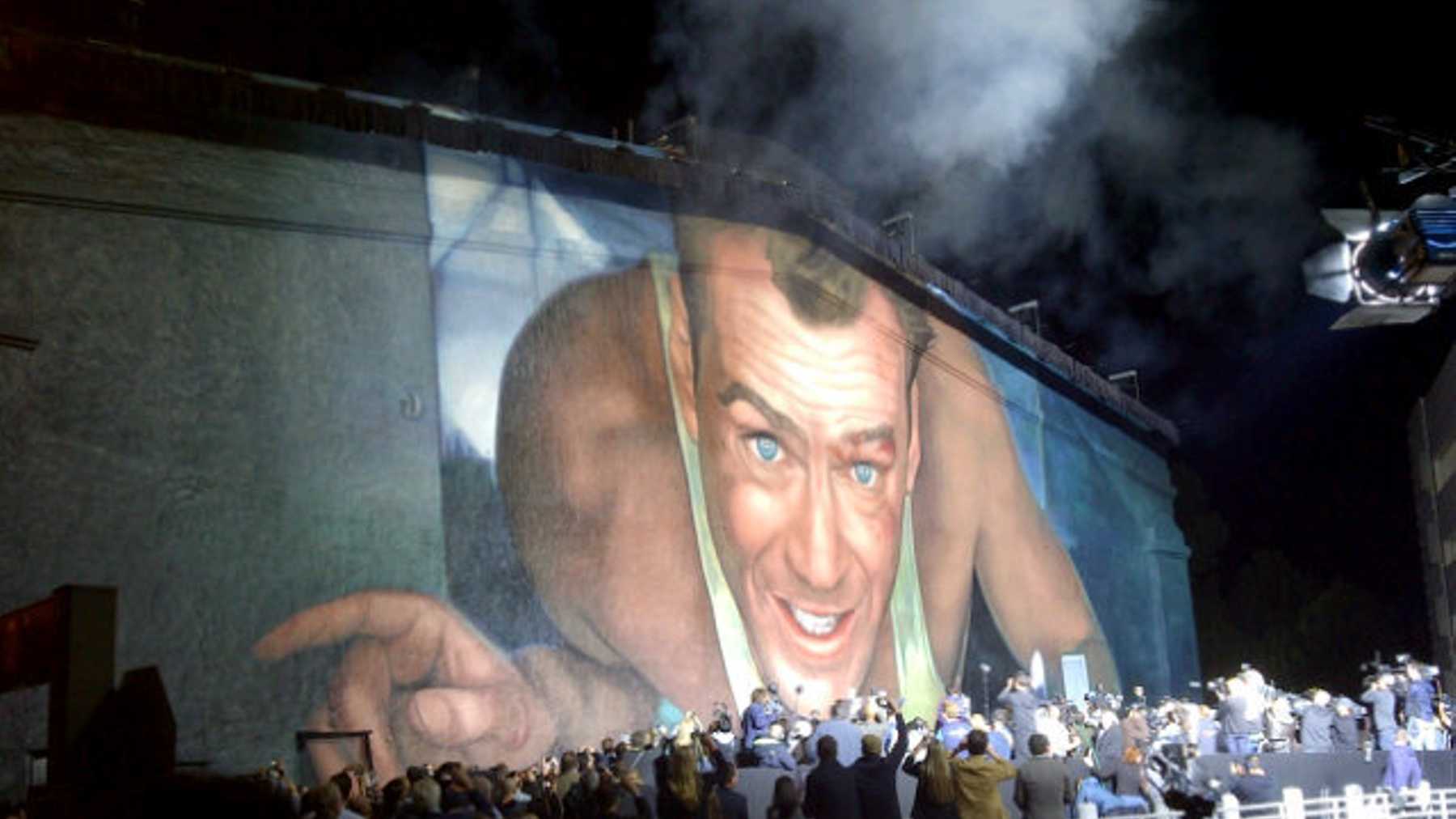
Afterwards, Gianopulos gave Willis a device which looked like a detonator to a bomb and, after the 20th Century Fox Fanfare was played, he pushed the button on it. What followed were some loud pyrotechnics and the dropping of the curtain to reveal the 35- foot “Die Hard” mural which was designed by muralist Van Hecht-Nielsen and painter Fernando Cepeda. It depicts the scene where McClane makes his way through an air vent and pulls out his cigarette lighter to see what’s ahead. This of course led to one of Willis’ famous quotes from the movie:

“Come out to the coast, we’ll get together, have a few laughs…”

I personally got a huge kick out of the whole presentation as did everyone else, and it was greeted with thunderous applause from the onlookers as well as many car alarms which were inadvertently set off by the pyrotechnics (I guess they had to have their say as well). Then again, “Die Hard” did get its name from a car battery, so the irony is hard to ignore.

Following the mural presentation, we were invited to a screening of “A Good Day to Die Hard” held at the Zanuck Theatre on the Fox Lot. Introducing the movie was its director, John Moore, who added he hopes his funeral looks like this and with so many excited people in attendance. He also pointed out while this was a special screening of the new “Die Hard” movie, he also called it a “nerd screening” because of a new sound system being utilized for it.

“This is an Atmos screening of ‘A Good Day to Die Hard,'” Moore said. “To explain what that is, Atmos is a new three-dimensional sound system that Dolby is rolling out over the next few years, and this is only the eighth film to be mixed in Atmos. If I could director direction to the ceiling for a moment, you can see there is an array of nearly 40 speakers, and this creates a three-dimensional sound that’s gonna role of you like nothing you’ve ever experienced… Or since the last time something’s rolled over you.”

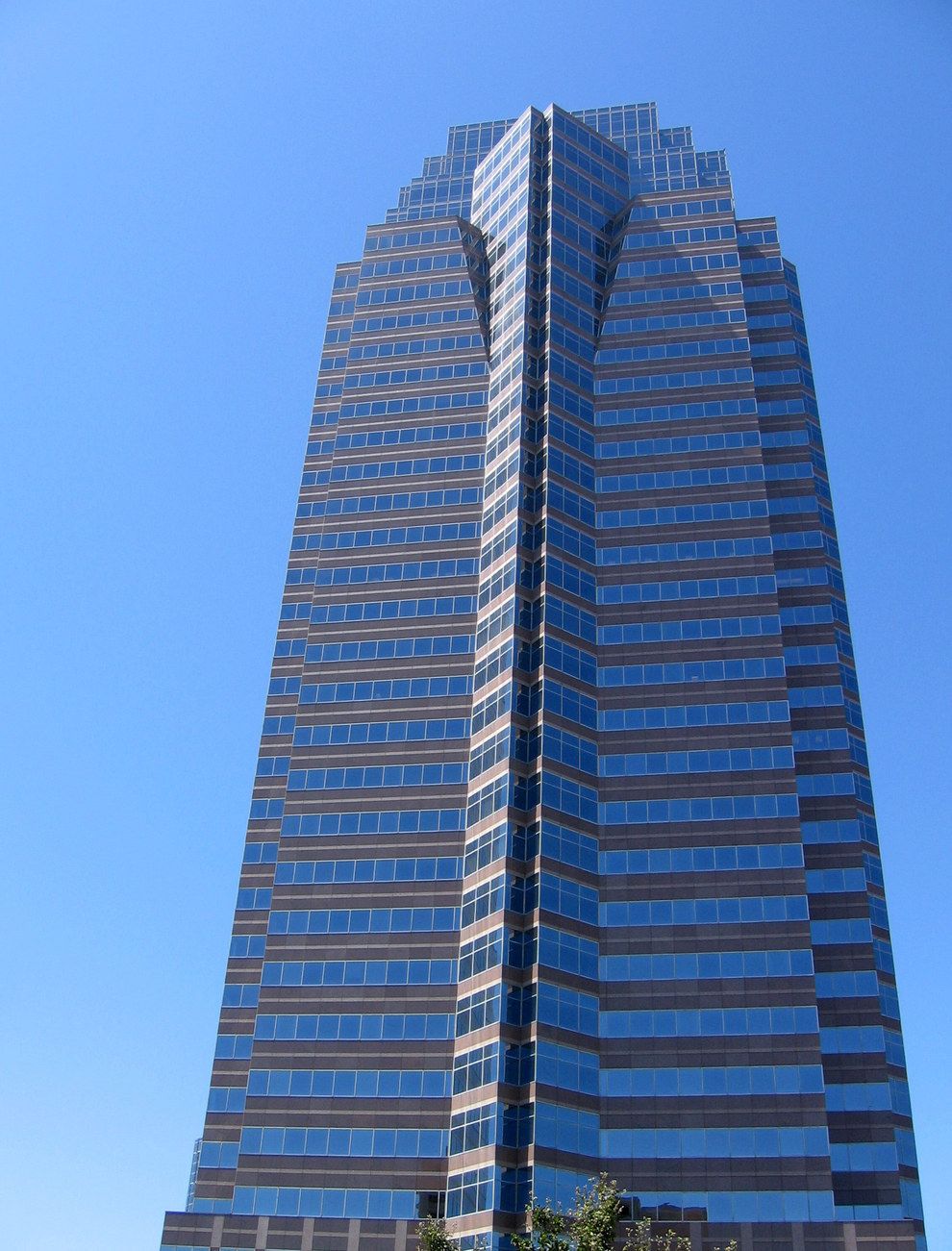
But for many of us, the biggest treat of the evening was when we were invited to the 21st floor of the Nakatomi Plaza where the original “Die Hard” was filmed… Okay, it’s really called Fox Plaza, but to us “Die Hard” fans it will always be known as the Nakatomi. The lobby in the building has changed only so much since 1988, and while the lighting inside was different, it still looks the same as it did back then. You should have seen us when we got into the elevators though because they looked exactly the same as they did in the movie. My friend Phillip was practically hyperventilating from all the excitement of being there, and he later claimed how he almost died of “sheer awesomeness.” We all definitely shared in that feeling, and I had a great grin on my face for the rest of the night.

The 21st floor was decked out with a DJ and food that ran from cheese and apple blintzes to bigger dishes like beef stroganoff and egg noodles, perhaps to reflect how “A Good Day to Die Hard” takes place in Russia. I loved how the floor resembled the one McClane hid out on when he set off the fire alarm and was waiting for the fire trucks to show up. This had a lot of us going up to the windows and looking out while repeating our favorite lines from “Die Hard” such as “c’mon baby, come ta’ papa, I’ll kiss ya’ fucking dalmatian” or “you macho a-holes! No! No!” We didn’t bang our hands on the windows though as that likely would have gotten us into trouble.

Actually, some of us got a really nice security guard to take us up to the 30th floor where the Christmas party in “Die Hard” took place, but it looks nothing like it did in the movie. In fact, much of what we saw in “Die Hard” was done on a soundstage, and the real 30th floor was full of empty office spaces still waiting to be occupied. We were hoping to go up to the roof where the helipad is so we could imitate the scene where McClane shot his machine gun into the air to get the hostages to run downstairs, but unfortunately the guy couldn’t do that for us (he was very nice about it though).

Still, we got to see the front parking area where Sgt. Al Powell (Reginald VelJohnson) drove around in circles before going inside, and we also got to see the place where a terrorist stole a Nestle Crunch candy bar while waiting for SWAT to break into the building. It’s all those little details which got us so excited.

Seriously, this was one of the best evenings I have had in a long time. To be a part of it was an honor, and it was an amazing thrill to go inside the Nakatomi/Fox Plaza and see where “Die Hard” was filmed. I came out to Los Angeles to be a part of the movies and to be close to those involved in their making, and this was an occasion which allowed me to do just that. I’ll never forget this evening, and I look forward to having many more of them.