Star Trek Beyond

Star Trek Beyond poster

With “Star Trek Beyond,” the rebooted franchise now follows the Enterprise crew on its five-year mission to explore strange new worlds, to seek out new life and new civilizations and to boldly go where no one has gone before. What results is a mixed bag of a movie that gets a little too bombastic for its own good at times, but which still entertains better than many of the other summer blockbusters released in 2016. More importantly, this movie remembers what makes “Star Trek” so memorable: the relationships these characters have with one another.

We meet up with James T. Kirk (Chris Pine) and his crew in the third of their five-year mission. Kirk finds his duties as captain growing monotonous and becomes increasingly interested in accepting a promotion to Vice Admiral. Spock (Zachary Quinto) is reeling from his breakup with Uhura (Zoe Saldana) and the death of Spock Prime (the late Leonard Nimoy) to where he is considering leaving Starfleet to help New Vulcan. Scotty (Simon Pegg) still loves his warp engines, Sulu (John Cho) and Chekov (the late Anton Yelchin) are still at the helm, and McCoy (Karl Urban) is still eager to remind everyone that he is a doctor and nothing other than that.

The Enterprise’s latest assignment has them traveling through an unstable nebula on a rescue mission, but it turns out to be a trap that destroys the Enterprise and leaves its crew stranded on an alien planet whose inhabitants are quick to enslave them. An alien commander named Krall (Idris Elba) seeks to destroy the Federation of Planets for reasons which eventually become clear as the movie goes on.

As the trailers for “Star Trek Beyond” have long since revealed, the Enterprise is destroyed early on. This isn’t the first time we have seen this famous starship destroyed. We watched helplessly as it self-destructed in “Star Trek III: The Search for Spock” and we its lower half explode and its saucer section make a spectacular crash landing in “Star Trek: Generations.” But what’s significant about this movie’s Enterprise is that it is destroyed very early on as opposed to the halfway point. This is a bold move as these films thrive on the presence of the Enterprise for the most part, but here we see it destroyed from the get go to where you wonder how the crew can do their jobs without it. As a result, things in “Star Trek Beyond” feel more unpredictable than usual as everyone is separated from one another and trying to figure out what to do without easy access to the Federation of Planets.

J.J. Abrams stepped away from the director’s chair as he was busy directing “Star Wars: The Force Awakens.” In his place is Justin Lin who is best known for his numerous contributions to “The Fast & The Furious” franchise, but I also like to remind people of his 2002 film “Better Luck Tomorrow” which I felt made him a good choice to helm this “Star Trek” movie. Thanks to a script by Simon Pegg and Doug Jung, he takes the time to focus on the characters and their evolving relationships with one another. I especially loved the scenes between Spock and McCoy as these two can’t stand one another but still need to rely on each other when danger looms over them. Spock may find the fear of death of illogical, but McCoy rightly points out that it is what keeps us alive. This is reminds me of a pivotal moment from the original “Star Trek” television series when McCoy said, “Do you know why you’re not afraid to die Spock? You’re more afraid of living.”

Having said that, Lin does make the action scenes in “Star Trek Beyond” feel, and I have to say it, a little too fast and furious. It gets to where we threaten to lose sight of the movie’s plot and what its main antagonist is aiming for. I imagine that when I see this “Star Trek” movie again, and seeing any “Star Trek” movie just once is not enough, I will better understand all that is going on, but the fact that I wasn’t able to follow every little detail here did take away from my enjoyment. I liked “Star Trek Beyond,” but I came out of it feeling like I could have liked it a lot more.

Speaking of the main antagonist, he is Krall and is portrayed by Idris Elba, an excellent choice as he is the kind of actor who can elicit fear with just a look of his eyes. Like Oscar Isaac in “X-Men: Apocalypse,” he is covered up with way too much makeup which threatens to take away from his natural charisma, but he still gives us a villain that is in no way, shape or form a one-dimensional character. As “Star Trek Beyond” goes on, we learn that he is a victim of circumstances beyond his control, but while that doesn’t justify his actions, it certainly explains why he does what he does. Elba is one of the best actors out there today, and his performance here is further proof of that.

It’s great to see how these actors have grown into the roles they were first cast in seven years ago. Pine shows how the years of space travel have worn down Kirk’s soul but not his spirit. Quinto continues to do excellent work as Spock, having made this character his own a long time ago. Urban remains a pitch perfect McCoy, and his delivery of that character’s classic catchphrases is worth the price of admission. Saldana continues to give us a kick-ass Uhura who isn’t about to take shit from anyone, and I mean anyone. With this “Star Trek” movie, Pegg gets to make Scott more than a comic foil as he works to get the support of a particular alien who can help him and the crew defeat Krall. And there’s Yelchin who finally gets to do much more as Chekov here than in the previous films. He’s terrific here, and it makes his recent death all the more tragic as he was a major talent whose life was cut much too short.

Special mention also goes to Sofia Boutella who gives a genuinely strong alien warrior character in Jaylah. This is the same actress who made an undeniably memorable impression as the henchwomen whose prosthetic legs were designed to leave some serious damage. Boutella steals every scene she has here as Jaylah looks to defend herself against those who destroyed her family, and I can’t wait to see what role she will take on next.

While part of me wishes “Star Trek Beyond” was a better movie than it is, it still proves to be better than many of the other summer blockbusters released so far in 2016. Many believe that this franchise is still be converted into one resembling “Star Wars,” but I don’t believe that as the filmmakers involved are fully aware that the characters are far more important in this one than the special effects. It also makes me smile that this franchise continues to live on to further generations no matter what. While some look at Gene Roddenberry’s vision of a hopeful future as nothing but hooey, others see it as one that nobody should stop believing in, and I am one of those people. Here’s to this franchise continuing to live long and prosper no matter what.

* * * out of * * * *

Copyright Ben Kenber 2016.
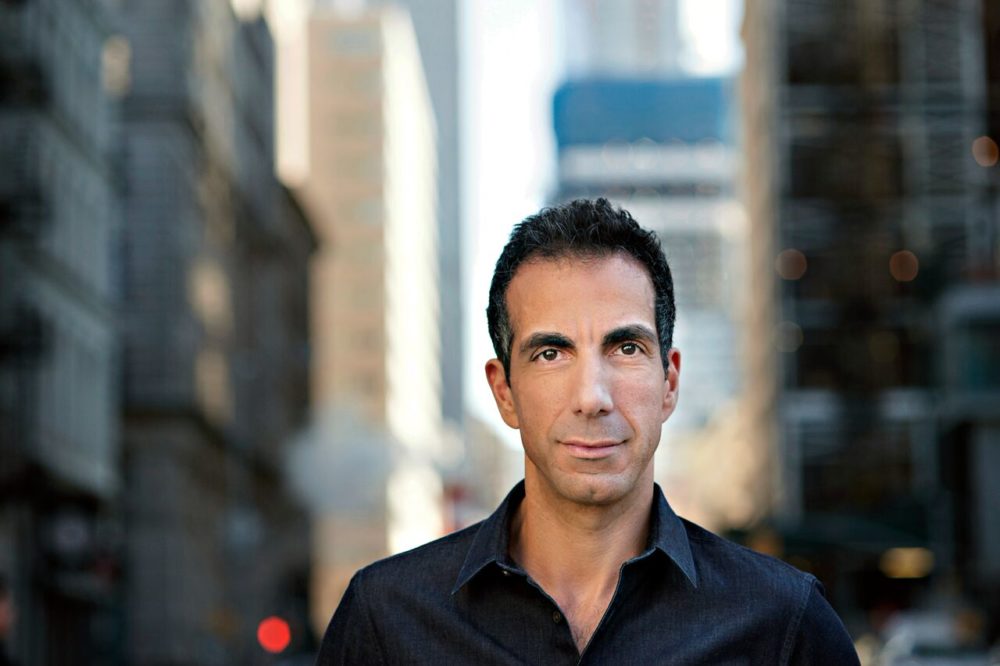
Exclusive Interview with Chris Hajian about his score for ‘The Infiltrator’

Chris Hajian

With “The Infiltrator,” Brad Furman’s movie about U.S. Customs special agent Robert Mazur (played by Bryan Cranston) and his attempt to bust Pablo Escobar’s money-laundering operation back in 1985, I couldn’t help but expect a film score that was inspired by Jan Hammer’s music from “Miami Vice” or a variety of electronic scores that were very popular at the time. But the film’s composer, Chris Hajian, ended up creating something much more modern, and it acts as Robert’s conscience as he sinks deeper into a world of crime he may not get out of alive.

Hajian was born and raised in Queens, New York, and his love of music began at the age of five when he started playing the trumpet. He went on to get formal training at New York’s High School of the Arts, and he later studied classical composition at the Manhattan School of Music. His credits include “Mr. Vincent,” “Inspector Gadget 2,” “Jingle All The Way 2” and the documentary “Unraveled.” “The Infiltrator” marks his latest collaboration with Furman who he worked with previously on a number of short films and “The Take.”

I spoke with Hajian over the phone recently about his music for “The Infiltrator,” and I was interested to learn how he managed to make it sound like much more than a typical 80’s synth score. It was also fascinating to hear him talk about his approach to this material and of the different elements he used to get into the psychology of the main character.

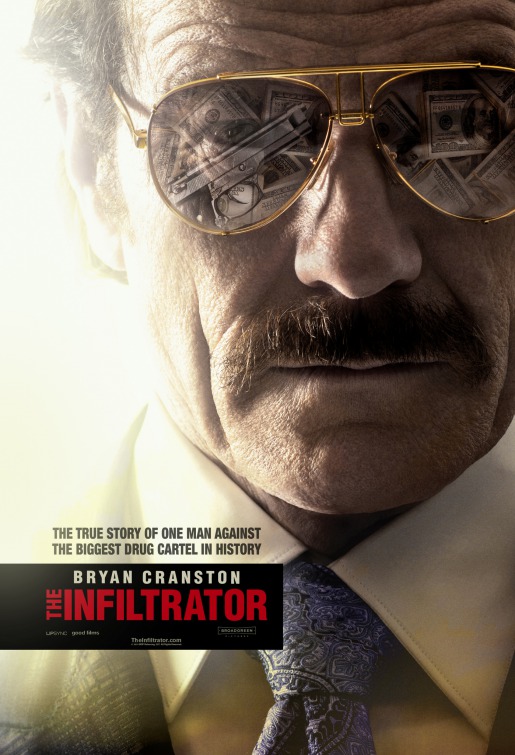
The Infiltrator poster

Chris Hajian: Thank you so much for making time for me and getting to know me and my music. I really appreciate that.

Ben Kenber: You’re welcome. I was really surprised with your score because the fact that the movie takes place in the 1980’s made me expect an 80’s score, but what you manage to do was take a lot of synth elements and orchestral ones to create something that’s surprisingly modern. Was that always your intent?

CH: Thank you for noticing that. When Brad Furman and I set out to talk about this in the initial phases, we always wanted the score to have a relevance to the 80’s as the film was shot in a way that’s relevant to that decade. We focused on that sound with the textures and the synth stuff, but we never wanted it to feel like a clichéd or tongue-in-cheek or cheesy reference. I also wanted to combine it with my aesthetic of the lyricism of the strings and the kind of very ambient textures that I use to create a lot of the emotional and internal conflicts, so that was my intention. The other thing was when I studied a lot of those classic 80’s synth scores, the “Blade Runner” and Vangelis stuff and Giorgio Moroder, I started noticing how those scores used a lot less music and thank God. I think the trend now to put music everywhere is not good for storytelling personally, and I tried to capture that and use that in the film because the film is so well acted, and when you have Bryan Cranston and the level of actors on there I didn’t want to clutter it with music or overcompensate. So we tried to look at that and use music in a way they did in the 80’s as well in smaller bursts. There’s a lot of music in the film, but there’s also a lot of moments where the film breathes without score so that’s the approach we took.

BK: There are a number of intense moments throughout this movie like when Bryan Cranston’s character auditions for a meeting with a certain drug dealer, and that’s a scene which almost doesn’t need music. But the way you added music in was quite subtle. How tricky was it for you to score that moment?

CH: It went through a lot of different iterations, but Brad wanted that moment to be the most abstract and surreal. This guy is diving into this crazy world, but now he’s taken down to a foreign place and put through this ceremony or an audition. There are some synth elements but there’s much more music score design elements that are working together. We wanted to avoid a lot of the horror clichés that you could do in that scene with the high strings and all that stuff that is so easy to go to. We always tried to counter ourselves and say let’s go to something more nuanced and internal. My whole goal with this whole score was to get into the mind of Robert Mazur and how he is going to pull this off and living with the impression that at any given time he gets discovered, he and his family are dead.

BK: We really do get into the mind of Bob Mazur and the danger he is constantly under. What was the challenge of getting into that character’s mindset?

CH: Just living the double life. As a composer I am a storyteller first and foremost, but I am also always trying to check and watch from the perspective of an audience and understand what can I use to deepen a character from a storytelling or an audience point of view. So for me it was about what’s the essence of a character that is living these two lives and is constantly one move away from getting exposed. To me that all just kept pointing back to keeping the score internal and pushing into his mind, and a good moment that I think illustrates that is after that car accident where he almost dies. He climbs out of the car and the score gets super, super into his mind and almost to the point where you can just see him processing all this. To me it’s all about him having to tie up his own fears and come to grips with his own fears and mortality, so that moment has a very, very surreal quality to it. That’s a sound that I used a couple of times in the film where I felt like it was appropriate to get into the world of what he was doing and the pressures he was feeling.

BK: I’m glad you brought up the car crash scene because that just came out of nowhere, and it’s like everything else goes silent when it happens.

CH: That was the idea. I love that technique when directors will pull out the ambience and the score can have a moment. From the point that the car stops and you’re just kind of wondering if he’s alive or if he’s dead, all the ambience comes out and all you hear is the score. You can’t write too over the top. To me it does a disservice to the story and it takes you out of the moment. I just wanted this thing to evolve. How is he going to reconcile all that just happened in his mind?

BK: What specific clichés from 80s synth scores you were looking to avoid the most when composing this score?

CH: You probably noticed by listening to the score that there’s very little use of drums or percussion in the entire score. Brad and I both talked about how when you deal with thrillers on some level and action and stuff like that, it’s very easy to go to the percussion bank and a lot of composers use it and it always works, there’s no doubt about that, but we felt that would’ve taken away from the film. So all the motion and the stuff that I’m generating were emotions by and large, and there’s a few moments with some drums but very sparingly were created by synth pulses and the ambiences and reverse sounds that I have created and created loops on, and that’s really what gave it a lot of propulsion.

BK: That’s what is fascinating about this score of how you use little in the way of drums or percussion. I don’t think I even realized that as I was watching the movie.

CH: Yeah, it worked. It just felt right and it became a really good challenge. As a composer you always want to get challenged by the director in a really wonderful way, and when Brad said I just don’t hear that sound, that made me say okay, cool, now what can I do or dig into to find something that’s maybe a different take on those kind of scenes. The other thing with the clichés too is I incorporated the kind of 80’s synth with the ambient textures and the strings that created that emotional warmth. That was my goal, to have those three things all work. I didn’t want you to identify one or the other like that, and I don’t ever want the audience to feel oh here’s synth, now here’s strings, now here’s ambient textures. I had to find a way to merge them so that it’s seamless and you don’t realize that. I wanted it to feel like it’s just a wave of these different sounds and textures. One of them becomes a priority at different times depending on what the narrative is.

BK: That’s a great point because this is a score that could’ve called too much attention to itself with the 80’s synth sound. But all of them, the synth, the ambient textures and the orchestral elements, do come together in a seamless way. You could have just composed the score electronically, but an emotional component to the story could have been lost in the process.

CH: You’re totally right. You can look at the film and think this is going to be a film about a drug cartel or it’s going to be like “Narcos,” but cocaine is really the least important aspect of the film. Yes, it’s in that world and the cartel is dealt with, but it’s really about this man’s journey and his emotional connection to his family, to his own self-doubts and ultimately to that bonding he makes with Alcaino played by Benjamin Bratt and his family and the immense amount of conflict he has knowing that he’s going to ruin this guy’s life and his family after he becomes friends with him.

BK: You worked with Brad Furman previously on a number of projects including “The Take.” How has your working relationship with him evolved from “The Take” to “The Infiltrator?”

CH: I have known Brad for 21 years. He is the most generous, trusting collaborator and I think the world of his talent. We have become amazing friends and have become better collaborators the more we work. We start with a really big sense of trust, and I think for a composer that’s what you need, to really see yourself and reach for something more interesting. To work in a situation where you’re afraid you’re going to fail or you’re going to try something different and it’s going to be looked down on as you can’t do the job, then it’s going to feel like a straitjacket. To me it’s not enough to just get a score done or get the cues down. I need to put my own mark and personality on it in a way that the director wants. I really know what makes Brad tick. I know his sensibilities, I know his inherent likes and dislikes in what a score represents. I have invested a lot in this relationship and I will go to the ends of the earth for him and to stop at nothing to make him feel that I was the only person who should be scoring his films and telling the story with him. That’s what it’s about; to have somebody that really gets you and understands you creatively.

BK: I read that one of the film scores that really influenced your work on “The Infiltrator” was Giorgio Moroder’s for “Midnight Express.” What was it specifically about that score which influenced you the most?

CH: I think that was one the most landmark synth scores. Nobody really did that before Moroder, and he did it in a very serious film with a lot of intensity. You listen back on some of those synth sounds now and some of the sounds are teeny or small, but at the time that put such an incredible uniqueness onto that score and really tapped into what was relevant in its pop culture in a positive way. I just think it was highly unique and I think it opened up the door for Tangerine Dream and Vangelis and all those things that followed it.

BK: When it comes to composing the score for any project, do you find yourself running music before you watch the movie or do you have to watch the movie before you can start writing any music for it?

CH: Usually a composer is hired relatively late in the process. In this case I was on very early because of my relationship with Brad, and it was so important that we define the tone of this thing so we spent as much time as possible on it. I was writing these really global themes and even just putting sounds together just to see if Brad connected with it. Even while they were shooting I was sending Brad some ideas. It just made him think about this film sonically.

BK: Did you ever get to talk with the actors or get any ideas from them that you put into the score?

CH: Yeah. Bryan Cranston is an amazing guy and of course an incredible actor, and I was down on the set for a couple days in Tampa and he’s saying that he’s really an aficionado. So we start talking about so many electronic scores and we kind of connected with what my concept was, and he was very generous and excited about what it would sound like. I saw a lot of them at the premiere and I am very friendly with John Leguizamo who is in Brad’s circle as well. It’s been nothing but the most encouraging, really wonderful experience and I wish they could all be like this. I hope everyone is going to experience something where there is just a really big coming together of people for the right reasons. That’s a real tribute to Brad. We were in the foxhole with him.

I want to thank Chris Hajian for taking the time to talk with me about his score to “The Infiltrator.” Please feel free to visit his website at www.chrishajian.com.

Star Trek Into Darkness

Star Trek Into Darkness movie poster

J.J. Abrams has done it again; he’s made another incredibly entertaining “Star Trek” movie. “Star Trek Into Darkness” proves to be just as much fun as the reboot he helmed in 2009, and I found myself with a big grin on my face as the end credits came up on the silver screen. In a summer season that has gotten off to a somewhat tepid start, Abrams manages to thrill us with a combination of spectacular action pieces and characters we come to care deeply about. He also takes this movie to where no “Star Trek” movie has ever gone before: a place where roman numerals and colons are not needed in the title.

One year has passed since the events of the last movie, and this one starts off with the crew of the U.S.S. Enterprise accidentally catching the attention of a primitive civilization that is not yet ready to discover the existence of things like starships. This leads the crew, and James T. Kirk in particular, to violate the Prime Directive which dictates that there will be no interference in the development of an alien civilization, to attempt to save one of their fellow crew members from certain death. Back on Earth, none of this sits well with Admiral Christopher Pike (Bruce Greenwood) who berates Kirk (Chris Pine) for acting as if the rules don’t apply to him.

But things change quickly when a vicious domestic terrorist named John Harrison (Benedict Cumberbatch) lays waste to certain parts of Earth, and Kirk becomes consumed with vengeance and determined to bring him down at any cost. But in their pursuit of Harrison, the crew of the Enterprise find themselves in conflict as to what course of action is the best one to pursue. While Kirk feels justified in killing Harrison, this action could lead to an all-out war that the Federation of Planets cannot afford.

Now some complain that ever since Abrams became part of the “Star Trek” franchise that the movies have become more about action than ideas, but that’s pretty much been the case since “Star Trek II: The Wrath of Khan.” What Abrams gets right though is his attention to the characters, and in the end this franchise is really more about the characters than special effects. While we love the action with all those starships firing their torpedoes at one another, it’s the characters and what they go through which keeps us endlessly riveted.

I love the complicated relationships these people have with one another. Admiral Pike continues to be the father figure Kirk needs in his life, and Greenwood is perfect in the role as he dishes out some hard love to the strong but arrogant captain of the Enterprise. You never really catch Greenwood acting in the role, and his moments opposite Pine are filled with a lot of genuine emotion that never feels faked.

But the key relationship in this particular “Star Trek” movie is the one between Kirk and Spock which remains as complicated as ever. While Kirk is willing to fudge the facts in order to justify his course of action, Spock has no choice to be 100% honest about everything because he’s a Vulcan, and Vulcans don’t lie (but they do exaggerate). You wonder how these two can stand to be on a starship together for even a brief period of time, but the fact is that these two need one another in order to survive from one galaxy to the next. This becomes all the more apparent as “Star Trek Into Darkness” reaches its relentless conclusion.

Pine gives another excellent performance here as the iconic character James T. Kirk, and it’s fun to watch him take Kirk from being a cocky individual to one who ends up making selfless decisions in order to save the only family he has left: his crew. Quinto remains riveting as ever as Spock as we watch his half-human and half-Vulcan sides battling with one another for supremacy. Spock has always been a very complex character, and there are many reasons why he was the only one to survive the pilot episode of the original “Star Trek” television series.

Zoe Saldana really gets to kick ass as Uhura, and there’s something thrilling about her not just being relegated to her communications station on the bridge. Simon Pegg remains a delight as Scotty who finds out more about starships than he’s supposed to in this one. John Cho really does get his moment in the sun as Sulu when he is required to take the Captain’s chair and makes it clear he is not to be messed with. And then there’s Karl Urban who remain as pitch perfect as ever as Dr. McCoy, and he delivers some of the character’s most iconic lines with a freshness which reminds us how much we loved this character in the first place.

As for Anton Yelchin, his character of Pavel Chekov is kind of underused in this “Star Trek” movie. Yelchin gives a good performance, but Chekov is relegated to engineering a little too much this time around, and he comes off looking like he’s not a necessary part of the Enterprise crew.

There are also some new additions to “Star Trek” family in this sequel that prove to be very welcome. Peter Weller, the original “Robocop,” co-stars as Starfleet Admiral Marcus, and he brings to his role the same relentless hard ass intensity he brought to the fifth season of “24.” Alice Eve portrays the very alluring Science Officer Carol Wallace who knows more about weapons than anyone is comfortable with, and she hides secrets which may jeopardize her relationship with the crew.

But the one actor everyone will be paying the most attention to is Benedict Cumberbatch. Long before this sequel was released, it was believed that he would give us one of the most unforgettable villains of the summer 2013 movie season, and he doesn’t disappoint. John Harrison is not your typical one-dimensional bad guy, and that makes Cumberbatch’s portrayal of him all the more mesmerizing to watch. He also gives the role a strong depth you don’t expect it to have as we discover his true nature and why he is wreaking all this havoc.

To say anything more would risk spoiling the movie for you, and I am not about to do that. Abrams makes a very welcome return to the director’s chair for this “Star Trek” adventure, and his success here bodes well for that “Star Wars” movie we are waiting for him to make. While some directors get caught up in visuals, battles and explosions, Abrams is one of the few who gives an equal amount of attention to the actors and the characters they play. That makes his films all the more thrilling and emotionally involving to witness.


It’s hard to say where “Star Trek Into Darkness” ranks among the other movies in this franchise that continues to live long and prosper, but it’s safe to say that it won’t be sharing company with “Star Trek V: The Final Frontier” anytime soon. This film entertained me from beginning to end and it never sacrificed character for the sake of action. It has me looking forward to the next film which should have the Enterprise crew finally starting their five-year mission to explore strange new worlds. Whether or not Abrams will be in the director’s chair, it’s bound to be a very entertaining journey.

* * * ½ out of * * * *

Copyright Ben Kenber 2013.

Star Trek (2009)

Star Trek 2009 movie poster

I have been into “Star Trek” since I started watching the original series when I was five years old. I reveled in Kirk, Spock and the rest of the Enterprise crew hurtling through space and exploring new worlds. I still remember watching the episode “The Return of the Archons” where the Enterprise crew was being held prisoner, and there was this overwhelmingly loud noise which rendered them unconscious. As they fell to the floor, I mimicked what I saw on that ancient Zenith television my parents bought, pretending I was part of this great crew. Back then, I envisioned myself as a character on that show and “Star Trek: The Next Generation” as its adventures made up for the dullness of reality.

As “Star Trek” expanded from its original incarnation later became a never ending movie franchise, I stayed with it as much as I could. My dad had to carry me out of “Star Trek II: The Wrath of Khan” after I burst into tears at the end. The fact that I kept saying he would come back to life was truly an utter coincidence when “Star Trek III: The Search for Spock” came out, and I was in tears after that one as well. I later became determined to be the first person in Thousand Oaks, California to own a copy of “Star Trek IV: The Voyage Home” on VHS. When my family moved from Thousand Oaks to the Bay Area, I found myself wanting those transporters to be real so that I could beam down south to hang out with the friends I was forced to leave behind.

But somewhere along the line, I found myself losing interest in all things Trek as I started to miss out on the last couple of seasons of “Star Trek: TNG.” Then there were other spinoffs like “Deep Space Nine” and “Voyager” among others, and I became increasingly less excited about the franchise as it came to resemble “Law & Order” and its various other incarnations. You knew what you were going to get, so the level of excitement I had for the franchise kept fading away year after year. Still, I believed that the franchise could be resurrected because, as Spock would say, there are always possibilities.

That resurrection has now arrived, seven years after “Star Trek: Nemesis,” thanks to J.J. Abrams. His “Star Trek” movie is the most exciting film this series has seen since “First Contact,” and I fucking loved it! This origin story of the Starship Enterprise and its cast gives the franchise a much needed kick in the ass. By taking the series in new directions, Abrams has succeeded in opening up the world of Trek to an audience that never fully embraced it before.

We get to see a young James Tiberius Kirk driving a hot rod while blasting the Beastie Boys’ “Sabotage” on the car’s stereo, and this is the first sign that this “Star Trek” is not going to be the same old shit. We see a young Spock getting taunted by his classmates which makes him use methods other than that famous Vulcan nerve pinch to subdue his enemies. Seeing Spock beat the crap out of others might have been hilarious in any other movie, but Abrams takes the character in fresh new directions we have not seen him go to before. This plays much more intensely on the fact that Spock has always been half-human and half-Vulcan.

The plot of “Star Trek” revolves around the device of time travel which has played a part in the most entertaining and successful films in the series (“The Voyage Home” and “First Contact”). It involves a large mining ship of Romulans commanded by Nero (Eric Bana) who is as thirsty for revenge as Khan was in “Star Trek II.” It doesn’t matter how much you know about Gene Roddenberry’s sci-fi universe because anything and everything you remembered about it previously will seem very different, and that makes this movie all the more entertaining and unpredictable.

One of the key successes Abrams has with “Star Trek” is the actors he has chosen as none of them try to do imitate what the actors who originated these roles did before them. Among the most impressive is Chris Pine who plays Kirk as a hotshot who gets himself in trouble constantly and lacks a father figure in his life. Pine really succeeds in capturing the same cockiness and over confidence that William Shatner brought to the role before him.

But even better is Zachary Quinto who plays Spock at his most emotionally unhinged. Of all the actors here, he has the biggest obstacle to overcome since the original Spock (Leonard Nimoy) is in this film as well. I admired how Quinto strongly displayed Spock’s inner turmoil and of the fact that he is a child of two worlds. One of his best moments comes when he essentially flips off the Vulcan High Command after he is accepted into their prestigious science academy. By describing Spock as having done well despite the “disadvantage” of having a human mother (played by Winona Ryder of all people), we get a huge thrill out Quinto making “live long and prosper” sound like he’s saying fuck you to the.

Another inspired casting choice in “Star Trek” is Simon Pegg as Engineer Montgomery Scott. As the movie heads to its exciting climax, it is frightening to see just how much Pegg resembles Scotty from the original series, and that’s even more so when we hear him say, “I’m giving her all she’s got Captain!” Pegg gives us a Scotty that is a perfect comic foil, and it will be great fun to see where he will take Scotty in future installments.

As Nero, Eric Bana gives us the strongest and most lethal villain this series has had since Khan. Whereas the previous antagonists seemed more refined in how they acted among their prey, Nero’s fury is so personal and uncontainable, and the fact that he is named after the Roman Emperor whose rule was marked by tyranny, and that he ordered the execution of his mother and adopted brother, should give you an idea of how screwed up he is.

The rest of the cast includes Bruce Greenwood who is perfectly cast as Christopher Pike, and it reminded me a lot of his underrated portrayal of John F. Kennedy in “Thirteen Days.” John Cho of “Harold & Kumar” fame plays Sulu, and he has a great moment where he gets to put his fencing skills to the test. Zoe Saldana plays Uhura with a calm sexiness and an intelligence that is foolishly underestimated by others until she makes you see the big picture. Karl Urban gives us a pitch perfect Dr. Leonard ‘Bones’ McCoy and captures the character’s infinite crankiness we all know him to have. Anton Yelchin plays Pavel Chekov, and while the character feels underused here, he is still well cast and has a flawless Russian accent. And of course, we have Winona Ryder playing Spock’s mother, and her performance is all the more impressive when you take into account that she is only two years older than Quinto.

What impressed me even more about this particular “Star Trek” is that it was given a budget of over $100 million. There is no doubt that the money is there on the screen, and the effects are remarkable. This is an especially good point to make as special effects have never really been the strong point of the “Star Trek” series, but here they are the best they have ever been. The Enterprise bridge looks so much different than it ever before, and it has a sleek style to it that makes being there all the more inviting.

I’ll be very interested to hear what die hard Trekkers think of this latest adventure of the Enterprise crew. This one does not dwell on big ideas the way “Star Trek” has done for the most part throughout its various incarnations. The main power of Roddenberry’s series was how it dealt with social issues of the day in the realm of science fiction. This one is meant to be more like “Star Wars,” and it allows Abrams to give this aging franchise an invigorated feeling that it desperately needed. While it may not be a “Trek” rooted in philosophy, I think this one leaves the door open for writers to explore present day themes in a future installment.

But I cannot go on without mentioning the welcome return of Leonard Nimoy as Spock (. This could have been a gimmicky cameo that lasted just a few seconds, but Nimoy’s Spock does play a very pivotal role in this movie. Furthermore, he also helps give it a sense of legitimacy that it would not have had without his appearance. Keep in mind, his character was the only one who survived the rejected first pilot of the original series.

Seeing this “Star Trek” brought a lot of happiness to me. My mood seems to get inadvertently sidetracked depending on the health of the franchise. I can honestly say that I am not all surprised at its longevity or constant rebirth. Roddenberry’s message of hope always finds a way to win out, and it is fitting that the movie is getting released around the beginning of the President Barrack Obama’s first term. Granted, this is really a coincidence since the movie was being developed before he made his decision to run for President, but it’s a wonderful coincidence all the same.

All those kids who gave me crap about liking this great series can suck it now, because “Star Trek” is here to stay. Even those who picked on me for being a Trekker, and ironically did much better in science classes than me, won’t be able to pass this one up. “Star Trek” can be seen as the first truly great odd-numbered movie in the long running series, and it is proof that this series will never die.

Live long and prosper? OH HELL YES!!!

* * * * out of * * * *

Copyright Ben Kenber 2009.

Exclusive Interview with Jessika Van about ‘Seoul Searching’

Seoul Searching poster

Jessika Van returns to the silver screen in “Seoul Searching,” a comedy by Benson Lee which follows a group of Korean teens from all over the world who are sent to a cultural heritage school in Seoul during the summer of 1986. Van plays Grace Park, a pastor’s daughter from Cherry Hill, New Jersey who worships Madonna the way her father worships God. Grace doesn’t even need to point that Madonna is her favorite singer as she dresses exactly like the Material Girl and even performs an acapella version of “Like a Virgin.” She also excels at teasing all the young boys who lust after her constantly, but she soon meets her match when an especially rebellious teenager catches her eye.

Van started her career in music where she was a classically-trained pianist and singer, and she won various awards and even performed for the Duchess of York, Sarah Ferguson. She made her breakthrough as an actress playing Becca, Queen of the Asian Mafia, on MTV’s critically acclaimed comedy “Awkward,” and she trained in weapons and martial arts for her role in the first-person shooter game “Battlefield 4.” Videos of her work can be found on her YouTube page.

I spoke with Van while she was in Los Angeles to promote “Seoul Searching.” She talked about the research she did into the 1980’s and Madonna to prepare for her role, what she learned about Korea while filming there, and of how she managed to peel back Grace’s emotional armor to reveal the person hiding underneath. She also spoke of how “Seoul Searching” is much more than just an Asian American film as it touches on issues that are universal to everybody and anybody.

Check out the interview below and be sure to visit the movie’s website (www.seoulsearchingthemovie.com) for more information.

The Neon Demon

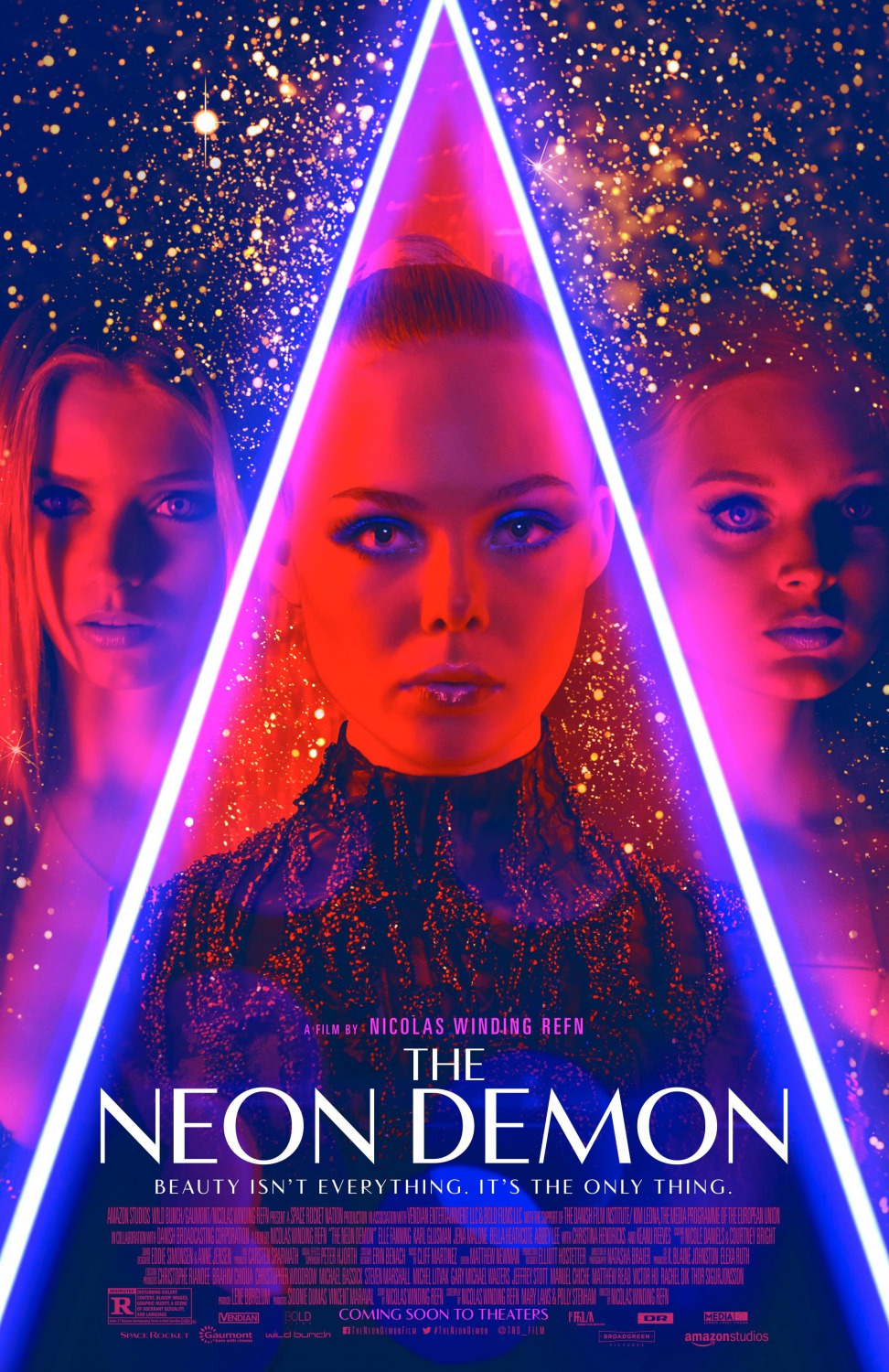
The Neon Demon poster

This is a motion picture you will either be on the same wavelength or not. That’s usually the case with any Nicolas Winding Refn film whether it’s “Bronson,” “Drive” or “Only God Forgives,” but I imagine “The Neon Demon” will be his most divisive movie yet. As for myself, I was entranced with this movie from start to finish as it combines the visual aesthetics of a Gaspar Noe film with the dreaminess of a David Lynch one, and those elements come together to form something that is uniquely Refn. In a sea of movies out right now which feel largely underwhelming, “The Neon Demon” is a refreshing one with its undeniably strong visuals, and that’s even though it takes a very sharp left turn in the last half.

We are introduced to Jesse (Elle Fanning), an aspiring model looking to get into the Los Angeles modelling scene. Equipped with some striking pictures shot by her friend Dean (Karl Glusman), she succeeds in getting signed with top Hollywood agent Roberta Hoffman (Christina Hendricks) who encourages Jesse to lie about her age and is quick to dismiss other aspiring talents coldly and without a second thought. Soon Jesse comes to befriend makeup artist Ruby (Jena Malone) who introduces her to the kinky club scene as well as a pair of models, Sarah (Abbey Lee) and Gigi (Bella Heathcote), who are ruthless in their intent to stay relevant in an industry quick to chew them up and spit them out.

Essentially, “The Neon Demon” is Jesse’s descent into the hellish and shallow world of modelling as she becomes the envy of photographers and fashion designers in the industry and creates a cauldron of resentment for those who can only dream of having her natural beauty. That’s the thing; Jesse has a look that feels infinitely real compared to other models who have long since resorted to plastic surgery which has made them look like lifeless statues. How does a novice model make her way through such a cutthroat and friendless realm of existence? Well, Refn is not out to give us the definitive answer to that question, but the journey he takes us on gives us kind of an idea of what it could be like.

I loved the beautiful and yet clinical look Refn gives “The Neon Demon” as it is entrancing and immersive. We are sucked into a world that is not healthy for us, but we can’t turn away from it as, like Pandora’s Box, we have an insatiable desire to see what is inside. Colors abound as if he tried to combine the beautiful images from Noe’s and Dario Argento’s films (“Suspiria” in particular) and turn them into something original. This movie also benefits largely from the beautiful electronic score composed by Cliff Martinez which hugs these images while poking at the darkness lying beneath them.

Elle Fanning has long since distinguished herself from her equally famous sister Dakota, and her role here as Jesse is her most daring yet. Some will complain that all she does in “The Neon Demon” is just sit around and look beautiful, but that’s missing the point. What’s utterly fascinating about Elle’s portrayal is how she takes Jesse from being a seemingly innocent rookie in a business that can be quite cruel to someone who fiercely owns her beauty in a way that is as seamless as it is haunting. This is not a dialogue heavy movie, so Elle has to show this transition without words for the most part and she succeeds to where we cannot help but be horrified about what Jesse will become.

However, Elle is almost upstaged by Jena Malone who combines an earthly look with an almost alien one as makeup artist Ruby. Malone has always been a tremendous actress, and she makes Ruby a wondrous enigma of sorts as she reveals only so much about her character on the surface. As the movie goes on, Malone comes to exhibit a strong vulnerability as Ruby is denied the thing she desires most and ends up acting out in sheer desperation. Malone is riveting and fearless, and she shows no hesitation in embracing Ruby’s dark side.

Abbey Lee deserves credit for bringing unexpected depth to Sarah, a model slowly realizing she is now past her prime, as she sinks into a swamp of infinite envy and resentment. I liked how Bella Heathcote makes Gigi into a model who is unapologetic about the sacrifices she has made for her career and is fiercely defensive of her place in the industry. While Glusman doesn’t get to show a lot of range here as Dean, he does have some nice moments as a man trying to hold strong to his ideals of what real beauty should be. And even Keanu Reeves shows up as Jesse’s unsavory apartment manager Hank, a man John Wick would show no hesitation to beating the crap out of. Say what you will about Reeves’ acting skills; he’s much better here than he was in Eli Roth’s “Knock Knock.”

If there was anything that perplexed me the most about “The Neon Demon,” it was the last half where it suddenly turns into a Grand Guignol horror film. It’s like the movie suddenly turned into something completely different as we find the women in Jesse’s life determined to possess her natural beauty any way they can, and I mean any way. Granted, this is a Refn film so you have to expect the unexpected, but it bears repeating here as things take a direction that almost seems out of whack with what came before.

Many will keep trying to get answers from Refn in regards to the questions “The Neon Demon” casually leaves unanswered. Then again, this is not a movie designed to have easily answered questions as the viewer will have to use their own imaginations to decipher what they have just seen. The movie’s title alludes to an antagonist that can take on a variety of forms that even the real world can’t separate itself from. Or maybe it’s the one deep fear we have to conquer before moving on with life. Whatever the case, “The Neon Demon” in not a movie to be easily dismissed or forgotten. People will either like it or hate it, and I am not afraid to say that I liked it a lot.

* * * ½ out of * * * *


Exclusive Interview with Justin Chon about ‘Seoul Searching’

Seoul Searching poster

In Benson Lee’s “Seoul Searching,” Justin Chon plays Sid Park, a rebellious teenager and a punk rocker whose truancy and defiance of adult authority knows no bounds. Sid is one of many teenagers forced to spend the summer of 1986 in Seoul at a camp for “gyopo” or foreign born teenagers where they can learn more about their homeland, Korea. It’s no surprise that he doesn’t want to be there and he tries numerous ways to get kicked out, but eventually his tough guy persona is broken through by a teacher who sees that Sid yearns for the acceptance of his father. What results is the most important summer Sid will ever have in his young life.

Chon is one of the most prolific Asian-American actors working in movies today, and he is best known for playing Eric Yorkie in the “Twilight” series. His career started in 2005 when he appeared in such television shows as “Jack & Bobby” and “Taki & Luci,” and he became known to audiences worldwide when he played Peter Wu in the Disney Channel film “Wendy Wu: Homecoming Warrior.” Chon also starred as Sonny, an immigrant who becomes a notorious gangster, in “Revenge of the Green Dragons” which was executive produced by Martin Scorsese. In addition, he has also directed several digital shorts that are featured on his YouTube page.

I spoke with Chon recently while he was in Los Angeles to promote “Seoul Searching.” While he was a student at USC, he spent time abroad in South Korea and explained how he was able to draw on that experience for his role. He also talked about the 80’s song he wished the movie’s director, Benson Lee, had included on its soundtrack, and he makes it clear why “Seoul Searching” deserves to be seen as more than just an Asian-American movie.

Check out the interview below, and please visit “Seoul Searching’s” website to find out where the movie is playing near you.

’10 Cloverfield Lane’ is an Infinitely Intense Thriller

10 Cloverfield Lane poster

A few hours after watching “10 Cloverfield Lane,” I found my nerves were still fried by what I had just witnessed. It feels like it has been ages since a movie made me feel that way, so that’s quite the compliment. Billed as a “spiritual successor” and a “blood relative” to the 2008 monster movie “Cloverfield,” this one works best if you know very little about it when you go inside the theater. Alfred Hitchcock would have gotten a kick out of this as the filmmakers play with your expectations and leave you in a suspended state of suspense throughout. It would be wise to see the movie before reading this review because it is that riveting.

The movie opens on Michelle (Mary Elizabeth Winstead) hurriedly packing her things and moving out of the apartment she shares with her fiancé Ben. While driving through rural Louisiana, she ends up getting into a very serious car accident which renders her unconscious, and she later wakes up to find herself in a concrete room chained to the wall. Eventually she meets Howard (John Goodman), a survivalist who tells her he saved her life and is nursing her back to health. However, Howard also tells her that a deadly attack has taken place and that everyone outside is dead or dying.

They end up occupying an underground bunker which Howard built himself as he always suspected that America was going to be attacked somehow, and along with fellow survivor Emmett (John Gallagher Jr.) they try to live normally by watching videos, doing puzzles, playing board games and occasionally playing a song on the jukebox. But things are never what they appear to be, and soon the bunker won’t be big enough for the three of them.

“10 Cloverfield Lane” marks the feature film directorial debut of Dan Trachtenberg whose previous work includes a short film entitled “Portal: No Escape” which caught the eye of producer J.J. Abrams. It’s a heck of a debut as Trachtenberg puts us right into Michelle’s shoes as we come to have as much an idea of what’s going on as she does. Was there really an attack? Is Howard really worth trusting? Should they stay in the bunker until it’s alright to come out? Questions keep coming up as we try to stay one step ahead of the characters, but anything is possible and nothing can be left to chance.

Trachtenberg is also well served by a strong screenplay from Josh Campbell, Matt Stuecken and “Whiplash’s” writer/director Damien Chazelle which gives us characters who are complex and easy to relate to. These three people are not cardboard idiots out to make the dumbest mistakes possible but instead complex individuals trying to navigate through their own personal issues while attempting to adjust to a possibly post-apocalyptic world. This only adds to the very palpable tension which escalates throughout as does the sharp cinematography by Jeff Cutter, the efficient editing by Stefan Grube and the pulse-pounding music score by “Battlestar Galactica” composer Bear McCreary.

Mary Elizabeth Winstead has long since proven to be a terrific actress thanks to her unforgettable turns in movies like “Live Free or Die Hard,” “Scott Pilgrim vs. The World” and in the criminally underrated “Smashed.” She is a revelation here as Michelle as her character goes from running away from trouble to being forced to confront it head on. It’s great to see Winstead portray Michelle not as some ordinary action heroine, but instead as someone trying to stay one step ahead of those who might not have her best interests in mind.

John Gallagher, Jr. is perhaps best known for his work onstage in the rock musicals “Spring Awakening” and “American Idiot” as well as for appearing on “The Newsroom.” For a moment it looks like his character of Emmett is going to be some clichéd southern dude, but Gallagher never falls into that trap as he reveals Emmett to be a man whose best days may have passed him by, but who is not about to give up on life and those he cares about.

But after coming out of “10 Cloverfield Lane,” I kept wondering if audiences realize just what a great actor John Goodman is. He has delivered one terrific performance after another for years, but has his talent been taken for granted? After serving time on “Roseanne,” he delivered a stellar performance as the seriously disturbed insurance salesman Charlie Meadows. I was reminded of that performance while watching him here as Howard as this is a character who cannot be simply described as a good or bad guy. Goodman makes him into a complex human being and one who is driven by fear more than anything else, and this makes the actions he commits all the more unnerving.

It may still be early in 2016, but Goodman most definitely deserves Oscar consideration here. He proves what a masterful actor he is in that he never has to move a muscle in certain scenes to generate severe unease in the other characters as well as the audience. Just a glare from his eyes will have you on edge as Howard is a man desperate to control his surroundings as well as the people living with him. It’s a frightening performance as Goodman makes Howard terrifyingly unpredictable in his actions. At one point Howards seems agreeable, and in the next he finds himself in a rage. If you are not convinced that Goodman is one of the best actors working in movies today, watching him here should change your mind.

Like I said, “10 Cloverfield Lane” has been described as a “blood relative” or a “spiritual successor” to “Cloverfield.” Those descriptions are very appropriate as it differs quite a bit stylistically to the 2008 movie. None of the characters from “Cloverfield” appear here, and this one is not a found footage film which means no shaky cam. In fact, it’s highly likely that “10 Cloverfield Lane” doesn’t even exist on the same timeline as “Cloverfield.” Still, this movie does share a number of thematic elements that were prominent in its predecessor. To say just how many of them it shares, however, would ruin many of the surprises in store for the audience.

While most sequels or follow ups try to outdo their predecessors by giving us something even bigger, this follow up is instead more simplistic in its approach and shows how less can be more. Trachtenberg makes you experience every claustrophobic and nerve wracking moment to an infinite degree, and it makes “10 Cloverfield Lane” blow “Cloverfield” right out of the water.

2016 has so far given some good movies and others that will be forgotten in no time at all, but “10 Cloverfield Lane” is one of the first great movies I have seen so far in this early year. It takes you on a rollercoaster ride filled with sharp turns, and keeps you guessing all the way to the end.

Copyright Ben Kenber 2016

* * * * out of * * * *

Save

The Duel

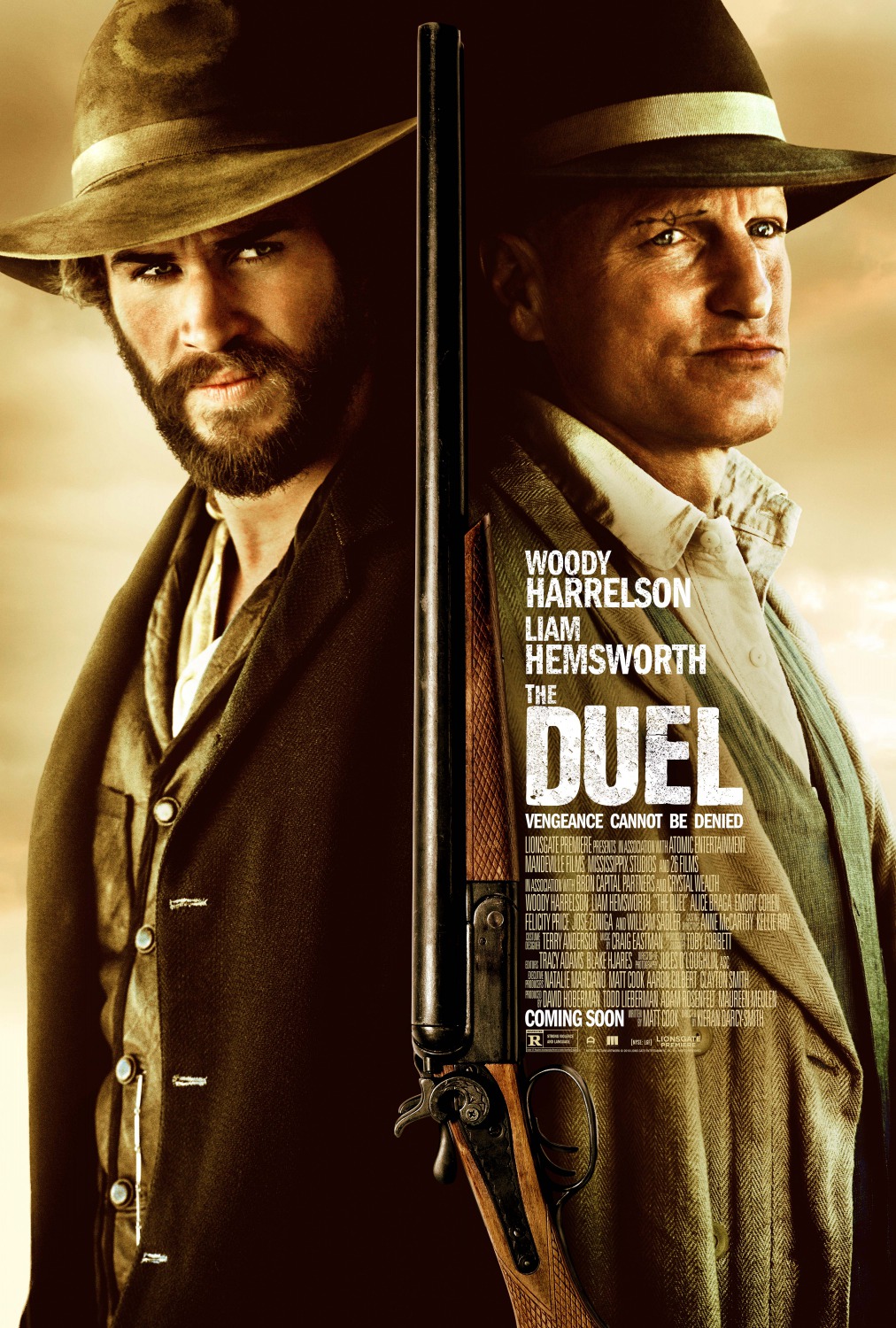
The Duel poster

The Duel” is one of those movies that wants to generate tension you can feel simmering below the surface, but it doesn’t come to life until it is much too late. It’s a shame because it features a pair of mesmerizing performances that are offset by a weak one, and its last half really does keep you on the edge of your seat. Everything leading up to that, however, is undone by a dullness that infects the whole proceedings.

The movie starts off in the year 1866 as young David Kingston watches his father get killed in a knife duel by Abraham Brant (Woody Harrelson), and then it moves to 20 years later with David (now played by Liam Hemsworth) a man and serving as a Texas Ranger. David gets assigned to investigate a series of murders and disappearances that have taken place in an Old West frontier town named Helena, and he reluctantly brings along his wife Marisol (Alice Braga) who doesn’t want to wait for him to return home. It is there that he becomes reacquainted with Abraham who is the town’s preacher and manages to keep the people there in a fearful grip. You should have a pretty good idea of where the story will go from this description.

The setup of the story is reminiscent of Martin Scorsese’s “Gangs of New York” which had Leonardo DiCaprio avenging his father’s death at the hands of Daniel Day Lewis, and “The Duel” looks to travel that same path. The problem is that director Kieran Darcy-Smith and screenwriter Matt Cook are not entirely sure how to reach the expected climax with David and Abraham fighting to the death. There are also many questions the movie raises and never answers in a satisfying way, and it really should not have taken long for Abraham to realize who David really is. As a result, the movie never comes to life until we get past the halfway point.

The best thing about “The Duel” is Woody Harrelson who, at this point in his career, can play just about any character he wants to whether it’s in a comedy or a drama. Right from the start, he is a menacing presence as he stares down into everybody’s soul and manages to put the town under a hypnotic spell. Harrelson has played his share of bad dudes before in movies like “Natural Born Killers,” “Out of the Furnace” and “Rampart,” and Abraham Brant is another he can add to his ever-growing resume. Harrelson may have made his Hollywood breakthrough playing a dim-witted bartender on “Cheers,” but watching him in “The Duel” makes that seem like such a distant memory.

Another strong performance comes from Alice Braga as Marisol, David’s wife who falls under Abraham’s spell to where you really want to kick David for leaving her alone so much. Braga is riveting as she takes Marisol from a strong-willed woman to one who is under the grip of something she is desperate to get control over. This is not some stock female character that can be found in your typical western movie, and Braga makes that very clear throughout.

But then there’s Liam Hemsworth who is simply miscast as David Kingston. It’s not that he isn’t believable as a Texas Ranger, but that he shows no real acting range in the role. In many ways he gives an emotionless performance, and it would have been better if another actor equal to Harrelson were cast in his place. Hemsworth just doesn’t bring much to the part, and the movie suffers considerably as a result.

For what it’s worth, Darcy-Smith does a very good job of transporting the audience back to the 1880’s as everything we see feels authentic to the era. He also jacks up the tension considerably in the last half as David and Abraham try to outsmart one another in the barren fields outside of town, and there’s a taut scene where the two face off in the town’s bar. It’s a very effective moment as the anticipation of guns going off becomes unbearably strong, and we can’t be sure of who is going to walk out of there alive.

Indeed, there are many things to like about “The Duel” from its production values to its performances, so it is frustrating to say that it really disappoints. The filmmakers may have wanted to emulate the great and gritty westerns of the past like “The Wild Bunch” or any starring John Wayne, but it can’t hold a candle to them. They are many who say that the western is dead, but no genre ever really dies. But after watching “The Duel,” it does feel like it needs a lot of reenergizing.

Copyright Ben Kenber 2016.

* * out of * * * *

Exclusive Interview with Benson Lee about his film ‘Seoul Searching’

Seoul Searching poster

It took him 16 years, but writer and director Benson Lee finally succeeded in bringing his most personal film, “Seoul Searching,” to the silver screen. The film is largely autobiographical as it is based on his own experience of being part of a summer school camp in Seoul, South Korea which proved to be one of the best summers of his life. What he attended was a special summer camp for “gyopo” or foreign born teenagers where they could spend their summer in Seoul to learn about their motherland. The intentions of this program were more than honorable but the activities of the teens were not, and we watch as controversies and revelations unfold for the teens and the adults.

Lee is an award-winning Korean-American filmmaker who has worked in drama, documentary and commercial production for many years. His first feature film, “Miss Monday,” made him the first Korean-American filmmaker to be accepted to the Dramatic Competition of the Sundance Film Festival where he earned a Special Grand Jury Prize. His first documentary, “Planet B-Boy,” proved to be one of the top-grossing theatrical documentaries of 2008 in the United States. With “Seoul Searching,” Lee gives audiences something close to his heart as he shares his own experiences from when he was a teenager, and the film resonates with many universal themes.

I was fortunate enough to speak with Lee while he was in Los Angeles to promote “Seoul Searching,” and he could not have been nicer to talk with. Lee described how this project came about, the challenges of getting many 1980’s songs into it, and of whether he had to stay true to the events he experienced or instead to see where those events took him in a dramatic fashion. Furthermore, he made me realize how Hughes’ “The Breakfast Club” affected him on a subconscious level before he even realized it.

Check out the interview below, and be sure to check out the website for “Seoul Searching” (www.seoulsearchingthemovie.com) for more information.