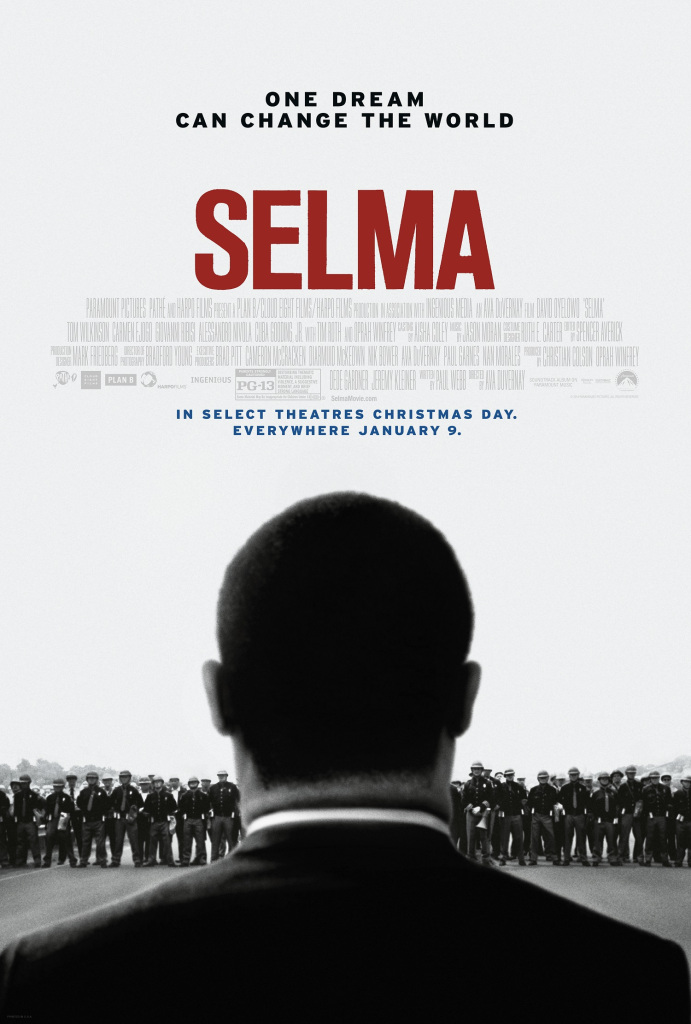
Had “Selma” been released a number of years ago, people would probably just see it as another movie which chronicles a historical moment which has long since passed us by. But with all the upheaval in places like Ferguson, Missouri where violence against people of color is increasing substantially and the Voting Rights Act having taken a very unnecessary hit, this movie could not be timelier. What we see in “Selma” now feels like prologue as the fight for equal rights continues on to this very day. By now we should very well know we’re not living in a post-racial society.
“Selma” takes us back to the year 1965 when Dr. Martin Luther King, Jr. (played by David Oyelowo) and several others led marches from Selma to Montgomery, Alabama in an effort to obtain equal voting rights for African Americans. It was tough times indeed as Dr. King faces an uphill battle with everyone including President Lyndon B. Johnson (Tom Wilkinson) who is not quick to pass a Voting Rights Act as he is still dealing with civil unrest in the South which he is desperately trying to get under control. But King knows this is not an issue that can wait much longer to be addressed.
I have got to start off by saying David Oyelowo is a powerhouse in his portrayal of Dr. King, and he holds our attention completely from the very first moment he appears onscreen. It should be noted how Oyelowo campaigned for this role for seven years and managed to keep it even after the original director, Lee Daniels, departed the project. I have seen Oyelowo do memorable work in movies like “Rise of the Planet of the Apes,” “Lincoln” and “A Most Violent Year,” but I couldn’t find a trace of him in “Selma.” It felt like I was really watching Martin Luther King Jr. resurrected and walking among us again. Not once does Oyelowo succumb to doing a mere impersonation of the man who had a dream we still want to see become a reality. There’s a saying that in the theater you play a character and in film you are the character, and Oyelowo is definitely the man here.
The other big star of “Selma” is its director Ava DuVernay who brings this ever so important story to life so vividly. Granted, in some ways her presentation of the 60’s feels a little routine, and some scenes feel one-sided when they shouldn’t. Her portrayal of the marches, however, is appropriately devastating as she makes you feel ever blow inflicted by those afraid of change. These scenes do not leave the mind easily. King and his supporters are determined to protest in a non-violent way, and it’s hard not to feel for them when their supporters are being beaten senselessly. Deep down you want to see them fight back against the brutality even though we’re aware to do so will be giving the opposition far more ammunition than they deserve.
“Selma” also features a wealth of great performances from actors like Oprah Winfrey who channels her inner Sofia (the character she played in “The Color Purple”) for her role as Annie Lee Cooper who, at the movie’s start, is cruelly denied the opportunity to register to vote. I also enjoyed Tom Wilkinson’s performance as Lyndon B. Johnson as he adds layers to the former President which the screenplay doesn’t always give him. Tim Roth also turns in a strong performance as George Wallace, the always welcome Wendell Pierce is excellent as Hosea Williams, and Dylan Baker is ever so effective as J. Edgar Hoover to where I ended up trying to remember the actor’s name while watching this film.
Another performance worth giving special note to is Carmen Ejogo’s as Coretta Scott King. Ejogo played this role previously in the 2011 movie “Boycott.” She and Oyelowo have a great scene together when she questions him about his alleged infidelity, and no music score is needed to empower it as DuVernay wisely focuses on the actors for all they are worth. Watching these actors here makes for one of the most compelling scenes I have seen in any 2014 movie.
Is “Selma” accurate to what actually happened in history? I don’t know, and I don’t really care. All that matters to me is that it is true to the spirit of the facts more than anything else. We are beyond the point where we should expect movies “based on a true story” to be completely accurate to what actually occurred because dramatic considerations have to be taken into effect. While some argue Johnson was more open to King’s request for voting rights than he was shown to be here, there’s no denying the one most passionate about this issue was King himself. Whether or not this movie fails on a historical accuracy level, it does succeed on a dramatic one.
Having said all this, I kind of wished “Selma” didn’t paint a number of its character in such broad strokes. I guess I was expecting something along the lines of Spike Lee’s “Do the Right Thing” which observed its characters, regardless of color or nationality, with a lot more thoughtfulness and dimension. The fact that “Selma” doesn’t quite succeed in doing this is a bit frustrating, but it doesn’t take away from the powerful effect the movie will have on those who take the time to see it.
“Selma” doesn’t just take us back to an important period in history; it reminds us of the things we as Americans should be fighting for. The movie shows many people of different races and religions joining Dr. King in this fight for an equality no one should have to fight for in this country. But here we are years later, and it turns out the fight is far from over. Once again, we have a lot to learn from history.
Happy Birthday Dr. Martin Luther King, Jr. You had a dream. A dream that, after all we have been through these last few years, I would still love to see realized. And that’s regardless of how much damage has been caused around the world, let alone in America. Paranoia is getting worse and worse, and ignorance continues to be utter bliss for those in power.
Where is the America you dreamed of? Why does it always seem so far, far away? Your vision is one which needs to be embraced, and yet the world seems to keep descending into an endless abyss which it looks unlikely to escape from. Yet we celebrate your life because you had a dream and none of us, however depressed and demoralized we get, are ever willing to let it die.
You were willing to live and die for what you believed in, and this is the kind of bravery we sure could use today. We have been scared to speak our minds of the truth we are trapped in, and when we do speak it we are not heard by those in charge. People are still judged by the color of their skin even when we try to convince ourselves this should never be the case. The powerful voices of truth keep getting muffled by the powers that be, and it usually takes some illegal activity to get to the facts, facts which are now more malleable and less permanent than ever before.
Where is your dream, Dr. King? I guess that’s what I want to write about. I want to believe it is still possible that we can all be free at last. I just don’t know. The world keeps getting scarier and scarier, and I keep hiding away from it all. It gets to be too much sometimes, but it never did scare you, did it? So, who am I to complain?
Whatever happens and whatever befalls us, you will never be forgotten. Thanks Dr. King, and not just for the day off from work (that’s a coincidence more than anything else). Thanks for being a brave voice in a scary world which you refused to be intimidated by. Thanks for your dream which will never die. Ever. Thanks for remembering the most important of things, that we need to work together even when life seems to be bringing us all down.
Happy Birthday Dr. King. May your dreams be realized.
On the surface, “Miss Lovely” might look like a typical Bollywood movie, but this couldn’t be further from the truth. It’s a Hindi feature film which digs deep into the sordid back alley of India’s film industry of the 1980’s which churned out countless horror and soft-core porn movies. In the midst of this sleazy atmosphere are the Duggal brothers, Sonu (Nawazuddin Siddiqui) and Vicky (Anil George), who are among the most prolific producers of trashy C-grade films for Mumbai’s underground market. But while Vicky has no problem with what he does, Sonu is desperately looking to escape this underground reality. When he meets the beautiful actress Pinky (Niharika Singh), Sonu sees not only his chance for escape but also the opportunity to make a real romance movie with her as the star. But as he works to make this a reality, he ends up going down a road from which there is no return.
“Miss Lovely” was directed by Ashim Ahluwalia who is said to be part of a new generation of Indian filmmakers who prefer to avoid working with Hindi film stars, and his films have been described as unconventional in how they blur the lines between documentary and fiction. This is certainly the case here as Ahluwalia’s film deals with an industry he has seen up close, and he invites us to journey into its murky depths. It was originally supposed to be a documentary, but when Ahluwalia couldn’t get those working in the C-grade film industry to be involved, he decided to make a fiction film instead. What results is an unforgettable motion picture which is as unsettling as it is intoxicating to sit through, and it’s one of those movies I sarcastically describe as being good fun for the whole family.
I got to speak with Ahluwalia while he was out to promote “Miss Lovely,” and he was super excited to talk about it as the movie looks at an industry which has long ceased to exist due to changes in technology and the widespread availability of pornography on the internet. It was fascinating to hear him talk about this as filmmakers today are dealing with a shift in technology from film to digital, and it’s a shift many are not quick to embrace.
Ben Kenber: I was blown away by it and it was not at all what I expected. It’s more of a movie you experience than just watch.
Ashim Ahluwalia: Exactly. I think that’s really a good way to describe it.
BK: I especially liked how you shot this movie on Kodak Super 16 and 35mm film as it gives the movie a really rough feel which in turn captures the sleazy nature of the business these characters are engulfed in.
AA: Yeah, it was also about the end of celluloid. The whole period that these films were made in was kind of the end of celluloid and then you have VHS replacing it. In a way, that was the precursor to the digital age and this whole way of consuming sleaze I guess. It just moved to the internet in the 2000’s and then that was the end of that. So I think a lot of it has to do with this material that was so critical in the way these films are made and consumed. It’s crazy to think that they were shooting that sleaze on 35mm (laughs), and now people would just die to get their hands on that kind of access to celluloid, so it’s pretty much part of what the film is about.
BK: Now some have suggested that “Miss Lovely” is part of a new wave of Indian cinema. How do you feel about the reaction this movie has had so far?
AA: It has random individuals doing random things and they’re not really connected, and that has more to do with the fact that now people are more exposed to cinema and they’re getting excited by what’s happening in the rest of Asia and the possibility of digital, etc. I think this whole idea was kind of overblown. It was sort of a moment when they were trying to tie everything together. I think “Miss Lovely” is a very odd film honestly. It’s not unique. It’s not odd just to India; it’s just odd generally because it’s such a hybrid film. It’s just taking very comfortably in a way that most art-house movies don’t just take it from the musical, taking from a 50’s noir, taking from sex horror, taking from porn, maybe documentaries or experimental films and stuff like that. I don’t think it represents a new specific type of film from India, but I think this is definitely a moment where there is new stuff and it’s not just Bollywood, Bollywood, Bollywood.
BK: To be honest, I’m not too familiar with Bollywood films…
AA: Well you’re lucky (laughs).
BK: I think the closest I’ve come to Bollywood so far is “Slumdog Millionaire,” but I’m not sure if that counts.
AA: Well yeah but it’s borderline Bollywood honestly. New Bollywood is kind of like that.
BK: How difficult was it to re-create the Mumbai of the 1980’s as you remember it?
AA: It was really hard because most of the places were being bulldozed as we were shooting them. So sometimes at a location, half the building was already knocked down and we just got them to hold for like a week until we shot a scene. It was literally shooting the last remnants of that kind of 80’s one-hour hotels and cabaret halls and stuff. I would say that about 60 or 70% of the locations are gone now and it’s not even been two years. It becomes kind of a document of those places and that kind of time. It doesn’t exist anymore.
BK: I read that you were not looking to romanticize or do a parody of the 1980’s. How did you manage to keep yourself from doing that?
AA: Well I think there’s sort of like a hipster 1980’s thing and I really wanted to stay away from that. I didn’t want to just make like fetishes of all those little 80’s objects. For me, the reason is because I spent a year and a half hanging out with a lot of these people from the C-grade industry because I initially wanted to make a documentary. So, by the time I was done with that one-and-a-half-year period, it was very hard to poke fun at anyone because these are people that you spent so much time with and saw so intimately. It was hard to caricaturize them.
BK: During the movie, we don’t see a lot of the real world outside of the one the Duggal brothers inhabit. When it does intrude on their sleazy underworld, you feel almost as lost as the characters do as they desperately try to escape their circumstances.
AA: Yeah, it’s kind of claustrophobic. I wanted the film to be like this kind of maze that you were trying to get out of and you can’t. The whole point is this kind of escape ends up being a fantasy of a film that could maybe get you out of there, but it’s sort of like endless passageways that lead into other passageways. It’s just a very interior, claustrophobic kind of environment which I think, for me, I relate to that. When you work sometimes in film you feel like that. You don’t have to really only work in secret cinema, but sometimes a bad day job can be like that. So, I think that idea of you were always trying to escape but you can’t, I like that somehow.
BK: This is your first feature film as a director, and your previous film was a documentary. What was the transition like for you from making documentaries to directing an actual feature film?
AA: The first film I made was “John & Jane” and that was a documentary, but it was shot on 35mm and looks more like a dystopian sci-fi film than a documentary. Somebody told me that my documentaries look more like fiction and my fiction looks more like documentaries, so I’m really interested in this idea of what a fiction film is and what a documentary is. “Miss Lovely” is not a conventional or traditional film. It’s still quite loose in terms of its language and it’s quite experimental, so I don’t find much difference. I feel like I could slip in and out between these two worlds quite easily in some ways.
BK: You once said that the raw energy of these C-grade filmmakers reminded you of why you set out to make films in the first place. What was it specifically about them that reminded you of that?
AA: Well I think what happens is that when you start working in any capacity like in an industry or an environment, what ends up happening is that you become quite jaded as a filmmaker. You’re just like always thinking about how do I get money, do I put it in this thing, if I put this person in it then I get this money and then if I work with that person then I get this distribution, etc. I think what ends up happening is that you lose that energy and spirit of why you really love cinema. You don’t watch films anymore because you’re so jaded by it. But when I experienced these guys making films, although the films are very bad admittedly, the way that they would make the films would be so like run and gone. It would be like, “Oh are we running out of film stock? What we do? The actor’s not available? Get another actor to stand in for the guy.” So the character is now played by a different actor, or if you don’t have a shot then you put a stock shot in, or the police are coming into the building so you have to finish the scene like within 15 minutes. The whole anarchic energy of the way the films are made really reminded me of what independent film should be; just making it with such passion. It’s like the passion is going to make the film happen. It really inspired me in a way to just make something which I really love with some degree of madness and passion which I think sometimes gets filtered out of you.
BK: I’m always waiting for the independent film world to explode again like it did in the 1990’s.
AA: Yeah exactly, and then you see how it’s just been co-opted and it feels like such a tired kind of thing.
BK: The characters in “Miss Lovely” are basically composites of the people you met in this industry. You said you originally wanted to do a documentary, but a lot of the people you talked to didn’t want to be involved in it because of the illegal nature of what they were doing. How accurate is this movie to those types of filmmakers?
AA: A lot of the people that were going to be in the documentary initially, I got them to just play themselves in the background. So all the background characters are all like real C-grade people. All the secondaries are actually people that, when I cast them in a fiction film, were like, “Okay I’ll do it.” But they didn’t want to be in the documentary somehow. So, a lot of those real elements I just kind of brought back into this movie in another way through another backdoor and just brought the realism back into it.
BK: That’s surprising to hear that they did find a way to be in this movie without compromising their true identities.
AA: Yeah, and as long as they were in costume they felt like they weren’t revealing too much of themselves, but they were playing themselves essentially. That just gave the whole thing a bona fide genuine authentic atmosphere that is just almost impossible to re-create artificially with actors who don’t know anything about that world. I felt it just brings another energy to it.
BK: The cast is just spot on with their performances. What was the casting process for “Miss Lovely” like?
AA: Well a lot of them are real people that, when you meet them, are so performative anyway. There’s a midget casting director, the little guy, and when I met him he was just so charismatic when he was talking to me about what he did. He is actually a casting director in real life, so he just had to do what he always does and he was really comfortable. A lot of them were really comfortable around the cameras somehow. It’s almost like they were waiting all their lives to be in front of the camera, and suddenly they just did that thing. And of course, if I gave somebody lines, finally they would never remember the lines but they would do their own thing which would be better than the lines I wrote. I would be like, “Yeah let’s just keep that. It’s much better.”
BK: All the actors seem to have a wonderfully natural quality whenever they appear onscreen. It’s like there inhabiting the roles instead of just playing them, and it really sucks you into the atmosphere of the movie even more.
AA: Well that’s because a lot of them really are those people, so that’s partly it. And the others who were more professional actors were now having to match their performance with someone who’s so bona fide and so real that they are like, “S—t! I need to get better at what I’m doing because I’m looking fake now in relation to this person.” So, putting nonprofessional and then professional actors in the same space together creates a very interesting dynamic.
BK: “Miss Lovely” reminded me a bit of the Coen Brothers’ film “Barton Fink” as both movies have protagonists who really want to make a difference in the industry they’re working in, and then they see their dreams get shattered in the worst way possible.
AA: Yeah, I like that film a lot actually. That’s a very atmospheric film. The atmosphere is very much a character in the film, and it’s not just about the narrative. It’s just about the texture of that space and stuff. It’s a good reference I think.
BK: Another movie reminded me of was “Boogie Nights” and the scene where the producers are talking to Burt Reynolds about switching from celluloid to videotape since it’s a lot less expensive.
AA: Yeah. I think probably there are similar interests from filmmakers because we grew up in a certain time and a certain place, and you’ve seen this shift happen to digital and it’s such a radical change in terms of what it means to make a movie or what a film even is. I think it’s all about a certain generation of filmmakers grappling with the shift.
I want to thank Ashim Ahluwalia for taking the time to talk with me. “Miss Lovely” is now available to own and rent on DVD, Blu-ray, and Digital.
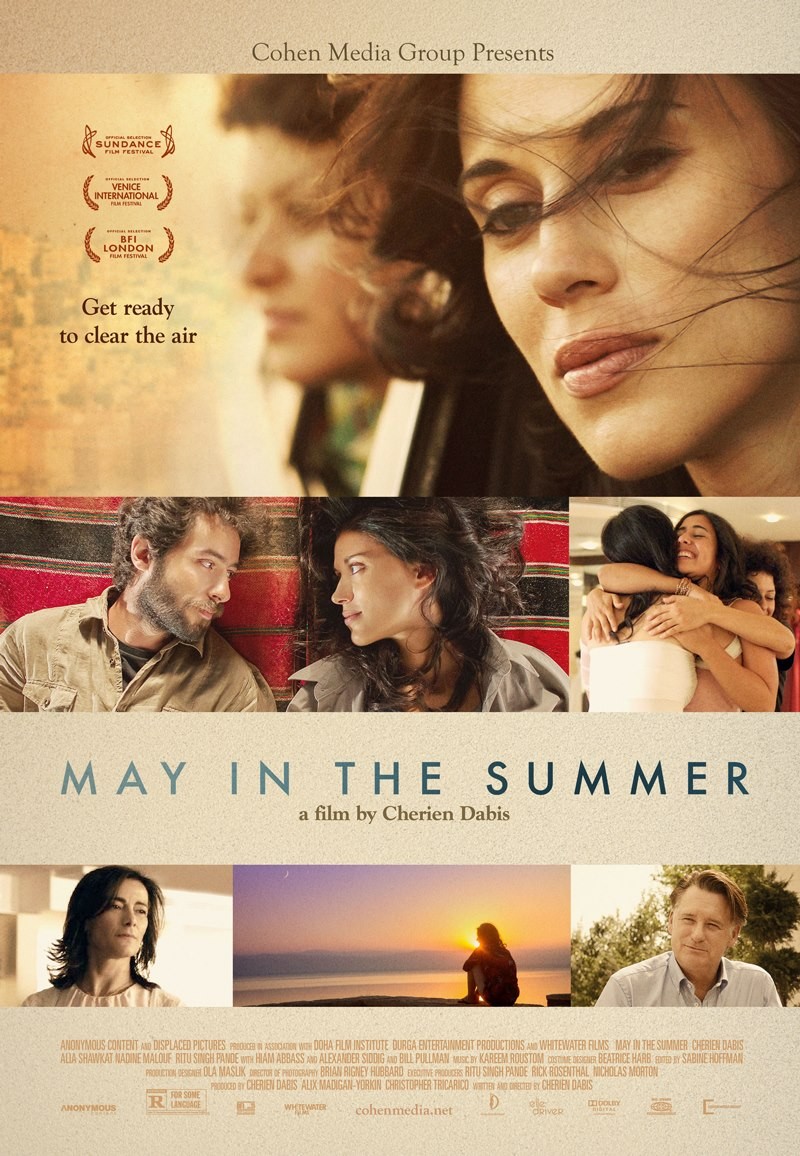
“May in the Summer” may look like the typical romantic comedy on the surface, but it’s really much more than that as it delves into a culture many of us have not seen. Cherien Dabis who wrote, directed and stars in this movie as May Brennan, a sophisticated New Yorker and an acclaimed author who travels to her childhood home in Amman, Jordan to prepare for her wedding. But shortly after reuniting with her sisters and her divorced parents, May begins to question whether she should go through with the marriage after experiencing a number of familial and cultural conflicts.
It was a pleasure talking with Dabis while she was in Los Angeles. While she talked at length about her movie, she also described just how much Jordan has changed from when she was a child. In addition, she spoke of the challenges she faced of acting and directing at the same time, what she was proudest of being able to capture onscreen about Jordan, and she talked about how actors Bill Pullman and Alia Shawkat came to be cast.
Ben Kenber: What I really liked about “May in the Summer” is that it gives us a unique look into a culture that most people have seen from a distance, and in some cases a rather biased distance. How was it for you capturing Jordan on film?
Cherien Dabis: It was great. Jordan’s a country I know very well. I’ve been traveling there since I was a kid. My parents are Palestinian and Jordanian and I was born and raised in the US, but we would return to Jordan almost every summer. For the last three decades I’ve watched the country grow and change so much that it’s been really shocking the amount of growth and change. I knew I always wanted to do something there because what I find really particular to Amman specifically is that it’s not only become super westernized, but it’s also quite Americanized. There’s a lot of American schools popping up, there are a lot of young people who are speaking English with an American accent, there’s so much American culture and American products; there’s fast food chains and Starbucks. So it’s just the side of the Middle East that I didn’t think people would find really surprising, and I wanted to feature that and to be able to feature the country and parts of the country that I’d been going to since I was young and places where I really discovered myself. It was really, really cool.
BK: You both acted in and directed this movie. Initially, you were looking to cast someone else in the role of May, correct?
CD: Yeah, I didn’t write the role for myself. I spent about a year looking for someone to play the part and I wasn’t finding someone who I felt was really authentic to the culture and language, but also someone who really embodied the spirit of the character. At the same time, I kept getting people, like random people, who would suggest that I consider myself for the part. It was really shocking to me that people kept saying that to me, but enough people said it that I just finally was like okay, this somehow feels like I am meant to do this. I am meant to consider this, that maybe this is part of my journey. I think ultimately that’s what I found. I very hesitantly put myself forward. I put myself on tape, I watch myself back and it’s always such a trip to do that for the first time. It took a little while for me to find a sense of objectivity or at least as close to objectivity as I could, but I saw something there that was raw enough that felt like I could work with it and that embodied the spirit of the character and what I had been looking for, and I surprised myself a little bit. So I called myself back, I made myself go through this rigorous casting process only to discover that wow, I think I might be able to do this. It was kind of an amazing journey and one in which I kind of paralleled May in a way. May is on this journey of self-discovery, and by putting myself in the film I was also on a journey of self-discovery in having to make myself vulnerable just like the character in the film. And when I realized that I was like oh God, now I really have to do it. It really feels like the right choice for the film, but it was a tough one to make given all of the hats that I was wearing.
BK: In terms of acting, did you have someone looking out for you when you stepped in front of the camera?
CD: I did. When I made the choice to do it, I brought on someone who became a very good friend. He’s an acting teacher in Brooklyn and he became somewhat of an acting coach to me. So I worked with him for about a year and a half before making the film, and it was great because my training was really about getting as much experience in the skill of acting and directing and not back and forth in directing myself. It is a very specific skill and I wanted to have as much experience in it as I could before getting to set, and it was really important that I did that because I would’ve been a mess if I hadn’t. But he came to set and he was there for me. He was sort of my eyes and by then we had a short hand because we had been working together for so long, so it was really great to have them there.
BK: I really loved how the Dead Sea looked in this movie. It’s just beautiful to the point where the name seems a little contradictory considering how lively the atmosphere out there seems.
CD: Right, and yet strangely appropriate given what’s on the other side of the Dead Sea. It’s (Palestine) so close. The Dead Sea’s so small and narrow, and the other side of the shore is the West Bank. It’s sort of shocking when you’re standing there looking out and you’re at a resort where there are these really beautiful infinity pools and spas and food and drinks and people partying by the pool. It’s a very contradictory paradoxical experience, and that was something I wanted to capture in the film.
BK: What would you say you were the proudest of being able to capture in this film about Jordan and its culture?
CD: That’s a really good question. I think the surrealism almost of being in a place. I have not seen that yet in a film, and I do think that what sets this movie apart from other Middle Eastern films, or Middle Eastern themed films, is that it really explores family. It’s a story about family and it’s a story that’s really relatable about relationships, and it looks at divorce but through a wedding. In some ways, it’s a sort of a divorce drama disguised as a wedding comedy. So it’s this really relatable film that’s set in this really specific part of the world, and it shows a part of that world that we don’t ever really get to see. The surrealism of that world I think is really interesting. Being in a place like Jordan which is just surrounded by conflict is at times really surreal because you can find yourself living this totally seemingly normal existence where you are going to cafés with friends or going out to dinner. You’re just going about your work, your life and you’re interacting with family, and then a fighter jet flies by and it rocks your entire world and you suddenly remember where you are and you remember that anything could happen at any moment. It gives you this incredible sense of perspective on your life where suddenly what you’re going through is not so bad and your problems seem really trivial and you remember the greater suffering in the world. I think it affects you in your life and your choices and who you are in a way that’s very unique to that part of the world, and that’s something I really wanted to capture and I think that’s something that’s there in the film. It’s something that I don’t think you get to see very often.
BK: We see a number of women in “May in the Summer” wearing a full hijab (a veil which covers the head and chest). Is it something that’s still imposed on women in Jordan or is that something women do by choice?
CD: Both. I think a lot of women do it by choice, but for a lot of women it’s not a choice. It’s imposed on them by their families or by society or by the culture. I do think this is a movie that looks at expectations like that. Our main character is definitely on a journey of self-discovery where she’s trying to figure out what kind of future she wants. She’s trying to strip away a familial expectation, a parental expectation or a societal expectation or even a political expectation, and she’s really trying to connect with her own inner voice and her own truth. That’s the only way she can really move into her own future, so it looks at those levels of expectations.
BK: Bill Pullman plays your character’s father and it’s great to see him here. Was it hard getting him cast in this movie?
CD: Surprisingly not and I was really presently surprised by that. My producer sent the script to his agent and he really responded to the script and the role. He’s just a very adventurous spirit so he wanted to travel to Jordan, he wanted to have that experience and he really wanted to go to Petra which was amazing. He was just fabulous. The moment he arrived in Jordan he just immersed himself in the culture and he wanted to just soak it all in. He was making friends right and left and he was having dinner with people he just met on the street. Within the first day of shooting, he knew everyone’s names. He was really just a special, special person and I’m so glad that he came over and wanted to be a part of that. People appreciated him so much for being so open in the culture.
BK: Alia Shawkat, who plays your sister Dalia, is also wonderful here, and she was also terrific in “The Moment” where she acted opposite Jennifer Jason Leigh. How did you go about casting her?
CD: Well I had worked with Alia on my first film, “Amreeka.” I was a huge fan of hers from “Arrested Development.” I just loved her. My executive producer on “Amreeka” actually told me that she’s half Iraqi which I had no idea, but I was very excited by that because I’m always looking to cast very authentically. So when I found that out I approached her for a role in my first feature, and when I met her she just so was that character in my first feature. When I worked with her I just absolutely loved her. We had a great time and we became friends and we kept in touch. When I conceived of the idea for “May in the Summer,” I immediately thought of her for the role of the sister, Dalia. She just has such a similar voice to that character; witty, sarcastic and subversive.
BK: Was there anything that you wanted to put into “May in the Summer” but were not able to for one reason or another?
CD: Well there are always things like that. You quickly realize when you’re making independent films that you have limited resources and there always comes a time when you have to make really painful decisions, and I definitely did on this film. I had to cut things out that I think would’ve added a lot of fabric and texture. There were a number of sequences, one where May goes downtown and we see a whole other part of the Middle East and we see it go from the really nice sort of upper-class neighborhood to the more downtown, shoddy kind of refugee camp neighborhoods. We are more used to seeing that probably on the news, and I wanted to show that transition and a little bit more of the society and give a little bit more of the political context of Jordan and the refugee situation. But ultimately the heart of the story is this family, and I had to keep the essence of that story. When I had to make those difficult decisions, Fort Lee a lot of that texture had to be cut out because we just didn’t have the time or the resources to capture it.
BK: My understanding is there’s a film industry growing in Jordan right now.
CD: Yeah that’s right, there’s definitely a burgeoning film industry. The Royal Film Commission in Jordan is great; they’ve been there for I think about 10 years now and they help facilitate production. They were enormously helpful to us and the crews are gaining a lot of experience. Kathryn Bigelow’s last two movies were shot there and a lot of the people I worked with worked on those movies. Also, John Stewart’s movie (“Rosewater”) was shot in Jordan which was another great experience for the country. It was exciting to be a part of that, to be a part of the really up-and-coming film community.
My thanks to Cherien Dabis for taking the time to talk with me. “May in the Summer” is now available to own and rent on DVD, Blu-ray, and Digital.
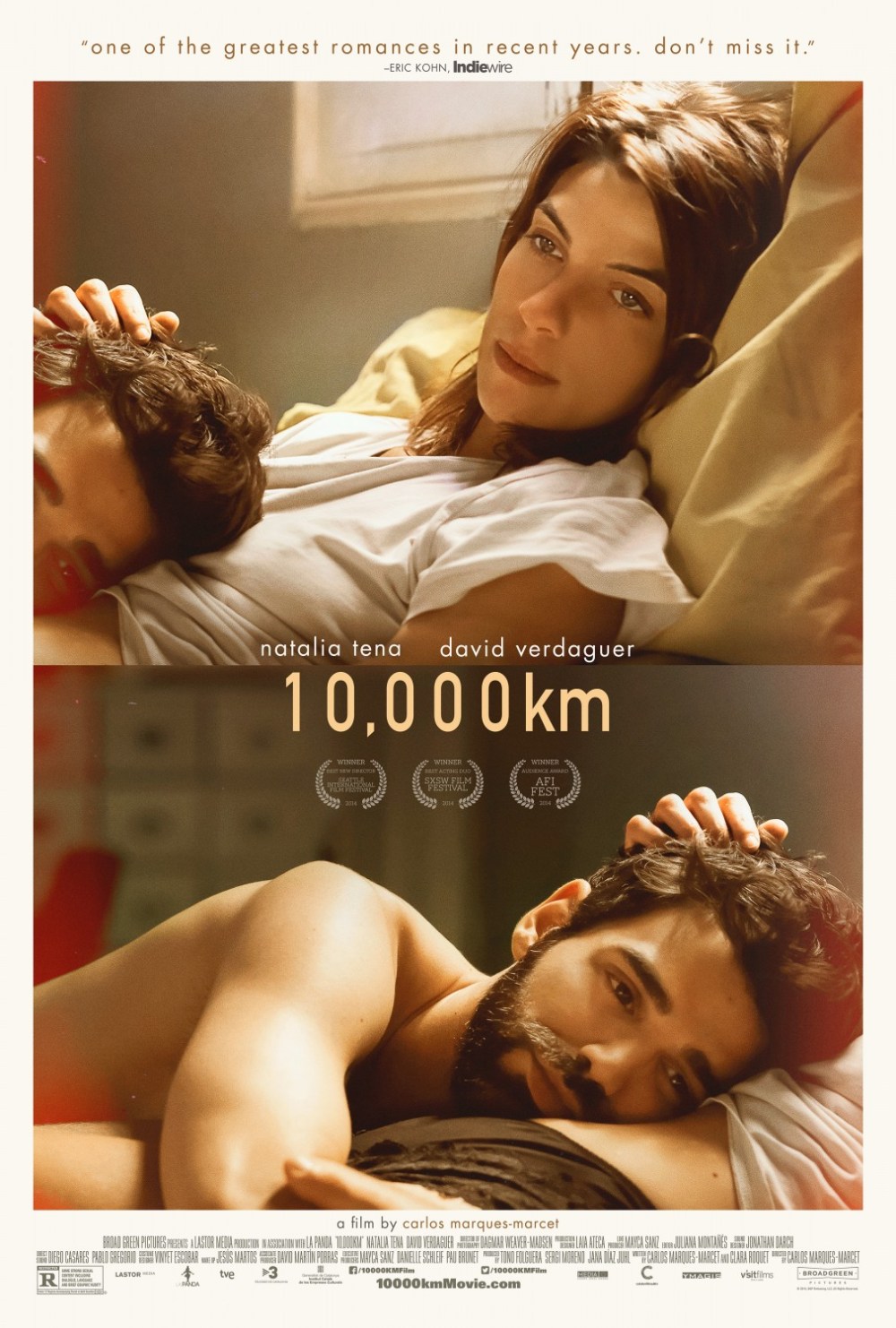
The thought of a long-distance relationship is frightening as it thoroughly tests the bond between a loving couple to where it looks like they are destined for disaster. One relationship is put to this test in “10,000 Km,” a romantic drama co-written and directed by Carlos Marques-Marcet.
Alexandra (Natalia Tena) and Sergi (David Verdaguer) are a loving couple living in Barcelona, Spain, but they also struggle to balance out their careers while trying to start a family. Then Alexandra accepts a one-year residency in Los Angeles which could really jump start her photography career, and Sergi has no choice but to stay in Barcelona where he works as a teacher. Luckily, they have modern technology which allows them to keep in touch on a daily basis, but what is helping to keep them together may also tear them apart.
“10,000 Km” proved to be a powerful meditation on the struggle of a long-distance relationship, and it starts off with a scene which lasts several minutes and captures the characters in their most intimate state. I got to talk with Marcet while he was in Los Angeles, and he talked about how that scene came about and how long it took to shoot. In addition, he also clarified how much of the movie was shot in Spain and Los Angeles, how he came to cast Tena and Verdaguer, and of how he kept the actors separated during shooting.
Ben Kenber: It’s interesting to see how this relationship evolves once the two lovers are separated by continents and use technology to keep in touch with one another. Was it hard to balance out the benefits of technology with the human element in this movie?
Carlos Marques-Marcet: No. We knew from the beginning that the driving point was to portray the relationship which derives from the human element. The technology was the tool and the human part was the means somehow, so it wasn’t so much about finding a balance but trying to see how to use these tools to convey the means.
BK: The opening sequence of “10,000 Km” is amazing as it lasts several minutes and features the two lovers being intimate with one another, and then one of them receives an unexpected job opportunity. How did you go about setting the scene up?
CMM: It was a long process to arrive there. It was originally not such a long scene, but then we looked at the script and it suddenly made sense to have this very long scene where you see them together. It’s a two shot of them and you are with them, then afterwards the rest of the movie we shot over shot because they have no other possibilities. There’s a symbolic element to it, this raw thing of being with two people together that weren’t there together. The making of it involved a lot of preparation. The location was the producer’s house, so I knew where I was going to shoot. It was a combination of working with all the departments, the actors and rehearsing. It was like a dance.
BK: This scene must have taken a very long time to shoot.
CMM: 17 takes and three days of shooting. We planned it and we wanted to do it with the dollies. There was no handheld camera. We wanted it to be grounded to the ground. I think it was an interesting way of how to go about it.
BK: Natalia Tena and David Verdaguer are both terrific in this movie. What was the casting process like?
CMM: So basically, we found David about a year before shooting. I had just graduated from UCLA and I didn’t want to shoot another short. I just took a couple of scenes from the movie and shot them just as an experiment with another actress. I watched a lot of You Tube videos and interviews. I like to see how actors move and how they talk, and I was looking for another actor, not David, and then I saw him in this video he made with a cell phone of two friends. Then I saw that he was an actor and I proposed to my producers that we bring him in for casting, but then it turned out that he’s actually known as a comedian. I had no idea. He’s like a “Saturday Night Live” comedian. Actually, he’s done a lot of theater, very serious theater, but people love him for his comedic aspect. But then he came into the casting process, and it was a very long casting process with two people for hours. I like to work with the actors instead of just having them come in to read. I like to meet people. It was David for sure, no doubt. And then with Natalia, it was a last-minute thing. We were actually going to shoot with another actress and she had to cancel, and when we finally found Natalia it was like a miracle. It was very clear that they had chemistry, and they became very close friends instantaneously.
BK: When it came to shooting the scenes when she’s in Los Angeles and he’s back in Spain and they are using Skype to keep in touch with one another, did you purposely separate the actors?
CMM: Yeah. Originally I wanted to shoot it in Los Angeles and in Barcelona at the same time, but Natalia had some scheduling conflicts. It wasn’t that cheap to do it. I wanted to shoot it in my own house in Los Angeles, but schedule wise it was not possible. So we put them in two different apartments in Barcelona and I actually after shooting the first scene said that it would be nice if they didn’t see each other, but that lasted like two or three days (laughs). After three days I was like it’s fine if they hang out with each other. I wanted to create the feeling of missing somebody, and three days was totally enough. In the end, they were hanging out together every night playing cards, going over the lines and drinking wine, and in the morning they had to be separated. So, for them being in touch every day and then during the day not being able to be together was very frustrating, and I think that shows up somehow in the movie.
BK: When “10,000 Km” begins we see this couple at their most intimate, and they still have that intimacy throughout the movie to a certain extent. I don’t want to give away the ending, but I loved how you ended the movie on an ambiguous note. It’s not the kind of movie that begs for a solid or more definitive conclusion.
CMM: Yeah, that came about during the editing. Actually, the script was much more clear, but while we were editing there was a bunch of dialogue that we decided to take out because I felt that already through the images we could tell what was going on. Then we took it out and then for some people it became more ambiguous than it was in the script. I like it. It was not in the plan of how I shot it. I have my own vision of it, but I also like to let people imagine whatever they want.
BK: “10,000 Km” is not designed to give anyone a definitive answer to whether long-distance relationships can work or not, but I came out of it hoping these two would find a way to make things work out.
CMM: That’s a very optimistic view (laughs). We leave it so that the very optimistic people can think that (laughs).
BK: Despite the scheduling conflicts, were you able to shoot any of the movie in Los Angeles, or was it mostly shot in Barcelona?
CMM: Mostly in Barcelona, and then I shot some of the stuff in LA. There are some shots where you see my home in Echo Park with the webcam and everything, but mostly we shot it in Barcelona. We faked the LA interior in Barcelona. It was not possible to do it the other way around. In Los Angeles, you won’t find interior like you would in Barcelona. I didn’t want to shoot in a studio. I wanted to shoot in a real location so they have the feeling that they are in a house or a real apartment.
I want to thank Carlos Marques for taking the time to talk with me. “10,000 Km” is now available to own and rent on Blu-ray, DVD, and Digital.
There are five stages of grief: denial, anger, bargaining, depression and acceptance. It’s never easy recovering from grief whether it involves loss of a loved one or dealing with the now inescapable fact that Donald Trump will be the next President of the United States. Watching Casey Affleck’s character in “Manchester by the Sea,” I wonder if he will ever get past the first stage. If he’s lucky, he just might make it to the second. While some are able to get past their grief, others are doomed to be stuck in it for an eternity.
Many movies about grief have been made over the years, but few feel as bitingly honest as “Manchester by the Sea” does. It is the latest work from writer and director Kenneth Lonergan who previously gave us “You Can Count on Me” and “Margaret,” and he really tops himself with this one. While this may, on the surface, seem like a depressing movie, it is one filled a surprising amount of laughter and a wealth of interesting characters whom we watch struggle with the steep hurdles life has thrown at them as well as the snowy weather which chills all those who live in Massachusetts during the winter months.
Affleck plays Lee Chandler who, as the movie starts, works as a janitor and lives in the tiniest of apartments in Quincy, Massachusetts. He is a quiet man and one who is not quick to make friends, especially with those who stare at him for a couple of seconds too long. His face seems as frozen as the snow he constantly shovels off his front porch, so we know the movie will be a journey into discovering how Lee ended up looking so bereft of life.
One day, Lee gets word his brother, Joe (Kyle Chandler), has passed away after suffering a heart attack. This forces Lee to drive to his hometown of Manchester-by-the-Sea to meet up with family members and relatives he has long since become estranged from, and his reaction to seeing them all seems strangely serene as if he has been preparing for this moment in a way no one else would bother to. But as the movie goes on, we come to see why Lee can never again be comfortable in his hometown as it is filled with memories and ghosts he may never ever put behind him.
Now in many ways this movie sounds like a typical one about someone reflecting on the memory of a friend who is no longer living, but Lonergan never tries to take the easy way out here. He presents us with characters who are ever so real, and their reactions to the tragedies thrown in their faces feels honest as one never responds to something so painful in the way you might expect. Everyone is far from perfect and no one here is easily likable, but the characters grow on you as they attempt to navigate past the wreckage of their lives.
Lonergan’s talent as a writer has never been in doubt, but what astounded me most about “Manchester by the Sea” is how confident his direction is. His cast ends up giving such naturalistic performances to where they inhabit their characters more than play them. I never felt like I was watching a movie, but instead it seemed like I was eavesdropping on people whose lives and problems feel more real than we ever could expect. Pulling something like this off requires major talent, and Lonergan has it in massive supply.
All eyes are on Affleck who gives what is far and away one of the best performances of 2016. His character of Lee Chandler reminded me of William Hurt in “The Accidental Tourist” and Nick Nolte in “Affliction” in that those actors played characters so damaged by horrific tragedies in life to where they could no longer process a wide range of emotions. Affleck has a tricky role here as Lee looks to be experiencing intense grief from start to finish, but at the same time he is constantly running away from circumstances which will cause those emotions to overwhelm him in a way he feels he can never handle. This must have been an exhausting role to play, but it’s no surprise to see Affleck rise to the challenge.
There is not a single weak link to be found in the cast here as each actor, no matter how small their role is, creates a multi-dimensional character worth following. Michelle Williams in particular has a show stopping moment as Lee’s ex-wife, Randi, as she tries to make peace with him after all they have been through. Williams has always been fearless in exploring emotions many of us have tried to numb ourselves to whether we realize it or not and, just like she did in “Blue Valentine,” she digs deep into the tragic nature of her character as Randi appears far more ready to deal with past than Lee is.
I also have to single out Lucas Hedges who gives an honest portrayal of a teenager as Lee’s nephew, Patrick. So many teenagers in movies these days seem designed to appeal to a popular demographic regardless of whether the target audience can relate to them or not. But Hedges gives us one who quickly reminds us of how we juggled a number of girlfriends (if we were lucky to, that is) while dealing with a tragedy no one that young should ever have to deal with. Hedges is a real find as he makes Patrick a far more mature character than his emotionally wounded uncle, and he is as unforgettable as Affleck is in this movie.
In a year which proved to be a mediocre one for motion pictures, “Manchester by the Sea” is easily one of the best for many reasons. If it has any flaws, they are hard to see on the first viewing. But even if you do spot any flaws, they are not enough to take away from how great a movie this is. Lonergan has given us a cinematic masterpiece which demands your attention as it deals with a subject that is never easy to grapple with. While the movie’s ending proves to be understandably ambiguous, he never leaves these characters without a sense of hope for the future.
Watching this movie reminded me of an episode of “Homicide: Life on the Street” entitled “Pit Bull Sessions” in which Frank Pembleton and Paul Falsone interrogate a man whose pit bulls have been trained for dogfighting have killed his grandfather. This man, who was played by Paul Giamatti by the way, cares for his dogs far more than he does for any member of his family to where he shows little, if any, remorse for what has happened to his grandfather. Falsone is incensed over how the son seems indifferent to what has happened to a member of his family, and it leads to a classic exchange between him and Pembleton.
“The 5th Wave” comes to us not long after the conclusion of “The Hungers Games,” and it is the latest in a seemingly endless line of young adult book to film adaptations. As a result, I came into this movie feeling worn out even before it started. While the novel it is based on, written by Rick Yancey, might be an interesting read, what unfolds onscreen feels like the same old thing. Only the names and places have been changed to protect the filmmakers from potential lawsuits.
Chloe Grace Moretz stars as Cassie Sullivan, a young teenager (is there any other kind?) who lives a normal life with her family, attends high school where she’s a cheerleader and constantly deals with unrequited love like any other child held prisoner by adolescence. But suddenly an alien ship, which looks like something out of “District 9,” appears in the sky, and the Earth goes through four waves which leave it decimated and on the verge of extinction. All Cassie has left is her brother whom she ends up getting separated from, and from there she is determined to save him from a fate many others have suffered.
This movie does not get off to a good start as the visual effects used to convey the various waves are shoddy CGI, and some scenes end up looking like outtakes from “Independence Day” or any other Roland Emmerich production. When the plot finally gains momentum, Cassie finds herself on the run and forced to defend herself in ways she never planned. She’s also looking for her brother whom she is very close to. Doesn’t this sound like something we just saw?
It’s a shame because the movie does have Moretz who makes this mess more bearable than it should be. Her breakthrough performance in “Kick-Ass” was no fluke and she continues to do strong work in each film she appears in, regardless of whether they are good or bad. She makes Cassie a strong heroine and one whom kids around the same age will easily relate to as she fends for herself in the dangerous world everyone has been thrust into, and Moretz makes you root for her throughout. But even she can’t save this routine young adult movie which has come out way too late.
Actually, what’s especially interesting about “The 5th Wave” is how the female characters are far more interesting than the male ones. It also helps they have such terrific actresses inhabiting those characters, and each of them clearly relishes the opportunity to bring them to life. Maria Bello, sporting a very funky hairdo, makes Sergeant Reznik a slyly manipulative soldier as she forces the children to see the alien threat her way to where getting them to fight for the human race is easy as cake. Maika Monroe, so good in “The Guest” and “It Follows,” makes her character of Ringer a wonderfully tough warrior, and she also skillfully unveils the other layers of Ringer to show us a person who is deeply broken. Along with Moretz, they keep “The 5th Wave” from becoming a complete bore.
The male actors, however, don’t have much to work with and their performances suffer as a result. Nick Robinson plays Ben Parish, the high school football hero who, when he is forced to enlist in the military, is nicknamed Zombie. Zombie proves to be an appropriate name as Robinson has little choice but to give a one-note performance as much of the emotion Ben has experienced in life has long since been drained from his psyche. Then there’s Alex Roe who plays Evan Walker, a man who may not be all that he appears to be. It seems like the screenwriters had some trouble in trying to figure out what to do with this character, and that leaves Roe with little choice but to make Evan far more enigmatic than the character has any right to be.
And let’s not leave out the great Liev Schreiber, wonderfully understated in “Spotlight,” as the movie’s main antagonist Colonel Vosch. It’s no surprise Schreiber can give us such a menacing villain, but there really isn’t much of a character for him to play here. Vosch is merely here as an obstacle for Cassie to overcome, and as a result the actor is wasted in a role which is too unworthy of his talents.
Then there is the love triangle between Moretz, Robinson, and Roe, and after having been subjected to a very similar one between Jennifer Lawrence, Josh Hutcherson and Liam Hemsworth in “The Hunger Games,” I could have cared less about it. I imagine it will give audiences much to swoon over, but it’s a romance that is bland as the male characters in this movie.
“The 5th Wave” was directed by J Blakeson who previously gave us “The Disappearance of Alice Creed,” a neo-noir thriller about the kidnapping of a woman by two ex-convicts. His direction on that film was much lauded by the press, and it makes me wonder just how much control he had over this project. Clearly, the studio is setting this up to be another franchise of movies for young adults to become obsessed over as a sequel to “The 5th Wave” has already been published and a third book is on the way. But it all depends of course on how this one does at the box office and considering how we are all still getting over the end of “The Hunger Games” movies, I’m not sure everybody is in a rush for yet another franchise like it.
Perhaps the target audience for “The 5th Wave” will enjoy it the most, but even they have to be outgrowing these kinds of movies at this point. Sooner or later we have to realize kids grow up and become adults, and even adults can save the world and their little brothers too.
I originally wrote this review on May 20, 1998, not long after I watched this “summer blockbuster.”
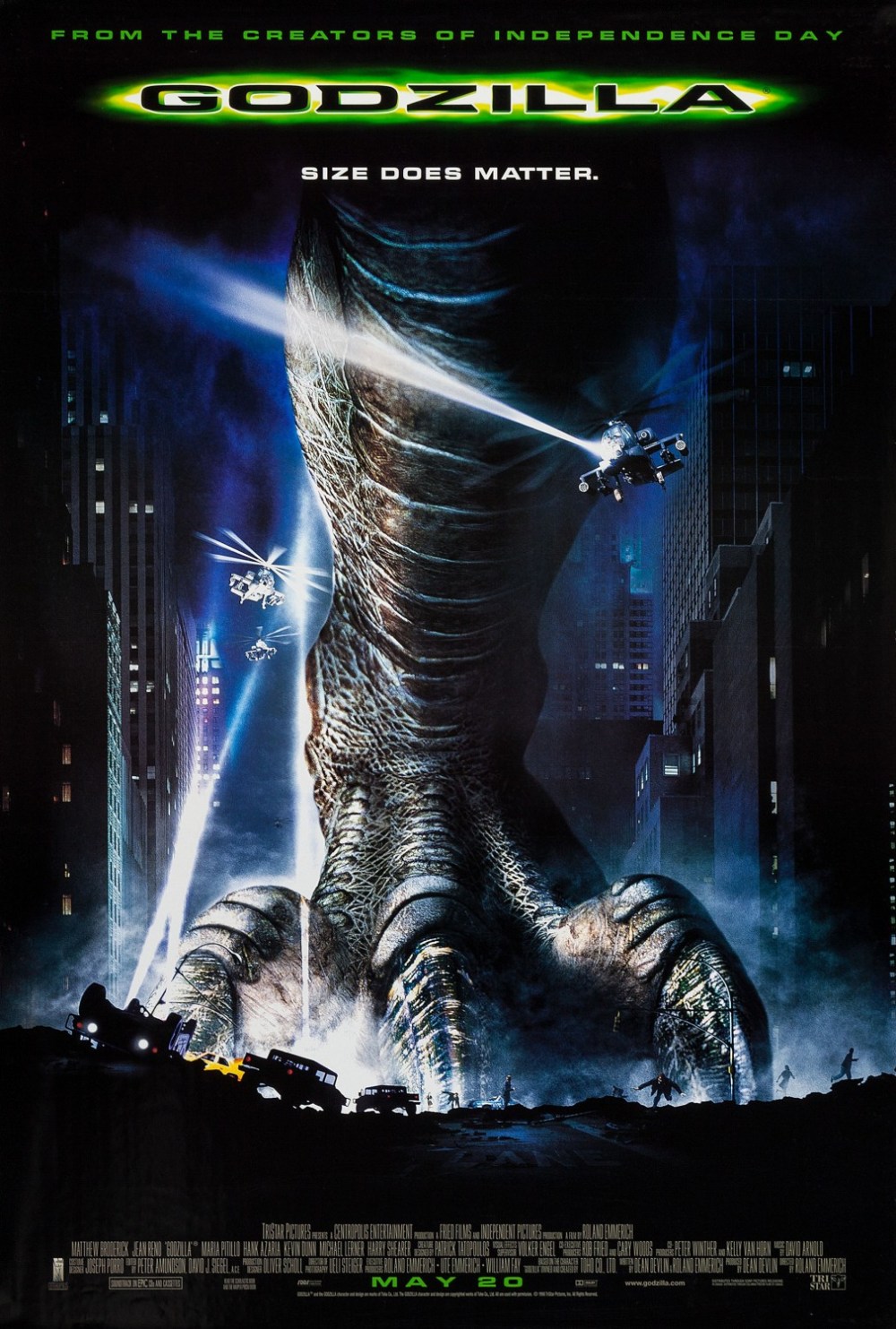
The momentous day has finally arrived! Roland Emmerich’s “Godzilla” has finally hit the big screen in all of its reptilian glory. Trailers for this movie have been up and running for over a year now, and the past few weeks have had us bombarded with television commercials from Taco Bell with the Chihuahua, hoping to cash in on this film’s predicted box office success. But now the wait is over and the film has finally hit the big screen. Everyone is waiting to see if the movie will suck in the biggest opening in box office history and outdo “Titanic” as the highest-grossing movie of all time…
What can I tell you? “Godzilla” sucks! I even wrote it up on the dry erase board in the main hall of my college dorm for everyone to see:
GODZILLA SUCKS!!!
People need to be warned because, unlike “Titanic,” this was not worth the wait. For me, this was a very depressing cinematic experience and one of those movies where the trailers for coming attractions, in this case “X-Files – Fight the Future,” “Lethal Weapon 4” and “The Mask of Zorro,” were far more entering than the main event. I read a review somewhere which quoted one patron as saying it made “Jurassic Park: The Lost World” look like “Citizen Kane.” I couldn’t agree more, and I liked “Jurassic Park: The Lost World,” a movie many consider to be one of the worst Steven Spielberg has ever directed.
Where do I start? The characters were all clichés, barely registering as humans. Kevin Dunn plays the military commander who is always in a bad mood and barking out orders, Michael Lerner is your typically clueless mayor, and Matthew Broderick portrays the nerdy scientist who is the polar opposite of Ferris Bueller. Maria Pitillo, who looks a lot like Heather Graham, was cute, but her television reporter character really belongs in a sitcom instead of a movie like this.
I blame this all on the direction of Roland Emmerich, a director who never seems to understand just how cheesy his movies are. “Independence Day” tried to be the next “Star Wars,” but it ended up being an overproduced B-movie. Still, it’s a classic of American cinema when you compare it to this overhyped mess.
There’s a scene in the beginning of the movie where three fishing boats are pulled backward underwater into the water – a direct rip off of “Jaws.” Now on one hand, I liked how Emmerich was never quick to show the giant mutated lizard, but on the other the “Jaws” reference came to illustrate all the things that “Godzilla” unforgivably lacks: great actors, strong characters, and a good storyline. Special effects by themselves can’t save a movie, especially one as crappy as this one.
Furthermore, the music score by David Arnold was way too much, and less could have been a lot more. In fact, everything about this movie was overblown, robbing it of whatever suspense it could ever have hoped to generate. There were moments where things did quiet down, and that was a relief and also showed some promise this movie might actually become exciting to watch. But then the screen became overwhelmed with countless explosions and massive destruction which we have seen in far too many movies to keep track of. Heck, the special effects in those movies are infinitely better than any in “Godzilla.” Trust me; the money is not up there on the screen.
Producer Dean Devlin and Emmerich appear to be big New York haters as they again lay waste to the city’s most famous monuments just like they did in “Independence Day.” But then again, New York seems to be the target of destruction this summer judging from the trailers I have seen for “Deep Impact” and “Armageddon.”
Now for Godzilla himself (or herself if you are not sure). When we do finally get to see the big lizard, it really proves to be nothing more than a big special effect. The more you are aware of this, the less threatening Godzilla becomes, and the action sequences end up lacking a lot of friction. I really loathe digital imaging and effects because they are too obvious on the big screen. In retrospect, I would have preferred seeing a guy in a suit instead.
There’s one moment where Godzilla jumps into the ocean, and it looks like it was lifted directly from a scene in “Alien Resurrection.” Originality is not in existence in films these days, but what else is new? I did not go in expecting a great movie, but I was at least hoping it would be exciting and intense. It was neither.
Furthermore, the look of Godzilla was nothing particularly impressive or horrifying. It looked like a cross between a Tyrannosaurus Rex that had an amazing growth spurt and the kind of lizard I saw crawling all over the place in Ibiza. Once again, originality is nonexistent and we have “Jurassic Park” all over again.
The only part that really scared me some was when the main characters discovered all the eggs Godzilla had lain in Madison Square Garden. What could we expect to see when they hatched? But hatched they did, and they all came out looking like Velociraptors or Velociraptor wannabes.
You’d think after a film like “Independence Day,” which was a huge hit worldwide but not exactly a critical success, that the filmmakers would learn from their mistakes and make a better movie. But no! We get one which is even worse and yet is still bound to make tons of money. But having seen “Godzilla,” I am more than confident that it will not dethrone “Titanic” as the all-time box office champ. Hey Tri-Star Pictures! Don’t count your chickens before they hatch!
A lot of people say that James Cameron is a big egomaniac and a jerk to his cast and crew on each movie he has directed. Maybe he is, claiming he can make these kinds of movies better than everyone else. But after “Godzilla” ended, I think Cameron can brag all he wants until he makes a tremendously crappy movie like this one. I don’t care how bad you thought the dialogue was in “Titanic;” “Godzilla” is the bottom of the barrel in the screenplay department. How many writers did it take to come up with this script anyway?
And, of course, we have the obligatory ending where Madison Square Garden is destroyed, but for some bizarre and unexplained reason there’s an egg which was somehow undamaged (go figure). The baby burst out of the egg just as the movie faded to black, and I imagined a lot of audience members probably thought the following when they saw it:
“Oh no! It’s a baby!!!”
But I just stared at the screen and thought to myself:
“Oh no! It’s a set up for a sequel!! SAVE US NOW!!!”
Just how many times can you destroy New York in the movies anyway?
I was invited to attend a special press screening of the 2014 “Godzilla” at Grauman’s Chinese Theatre (it’s now called TCL Chinese Theatres, but I prefer to call it Grauman’s), and it proved to be a huge improvement over Roland Emmerich’s 1998 debacle. Following the screening, we were treated to a Q&A with the movie’s director Gareth Edwards and the CEO of Legendary Pictures, Thomas Tull. The two of them discussed how they saw this version of the giant monster, the first time they became aware of who or what Godzilla was, and of how their film mirrors the current events of today.
There have been dozens and dozens of “Godzilla” movies made since 1954, most of them made in Japan by Toho Company Limited. There have been a couple of American movies made about this enormous monster as well, but they didn’t fare well to say the least. “Godzilla 1985” was universally panned by film critics and died a quick death at the box office. As for Roland Emmerich’s “Godzilla” which came out in 1998, I still cringe at the thought of its existence as it was amazingly awful. But when it came to making the 2014 version, Edwards made clear he was not about to let fans or critics down.
“We were trying to put more into it than just a simple monster movie because the original was definitely a metaphor for Hiroshima and Nagasaki and a very serious film. So we were inspired to try and reflect that,” Edwards said. “We police the world and go, ‘You can’t have nuclear power. You can’t have it. But we can have it, and we have nuclear weapons.’ And what if there were a creature that existed, creatures that were attracted to radiation? Suddenly the tables would be turned, and we’d be desperately trying to get rid of that stuff.”
From there, both Edwards and Tull described the first time they saw Godzilla. Hearing Tull talk about his first exposure to the Japanese monster came to illustrate just how big of an effect monster movies had on him when he was growing up. As for Edwards, he ended up describing his first exposure as being embarrassing.
“First time I saw it, it was the ’54 version,” Tull said. “I was probably around 7 years old. Where I grew up in upstate New York, what I looked forward to every year was the Friday after Thanksgiving when the local TV station would play ‘Godzilla’ marathons all day. That was my favorite thing of the year. I had the incredible fortune of making movies out of all the stuff I loved as a kid: ‘Batman,’ ‘Superman,’ Watchmen’ and now ‘Godzilla.’ Somehow the magic genie made it happen. This is really special to me.”
“In the U.K. when we were kids growing up, they had the Hanna Barbara cartoon. Not many people know that in America. I thought it was a worldwide thing,” Edwards said. “But it was basically Godzilla and I guess his son, Godzuki, and it would fly; it was all very cute. When you’re a kid it was great. I got offered this amazing opportunity. People in the U.K, they like to take the piss out of their friends, so just to mock me they would always refer to it as Godzuki. They’d be like, ‘How’s Godzuki going? Have you been to any Godzuki meetings?’ And I used to play along with it to the point where my phone learned how to spell Godzuki more than Godzilla. So when we used to have regular emails about the film, I’d type Godzilla and it would automatically change it to Godzuki. And for a while, I thought I might get fired.”
Edwards said while he and Tull were in the process of putting the movie together, the Tōhoku earthquake and tsunami, also known as the Great East Japan Earthquake, occurred which decimated much of Fukushima and caused serious accidents at nuclear power plants. Now when horrific events like this occur, Hollywood is quick to distance itself from them for fear of appearing like they are profiting from them. But considering the genres “Godzilla” covers, there was enough of a reason not to ignore the serious events happening around the world.
“There was a point where it felt like, well, maybe we shouldn’t set it in Japan. Maybe we shouldn’t deal with radiation or anything like this,” Edwards said. “We had genuine conversations for quite a while and we talked to a lot of people, and knew a lot of people, who were Japanese obviously working with Toho. And after a while the general consensus was that the 1954 version, the whole point of that movie, and science fiction and fantasy in general I think, they have this opportunity to reflect the period that they’re made in, and so it was thought as long as we did it respectively and the city and the events in our film are not about anything that happened in Japan. So, we felt it kind of appropriate to acknowledge some of these issues as we were figuring out the storyline.”
“When I was a kid, my dad used to have an encyclopedia on the twentieth Century, and on the front cover was Hiroshima, JFK’s assassination, Hitler, all the major events of the twentieth century,” Edwards continued. “I used to look at it and think none of that happened in my lifetime. Nothing significant like that has happened in my lifetime. Maybe nothing like that ever will. And then in the last ten years with the obvious things, it’s nearly impossible to genuinely sit down and say, ‘OK, I want to do a monster movie. I want to try and treat this like it really happened. What would it look like? How would people react and not be infected by the imagery over the last ten years, whether it be the natural disasters or even some of the terrorism?’ So that kind of infected the film a little bit. But we tried to do it in a way that, first and foremost, it’s entertainment. You’re here to see a Godzilla. But I personally like a little meat on my bone, so within that there’s obviously this other imagery and meaning that you can pull from as much as you want or as little as you want.”
Before this, Edwards had only one directorial effort to his name, the 2010 film “Monsters.” It had a budget of only $500,000 and, in addition to directing it, he also worked as writer, cinematographer and the visual effects artist which may explain why it didn’t cost much to make. With “Godzilla,” he had the backing of a major studio and an estimated budget of $160 million. Talk about one heck of a promotion! This has got to put the fear of God into any filmmaker making this kind of transition, but Edwards sounded like he has handled big budget moviemaking very well.
“It’s a massive, massive deal,” Edwards said. “It’s not just a once in a lifetime opportunity; it’s a once in a million-lifetime opportunity to be able to get to do this. The way I dealt with it was to forget we were doing it and just convince ourselves, which was kind of very easy to do, that we’re just in this bubble; it’s just us, and we’re just making a movie that we want to sit and watch, something that will give us goose bumps. And it’s kind of this selfish passion project in the way you kind of approach every day. Because I’d get paralyzed if I really thought about the number of people who would end up seeing the film and all the publicity and press that would come from it.”
“But it’s such a great opportunity,” Edwards continued. “I grew up since I was a little kid desperate to be a film director, and the second they mentioned it I was just like, I could never live with myself if I ever turned this down. I mean, I love monster movies. My first film was a monster movie. This is the ultimate monster movie. So how could you live with yourself having not made ‘Godzilla’ when you had that opportunity?”
Even before its release, “Godzilla” had already sparked conversations about a sequel or a potential franchise. This is not a surprise as movie studios are always looking for the next big movie trilogy to thrust at movie fans eager to pay their hard-earned money for. Edwards, however, said it was his intention to make a stand-alone movie, something I was very pleased to hear. As for Tull, with Legendary Pictures having been purchased by Universal Pictures, he was asked if a sequel would be released by either Universal Pictures or Warner Brothers, the latter which is distributing this movie. In the end, Tull could only say the following:
“We have a little rule: we can’t talk about anything else until this comes out and works,” Tull said. “It’s a little superstition I have. All I can say is, we’re passionate fans of the universe and we love Godzilla and some of those other folks do too, so if this comes out and works we’ll figure it out.”
The worst Christmas memories we have tend to become the funniest and most memorable moments of our lives, and I went into “A Merry Friggin’ Christmas” thinking it would reflect this fact. With a cast which includes such tremendously talented actors like Joel McHale, Lauren Graham, Candice Bergen, Clark Duke and Robin Williams, in what sadly turned out to be one of his last roles before his tragic death, this seemed to be a surefire winner and quite possibly one of the most subversive Christmas comedies ever, right?
Nope, no such luck. “A Merry Friggin’ Christmas” turns out to be a tremendous disappointment as it strands its wonderful cast in a far too typical Christmas movie with very little in the way of laughs. In fact, I never got much in the way of gut-busting laughs like I hoped I would. When actors like these can’t make this holiday comedy rise above its formulaic conventions, you know something is seriously wrong in the state of Denmark.
McHale stars as Boyd Mitchler, and the movie starts with him as a boy hiding under the Christmas tree waiting for Santa Claus to appear. But instead of Santa Claus, Boyd is greeted by his drunken father Mitch (Robin Williams) who quickly tells him that, like the Easter Bunny, Santa doesn’t exist. Move to a number of years later, and Boyd is now happily married to Luann (Lauren Graham) and the father of two adorable children. Unlike his father, Boyd is determined to keep the magic of Christmas going for his kids as long as he can before the reality of the cruel world they live in forever robs them of it.
It’s interesting how Boyd’s daughter already knows Santa doesn’t exist as kids these days are getting increasingly harder to trick or fool. Still, Boyd is determined to keep his son Douglas (Pierce Gagnon from “Looper”) believing the jolly fat man from the North Pole is real even if he has to fly at 20,000 mph in order to deliver all those presents in a timely fashion. Of course, with climate change melting away much of the ice on this planet, Santa will most likely be living in a submarine at this point.
But then Boyd gets word from his brother Nelson (Clark Duke) that his baby is going to be baptized on Christmas Eve, and this means the whole Mitchler family is going to be reunited under one roof for the first time in years. We all know what happens when such a dysfunctional family gets together; tempers flare and old resentments quickly rise to the surface. Clearly, things are going to get worse before they can finally get better, and it doesn’t take a genius to see how predictable this “comedy” is going to end up being.
What’s even more unsurprising is how we see early on that Boyd is going to completely forget to bring Douglas’ presents along with him, and this results in him going on an 8-hour round trip to get them and preserve his son’s belief in Christmas. Coming along with Boyd on this ride is father who uses his truck which has a couple of portable toilets stowed in the back. Will one of them fall off the truck and create a disgusting mess? Does a bear shit in the woods?
Holiday movies are a dime a dozen, and I’m always waiting for one which messes around with the formula to give us something different. “A Merry Friggin’ Christmas” had the potential to be such a movie, but it ends up falling apart as soon as it starts. The performances and the comedy are played much too broadly, and everything comes off as uninspired. It’s such a shame because you have an actor like Graham, who starred in one of the greatest Christmas movies ever made, “Bad Santa,” and even she can’t save this movie with her priceless expressions (and they really are priceless).
“A Merry Friggin’ Christmas” has taken on a special meaning in light of Williams’ tragic death, and it’s sad his career had to end with a movie like this one. Having said that, he does have some moments where he doesn’t say a word but his face speaks volumes about what Mitch is feeling and going through in his head. He makes you feel Mitch’s pain when he discovers he has been photo-shopped out of a family photo, and while his character is mostly a one-dimensional jerk, Williams gives him a depth many other actors would not have been able to achieve. It’s a shame his talents ended up being wasted on such a half-baked screenplay.
For me, there are few things worse than a comedy that doesn’t make you laugh, and “A Merry Friggin’ Christmas” sadly turns out to be one of them. Those looking for the perfect Christmas movie for the whole family will be better off renting “National Lampoon’s Christmas Vacation,” “Love Actually” or “Bad Santa.” This one is not going to keep you entertained.
* out of * * * *
On the upside, the existence of this misbegotten Christmas movie did allow me the opportunity to talk with two of its stars, Joel McHale and Lauren Graham, about its making. Please check out the interview below:








 The Ultimate Rabbit