‘Captain Underpants: The First Epic Movie’ is Wonderfully Entertaining

Captain Underpants movie poster

Sooner or later, we were bound to have a superhero, animated or live action, wearing just underwear. The main characters of “Captain Underpants: The First Epic Movie” tell the audience how superheroes typically look like they are in their pajamas, so they have created one who is wearing little to nothing. Most of the time, superheroes are wearing things we would never wear to the office, and there are others who look like they are barely dressed as it is. With Captain Underpants, we now have a heroic character who wears underwear as well as a cape, and he shows no shame in his appearance. Why should he anyway? He’s a superhero, and one look at him will confirm whether he prefers boxers or briefs.

“Captain Underpants” is a series of children’s novels written by Dav Pilkey who channeled his class clown behavior and learning disabilities into them, and now it has been adapted to the big screen by Dreamworks Animation. I had no idea what to expect from this “First Epic Movie” as I am unfamiliar with these books, but I am delighted to say the filmmakers have created an animated film which appeals to both kids and adults. While kids can revel in the adventures these characters have, the adults will get a kick out of the subversive comic elements which remind us of the problems we Americans experience with our malfunctioning education system. Just keep in mind, a lot of these problems began occurring before Betsy DeVos became Secretary of Education.

Anyway, we are quickly introduced to the main characters, George Beard (Kevin Hart) and Harold Hutchins (Thomas Middleditch), a pair of fourth-graders and best friends who revel in entertaining their classmates with pranks and creating comic books in their treehouse which they have branded as the headquarters for their company, Treehouse Comix Inc. Their friendship, however, is threatened by the evil Mr. Krupp (Ed Helms), the elementary school principal. After one prank too many, Mr. Krupp, decides to tear them apart by putting them into separate classrooms. But our young heroes quickly turn the tables by hypnotizing him with a 3D Hypno Ring they got out of a cereal box, and this allows them to turn Mr. Krupp into their most popular comic book creation, Captain Underpants.

I loved how this movie touches on a child’s view of elementary school to where I was reminded of the years I spent there. The thought of being in a separate classroom from your best friend was a real fear as recess time never seemed long enough to hang out together. And yes, school did seem like a prison at times where the teachers, the bad ones anyway, look determined to suck the fun out of anything and everything while making us learn facts and dates, some of which will escape our minds in the distant future. Heck, the teachers need textbooks to be reminded of these same things.

But moreover, “Captain Underpants” reminds us of how powerful our imaginations were at that age. We had such vivid fantasy worlds playing in our heads, and we went to places and experienced adventures where we were always the hero. Seeing George and Harold bring these adventures to life in comic books should make you remember when your imaginary worlds were infinite in what they promised. While the forces of schoolwork and conformity loom large in their lives, and they will loom even larger as they get older, we root for these two kids to persevere as we are reminded of how children need time to play and create. I feels like, in this day and age, the fun of childhood has given way to preparing kids for those damned SATs even before they graduate from pre-school.

Okay, maybe I’m making “Captain Underpants: The First Epic Movie” sound more serious than it has any right to be. In the end, this movie is all about fun as George and Harold try their best to keep their hypnotized principal in check even as his alter-ego of the Captain keeps him bouncing all over the place as he attempts to save those who don’t necessarily need saving. Seeing these two kids switch Mr. Krupp into Captain Underpants and vice versa makes for one of this movie’s funniest moments.

Of course, there proves to be an even bigger threat than Mr. Krupp here as the movie’s main villain, Professor Poopypants (Nick Kroll), comes to the elementary school as the new science teacher. His plan? To eradicate laughter from the planet as he has long become impatient with everybody not taking him seriously. Then again, how can anyone be taken seriously with a name like Poopypants? Just wait until you hear his full name.

Directed David Soren (“Turbo”) and screenwriter Nicholas Stoller (“Forgetting Sarah Marshall”) have given us a tale of good versus evil which is largely predictable, but they keep throwing left turns at us which keeps this movie feeling less so even when the climax is never in doubt. Not all the jokes work, but there are some which are priceless, and Professor Poppypants statement on the state of education is dead on. And yes, there are some fart jokes, but the ones here are far more creative than any which begged for your laughter in the abysmal “Diary of a Wimpy Kid: The Long Haul.

Both Hart and Middleditch have loads of playing the two fourth graders, and they remind you of the benefits of doing voiceovers in animated movies: you can get away with playing children even when you’re in your 30’s! As for Helms, you can always count on him to make a superhero sound so confident even as said superhero has yet to learn of his limits, of which there are many. Kroll has fun playing around with supervillain clichés as Professor Poopypants as he exploits the bad guy conventions which come with crazy hair and an all too thick accent. Jordan Peele, riding high on the success of “Get Out,” has a blast voicing the tattle tale we all love to hate, Melvin Sneedly. Kristen Schaal also co-stars as Edith, the school lunch lady whose shyness and closeted affections for Mr. Krupp she makes all the more palpable.

“Captain Underpants: The First Epic Movie” may not go down as an animated classic, and its animation does pale in comparison to what Pixar typically comes up with, but it is filled with an abundance of imagination and cleverness which I did not expect to find. The filmmakers clearly have a great affection for the books of Dav Pilkey, and if this is to become Dreamworks’ next big animated franchise, it will be lots of fun to see where it goes from here.

By the way, does it really make sense that Principal Krupp would just turn right into the hero George and Harold created from their imaginations? Oh wait, it’s an animated movie. Who cares?

* * * out of * * * *

‘Big Eyes’ Marks a Return to Form for Tim Burton

Big Eyes movie poster

Tim Burton’s unique talents as a filmmaker have floundered in recent years with his abysmal remakes of “Planet of the Apes” and “Alice in Wonderland” which was lacking in wonder. But with “Big Eyes,” he gives us his best and most human movie in a long time as he examines the life of American artist Margaret Keane whose paintings of children with oversized, doe-like eyes became very popular in the 1950’s. It reunites Burton with his “Ed Wood” screenwriters Scott Alexander and Larry Karaszewski who have provided us with some of the most unique biopics in recent memory like “The People vs. Larry Flynt” and “Man on The Moon.” Yes, it is based on a true story, but for once it helps to know this as the movie is a tale which proves there are things much stranger than fiction.

“Big Eyes” starts with a narrator saying the 1950’s was a good time if you were a man. This certainly seems to be the case with Margaret Keane (Amy Adams) as she is in the process of leaving her husband and drive herself and her daughter Jane out to San Francisco to start all over again. This decade had women relegated to the role of housewife, and they could do very little else as feminism had yet to become a movement. Margaret has trouble finding work until she gets a job at a furniture company painting baby cribs. At the same time, she is quite the painter who paints pictures of children, most of which resemble her daughter, that stand out because of the big eyes she gives her subjects.

While at an art sale, Margaret meets Walter (Christoph Waltz), a fellow painter who quickly becomes enamored of her and her paintings, and he quickly begins to encourage her not to sell herself short. They soon fall for one another and get married, and they become determined to sell their art to the masses. When their attempts to get their work hung up at art houses fails, Walter resorts to renting the walls at The Hungry I club owned by Enrico Banducci (Jon Polito). It is there the paintings begin to gain notice, but patrons are far more interested in Margaret’s work than they are in Walter’s. In the process, Walter starts to take credit for his wife’s paintings, and this is where things take a rather interesting turn.

Margaret is repulsed at first by the idea of Walter taking credit for her work, but she finds herself giving in to him as he promises to give her everything she ever wanted in life like a big house to live in. But as the popularity of the paintings grows, a rift forms between them as Margaret ends up residing in the background while Walter takes center stage at various talk shows and public engagements. Soon, Margaret goes from being timid to becoming a very determined person as she aims to reclaim the art she created.

What happened between Margaret and Walter Keane became the story of one of the most epic art frauds in history, and I have to admit I was not aware of this piece of history before I saw “Big Eyes.” If this story were presented to me as fiction, I’m fairly certain I would not have bought it as this story would have been far too bizarre to be the least bit believable. But these events did happen, and Burton’s strong affection for Margaret’s work is definitely on display here.

I’m so glad Alexander and Karaszewski are still getting away with making these renegade biopics about individuals who might otherwise not get cinematic treatment. The fact they brought this particular story to the big screen is extraordinary as it involves an act of plagiarism which didn’t take place in Hollywood. It sounds like a typical good guy/bad guy story, but the way the story develops shows this to not be the case.

Adams is her usually remarkable self as she takes Margaret Keane from the depths of isolation and bitterness to the heights of confidence and self-assertion. She also presents Margaret to us with flaws and all to where we respect her deeply even if some say she put herself in the position of having her work stolen. The 1950’s may have not been the best time for women, but the victory Margaret achieved opened doors for them to where they would never ever be held back by the role society expected them to play.

Waltz won his two Oscars for good reasons as he portrayed his characters in Quentin Tarantino’s “Inglourious Basterds” and “Django Unchained” with such relish. His performance in “Big Eyes” proves to be equally wonderful as he makes Walter into such a charismatic figure to where it’s no wonder Margaret falls under his spell. While his character is essentially the bad guy of this piece, Waltz does give Walter some empathy as his actions result from a rather unconscious need for approval in a world which has deemed him a fair artist at best. While we can’t condone his actions, we can certainly understand where his motivations come from.

For Burton, “Big Eyes” is a return to the low budget roots he started out in. While it may not feel like the typical Burton movie along the lines of “Beetlejuice,” “Edward Scissorhands” or even “Batman,” it’s certainly his most heartfelt movie in a long time. He recreates the San Francisco many of us know from the 1950’s and 1960’s, and he shows us how Walter succeeded in commercializing art to where it became available at all the local supermarkets. But at the heart of it all, “Big Eyes” fits in with the kind of stories Burton loves to tell; of outsiders who are seen as far too different to succeed in popular culture.

“Big Eyes” falters a little towards the end as Walter starts to come across as less complex and more of a one-dimensional bad guy the audience understandably wants to see go down. Part of me wanted to see Burton delve a little deeper into his psychology as making him the typical bad guy in this movie seemed much too easy. Still, it makes for a very entertaining courtroom scene where both he and Margaret fight for the right to Margaret’s work like never before.

It’s heartening to see Burton give us such a heartfelt motion picture like “Big Eyes” as his last few movies kept taking away from his distinct talent as a director. Even with a lower budget than what he is used to working with, he still gives us a wondrous if roughened up look at an artist caught up in a real-life situation which threatens to rob her of the work she created. Here’s hoping we see more movies like this from Burton in the near future.

* * * ½ out of * * * *

Gregg Araki Grows as a Filmmaker with ‘White Bird in a Blizzard’

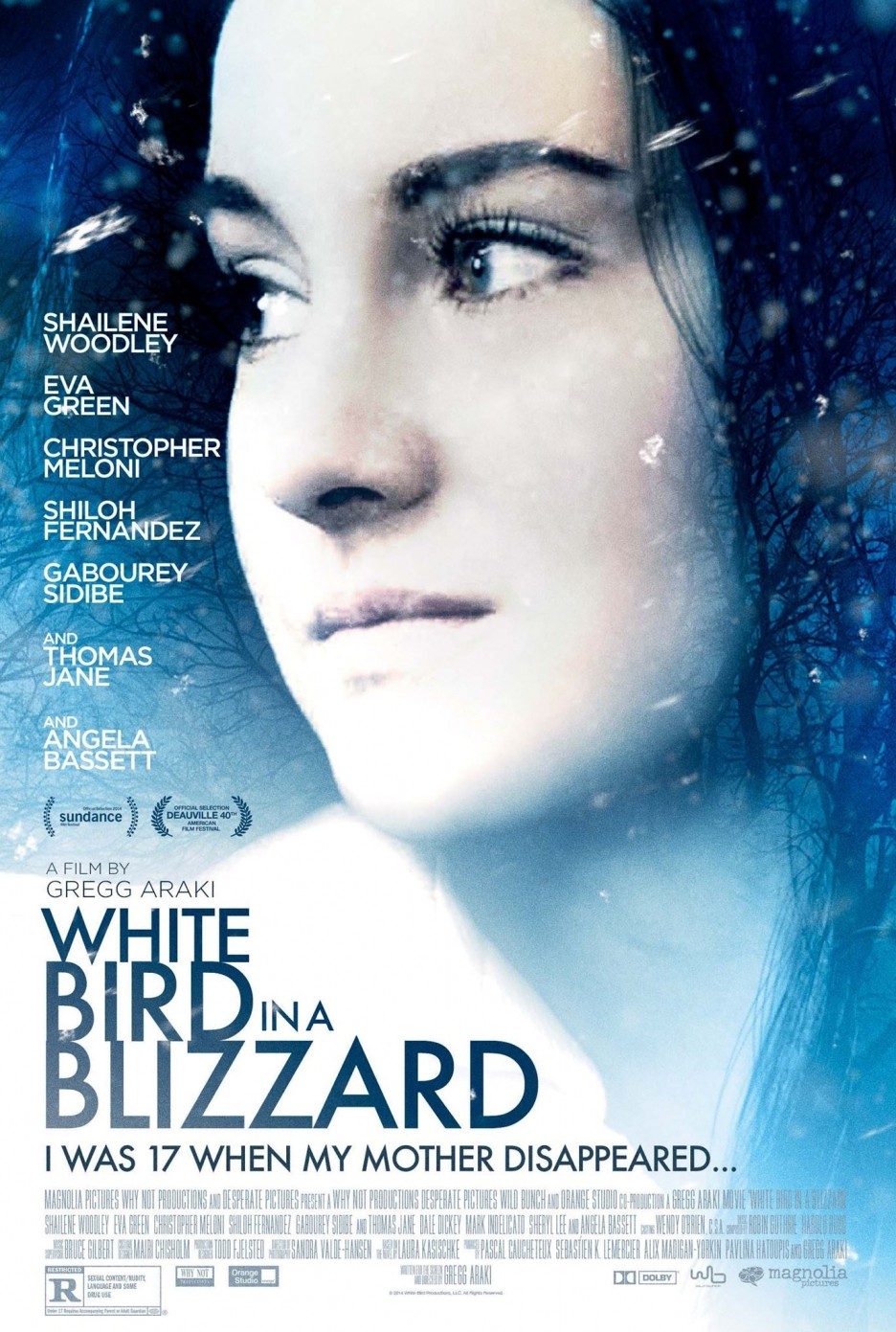
White Bird in a Blizzard movie poster

With “White Bird in a Blizzard,” Gregg Araki deals with the life of an adolescent once again. Based on the book of the same name by Laura Kasischke, it takes place in the 1980’s and stars Shailene Woodley as Kat Connor, a young woman whose mother ends up disappearing from her life. This happens at the same time she is discovering her sexuality with the next-door neighbor, Phil (Shiloh Fernandez), and she doesn’t seem too phased by her mother’s sudden absence. Her father, Brock (Christopher Meloni), has long since become a complete wimp, and his emotional repression prevents him from dealing with this situation in a rational manner. We follow Kat as she goes from high school to college, and eventually, she comes to see just how deeply affected she was by her mother’s disappearance and becomes determined to find out what happened to her.

Many of Araki’s films deal with the lives of teenagers, and he deals with them in a way which feels both honest and emotionally raw. “White Bird in a Blizzard” is the latest example of this, but while it deals with similar themes, it also feels somewhat unique to what Araki has given us before. He appeared at the Four Seasons Hotel in Los Angeles, California for the movie’s press conference, and I asked him if his view of adolescence has evolved much from one movie to the next. Araki replied it definitely has.

Gregg Araki: Back in the 90’s I did a series of three films (“Totally Fucked Up,” “The Doom Generation” and “Nowhere”) that I have become sort of famous or infamous for that were kind of a trilogy about being a teenager. It was called the “Teenage Apocalypse Trilogy” and they were very unhinged in a way and a little bit chaotic. I made those films 20 years ago and I definitely feel like in that time I’ve become older for sure and I think more mature and I’m more developed. I don’t really think I had a film like “White Bird” in me then. The analogy I make is that in this film I did called “The Doom Generation” which is also about young people, those kids have no parents. They have no house and they have no family; it’s just these kids doing crazy stuff. And in this movie Shailene does play somebody who is 18 and Shiloh (Fernandez’s) character is 18, and so they have their teenage moments and they meet in a Goth club and dance and they have that sort of carefree youth about them. But at the same time, this film is so much more about the family. Kat’s relationship with her mother or father, her parents’ marriage and just that whole world that, to me, like “American Beauty” or “The Ice Storm,” is about the world of the American dream and what is underneath the surface of it all. To me, that’s much more this film than my earlier movies about young people.

It’s always great to see a movie which takes adolescence seriously, and “White Bird in a Blizzard” does qualify as one. It also allows Woodley the opportunity to give another great and honest portrayal of a teenager just like she did in “The Descendants” and “The Spectacular Now,” and it shows how Araki, even at the age of 54, still truly understands what teenagers go through. But moreover, it shows how far Araki has come as a filmmaker, and it will be interesting to see where his career goes from here.

“White Bird in a Blizzard” is now available to own and rent on DVD, Blu-ray, and Digital.

Here is a video interview I did with Araki, Woodley and Chris Meloni which I did for the website We Got This Covered.

Pirates of the Caribbean: On Stranger Tides

Pirates of the Caribbean On Stranger Tides poster

I am happy to say “Pirates of The Caribbean: On Stranger Tides” is a big improvement over the previous entry, “At World’s End.” Whereas the latter had an incomprehensible story I gave up on following, “On Stranger Tides” has a plot which is a little more straightforward and easier to follow. Stars Orlando Bloom, Keira Knightley, and director Gore Verbinski have done left the building, and in their place are “Chicago” director Rob Marshall, Ian McShane and the alluring Penelope Cruz. With some of the dead weight removed and new elements thrown in, this showed promise. And of course, we have Johnny Depp back as Captain Jack Sparrow, whom without there would be no “Pirates” franchise.

This one has Jack sailing to the Fountain of Youth, and we’re not talking Beverly Hills. Along with him on the voyage is his former lover Angelica (Penelope Cruz) who proves to be every bit as trustworthy as Jack, which is to say not at all. Also onboard is legendary pirate Blackbeard (Ian McShane) whose giant sword wields a vicious power even with a simple wave of it. And just when you thought he was out of the way, Captain Hector Barbossa (Geoffrey Rush) is back as well, leaving Sparrow with the usual number of antagonists working against him, and there’s always plenty to go around considering Sparrow’s checkered history.

You would think by now this franchise would have bought the farm as it seems the only reason for it to continue is money. But even in this sequel, Depp still looks to be having a blast as this rock star of a pirate. Never easily upstaged, except by Keith Richards who has one of the movie’s best lines, he finds much to play around with and hasn’t lost a beat since the beginning. It could have been a movie where he could have just taken the money and run, but if he’s still having fun then so am I.

Personally, I’m glad Bloom and Knightley are gone as their romance ran its course, and to have them bitching and moaning at each other yet again would have been tiresome from the start. Instead we have Penelope Cruz who remains an actress as fantastic as she is beautiful. She more than holds her own opposite Depp as Angelica as her character threatens to be even more devious than Jack. Seeing these two play off each other kept me guessing as to who was the more honest of the two, and if they ever reached a point where they start believing their own lies.

I’m also glad to see Geoffrey Rush back as well and fresh off the Best Picture winner “The King’s Speech.” His character of Barbossa has had an interesting journey throughout these films as he’s been an antagonist and then a protagonist. By the time you reach him in “On Stranger Tides,” you’re not quite sure what to make of him which is part of the fun. Like Depp, Rush still has a joyous time playing this enigmatic character, and his gleeful delivery of dialogue is highly entertaining.

Ian McShane was an inspired choice to play Blackbeard, but in some ways his performance is a bit of a letdown. He’s very good, but after watching him portray one of the most cold-blooded bad guys ever in “Sexy Beast,” I expected a lot more menace from him which would have made “On Stranger Tides”’ all the more enthralling to watch. Still, he’s a great actor and could have done much worse.

The one character, however, I could have done without is the stubborn missionary Philip Swift. He’s a bland character who serves no real purpose in a movie which already has more then enough characters to juggle. This is no fault of the actor playing him as Sam Claflin does his best with an underwritten role, but it felt like the screenwriters were making up for the loss of Bloom and Knightley, and they really didn’t need to.

I do have to admit I really dug the mermaids and their natural beauty as much as I did the filmmakers’ take on them. Whereas they are as lovely as we remember them from stories and fairy tales, these mermaids here pack a vicious set of jaws and would sooner devour you than kiss you. There is some nudity here but no breasts (it’s a Disney movie folks), and you will find them unusual than the mermaids you grew up reading about. I guess you could say this is Disney’s subtle take on “Fatal Attraction.”

With Rob Marshall taking over directing duties on this one, I really admire how he streamlined this venture. Even though the movie stumbles a bit in the mid-section, Marshall keeps things moving at a swift pace and none of it gets overwhelming. “At World’s End” was so over bloated to where I wouldn’t be able to describe the plot or remember the name of the character Chow Yun Fat played to you. But here you have a good idea of who everyone is, and even if there are things which don’t make complete sense, it doesn’t matter too much.

In the end, all I really wanted out of “Pirates of The Caribbean: On Stranger Tides”’ was a good time. It’s not a movie I ask too much from, and I liked how Disney learned from the franchise’s previous mistakes. While the wonderfully entertaining “Curse of The Black Pearl” set the bar high, this one reaches up far enough towards it. Along with another thunderous Hans Zimmer score, I was pleased with this fourth “’Pirates” film, and I am open to seeing a part five, and you know there will be one at some point in the future.

* * * out of * * * *

George Lazenby on Why He Played James Bond Only Once

George Lazenby as James Bond

More than 40 years after “On Her Majesty’s Secret Service” was released, George Lazenby still has the dubious distinction of having the shortest tenure as James Bond. To many, he’s the joke of the franchise and referred to by others as “the one that failed.” Whether or not you agree with this, everyone still wonders why he ended up starring in only one 007 movie. Did critics rip his performance to shreds in the press to where it was too painful to continue? Did he have other plans? Well, he told a sold-out audience at the Egyptian Theatre in Hollywood why his tenure as Bond lasted only for a single film.

Lazenby said he does and doesn’t regret doing more Bond movies and that, after all these years, he still doesn’t know why he got the part. The producers did, in fact, want him to play Bond again and even offered him a contract to do several more. The 70’s, however, were just around the corner (“On Her Majesty’s Secret Service” was released in 1969), a time of long hair and bell bottoms, and his agent informed him the Bond franchise would not last beyond the 60’s. Although we know this was clearly not the case, Lazenby listened to his agent.

Lazenby also admitted he was happier as a model in Paris and didn’t like getting up early in the morning. When the movie was released, he had already grown a beard to hide from the public. But once he became unrecognizable, he had a little trouble getting into the premiere.

The things Lazenby did enjoy included going to fine restaurants whose owners invited him back and said, “The check’s on us.” It also got him instant access to nightclubs where he fearlessly jumped onstage with the dancing girls as if it were perfectly allowable. At one club he even told the head bouncer, “Send the girls to my place for a drink!” Now he didn’t think the bouncer would honor this request, but sure enough, there were 20 girls waiting for him and his buddies at the hotel. The next morning, four of them were still hanging around.

Albert R. Broccoli remarked that had Lazenby done more James Bond films, he would have been seen as the best actor to have portrayed 007. While many still consider him the least of the Bond actors, he still has many fans who considered his performance in “On Her Majesty’s Secret Service” terrific, and he still holds the record for being the only Bond who could perfectly throw his hat onto the hook. To quote a line from the beginning of the movie, “This never happened to the other fellow.”

George Lazenby Reflects on Playing 007 in ‘On Her Majesty’s Secret Service’

On Her Majestys Secret Service movie poster

After all these years, George Lazenby is still the only actor to play James Bond in just one movie, “On Her Majesty’s Secret Service.” While nowhere as respected as Sean Connery or Daniel Craig, Lazenby still has his share of fans who gave him a standing ovation when he appeared at the Egyptian Theatre in Hollywood. The evening’s moderator, Stephen Rubin, proclaimed Lazenby was a “terrific James Bond,” and if he had to do just one Bond movie, he picked the right one to star in.

After five movies, Connery quit playing Bond as he had grown tired of what he described as “impossibly long schedules.” Lazenby was not the first choice to replace Connery as he had no acting experience other than doing commercials, and Lazenby claimed he got considered for Bond when the late Cubby Broccoli spotted him at a haberdashery getting a Connery-like haircut.

Directing this 007 adventure was Peter Hunt who apparently got the job as a Christmas present from the Broccoli family. Lazenby described him as tough and that he got his way most of the time. He also admitted lying to Hunt about being an actor, and when Lazenby later told him he wasn’t, Hunt went crazy and fell down on the floor laughing. Once he composed himself, he told Lazenby, “Stick to your story. I’ll make you the next James Bond!”

The two of them, however, had a falling out on the first day of shooting, and Lazenby said Hunt didn’t speak to him again for nine months. According to Rubin, Hunt’s challenge in getting a performance out of Lazenby was to “piss him off.” Rubin also remarked how tough the last scene must have been for Lazenby as it’s the most emotional in the Bond franchise, and Lazenby said he did one take with tears and that Diana Rigg, who plays Contessa Teresa di Vicenzo in “On Her Majesty’s Secret Service,” bit him to get the desired emotion in another which he said wasn’t needed.

One thing’s for certain, Lazenby’s work in the action sequences was nothing short of excellent. On top of holding several black belts in martial arts, he credited a lot of his toughness from living in Australia where you “smack your mate.” Sounding almost Russell Crowe-ish about his birthplace, Lazenby said he could take care of himself once he got the first hit in, and back then he was too stupid to be afraid.

Regarding his fellow cast mates, Lazenby said Rigg thought he was a “complete idiot,” and she got pissed at him after he beat her in a game of chess. She also didn’t want him mucking around with other girls during filming, a promise Lazenby admitted he was unable to keep. He was discovered having a tryst with a receptionist, and when asked if she was memorable, Lazenby replied, “She was!”

Telly Savalas played Bond’s arch nemesis Ernst Stavro Blofeld, and Lazenby described him as a “great guy who loved to gamble.” When Lazenby got a raise from $100 to $1,000 a week during shooting, Savalas saw his money and asked, “Hey, do you play poker?” Lazenby also said Savalas used to bet everything he had including his house.

Even if Lazenby is still considered the worst actor ever to portray James Bond, it certainly didn’t seem to be the case considering the standing ovation he got upon entering the Egyptian Theatre. He gave us a 007 at his most relaxed in “On Her Majesty’s Secret Service,” and this makes his interpretation of the role the most unique in the long-running franchise.

‘Alien: Covenant’ Mixes the Old and the New for a Pulse-Pounding Ride

Alien Covenant poster

With the “Alien” franchise, it always helps to keep your expectations in check. The first one, released back in 1979 was one of the scariest science-fiction movies ever made, “Aliens” was one of the most intense, “Alien 3” was one of the most infinitely depressing, and “Alien Resurrection” was the slimiest by far. When Ridley Scott, who directed “Alien,” returned to the franchise with “Prometheus,” he presented us with a film containing, as he said, “strands of ‘Alien’ DNA in it,” but it was also designed to have its own mythology and ideas while existing in the same cinematic universe. Each time, the filmmakers brought their own unique vision to this franchise and succeeded in creating something daring, and at times maddening, which no other franchise would have dared pulled off. As for the “Alien vs Predator” movies, the less said, the better.

Now Scott returns again to the franchise with another prequel, “Alien: Covenant,” which looks to be a return to basics after the mixed reaction “Prometheus” received. Sure enough, composer Jed Kurzel’s score starts off with a taste of Jerry Goldsmith’s theme from “Alien” which has the audience feeling like they are entering familiar territory. But Kurzel’s music also has the music Marc Streitenfeld created for “Prometheus,” and it made me realize Scott was not about to leave the themes he explored previously in the dust.

“Alien: Covenant” picks up ten years after “Prometheus” as we come across the spaceship Covenant making its way to a remote planet where colonists intend to start a new life. These plans go awry when a neutrino blast hits the ship, killing some of the passengers and leaving the survivors in a state of devastation they cannot be expected to quickly recover from. Suddenly they intercept a human radio transmission from a nearby planet not on their charts and despite some objections, which of course are ignored, they change course to investigate. From there, you have a pretty good idea of what will happen.

Scott, as usual, works visual wonders along with cinematographer Dariusz Wolski which put us right into the action instead of just viewing it from a distance. Seeing these humans arrive on a planet we know many of them will not leave, not in one piece anyway, jacks up the tension in no time at all, and he still knows how to make those xenomorphs look more vicious than the average sci-fi creatures.

At the same time, he continues the themes of “Prometheus” with the assistance of one of its best actors, Michael Fassbender (god he has an awesome last name!). Fassbender returns as David, the synthetic android who is revealed to be alive and in one piece on this new planet, and he also plays Walter, another synthetic android assigned to look after the crew of the Covenant. Seeing David and Walter share scenes with one another prove to be some of this movie’s most fascinating for me as Fassbender makes you forget special effects were involved in him having a conversation with himself.

The balance between the themes of “Prometheus” and the typically visceral action of the average “Alien” movie is a tricky one, and Scott manages to pull it off for the most part. Still, it will be interesting to see how audiences react to this one as they may like certain parts of “Alien: Covenant” more than others.

I do wish Scott and screenwriters John Logan and Dante Harper had given more attention to the characters here as many of them appear to be too one-dimensional for this movie’s own good. This franchise thrives on our getting to know these characters as individuals we can relate to, but many of them appear to exist solely for the xenomorphs to rip apart limb from limb. Some characters fare better than others, but the rest of the pack deserved more attention than they got.

Katherine Waterston, unforgettable in Paul Thomas Anderson’s “Inherent Vice,” has a big challenge here as she is essentially playing the Sigourney Weaver/Ellen Ripley role as terraforming expert Daniels Branson. What I really admired about Waterston’s work here is how she never invites easy comparison to Weaver, and I never bothered spending time comparing the two actresses as the movie unfolded before me. Waterston fully embraces her character’s complex emotions as she is forced to deal with an unexpected tragedy which would easily wreck another, and she turns Daniels into formidable warrior long before the movie’s furious climax.

Another actor I got a kick out of seeing here was Danny McBride who plays the chief pilot of the Covenant, Tennessee. McBride is best known for his no-holds-barred comedic performances in “Pineapple Express,” “Tropic Thunder,” “The Foot Fist Way,” and the HBO series “Eastbound & Down,” and several critics have said they felt he was miscast here. I completely disagree as he brings the kind of the down-to-earth character the “Alien” movies can’t exist without as well as a subtlety which makes his emotions feel genuine and never faked. Once again, I truly believe that if you can do comedy, you can do drama.

I also have to give Billy Crudup a lot of credit for taking a character like the self-serious man of faith, Christopher Oram, who lacks the confidence a leader should have and making him into someone more human than any other actor could have. I say this because this kind of character usually comes across as totally annoying and infinitely idiotic, but Crudup succeeds in making Christopher down to earth and more empathetic than you might expect. And those scenes he has with Fassbender in the latter half? Priceless.

Does “Alien: Covenant” reach the exhilarating heights of the first two “Alien” movies? No, but I wasn’t surprised it didn’t. We have long since gotten used to these vicious creatures to where they aren’t as terrifying as when we first met them. Still, I found “Alien: Covenant” to be a pulse-pounding ride with strong performances, a sleek design and the kind of stunning look you can always expect from the average Ridley Scott film. It pays homage not just to its predecessors, but also to “Blade Runner” as well, and it has an infinitely unnerving conclusion which reminds us all that in space, no one can hear you scream.

Just try to go into it with an open mind. There is a bit of the old here which I know fans will enjoy, but there is also a lot of thought put into the story which you don’t often get with the usual summer blockbuster.

* * * ½ out of * * * *

Ridley Scott’s ‘Alien’ Remains an Exceptionally Intense Experience

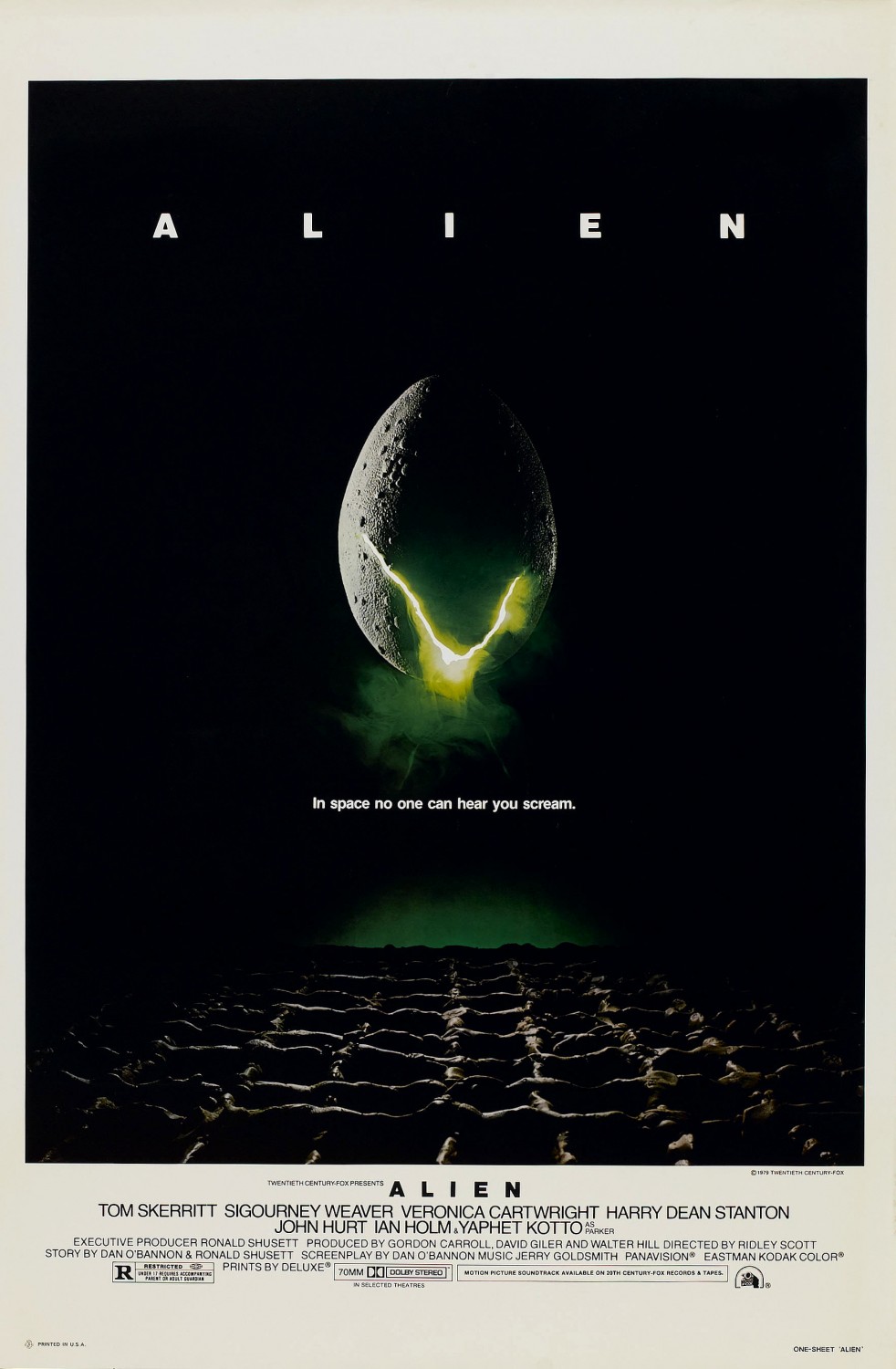
Alien movie poster

In regards to horror movies, “John Carpenter’s The Thing” ranks highest on the list of my all-time favorite movies in general. However, if you were to ask me what I consider to be the scariest movie ever, the first that quickly comes to mind is Ridley Scott’s “Alien.” Now considered a classic haunted house kind of movie, it freaked me out far more than I had expected it to. These days, if I come across someone who hasn’t seen “Alien,” I would be desperate to take the time and watch it with them just to see the look on their face. What may seem like a harmless old science fiction movie still has the power to unnerve and creep up on its audience when they least expect it.

Now when I say that this movie freaked me out more than I expected it to, there are a number of reasons why: I ended up seeing James Cameron’s sequel “Aliens” beforehand, so I already knew Ellen Ripley (played by Sigourney Weaver) was the sole survivor from the original. When I watched “Alien” for the very first time, it was back in the days of VCR’s and VHS tapes, and the one I obtained from my favorite video store was a fairly old copy which showed a bit of wear and tear. When it came to watching it, I got consigned to my parents’ bedroom as they had already called dibs on the big television in the family room which was connected to a “super cool” stereo system. The TV set in their bedroom was tiny by today’s standards. As I remember, it was a 13-inch set which was already on its last legs after years of use. This one didn’t have any surround sound system to enhance the experience, so I just tried to be happy I had a TV to view it on at all.

Having said all this, “Alien” still had my hairs standing on end throughout. Even though I knew who would live and die, the suspense and tension were extreme throughout, and you never ever felt safe on board the spaceship Nostromo. I can still remember hiding my eyes and would be turning the volume down at certain points because my heart threatened to stop beating a few times. Imagine if I had watched it for the first time on a big screen TV with surround system, or better yet, in a movie theater when it originally came out! I wouldn’t have slept for days! Some movies play better on the silver screen than on your television, but “Alien” appears to work on either format with the same degree of success.

There are many different reasons why Scott’s film remains such an effective sci-fi horror classic to this day. For me, it starts with the characters and how down to earth they are. While other outer space movies have characters who revel in the wonder of what’s out there, all the workers on the Nostromo treat their dark habitat as just another office job they take to get by. When we meet up with them, they are on their way back to Earth and just want to be home already. The writers also gave the actors dialogue which was never too heavy on the technobabble and hearing the characters talk about how they deserve full shares for the work they did defines them as blue collar workers. These are not brilliant scientists looking to discover new planets; they’re just people working for the man. The time Scott takes in introducing all these individuals pays off by the time we are given a visceral introduction to the alien of the movie’s title.

Now let’s talk about this alien which was designed by H.R. Geiger, a Swiss surrealist artist. I can’t really compare it to other movie creatures I’ve seen in the slightest because it looks so frighteningly unique in its construction. Its mouth hides an additional set of jaws that lunges out at unsuspecting victims as if they are “faster than a speeding bullet.” Furthermore, there is something quite phallic about that jaw in how it juts out at you without warning or of any thought of the damage it is about to inflict. Its lethal penetration is highly unnerving in how it reminds the viewer of what we all agree constitutes a serious and unconscionable violation to the human body.

But one of Ridley’s most brilliant moves with “Alien” was in not showing the creature fully. We only got glimpses of it throughout the film until the end, and even then we weren’t entirely sure of all that we saw. It was all up to our imaginations to figure out what kind of a threat this creature is. This added immeasurably to the film’s infinite suspense and unending tension. Plus, with the spaceship Nostromo designed to look all dark and shabby with not much light to be found in certain sections, this made it easier for the creature to hide. When it leaped up at the cast member about to meet his maker, it was completely unexpected and defined the jump out of your seat moment for me.

As the movie goes on, we get to an even more frightening aspect; of how corporations can put profits above their workers so coldly. When Ripley discovers the Nostromo crew was made to pick up an alien organism to bring back for further study and that they were expendable, it only further demonstrates just how much alone everyone is on the ship. To realize the company which has employed you couldn’t care less about your existence makes you fully aware of your immediate surroundings, and the instinct to survive becomes stronger than ever. Of course, are cynicism today has us expecting this from any corporation we work with, so we’re more prepared for this than the Nostromo crew was.

A lot of credit also goes to the late Jerry Goldsmith for creating a music score which adds subtly to the action, or at least until the film’s last half hour when the realm of outer space feels even smaller than before. His music touches on the tension inherent in each character without becoming melodramatic, and at times it sounds like invisible ghosts hovering over the unprepared crew waiting to strike. Also, the use of silence in certain scenes makes it even more frightening as we are reminded of how unsettling things can be when our surroundings become far too quiet for comfort.

All of this leads to one of the most intense climaxes in cinema history as we are fully aware of time running out. Just when you think the movie’s over, there’s still another horrendous challenge to overcome. It’s in the movie’s last minute where you can finally breathe a much-needed sigh of relief. Even if you know how of this movie will end, it is still an intensely riveting experience that never lets up for a second. The look in Ripley’s eyes as she makes her way to the escape shuttle perfectly mirrors our own emotions as she is forced into a situation which leaves her with no other options to consider.

I still have very vivid memories of seeing this movie on that unspectacular little television set in my parents’ bedroom while they enjoyed something on Masterpiece Theater with more advanced technology. As the beginning credits began to roll, I was convinced that sitting through this would be a piece of cake. Coincidentally, I also felt the same way about the original version of “The Texas Chainsaw Massacre” when I rented it through Netflix. “Alien” remains one of the most truly terrifying experiences I have ever had watching a movie either on the big screen or the small one. To this day, it remains an effectively scary movie which has lost none of its power. Now if 20th Century Fox had fully realized how all these elements had added to make such a great movie, those hopelessly pathetic “Alien vs. Predator” films might have actually been worth watching.

* * * * out of * * * *


Soundtrack Review: ‘Lethal Weapon 3’

Lethal Weapon 3 soundtrack

We are now at the 25th anniversary of the release of “Lethal Weapon 3” in theaters, something I have a hard time accepting as I still remember seeing it for the first time like it was yesterday.

With it being the third movie in a highly successful franchise, “Lethal Weapon 3” settles into a familiar formula which, as this sequel proves, still works. Director Richard Donner and stars Mel Gibson and Danny Glover were interested in making this film more of a comedy, and we get the usual gunfights, explosions and car chases which are all expertly filmed. In addition, we also get another thrilling music score from the composers who worked on the previous “Lethal Weapon” movies: Michael Kamen, Eric Clapton, and David Sanborn.

I still remember the first time I saw “Lethal Weapon 3” and how gleefully entertained I was while watching it. I also loved the score for it as well even if it sounded recycled from the previous two films. After seeing this sequel twice in one week, I couldn’t wait to buy the soundtrack in the hopes it would have more of the music I expected to hear on the soundtracks to “Lethal Weapon” and “Lethal Weapon 2.” But yet again, the commercial release of the “Lethal Weapon 3” soundtrack left me disappointed despite some good tracks (“Armour Piercing Bullets” was the standout) included on it. Furthermore, it only had a portion of Kamen’s, Clapton’s and Sanborn’s music score on it.

But now we have a brand-new expanded and remastered soundtrack for “Lethal Weapon 3” which includes two compact discs containing all of the music cues I prayed would be on the 1992 commercial soundtrack release. It is being released as part of La La Land Records’ “Lethal Weapon Soundtrack Collection” box set, and it is gratifying to listen to this score in its entirety.

This film score starts off with a whimsical feel as Riggs and Murtaugh try to disarm a bomb and end up failing to do so quite explosively. Busted down from detectives to beat cops, they are at the scene of an armored car robbery and immediately jump into action. This leads to one of my favorite tracks on the first disc entitled “Armoured Car Chase.” Hearing the three composers come together to create such a thrilling piece of music made watching this sequence all the more exciting.

My other favorite tracks on this expanded soundtrack are “Gun Battle” which is the same piece of music as “Armour Piercing Bullets,” and it always succeeds in getting me super excited to where I can see myself in appearing in an action movie. Another is “Fire/Fire Battle/A Quiet Evening by the Fire” which gives the movie’s action climax an equally thrilling and highly emotionally effect which reminds you of how the “Lethal Weapon” movies are as big on character as they are on unforgettable action set pieces.

The second disc of “Lethal Weapon 3” features the commercial release of the soundtrack which includes the songs “It’s Probably Me” by Sting and Clapton, and “Runaway Train” performed by Clapton and Elton John. The rest are pieces of the score by Kamen, Clapton and Sanborn, and there are some additional tracks featuring alternate versions of music cues. I have to give credit to La La Land Records for including the original album on this special release instead of just trying to bury it under a rug or something.

Jeff Bond, whose booklet “Some Movies Don’t Invent Genres: They Just Perfect Them” accompanies the “Lethal Weapon Soundtrack Collection,” writes about how Donner decided to put more of an emphasis on comedy and family with this sequel. Still, there were some new additions like renegade ex-cop Jack Travis (Stuart Wilson) and Internal Affairs officer Lorna Cole (Rene Russo) to give “Lethal Weapon 3” the dark edge it needed. It also was revealed Lorna was originally written as a male character. For those who have seen the movie, I think we can all agree the change in gender was a very welcome one. Who else but Russo could have inhabited this role so memorably?

In regards to the score, Bond makes it clear Kamen, Clapton, and Sanborn did not phone this one in at all. Unlike the previous “Lethal Weapon” movies, this one starts out with a song performed by Sting. The song was “It’s Probably Me,” and Bond quotes Sting as saying his idea behind it was that Riggs and Murtaugh are such macho guys to where they wouldn’t express their love for one another right away.

Bond also points out Kamen did intentionally stick with the formula which made the scores to the previous movies work so well. But at the same time, this score shows how talented Kamen and company are in scoring the most humorous scenes as well. In “Lethal Weapon” and “Lethal Weapon 2,” Kamen succeeded at balancing action spectacles with character driven moments. But in “Lethal Weapon 3,” he also proves to be a master at adding to the endless laughs which were to be had in this sequel.

Once again, La La Land Records has given us another great special edition of a soundtrack long overdue for an expanded release. Here’s hoping they release more remastered and expanded soundtracks I have spent decades waiting for in the future. Can an expanded release of Harold Faltemeyer’s film score for “Fletch” be far behind?

Save

Michelle Monaghan and Ron Livingston on the Making of ‘Fort Bliss’

Fort Bliss movie poster

Claudia Myers’ “Fort Bliss” deals with something we don’t see much in movies: the challenges of being a female soldier and a single mom at the same time. The movie stars Michelle Monaghan as U.S. army medic Maggie Swann who has just returned home after serving a tour of duty in Afghanistan. But instead of arriving to greet her son Paul (Oakes Fegley) at the air base, she instead finds him back at home with his dad, her ex-husband Richard (Ron Livingston), and stepmom, and he doesn’t really remember her much. From there, Maggie works to repair the bond between her and Paul before her duties in the military threaten to tear them apart yet again.

Both Monaghan and Livingston dropped by the SLS Hotel in Los Angeles, California for the “Fort Bliss’” press day, and it was fascinating to hear about their experiences making this particular movie. This was a very low budget production, so there wasn’t much time for anyone to waste. I always wondered how actors deal with the lack of time because we are led to believe they are used to working on movies which allow them to take a nap in their trailers between takes while the crew sets up for the next shot. But while having fewer resources can seriously affect some actors, Monaghan and Livingston did not let any limitations stand in their way.

“There’s something really exciting about the idea that they just don’t have time to micromanage you in your performance, so there’s a lot more responsibility to just show up,” Livingston said. “Your first take on it is gonna be the take that goes into the movie by and large unless it’s really egregious because there’s not a lot of time to waste tinkering with it, you know?”

“It is true that you don’t have a lot of time to play with it,” Monaghan said. “I think that’s why the prep time becomes so essential for an independent film. It’s your responsibility as an actor or a director or a writer to really play your part. You can’t just turn up and expect all these experts to show you something on the day. That’s really, really important. That’s a part of our job, and also we shot this movie in 21 days. It was so incredibly exciting because we were living, eating and breathing it. We shot in two different locations in and around Los Angeles and then Fort Bliss (in El Paso, Texas) with the help of the Army. With all their resources, the production value looks by far more than what we had for it.

“21 days with combat sequences is pretty incredible,” Livingston noted.

Again, I imagine some actors would have preferred to have more time to prepare for the roles, but they don’t always have that opportunity. When it comes down to it, they have to work with what they are given instead of complain about what’s working against them. For Monaghan, the fact there wasn’t a lot of down time on the set of “Fort Bliss” didn’t affect her too much.

“There’s not (a lot of down time), but I always tend to find that I feel the strongest about performances in general when they’re shot in that way because you’re in it,” Monaghan said. “You are in the thick of it, and to say that I go to sleep at night and dream about the character and the role, you are. It’s 21 days where you’re attacking it for that period of time, and you don’t have time to think about it. Good things tend to come from that.”

One of the best scenes in “Fort Bliss” comes at the beginning when Maggie and dozens of other troops are returning home from Afghanistan. It looked like the production succeeded in hiring the best background extras they could find as they looked so incredibly enthusiastic in welcoming the soldiers home, but it turns out there was a lot more authenticity involved than we realized.

“When you see the coming home scenes at the beginning, it was truly people of soldier’s families, military wives, husbands, and children that two days prior had just welcomed one of those big planes home,” Monaghan said. “Fort Bliss sent out an email saying, ‘Would you guys come back two days later to shoot a scene?’ So they brought back all their signs and it was amazing. The military band was there and even the Harley Davison guys came back and all the former vets with their bikes and everything. Everybody was so proud to be there. That’s so profound to be able to have that experience and to feel that energy of what it’s like and everybody hugging one another. To be able to have that access and that resource was so invaluable. We constantly had that throughout the process of filming. I say this film has been so blessed, but it has. I’m so grateful to everybody in how far reaching the efforts that everybody has gone to.”

“Fort Bliss” may be coming in under the radar, but it is truly deserving of your attention. It deals with the female perspective of war and how women still have a stigma attached to them whenever they serve in the military. Many expect women to stay at home and be a mother to their children instead of fighting wars overseas, but life continues to be more complicated than we expect it to be, and nothing is ever that simple.

You can also check out this video interview I did with Monaghan and Livingston which I did for the website We Got This Covered.