Logan

Logan movie poster

Watching “Logan” is especially thrilling if you have been keeping up with the “X-Men” movies since the first one came out in the year 2000. While the previous installments played by a certain set of rules, this one smashes through them to create something unique in the long-running franchise. No longer shackled by the PG-13 rating, Hugh Jackman is given free rein to show just how bloody Wolverine can get when you piss him off, and he gives this character, which made him into a movie star, the swan song he deserves.

While the “X-Men” movies were largely science-fiction, “Logan” plays more like a western, and this will become abundantly clear even before characters sit down in a hotel room to watch “Shane.” We catch up with Wolverine, a.k.a. James “Logan” Howlett, in a future not too distant from our own where mutants have long since become an endangered species. Wolverine is now past his prime and works as a limo driver in an effort to save money to buy a boat which he and the ailing Professor Charles Xavier (Patrick Stewart) can sail away in from all of humanity. While he can still kick ass, he is now hobbled by a bad leg and a dependency on alcohol which eases the pain of surviving in this world for far too long.

The same goes with Xavier who now suffers from a neurodegenerative disease which has turned his telepathic abilities from a blessing into an unstable force people would be best not to be in the vicinity of. When he has an episode, the world around him is threatened in a highly unsettling way, and only Wolverine can give him the medication he needs to stop him from becoming a true weapon of mass destruction.

Then into the picture comes Laura (Dafne Keen), a young mutant who has more in common with Wolverine than he would care to admit or realize. Like the miraculously pregnant woman in “Children of Men,” Laura represents the next step in human evolution, and she needs to be taken to a safe haven for mutants which may or may not exist. On her trail are Reavers, a team of criminal cyborgs hell-bent on wiping mutants off the face of the earth, led by the gleefully sadistic Donald Pierce (Boyd Holbrook) who is not about to let his fandom of Wolverine get in the way of his mission.

What I especially admired about “Logan” is how it dealt with the effects of aging and of people now past their prime. This is s0mething superhero or comic book movies, let alone most Hollywood movies, usually avoid dealing with as the powers that be wish to keep everything looking and feeling youthful. But we are forced to look at Wolverine and Xavier at a point in their lives where they are more vulnerable than ever to their enemies and especially their own mortality. Once they were powerful, but now they are pretty much off-warranty. How does one deal with arriving at a point in life where their bodies start working against them? “Logan” dares to deal with this question, and it does so in a way which is more character driven than ever before but still action packed as ever.

Jackman intends “Logan” to be his last “X-Men” as he has played Wolverine now for over a decade, and he has certainly given the character quite the exit. He even took a pay cut in order to ensure this film would get an R-rating, and it was certainly worth it as it gives him the freedom to make this iconic comic book character a far more blunt and brutal instrument than ever before.

Life is suffering, and no one knows this more than Wolverine who has lived more lifetimes than anyone else around him. Jackman has been brilliant at letting us see the inescapable vulnerabilities which are just beneath the surface of his tough and rugged exterior. Seeing him portray Wolverine at his most wounded is brave as he shows how even the most powerful of superheroes can reach their limit and yet still fight the good fight.

The movie also proves to be a perfect swansong for Patrick Stewart’s interpretation of Charles Xavier as he too portrays this character in a way we never expected. The professor was once a man of significant intelligence and insight, and now he has become a victim of the cruelties of aging none of us are eager to experience. Stewart shows no fear at portraying Xavier in his most disabled state, and while it is painful to see this once great character reduced to a mere shell of who he once was, the great actor is priceless in giving us a man who clings on to the mere gifts afforded to him in a way we all take for granted. It’s a heartbreaking performance, and Stewart plays it without a single faked emotion.

There are also a number of terrific supporting performances here, and the most impressive of the bunch comes from Dafne Keen as the young and deadly mutant, Laura, who befriends Wolverine and Professor X. At the tender age of 11 or 12 years old, Keen is forced to play most of her scenes with no dialogue whatsoever, but she still speaks so many words with even the smallest of facial expressions. It’s a lot to ask of an actor of any age to accept such an acting challenge, but she is more than up to it and gives us a riveting portrayal of a child who has been made to become something no child should ever be made into.

I also admired Stephen Merchant’s performance as Caliban, an albino mutant who can sense and track other mutants. This could have easily been the kind of wimpy character who goes through the usual scenarios of betraying others for his own selfish purposes, but Merchant makes him into much more than that as we see how heavy the consequences of his actions weigh on his conscience. In the hands of another actor, this could have been a throwaway role, but Merchant is too good to let something like that happen.

Boyd Holbrook makes a perfectly hateful yet charismatic villain out of Donald Pierce, Eriq La Salle has some strong moments as a family man who helps out Wolverine and his friends, and Frank Gallegos figures prominently in a small role as a Federale Lieutenant who ends up in the wrong place at the wrong time. Please believe me when I say Gallegos is concrete proof of how actors in the smallest of roles can make quite the impression, and he more than does that here.

Directing “Logan” is James Mangold who directed the previous “X-Men” spinoff “The Wolverine” which was easily better than its predecessor, “X-Men Origins: Wolverine.” Mangold’s films have mostly been studies in empathy about people who have been severely damaged by life, but who still have yet to meet their greatest challenge. Whether it’s Sylvester Stallone’s disabled police officer in “Copland,” the emotionally unstable women portrayed by Winona Ryder and Angelina Jolie in “Girl, Interrupted,” singers Johnny Cash and June Carter in “Walk the Line,” or even Tom Cruise’s eccentric spy in “Knight and Day,” the characters who occupy his films have suffered deep emotional wounds which they will be eventually forced to confront and make peace with whether they want to or not. “Logan” definitely fits in with the themes Mangold has explored throughout his films, and he makes this comic book/superhero an especially enthralling one as we are thrilled as much as we are moved emotionally.

Mangold also breaks free of the rules and conventions the “X-Men” movie franchise has laid out for its various filmmakers, and as a result, it really does feel like a true spin-off compared to the others before it. He gives “Logan” a very gritty feel, but as brutal and bleak as this movie is, it is also filled with hope. While history does repeat itself more often than we would like to admit, we are left with the strong possibility that the next generation of mutants will find a better way to exist in a world with those who have yet to fully trust them.

Seriously, I found “Logan” to be a thing of beauty as it dares to take characters we have grown up watching and put them in situations no filmmaker would have dared to put them in 10 years ago. I came into it thinking it would be the “Alien 3” of the “X-Men” movies as the use of Johnny Cash’s cover of Nine Inch Nails’ “Hurt” in the teaser trailer implied this would show Wolverine and Xavier at the darkest points in their lives. It certainly does, but it doesn’t leave us in a state of utter depression at its climax. We have come too far to give up on these mutants, and there’s no giving up on them now.

“Logan” proves to be one of the best “X-Men” movies as well as one of the best comic book movies ever made. With this gripping installment, this franchise has found its own version of “The Dark Knight,” and 2017 has already found one of its best motion pictures in only its third month.

* * * * out of * * * *

X-Men Origins: Wolverine

x-men-origins-wolverine-poster

I was racing to the movie theater, one of the smaller ones in the Los Angeles area, trying to get there before the movie started. My friends were all there waiting on my slow ass, and as usual, I had left my apartment at the last possible minute. Cursing myself and the slow ass drivers placed in my path, I hurried while risking the possibility of getting pulled over. With the economy now being located in the center of the earth while we slowly dig towards it, the police are handing out more tickets than ever. Heaven forbid I make some sort of unnecessary donation to them and miss the film.

Anyway, with an enormous stroke of luck, I managed to make it to the theater just as the trailers were about to start. I was thankful to find my friends who managed to save a seat for me, and I was even more thankful to miss out on all those stupid commercials AMC Theaters feels the need to inflict on us. It is an addictive thrill to get to where you are going just in the nick of time and a hard one to get over (it would help if I did, though). Thank god for Japanese machinery, especially with it having almost 200,000 miles on the odometer.

I bring this up because my maddening drive to get to the theater on time turned out to be far more exciting than the movie I ended up seeing: “X-Men Origins – Wolverine.” It is the fourth movie in the “X-Men” franchise, and the first big movie of summer 2009. But more importantly, it is also summer 2009’s first big disappointment. This has been the case for the past couple of years, with the first big summer movie not meeting expectations.

“X-Men Origins: Wolverine” takes place years before the first “X-Men” movie, and we get to see the pivotal character of Wolverine as a young boy who ends up committing a violent act he can never take back. As a result, he runs away from home with his half-brother Victor Creed (later to be known as Sabretooth). From there, we get a spectacular opening sequence in which we see the both of them fight in just about every major war they were exposed to throughout their endless lifetimes. From the American Civil War to the Vietnam War, we see them fighting with the other side, taking their hits, and they come out of it all relatively unscathed. Of course, when Wolverine and Sabretooth end up being played by Hugh Jackman and Liev Schreiber, they stop aging for good. Very convenient for the box office, wouldn’t you say?

With this being a prequel, a lot of the suspense is sucked out right there because we all know Wolverine is going to survive this adventure and go on to experience many more. Granted, some prequels can be exciting and leave you hanging on the edge of your seat (“Indiana Jones and the Temple of Doom” is a perfect example), but it takes a really good script and precise direction to suck you into the present tense of the movie you are watching. The more you as an audience member are sucked into the moment, the more you forget about the film which chronologically comes after it. But since this franchise has been around since the early part of the 2000’s, we have come to know these characters all too well. We know what will happen to them eventually, and we end up spending too much time trying to connect the dots between this and the other “X-Men” movies. It makes this origin movie a lot less exciting as a result.

Seriously, this is “X-Men” meets “The Punisher” when you take a close look at the story. We see Wolverine working as a lumberjack after having left special ops six years ago, and he lives with his girlfriend Kayla Silverfox (the lovely Lynn Collins) in a secluded cabin up in the hills of Canada, but the past, of course, catches up with him like we expect it to. Logan (Wolverine’s real name) is approached by William Stryker (Danny Huston playing the same character Brian Cox played in “X-Men 2”) to get back into action because Victor/Sabretooth is on the loose. Logan says no, and this had me rolling my eyes because we all know Kayla is going to get murdered by Victor, and this will make Wolverine become thirsty for revenge. In doing so, he will be forced to alter his body to where he will become the indestructible animal we already know him as through the previous installments.

One of the movie’s real stumbling blocks is both Wolverine and Sabretooth are presented as indestructible. No matter how many bullets are shot at them or how many times they get stabbed, we know they will get back up and heal themselves in a matter of seconds. This knowledge affects the movie’s big action sequences because, regardless of whether or not they get the bad guys, we know they will come out of it all unscathed. We also know Sabretooth is not going to get his due justice at the end of this story. It gets to where you expect either of these characters to start singing “Shoot Me Again” by Metallica. You know how that one goes, right?

“Shoot me again, I ain’t dead yet!”

In terms of performances, Hugh Jackman still delivers the goods as Logan/Wolverine. If you think his successful stint as host of the Oscars might have softened him, you needn’t worry. Even with a script which deals with elements we have seen in other movies like this one, he gives this comic book hero a real heart and soul just as he did before. Starting off an “X-Men” prequel series with this character wasn’t a bad idea, but it’s a shame the filmmakers did not give him a more original and compelling story.

Liev Schreiber also does solid work here as Victor Creed/Sabretooth. While the script could have given the character a little more dimension, Schreiber makes the character an effectively dangerous rival with a never-ending bloodlust, and he keeps our interest along with Jackman throughout the movie’s two hour running time.

The other actors don’t fare as well. Danny Huston’s portrayal of William Stryker lacks the complex nature Brian Cox brought to the role previously. The fact Stryker’s son is a mutant is brought into this film as an afterthought, and it leads to one of the character’s more ludicrous moments. Stryker’s fate at the end of the film doesn’t make much sense either because you can’t help but wonder how he managed to become such a powerful military leader by the time we see him in “X-Men 2.”

Ryan Reynolds plays Wade Wilson/Deadpool, and it is same kind of character he played in the dreadful “Blade: Trinity.” While I got a kick out of Reynolds’ sardonic wit and lightning speed with swords, his appearance in “Wolverine” feels like a wasted opportunity. Reynolds ends up disappearing from the movie too quickly, and we don’t see him again until much later. This leaves us with mutants who are nowhere as interesting as the ones we met in the previous “X-Men” movies. Characters like Agent Zero (played by Daniel Henney) are so one-note, they cease to be interesting almost immediately.

In fact, this is my biggest beef with “X-Men Origins: Wolverine;” it has an utter lack of character development. The three previous films gave us characters to care about as soon as they appeared onscreen. Bryan Singer, who directed the first two films, really took the time to make us feel what these characters were going through as they were cruelly branded as outcasts. We sympathized with their struggles as they worked with Professor Charles Xavier to co-exist peacefully with humans. This made the action sequences all the more exciting; we worried about these characters getting hurt. It was like we got hurt along with them.

But with this newest “X-Men” movie, these characters cease to be as interesting as they once were. They exist here as a means to an end, to guide Wolverine to the point where we first met him. We get introduced to some cool characters like Gambit, but it feels like he is being given only a test run here to see if he will be popular enough to include in future installments. More attention is paid here to the spectacle than anything else, and it shows. There are some great visuals to be found here for sure, but without stronger characters, they just come across as empty. There is no visceral feeling to them, and not much risk is on display.

“X-Men Origins: Wolverine” was directed by Gavin Hood who previously directed the Oscar-winning “Tsotsi” as well as “Rendition” which starred Reese Witherspoon and Jake Gyllenhaal. I’m not sure how much of the blame he should take for this one. Word is the production was troubled and that executive producer Richard Donner took over directing duties for a few scenes, and the script was constantly being rewritten (no surprise there). I guess by bringing in an indie director like they did with Singer, the producers were hoping to bring a fresh new perspective to the long-running franchise. But Hood’s direction is not exemplary here in the way Singer’s was, and he makes this nothing more than an average action movie. There is nothing really special he accomplishes here which could have made this particular comic book movie more unique.

Indeed, there are many twists towards the end which serve to define the character of Wolverine. But the more they came, the less I believed them. There are gaps in logic I am willing to forgive in movies, but once I start thinking about them while watching what unfolds onscreen, I will undoubtedly have some serious issues. Some plot twists would have required years of preparation for the characters to pull off, and I can’t see any of them thinking that far into the future. Much more attention should have been paid to the script, and the characters should have been given top priority. They also should have given this film a much different story than an average one of a man scorned by the loss of love and the need for vengeance. The conflicted hero act worked for a while, but now it feels old, old, old.

It’s hard to dissuade you “X-Men” fans from seeing this movie, so I’m not going to try. Granted, I’ll be interested to hear what you all think of it. You may end up enjoying it far more than I did. Jackman is great as always, but his performance is not enough to save this scripted mess. “X-Men Origins: Wolverine” should serve as a warning for future origin movies in how they should and should not be made. Seeing Wolverine before he goes on his Jason Bourne-like mission takes many of the character’s mysteries away and renders him far less intriguing. Sometimes it is better to not know so much about where certain people come from.

* * out of * * * *


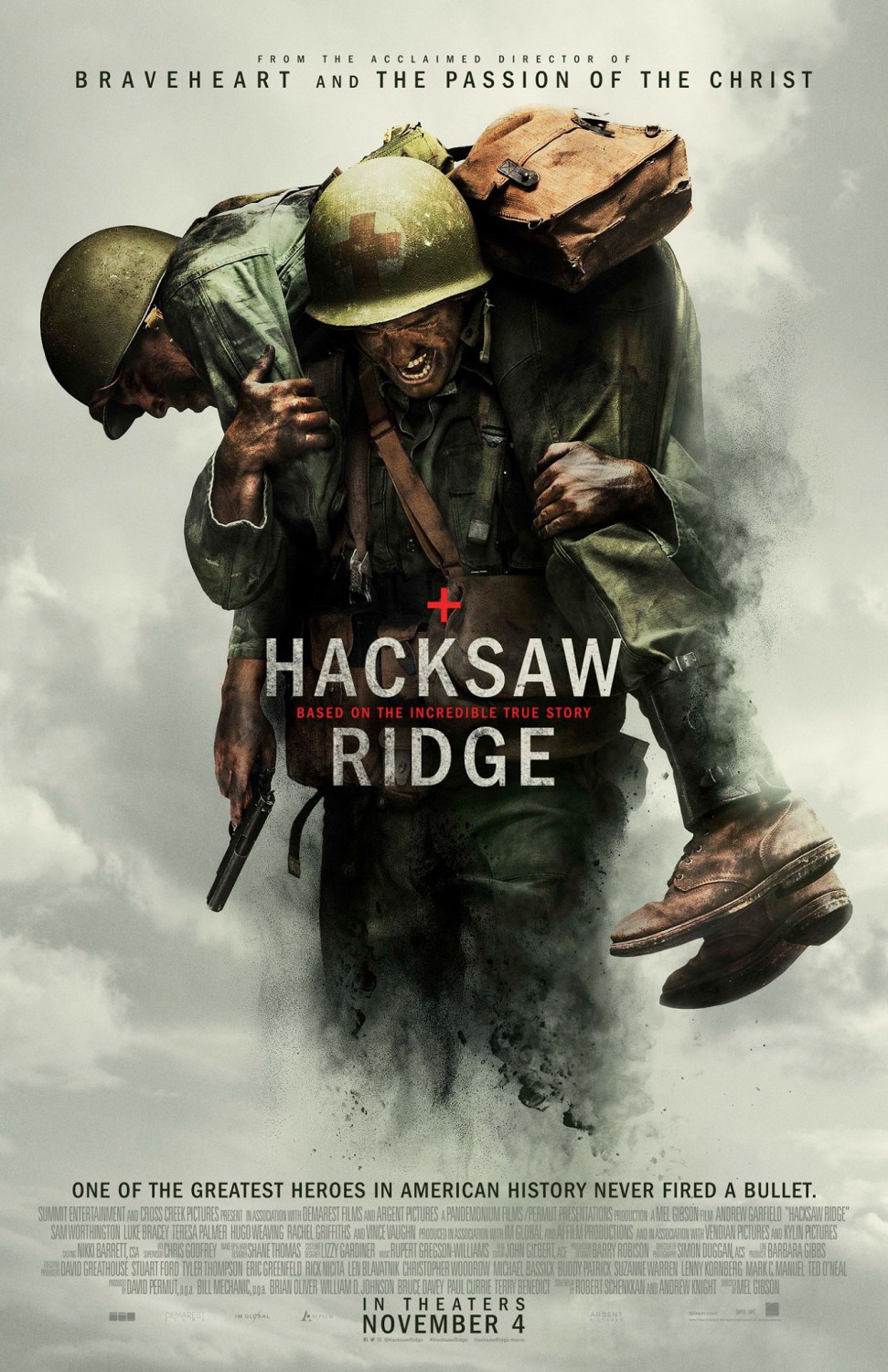
Hacksaw Ridge

hacksaw-ridge-movie-poster

I want to start off first by applauding director Mel Gibson for using the term “A True Story” as opposed to “Based on a True Story” when he starts off “Hacksaw Ridge.” You all know how much I have come to despise the term “Based on a True Story” as it has long since lost its meaning, and I have to give credit to Gibson for altering this phrase here. As a director, you know he’s not about to take the easy way out or give us something which feels emotionally false. This continues to be the case with “Hacksaw Ridge,” his first directorial effort in ten years.

This movie tells the story of Desmond Doss, a Seventh-day Adventist Christian who joined the Army in World War II to serve as a medic. The only thing is, he joins as a conscientious objector and refuses to carry a weapon of any kind into the battlefield. At the Battle of Okinawa, he succeeded in rescuing 75 wounded soldiers without firing a single shot, and he was later awarded the Medal of Honor for his acts which went above and beyond the call of duty.

Desmond is played as a young adult by Andrew Garfield, and he is very deserving of the Oscar nomination he received for his performance. From start to finish, the British-American actor imbues Desmond with an unshakable faith in a higher power, and I never saw this faith waiver for a single second. Seeing him square off with a fellow soldier who assumes he is a coward for not picking up a rifle is fascinating as Garfield’s eyes emit a hard-won bravery the others around him only think they possess. This even comes across as he pursues Nurse Dorothy Schutte (the luminous Teresa Palmer) as obsessively as Dustin Hoffman chased Katherine Ross around town in “The Graduate” to where you wonder if anything could stand in Desmond’s way at all.

We all know Gibson is a devoutly religious person, and not just because he made “The Passion of the Christ.” Indeed, “Hacksaw Ridge” could have easily looked silly if it took its subject far too seriously or tried to indoctrinate us or push some agenda, but Gibson doesn’t make those mistakes. The director treats Desmond with the respect he deserves, and he was clearly determined not to make him look like a joke. Desmond was the real deal, and he found the perfect actor to portray him in Garfield.

Gibson also wades through a wealth of war movie clichés which do take away from the final cut, but the scenes are elevated by a number of strong performances from a well-chosen cast. Hugo Weaving of “The Matrix” and “Lord of the Rings” fame (“Welcome to Rivendale, Mr. Anderson”) is a big standout as Desmond’s father, Tom. Being a war veteran himself, Tom has seen the vicious damage it has done to the soul and the psyche. Weaving makes Tom more than the average abusive drunk you see in cinema as he shows his character’s pain over the memories he can’t drink away, and of the terror he wishes to keep his sons from experiencing themselves.

Rachel Griffiths provides the yin to Weaving’s yang in her performance as Desmond’s mom, Bertha, who enforces in her son the importance of God’s commandments, especially the one which states “thou shalt not kill.” She also gives Bertha a strong gravitas which Garfield benefits richly from as the movie goes on, and you can see how her presence remained a strong one in Desmond’s life.

Then there’s Vince Vaughn who gives his best performance in quite some time as Army Drill Sergeant Howell. While his work may pale in comparison to R. Lee Ermey’s brutal performance in “Full Metal Jacket,” at least Vaughn invests Howell with a strong dose of human you wouldn’t often expect characters like these to have in war movies.

But the real meat of “Hacksaw Ridge” comes in the last section during the battle sequences. Now Gibson might not be able to match Steven Spielberg’s powerful realism when it came to those unforgettable opening minutes of “Saving Private Ryan,” but he tops him when it comes to bloody carnage. Bullets fly everywhere, limbs are blown off and guts are laid out for rats to chew on. This should be no surprise as this movie comes from the director of “Braveheart,” “The Passion of the Christ,” and “Apocalypto,” and like those movies, it features a protagonist who has to wade through body parts and blood in order to receive any kind of salvation.

Along with director of photography Simon Duggan, Gibson gives us some of the most visceral and best war movies I have seen in a long time as he shows you the damage war leave in its wake as well as what it does to the souls of those in the front line. It also gives a real-life superhero who selflessly risked his life to help those who could no longer help themselves. While certain sections are undone a bit by an innate corniness which comes with unavoidable clichés, Gibson gives us a war movie for the ages which, in the wrong hands, could have become silly and heavy-handed, but in his, it becomes a celebration of a man who saved so many without even firing a bullet.

“Hacksaw Ridge” had been in development hell for 14 years, and the rights to it were at one point in the hands of Walden Media which wanted to turn Desmond’s story into a PG-13 movie. Something tells me this would have been a mistake as sanitizing the struggles of war would have been an insult to those who fought for our freedoms. Yes, this is an ultra-violent motion picture, but for good reason. Could we have appreciated what Desmond without having a clear view of the chaos he and other soldiers put themselves into? I think not.

* * * ½ out of * * * *


Arbitrage

arbitrage-movie-poster

Definition of Arbitrage:

  1. The nearly simultaneous purchase and sale of securities or foreign exchange in different markets in order to profit from price discrepancies.
  2. The purchase of the stock of a takeover target especially with a view to selling it profitably to the raider.

Arbitrage” looks like the average thriller better suited to the usual made for TV movie on network television or the Lifetime Channel. However, it turns out to be a brilliant thriller which takes a seemingly simple story and spins it into a complex one filled with characters that seem easy to figure out but prove to be anything but. Just when you think this will be a film about what’s right and wrong, it becomes one in which everyone finds their moral values permanently compromised no matter how good their intentions are.

Richard Gere stars as Robert Miller, a hedge-fund magnate whose every inch of his being oozes success like it’s supposed to. Robert looks to have all the money he ever needs, a loving family, a loyal wife, grandkids and the whole nine yards. We soon find, however, that he is deeply immersed in fraudulent practices which could tear his whole empire down if exposed. Robert’s only salvation is to sell off his trading empire to a major bank before his wall street crimes are revealed so he may pay off all his debts for good.

But things get seriously complicated for Robert when he is driving to upstate New York with his mistress Julie (Laetitia Casta) and their car flips over on the road. The crash ends up killing Julie and leaves Robert in a serious predicament as he cannot report what happened to the police. If he does, it will seriously delay the sale of his company which could put him and his family on the brink of financial disaster. The walls continue to close in when NYPD Detective Michael Bryer (Tim Roth) is assigned to the case and finds circumstantial evidence implicating Robert in Julie’s death. The question is, how much longer he can keep up this moral duplicity before it undoes him permanently?

“Arbitrage” marks the directorial debut of writer Nicholas Jarecki whose work deals with larger than life characters and morally ambiguous themes of industry, power, and corruption. What I loved about his direction here was how naturalistic everything seemed, be it the acting or the setting. No one in the cast overdoes their performance which makes for a more invigorating cinematic experience than we typically get.

Jarecki also gives us some brilliantly conceived characters who appear to represent right and wrong very clearly, but as the story goes on, we find they are not immune to moral compromises. Even the police detective who represents working class Americans sick of being screwed over by the rich proves he is not above bending the rules to get a conviction. All this time, Julie becomes less of a human being and more of a bargaining chip for everybody involved.

I was listening to an interview with Gere and NPR’s Audie Cornish who remarked how she’s always rooting for the actor no matter what character he plays. Whether he’s playing a slick defense attorney who lives for self-promotion in “Primal Fear” or as a seriously corrupt cop in “Internal Affairs,” Gere comes across as strangely likable even when his characters are jerks to say the least. His role as Robert Miller is further proof of how brilliantly he portrays the kind of people we love to hate in these endlessly difficult economic times.

Robert is at his heart a slick manipulator and a liar; he deceives his children, cheats on his wife, is knowingly committing fraud, and is not about to accept any responsibility for his mistress’ death. Throughout “Arbitrage’s” running time, Gere is riveting as he tries to stay one step ahead of the law, and we find ourselves rooting for him to do so. We should despise this man and his morally duplicitous ways, but you have to admit Robert is a very smart guy who has managed to stay afloat despite some bad decisions.

Although his New York accent sounds a little weird, Tim Roth is also excellent as NYPD detective who becomes bent on taking Robert down. His character of Michael Bryer is on the side of law and justice, but he proves to be as ruthless as Robert while he pursues witnesses relentlessly, and he has no problem threatening their livelihoods in order to get a conviction.

Nate Parker plays Jimmy Grant; a family friend of Robert’s who helps him out of and then finds himself in the middle of his problems. Jimmy is a familiar character in that he is caught between doing the right thing and keeping his mouth shut and we see so many of them in movies. But Parker does great work in conveying Jimmy’s inner turmoil to where this character seems like anything but a cliché, and he makes you feel what it’s like to walk in his shoes.

Brit Marling is wonderful as Robert’s daughter and heir-apparent Brooke, and seeing her transition from loyal daughter to one whose trust is forever shattered is heartbreaking. Her scene with Gere will remind those of us who have been put into impossible situations we cannot easily extricate ourselves from, and the look on her face is one which never goes away.

But it’s Susan Sarandon who almost steals the show as Robert’s wife Ellen, and she reminds us what a powerhouse of an actress she can be. Sarandon portrays Ellen as loyal almost to a fault, but she reveals vulnerabilities throughout which indicate she knows more about what’s going on than Robert realizes. Sarandon’s final confrontation with Gere is a knockout as she comes up with an extra strategy which is as brilliant as the one Katie Holmes pulled on Tom Cruise.

In addition, there’s also a wealth of beautiful cinematography by Yorick Le Saux and a music score by Cliff Martinez which fits this material like a glove.

I was stunned at how much I liked “Arbitrage,” and it really is one of the best movies I saw in 2012. It’s the kind of film you can’t quite prepare yourself for how good it will be because it came cloaked in trailers and advertisements which make it look ho-hum. Jarecki, however, gives us a film which is anything but average, and I thank him for that.

* * * * out of * * * *

Amy

amy-documentary-poster

I remember the first time I listened to Amy Winehouse’s album “Back to Black.” It transported me to another time and place that had long ceased to exist as her music sounded like something out of the 60’s. I actually found her album at my local library and downloaded it onto my iPod with the hopes of listening to it one day. Once I did get around to listening to it, I couldn’t turn it off as I was too captivated by her amazing vocals and heartfelt lyrics.

It was profoundly sad to see Winehouse’s life get cut short at the age of 27 from alcohol poisoning. In some ways, her death wasn’t a huge surprise as she had endured a lot of substance abuse and paparazzi harassment in the years leading up to her death. She had become a tabloid punchline as it appeared as though she had no desire to hide her debaucheries from the public eye. Many of us rooted for Winehouse to pull herself out of her downward spiral and struggled to understand why she would self-destruct on such a public level, but it only goes to show just how much we know about being famous. One person described her as being an old soul in a young woman’s body, and this became even more the case as time went on.

The documentary “Amy” succeeds in giving us a very intimate look at Winehouse not just as a public figure, but as the person she was before and after she achieved worldwide fame. Many who knew her personally are interviewed here, and it gives us a picture into a life which became irrevocably damaged by fame and substance abuse. But even though we know how her story will end, the documentary brings her back to life for a short time, and it feels like she is still with us.

“Amy’s” first image will forever burn in my memory as we see the singer at her best friend’s 13th birthday party. We see her sing the song Happy Birthday and can’t take our eyes off of her as she does such an amazing job of belting it out. This proved to be the best way to start this documentary as we see right then and there a star has been born. Listening to her makes you wish she would sing at your next birthday party, seriously.

The documentary is full of never before seen home videos and footage which helps to give her more complexity and dimension than the media ever could while she was alive, and this makes seeing “Amy” all the more necessary. The singer has long sing joined the ranks of Janis Joplin and Billie Holiday, famous singers whose lives were cut short at such an early age, and like them, she deserves to be known for more than her vices.

What “Amy” shows is how Winehouse was a woman who got into music as a form of survival. Having been a child of divorce and suffered from depression, music and singing offered her an outlet from all the psychological damage life kept inflicting on her. She never saw herself having a career as a singer, and she admits early on she didn’t set out to become famous because she didn’t think she could handle it. Those words soon prove to be prophetic.

It was great to see all the home footage of Winehouse as it gives us a side of her the public never got to see until now. She appears for a time to be a fun-loving girl eager to spend her days with friends and smoke weed, but like any famous artist she was a tortured soul whose eagerness to sing was more about getting negative energy out of her system than making millions of dollars.

The fact “Amy” is such an intimate documentary isn’t a huge surprise to me as it was directed by Asif Kapadia, the same filmmaker who gave us one of the very best documentaries of the last few years with “Senna.” Just as he did with “Senna,” Kapadia invites us to spend time with a celebrity who we previously saw through the distorted lenses of corporate media.

It also gives you an up close and personal view of how damaging fame can be. One scene has Winehouse going up to the stage to accept an award, and the noise of the audience and fans quickly becomes deafening, illustrating how her life had become a fish bowl which cut her off from everyday reality. It’s not hard to feel for her as the prying and voyeuristic eyes of the media render her private life nonexistent.

Her addictions included alcohol and hard drugs like cocaine and heroin, but perhaps her biggest drug of all was the tempestuous love affair she had with Blake Fielder-Civil. The fact she and Blake didn’t meet the same fate which greeted Sid Vicious and Nancy Spungen seems amazing considering how deeply intertwined they were in each other’s lives and vices. Woody Harrelson in “Natural Born Killers” said “love beats the demon,” but for Winehouse, love may have proven to be her biggest demon even as it fueled some of her most unforgettable songs.

“Amy” also calls into question how we deal with celebrities whose lives are spinning out of control. Winehouse became a punchline for comedians as her woes continued endlessly, and what might have seemed funny while she was alive now seems cruel in retrospect. Perhaps we are numbed to the suffering of celebrities as we have many examples of famous peoples’ lives getting cut short from one generation to the next, but it also shows the pleasure many took in her self-degradation. Now you may say she brought this all on herself, but did she really?

It’s horrifying and ultimately heartbreaking to see Winehouse in her last days as such a gaunt and unhealthy looking person. Many have called her a nasty diva but, as Kapadia shows here, she was really trying to escape the constant glare of the media and attention she never set out to get. At the last concert she did before her death, one she did not want to do, she refused to sing a single note even as the crowd mercilessly booed her. From a distance this looks like the antics of a spoiled pop star, but it was an act of defiance on her part as she was struggling to escape the famous persona which had been thrust upon her. Sadly, she found the escape through death.

Now I may be making “Amy” sound like a truly depressing cinematic experience, but while it is heartbreaking, it is also joyful as well. Winehouse was an exceptionally gifted singer, and hearing her voice when it is not being backed up by a band is jaw-dropping to witness. She really did have one hell of a voice. Also, Kapadia pays close attention to the lyrics she wrote and how autobiographical they proved to be. After watching “Amy,” it will be impossible to look at any of her songs the same way again.

There are wonderful moments when Winehouse performs in London for the Grammys after getting clean and sober, and it’s great to see her excitement when Tony Bennett comes onstage. When she ends up winning a Grammy, the theater she’s in bursts into applause and cheers, and it’s exhilarating to see everyone’s reactions as all the hard work paid off in a great way. Of course, this moment is also tinged with sadness as we know this will be the last true moment of happiness in Winehouse’s life.

Granted, “Amy” has been dealing with some controversy as her family has blasted the documentary as being inaccurate. Her father, Mitch, has been especially critical as he feels the filmmakers portrayed him in a very negative light. Mitch, in all fairness, has a right to feel this way, but Kapadia has given us an objective look at him and everyone else featured in a way which doesn’t moralize or demonize anyone. Any faults of Mitch shown onscreen are his to own up to, but at least the movie doesn’t show him as being completely absent throughout his daughter’s life.

For what it’s worth, Mitch comes off a lot better than her daughter’s ex-husband, Blake Fielder-Civil, who openly admits to introducing Winehouse to crack cocaine and heroin. The fact he admits this to Kapadia in an interview is astonishing, and it makes clear he is the one with the higher price to pay for Winehouse’s demise.

I’ve watched a number of documentaries recently which have been very entertaining, but many of them dig only so deep or touch at the surface of their subject’s life. It’s like there’s something missing which makes the whole endeavor seem like a loss opportunity when you look back on it. But “Amy” proves to be one of the very best documentaries in the past few years as it examines its subject objectively and without fear, and it leaves no stone unturned as it uncovers the many aspects of this troubled singer’s personality.

Just as he did with “Senna,” Kapadia has made “Amy” as a way to get to know this famous personality in a way we never had before. It’s like he has brought her back to life for a short time to where it feels like she never left, and it is nice to see her portrayed in such a way more befitting to who she was as an individual instead of how she was as a worldwide famous celebrity.

It was nice to meet you, Ms. Winehouse. Sorry you couldn’t stay with us a little while longer.

* * * * out of * * * *

A Most Violent Year

a-most-violent-year-movie-poster

A Most Violent Year” takes us back to the New York City of 1981 which was statistically the most dangerous year in the city’s history. It was just before crazy hairdos, Madonna, “Miami Vice,” and MTV became a reality, and it was also a time where doing business in the Big Apple became fraught with unbearable tension. Many people fled to the safety of the suburbs as immigrants arrived who were searching for the American dream, and I don’t just mean Tony Montana. In some ways, the movie’s title is misleading as this is not one filled with wall-to-wall violence. Instead, it’s more about the violence hiding beneath the surface which is just waiting to burst out as one immigrant in particular looks to start a legitimate business, but he soon discovers that the road to success is paved with devious intentions.

Oscar Isaac stars as Abel Morales, and this movie starts with him putting a down payment on a piece of land in Brooklyn where he looks to expand his small heating-oil business to a significant degree. Abel has a strong business partner in his wife, the straight out of Brooklyn Anna (Jessica Chastain), whose father, a known gangster, he bought the business from. Abel makes it no secret that he intends to run this business in a legitimate fashion, but it doesn’t take long to see how incredibly difficult that will be for him.

Just as Abel’s plans look to be coming together, he finds himself dealing with competitors who are ever so eager to snag a bigger share of the market. On top of that, thieves keep attacking his drivers, stealing his fuel and selling it to illegitimate markets, and Assistant District Attorney Lawrence (David Oyelowo) is investigating Abel’s accounting practices which just might reveal that he’s not the law abiding citizen he constantly claims to be. Suffice to say, this man has a lot on his plate and he now has only three days to finalize his deal on the land he wants to purchase.

What’s fascinating about “A Most Violent Year” is how all the characters are stuck in a morally gray area throughout. The difference between right and wrong is impossible to sort out because the overriding concern for Abel and Anna is to close the deal before everything falls apart and their dreams are destroyed. The movie really puts you in Abel’s shoes to where you get a full sense of his desperation to keep his head above water. What he comes to discover is that he cannot depend on others in the business community to help him with his escalating troubles. In his attempt to expand his business, he finds that he’s living in a time where it’s every man for himself.

I loved watching Isaac as he imbues Abel with such a strong aura of confidence (some may say overconfidence) as he tries to gain the trust of those who are in a position to help him. To be honest, it’s that kind of confidence I would love to exude in my own life. As “A Most Violent Year” goes on, we see that confidence start to slip ever so slightly which leads to a number of intense moments Isaac has no problem delivering on. This is the same actor who so memorably broke through into our consciousness with his performance in the Coen brothers’ “Inside Llewyn Davis,” and with “A Most Violent Year” he shows just how far his range as an actor goes. Even when his character becomes desperate in his attempts to make his business expansion a reality, Isaac maintains a commanding presence throughout.

But as good as Isaac is, he almost gets the movie stolen out from under him by Jessica Chastain. Her performance as Anna is a scorcher as she makes clear who the better businessman is in the family, and Chastain molds her into a Lady Macbeth-like character who is far cleverer than anyone will ever give her credit for. Knowing she’s a native of Northern California, I thought casting her as someone born and raised in Brooklyn might be a mistake. Well shame on me for thinking that because Chastain once again proves why she is a talent to be reckoned with.

“A Most Violent Year” was written and directed J.C. Chandor who also gave us “Margin Call” and “All is Lost.” All of his films to date have dealt with people caught up in crisis situations that continue to spiral out of their control, and this one proves to be every bit as enthralling. Chandor gives us a highly specific view of 1981 that never feels clichéd or obvious to the decade, and he takes us on a very tense journey with someone who may dress far better than I ever will, but who also exhibits the same anxieties and concerns we all do. His attention to character is exemplary, and he leaves on the edge of our seats in more ways than one.

It would be so nice to do business without having to go against the things we were taught to believe in, but we eventually learn business in general is never fair (and I don’t just say this because I live in Los Angeles). I found myself never quibbling too much about the things Abel ends up doing in “A Most Violent Year” because I have a very nasty feeling I wouldn’t approach his situation all that differently. Back in a time where the established way of doing business ceased to exist, I imagine I would have made the same compromises Abel is forced to make here. Whether one can live with that is a whole other story, and “A Most Violent Year” tells it in a very compelling manner that holds your attention throughout.

* * * ½ out of * * * *

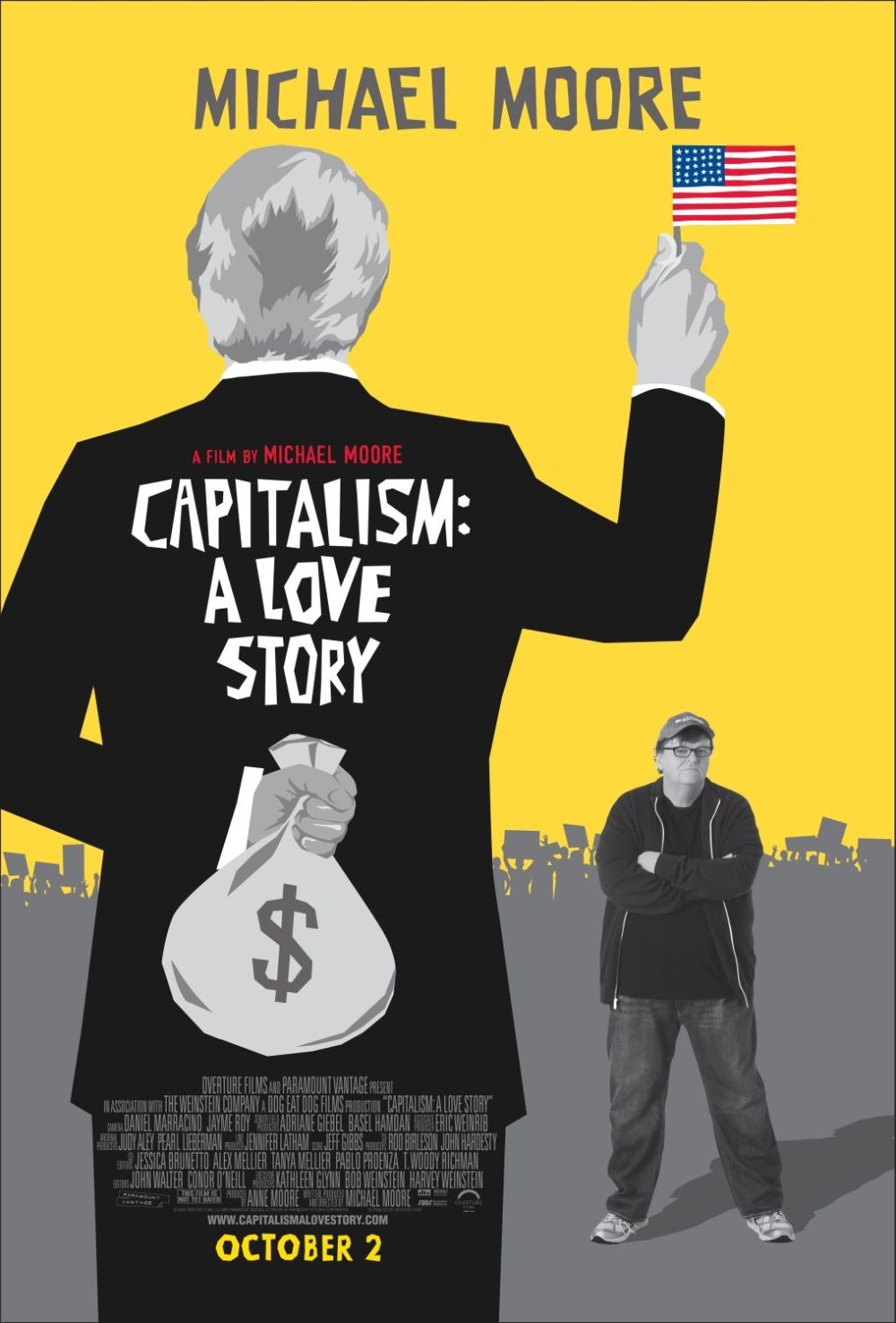
Capitalism: A Love Story

capitalism-a-love-story-poster

“We are here to tell the truth! People say if you don’t love America, then get the hell out! Well I love America!”

                                              -Tom Cruise as Ron Kovic in “Born on The Fourth of July”

“I believe that banking institutions are more dangerous to our liberties than standing armies.”

                                                                                                                                                           -Thomas Jefferson

I was a little worried about Michael Moore’s film, “Capitalism: A Love Story.” It covers the catastrophic economic fallout from 2007 to 2009 and presents a very harsh indictment of the current economic order in the United States. Throughout the movie, Moore shows us families being evicted from homes which they have owned for years, and how many get swindled out of them without them realizing the trap they are ensnared in until much too late. He also looks at how Wall Street treats the country’s economy like a reckless night of gambling in Las Vegas, and at how Goldman Sachs gained a frightening amount of leverage over congress at an economically vulnerable time. In short, it is Moore’s attack on all things capitalism, and of how it is an evil which is ruining the fabric of our once great country.

While it may seem ironic how Moore would take on capitalism, especially when he has benefited so much from it over the years, he creates a very compelling case here. Whether you think he is telling the truth or simply manipulating facts to his own advantage, he remains the most entertaining documentary filmmaker in American films. “Capitalism: A Love Story” is honestly one of his best films to date, and it combines some truly devastating moments along with some very funny ones. The movie does need those humorous moments, otherwise this could have been one of the most emotionally draining cinematic experiences ever.

“Capitalism: A Love Story” starts off in a way both hilarious and frightening. Moore starts off with one of those cheesy, snicker-inducing 1950’s instructional movies about the rise and fall of the Roman Empire. It resembles all those films we were constantly subjected to throughout our school years. While the movie plays out along with the stiff narration, Moore inserts clips from the Reagan era White House, and continues all the way through the Clinton era, not to mention both of the Bushes, showing us how the fate which befell the Romans is very much alike to what is happening to America right now. Clearly, he sees us following in the footsteps of a society destroyed through endless greed and avarice, and he is amazed people want to hang on to this damaged system regardless of how bad it is.

From there, Moore takes us to a family in Peoria, Illinois getting evicted from their home. It’s one of the saddest moments in the film, and to add insult to injury, the family ends up getting thrown out of their home much earlier than they had expected. They were given a couple of weeks originally, but it turns out the bank which repossessed their home had just sold it to another family who were ever so eager to get settled in it.

I’ve been looking at these foreclosures from a distance, and I felt a good portion of them were due to owners not living up to their responsibilities. But while this may be the case to a certain extent, Moore creates a very interesting case of how the banks ended up swindling many families out of their homes because the banks continued to charge them more and more for their mortgage. For those looking to become homeowners, the movie is a reminder of how important it is to read the fine print of every contract you sign.

For Moore, capitalism seemed like such a great gift to our country when he was growing up in Flint, Michigan. The way he saw it, it provided his dad with a good job, helped give his family free health care, helped to pay for him to go to college without falling into tremendous debt over student loans, etc. But then Reagan came along and ruined it all from Moore’s perspective. “Capitalism: A Love Story” doesn’t necessarily portray Reagan as an evil man, but it views him more as a puppet for the banking industry among others. Before the star of “Bedtime for Bonzo” came along, the rich were apparently given a 90% tax on what they made, so naturally, they weren’t very happy about this. With Reagan taking over as President, the banks were able to gain control of all things money related, and they created massive tax breaks for the rich. From there, the cost of living rose faster than the cost of living, and prices on things like health care skyrocketed to an exorbitant rate. Even prisons and juvenile detention halls became for-profit businesses where the sentences turned out to be longer than you were told. In short, things were changing, and the price of those things started to get higher and higher.

Much of the American public seemed to be sold on the idea we could be rich too, and therein lays the big lie of Reganomics. In actuality, his policies throughout the 1980’s resulted in creating a bigger gap between the haves and have-nots, and the middle class at times threatened to be rendered extinct. Moore presents this as the point in our country where things started to change to where the rich benefited more than anyone else. Greed became a powerful influence on everyone, and much of America turned into a “me, me, me” society as opposed to one which sought to help the less fortunate. He also shows how it went from there to the Clinton era and, more horrifyingly so, to the George W. Bush era in which the tax cuts for the rich almost became permanent.

“Capitalism: A Love Story” is kind of a semi-sequel to Moore’s “Roger & Me” which came out 20 years ago. In that film, he pursued General Motors chairman Roger Smith for an interview over the closing of the car factory in his hometown. The closing resulted in a tremendous loss of jobs, all despite the fact GM was posting record profits. All these years later, Moore still cannot get a meeting with the CEO of GM. What occurred in Flint, Michigan all those years ago gave him a chance to tell the automotive industry, “I TOLD YOU SO!!!”Unsurprisingly, after all these years, Moore can still not get inside the doors of the GM corporate headquarters to talk to the CEO. His attempts to enter other buildings are just as unsuccessful, and when he tries to get any of the bankers to explain what a “credit derivative” is, one of them says, “Stop making movies!”

Unsurprisingly, after all these years, Moore can still not get inside the doors of the GM corporate headquarters to talk to the CEO. His attempts to enter other buildings are just as unsuccessful, and when he tries to get any of the bankers to explain what a “credit derivative” is, one of them says, “Stop making movies!”

One moment in “Capitalism: A Love Story” which really stayed with me was when President Reagan addressed the bankers on Wall Street, and one of the most powerful bankers standing right next to him told, not asked, him to “speed it up.” Wait a second, Reagan was one of the most powerful people on the planet at that time, and someone next to him was telling him to speed it up? It makes you wonder who was really in charge of America back then.

A truly heart breaking scene comes when a former Wal-Mart employee talks about how, when his wife died at a young age, the company ended up making thousands of dollars off her death. It turns out Wal-Mart took out life insurance policies on all their workers, and ended up profiting from their passing. To make matters even worse, the younger the worker, the more money they get. Now fact checkers everywhere are going to point out how Wal-Mart has since ended these policies, but Moore does mention this during the closing credits.

Another section of the film which hit close to home was when Moore points out how airline pilots are paid less than the manager of a Taco Bell; about $19,000 a year for starting pay. My brother is an airline pilot, and while he makes better wages now, those first few years were a struggle to say the least. It seems almost criminal how these huge airline companies which make millions of dollars end up paying their pilots so pitifully. Thus, we get an example here of the ever-widening gap between the rich and the poor.

Now let’s take a moment here because we all know many will be accusing Moore (many of whom will not even bother watching this film) with thoughtlessly manipulating his on-camera subjects and distorting what they say to his own advantage. Granted, there are moments where his camera focuses on crying family members a little longer than what feels comfortable. While the feeling of manipulation is hard to ignore, getting angry at Moore for showing this will be missing the point. He wants you to be mad. With “Capitalism: A Love Story,” he means to stir up your anger because he does not want you to react passively to what you are witnessing. He wants you to take action against what is happening because he is really sick and tired of doing this all by himself. Can you blame him? Many of us are viewing this economic breakdown and corruption from a distance, and we can’t spend the rest of our lives letting all this go unchecked.

But if scenes of everyday working class people getting heartlessly fleeced doesn’t frighten or enrage you, then the latter half of the movie where nerve-wracked members of congress get swayed by Goldman Sachs among other banks to bail them out so the banking industry could survive should do the trick. Nobody I know of was happy to hear about this, and we got even more pissed off when they got million dollar bonuses which were undeserved. There was a great article in Rolling Stone of how Goldman Sachs circumvented the economic crises of past and present to benefit themselves. Seeing this play out on the screen brought back my own deep feelings of unrestrained infuriation at what these bankers were doing with taxpayer dollars. Why exactly do we have to pay for the mess they created anyway? What happened to accountability?

Many still believe Moore is nothing more than an anti-American zealot who has nothing better to do than say bad things about our country. The conservative comedy “An American Carol” had a character like him trying to convince fellow citizens to abolish the Fourth of July as a holiday. But what made me really love the last half of this film is how he shows how the power of the people really did win out. If you still think he is a hater of this country after watching this, you may need to remove yourself from the cave you have been hiding in.

Moore shows how it was the will of the people which prevented the first economic stimulus, largely engineered by members of Goldman Sachs, from passing. At seeing what was about to occur, Americans everywhere contacted their representatives, urging them not to pass this bill. There were enough house representatives who saw how the banks were in the position of almost completely controlling the legal process, and they rallied against them for the sake of the country. This was all the result of American citizens speaking up loudly.

The spirit of the American people is shown even more strongly when we witness the laid off workers of Republic Windows and Doors in Chicago do an in-house protest at their place of employment. This came about because none of them were paid the severance promised from Bank of America. We also get a look at community groups like LIFFT in Miami which helped unfortunate families and “liberated” the houses they were evicted from. The police came out in force of course, but they ended up not arresting anybody probably because it wasn’t worth the trouble. Then we see Captain Chesley Burnett “Sully” Sullenberger III, the pilot who saved the lives of all 155 passengers aboard US Airways Flight 1549 when he landed it in the Hudson River, go before Congress to protest the way pilots were treated in general and how underpaid they are.

I should add when the section regarding Captain Sullenberger came up, I was afraid Moore would bash him in some way. But he actually applauds Sullenberger for taking his newfound fame and using it to help others who love their job of being a pilot. This leads to one of the movie’s funniest moments as Moore shows how the media seemed to like him more as a hero instead of someone who stands up against the companies for not paying pilots enough. Moore ends up putting some patriotic band music over the soundtrack to shut out Sullenberger, because no one really likes a Debbie Downer.

After all the films Moore has made criticizing people and polices of the United States, it seems amazing anyone would talk to him on camera. But he does get people like University of Missouri professor Bill Black, and Ohio Congresswoman Marcy Kaptur to talk about what they see as the ills of capitalism. Furthermore, he even talks to the Catholic priest who married him and his wife who says capitalism is a sin and not very Christian-like.

Kaptur is one of the movie’s most compelling voices, and she said the first economic stimulus bill would have been a disaster for democracy had it been passed. It would have allowed the banks to have more control over taxpayer money and the legislative process, hence rewriting the law books we have come to study all these years. The banks may want to concentrate the nation’s wealth among the 1% of the population who has it, but they cannot be allowed to silence the voices of the 99%.

Black himself comes off as one of the most intelligent people seen here, and it is heartbreaking to see how some of the smartest minds in America saw this economic disaster coming from miles away. He compares the fallout to a water damn which breaks apart, but of how we could see those little cracks forming. The fact many people like him were silenced or had their character smeared beyond all repair is shameful. For them, they saw it as only a matter of time before the banking industry came crashing down, so there was no way they could have been surprised by any of this.

I was also really pleased to see Moore stick it to the Democrats as well as the Republicans. While the Republicans may share the largest blame, the Democrats cannot be excluded because many of them are every bit as guilty in what transpired. It doesn’t matter what side of the political spectrum they were on, politicians of all kinds were bought out with what seemed like very little effort. Truth is, I am seriously frustrated with both major parties, and Moore taps into this because many Americans, regardless of party affiliation, feel the same way.

By the way, if you really think that Moore is this left-leaning zealot, keep in mind he has spent many years criticizing both parties, and his ire at Democrats seems much larger because he expects more from them. I’m sure if Moore had it his way, Ralph Nader would have been President by now.

As for President Barrack Obama, Moore steers clear of saying anything bad about him, probably because many still see him as a symbol of hope. If Obama does foul things up in Afghanistan, I’m sure Moore might consider doing something on it. But that coupled with the power of people made the last half of this movie seem like the feel-good movie of the year, and this is regardless of how exaggerated it all may seem to those who cannot stand this baseball cap wearing filmmaker.

In the end, Moore is not out to make you repeat everything he says or believes in like it’s the gospels. His attack against capitalism is not entirely waterproof, and much more blame could be thrown at how corporate America has become so corrupted. But it doesn’t matter because what he wants is for you to be angry, and to fight against those who would try to wrestle away the powers given to us in the Constitution.

“Capitalism: A Love Story” is really one of his best films in how he attacks many policies this country has adopted, and then counters it with proof that the power still does belong to the people. It does to the banking industry and deregulation what “Sicko” did to the health care industry, and it is informative, funny, moving, and endlessly entertaining.

For those who wonder why Michael Moore hasn’t left America yet, see this movie to find out. Like him, you may hate what this country is doing to its people, but you are not about to leave it.

 * * * * out of * * * *

Save

Save

Forget ‘Fifty Shades of Grey,’ and Check Out ‘The Duke of Burgundy’

the-duke-of-burgundy-movie-poster

Looking at the trailer for “The Duke of Burgundy,” I couldn’t help but expect a sexploitation flick with lots of nudity and dozens of butterflies. But while the movie does deal with a sadomasochistic relationship between two women, it actually turns out to be a domestic drama about two people who love one another deeply. When the movie starts, however, it looks like this relationship is reaching its breaking point.

“The Duke of Burgundy” starts off with an innocent looking woman named Evelyn (Chiara D’Anna) cycling over to a grand mansion where she is greeted coldly by Cynthia (Sidse Babett Knudsen) who bluntly informs her she is late for work. From there it looks like Evelyn works as Cynthia’s maid and is rudely ordered around and made to do chores, each of which are increasingly demeaning. It’s a daily routine for these two, and the day ends with Cynthia punishing Evelyn behind a closed bathroom door. We have a good idea of what Cynthia’s doing to her, but director Peter Strickland is more content to let us visualize what’s happening instead of showing us everything.

At this point, I became very eager for Evelyn to smack Cynthia in the face, but as the saying goes, you can’t judge a book by looking at the cover. What’s actually happening is that these two are in a relationship where Evelyn is the submissive one and Cynthia is the dominant one. They are deep into role playing and enjoy each other’s company more than we could have realized. But as “The Duke of Burgundy” continues on, it becomes apparent that a compromise in this relationship is desperately needed. We see in Cynthia’s eyes a longing for a more normal relationship, but Evelyn has become hopelessly addicted to the submissive role she plays and wants her lover to punish her more aggressively than ever before. With any addiction, you eventually come to find too much is not enough.

This movie surprised me throughout as it plays around with what you think you know about sadomasochism to where you’d expect Cynthia to come out dressed as a dominatrix and carrying a big whip. But if you strip away the strange and painful things they do to one another, you see their relationship is no different from any other, and like any relationship, there needs to be some compromise. The question is, who’s willing to compromise more?

Both D’Anna and Knudsen are perfectly cast, and they nail each of their characters’ complexities with a lot of depth. It’s fascinating to watch their relationship evolve to where the most dominant one is actually Evelyn as she continually begs Cynthia to feed her dark desires. Knudsen, in particular, has a great moment where she’s getting intimate with D’Anna, and you see this wounded look in her eyes which says without words how this relationship is becoming a lot less comfortable for her.

“The Duke of Burgundy” is also one of the most beautifully filmed movies I’ve seen in a while as it looks like it was shot on 16mm film to where you think you’re watching something from the 70’s. To my astonishment, I discovered it was shot digitally which completely blew my mind. Many congratulations go to cinematographer Nic Knowland who has been working in movies since the 60’s. The lush and hazy look he gives this movie feels magical and makes you realize what amazing things can be captured with digital cameras. It was also fascinating to learn many of the images were created in the camera and not in post-production.

The movie also features a very unique and original score by Cat’s Eyes, an alternative pop duo made up of two musicians from entirely different disciplines. Their music adds immeasurably to the story which reaches a fever pitch towards the end when this relationship looks to be doomed. Like Mica Levi’s score for “Under the Skin,” I have a hard time comparing Cat’s Eyes score to others out there. Here’s hoping they compose more film scores in the future.

Strickland previously directed “Berberian Sound Studio” which brought him to the attention of many film critics who became immediately enthralled with his work. I regret to say I haven’t seen that movie yet, but watching “The Duke of Burgundy” does make me want to check it out sooner than later. Strickland shows a strong mastery of the filmmaking process, and he ends up taking us on a journey unlike few other have recently. He also tricks us into thinking we are watching one type of movie, and he ends up giving us something which is not only different but far deeper and more mesmerizing than we ever could have expected.

I also want to point out that there’s not a single male character to be found in this movie. That’s actually pretty amazing considering how hard it is to think of an American movie where this is the case. I’m sure there’s one like this one out there, but nothing comes to mind right away.

What bums me out is audiences will not be quick to come out in droves to see a movie like “The Duke of Burgundy.” Small and original movies like these tend to get swept under the rug far too quickly in this day and age of superhero franchises, and I hope those with a taste for challenging and unusual material will give it a shot. What Strickland has given us is an edgy fairy tale which could take place in any time period, and he sucks us into a story you cannot help but be enthralled by. With any luck, we’ll get more challenging movies like this one in the future. At the very least, it’s infinitely better than the awful monstrosity which is “Fifty Shades of Grey.”

* * * ½ out of * * * *

Save

Fifty Shades of Grey

fifty-shades-of-grey-movie-poster

I have not read E.L. James’ book “Fifty Shades of Grey,” but I have yet to hear anyone I know say a good thing about it. But after watching Sam Taylor-Johnson’s cinematic adaptation, I think I understand why it became such a literary phenomenon. It allows its readers to visualize sexual fantasies they don’t get perform in their own lives as the two main characters engage in a sadomasochistic relationship which appears alarmingly pleasurable. The question, however, is this, can the individual erotic desires James’ book conjures up come even close to equaling what we see in this long-awaited film adaptation? The answer is no, not even close, and I’m certain you don’t have to have read the book to confirm this.

Fifty Shades of Grey” is essentially a big tease of a movie which promises so much naughty stuff but instead ends up giving you very little if anything. It’s like the girl who kept teasing you in high school, and of course, you fell for her charms when you should have known better (don’t ask me how I know this). I came in with low expectations, and it proves to be a hilarious comedy for all the wrong reasons. But long before its climax or lack of one so to speak, I found myself becoming increasingly bored and started to wonder if this movie would ever end. When it finally did, I found myself breathing a huge sigh of relief.

We come to meet college student Anastasia Steel (Dakota Johnson), an English literature major on the verge of graduating when she is offered the opportunity to conduct an interview with the infinitely wealthy business entrepreneur Christian Grey (Jamie Dornan). Sparks end up flying for them instead of the audience, and while it takes far longer for them to kiss for the first time, it eventually allows Christian to bring Anastasia into his inner sanctum which includes a room filled with all the BDSM equipment you could ever hope to find or see so beautifully maintained.

Does Anastasia end up becoming the submissive to the dominant Christian? The answer seems fairly certain, but the movie takes forever to get to that point as Christian keeps encouraging Anastasia to sign a contract which will allow him to do the craziest things to her. It got to where I wanted to yell at the screen, “SIGN THE DAMN CONTRACT ALREADY!!!” Granted, Anastasia’s hesitation to do so is understandable and smart, but it just makes her inaction all the more tedious to endure. To encourage her, Christian does several things like buying her a new computer and a new car, selling her old one off in the process, and showing off the cars in his building’s garage. I kept waiting for Christian to reveal himself as a serial killer, but to do so would have threatened to make this movie interesting.

Perhaps it’s a mistake to come into “Fifty Shades of Grey” expecting anything truly realistic as it seems to exist more in a fantasy world than the real one. Still, I can’t help but wonder how Christian Grey finds the time to engage in any kind of sadomasochistic activity when he runs the kind of business which should keep him fully occupied 24/7. Then again, he does have plenty of time to work out at the gym so he can show off those six-pack abs you know he has hidden underneath his shirt.

Regardless of how I feel about Anastasia as a character and of her foolish descent into Christian’s twisted lifestyle, Dakota Johnson, the daughter of Don Johnson and Melanie Griffith, proves to be quite a good actress. I liked how she was able to convey a variety of emotions without having to say a word, and she is able to show her character’s longing while her co-star is unable to do so, which is putting it nicely. With the right role in the right movie, she may end up with quite the career as an actress, and she looks to be capable of doing so much better than appearing in this piece of dreck.

As for her co-star, Jamie Dornan who plays Christian Grey, watching him reminded me of a scene in “The Shawshank Redemption” when Red described Andy Dufresne as a guy who “looked like a stiff breeze would blow him over.” Watching “Fifty Shades of Grey,” I can’t help but think Dornan was cast just for his good looks. From start to finish, he comes across as so emotionally vacant to where I wondered if he was capable of exhibiting any kind of emotion at all. His face looks like it is frozen in place, and not even sex can seem to thaw it. Dornan does, however, have the best line when he says he’s “fifty shades of f**ked up,” and that line effectively sums up this whole movie.

Among the other things which cripple “Fifty Shades of Grey” is the fact that Johnson and Dornan don’t have much chemistry. Romantic relationships in movies thrive on the stars having some form of it, and this isn’t the case here. Rumor has it that they didn’t get along behind the scenes, and this shows here regardless of the studio’s efforts to hide the truth. Then again, it must be somewhat difficult to have chemistry when one lover punishes the other lover physically in order to feel anything.

Director Sam Taylor-Johnson only has one previous credit which is “Nowhere Boy,” a film which chronicles the childhood experiences of John Lennon. I haven’t seen it, but I’m certain my friend Trevor, a huge John Lennon fan, has many great things to say about it. But whatever great things she was able to accomplish with “Nowhere Boy” is not on display here as she succeeds in making the most sleep-inducing erotic movie ever. The sex scenes come way too late and are very unimaginative. Christian running an ice cube down Anastasia’s stomach? We’ve seen that before. As for Taylor-Johnson’s song selections which include “I Put a Spell on You” and “Beast of Burden,” they are far too obvious even if the former is sung by Annie Lennox.

“Fifty Shades of Grey” marks the first erotic studio movie Hollywood has released since “Unfaithful” which came out back in 2002. This movie represented a chance for Hollywood to deal with sexual relationships more frankly than others have in recent years, but it instead proves to be an astonishingly chaste motion picture which seems stunning considering the source material. Late night movies on Cinemax and Showtime have far more erotic power than this one (don’t ask me how I know this either), and the sex scenes are so sterile looking that it feels like they were shot in Irvine, California. The marketing department did a brilliant job in titillating moviegoers into thinking they were getting some sexy stuff they won’t find on the internet (unless they look in the right places, of course), but we went through the same thing with “Showgirls” and look what happened there. “Fifty Shades of Grey” ends up making Paul Verhoeven’s camp classic look like “Vertigo.”

Seriously, there are so many other movies that are far better than this piece of crap and which deal with sadomasochistic relationships in a healthier and far more sensual way like “Secretary” which starred James Spader and Maggie Gyllenhaal, and “The Duke of Burgundy” which is from the director of “Berberian Sound Studio,” Peter Strickland. What depresses me is audiences are going to flock out to this adaptation than they will to other movies far more worthy of their time and money. Some books translate well to the silver screen, but this one should have stayed on the written page. Then again, when a book like “Fifty Shades of Grey” sells an incredible amount of copies, why stop there?

* out of * * * *

No, I Haven’t Seen It Until Now: Empire of the Sun

empire-of-the-sun-movie-poster

Empire of the Sun” is one of the few Steven Spielberg movies which has eluded my watching it for far too long. I remember when it was released back in 1987, and my brother and I watched a documentary on its making. What we saw did not make it look like the typical Spielberg crowd-pleasing movie people had come to expect from him back then. It also dealt with a young boy who is separated from his parents, and separation anxiety was a HUGE thing for me back in the 80’s. But with it now at its 30th anniversary of its release, and having the opportunity to see it on the big screen at New Beverly Cinema in 35mm, the time had come to give what is largely considered to be one of Spielberg’s more underrated films a look.

Based on the semi-autobiographical novel by J.G. Ballard, “Empire of the Sun” takes us back to the days of World War II where we meet Jamie Graham (Christian Bale in his film debut), a young schoolboy who lives a privileged life with a wealthy family out in the Shanghai International Settlement where he sings in the school choir, rides his bicycle everywhere and anywhere, and has a love of airplanes which knows no bounds. A key shot for me comes early on when we see Jamie taking some food out of an overstocked refrigerator which is filled with goodies as it shows how easy things come to this young lad to where he can boss the Japanese maid around like his parents do.

Of course, this all changes when the Japanese invade the settlement following their bombing of Pearl Harbor, and Jamie and his family are forced to flee their home and escape with their lives. In the process, Jamie gets separated from his mom after he picks up his metal toy airplane which he dropped on the ground, and he is forced to fend for himself as he is swept into a conflict far beyond anything he could have imagined.

When it comes to “Empire of the Sun,” it was no surprise to learn David Lean was originally going to direct this adaptation as Spielberg certainly made it look like a Lean movie with scenes filled with crowds of people struggling to survive in life during wartime. Spielberg ended up putting together scenes which must have made Lean proud as it brings to mind the epic shots the director pulled off in his masterpiece “Lawrence of Arabia.” Today, most of those shots would have been accomplished with the use of CGI effects, but “Empire of the Sun” was made back in a time where they weren’t so readily available.

Watching this movie reminded me of how brilliant Spielberg is at taking us back to a day and age many of us were not alive to see, and he does it so vividly to where we can never doubt his authenticity to the period. Spielberg has visited the era of World War II time and time again to amazing effect whether it’s the Indiana Jones movies or “Saving Private Ryan,” and he never seems to miss a detail in the process.

And then there’s Christian Bale who made his film debut in “Empire of the Sun,” and he brings to this role the same kind of intensity he would later bring to his work in movies like “American Psycho” and “The Fighter” among others. I could never take my eyes off of him as he takes Jamie from being a privileged young man to one who struggles for even the smallest reward like a Hershey chocolate bar. Was there another young actor who could have pulled off such a brave and emotionally honest performance as Bale does here? I think not.

Another great performance to be found here is from John Malkovich who plays Basie, an American ship steward stranded in Shanghai who befriends Jamie in his most desperately hungry state. Basie looks to be the Han Solo kind of character who befriends a young innocent who has yet to learn how cruel the world can be, but he turns out to be more of a manipulator than a hero in the making. Malkovich makes Basie into a fascinating study of someone who seeks to benefit themselves more than anyone else, and he constantly leaves you wondering if his character can rediscover whatever humanity he has left.

In addition, there are fine performances from Miranda Richardson as a neighbor of Jamie’s, Nigel Havers as a doctor who desperately tries to teach Jamie about humility, Joe Pantoliano has some choice moments as a companion of Basie’s, and Burt Kwouk, best known as Cato from the “Pink Panther” series, shows up in a small role which he is almost unrecognizable in. Heck, even Ben Stiller shows up here as an American soldier. Seeing him at first is a bit disorienting as he has since become a big comedy star to where he now seems out of place here, but I’ll chalk that up to one of the disadvantages of watching this movie at a later date.

Looking back, I feel “Empire of the Sun” was Spielberg’s first real foray into darker material which would soon pave the way for films like “Schindler’s List,” “Saving Private Ryan” and “Munich.” While it feels like he was taking baby steps here, as those aforementioned films proved to be much darker than this one, it was a giant cinematic leap for him to tackle something like this back in the 80’s.

Still, part of me wonders if he played a little too nice with the source material. Being that this was an adaptation of a J.G. Ballard novel, the same writer whose controversial books “Crash” and “High-Rise” were adapted into deliriously dark motion pictures by David Cronenberg and Ben Wheatley, I can’t imagine “Empire of the Sun” was any easier of a book to read. Ballard wrote some pretty dark stuff, and it makes me wonder just how dark his novel “Empire of the Sun” was compared to Spielberg’s film.

All the same, “Empire of the Sun” is an amazing achievement to watch today as he managed to pull off many epic scenes long before the use of CGI effects. Part of me wishes I had watched it when I was younger as it would have had a more powerful effect on me emotionally, but better late than never with a film like this. Along with cinematographer Allen Daviau, composer John Williams, writer Tom Stoppard and editor Michael Kahn, Spielberg created a World War II epic which stands out among the most memorable of them all, and it deserves more attention than it received upon its release thirty years ago.

* * * * out of * * * *