Four-Eyed Frog – A Most Fantastic Bookstore
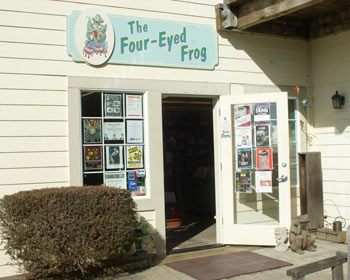
Four Eyed Frog Books has always been a popular destination for me and my family whenever we are vacationing in Sea Ranch. This independent bookstore opened up for business in Gualala back in 2003, and it has long since become a go-to destination in this small city in Northern California. While it is much smaller than your average Barnes & Noble, its selection is still very impressive and you can count on new releases always being available. And what if they don’t have what you are looking for, you ask? They can order it for you with no problems whatsoever.
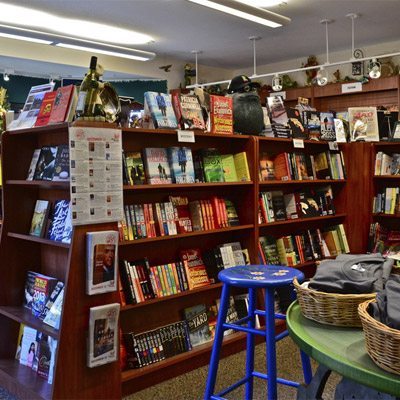
Even if I am not intending to buy a book, I am always enjoy visiting this unique bookstore whenever I am in town thanks to its very friendly atmosphere. Being in there is worth it just to watch my nieces run inside and decide what book their grandpa can buy for them next. I also love holding up those literary works by Sarah Palin or Glenn Beck in front of my parents just to see how they react. They don’t care for Palin’s or Beck’s books, but that’s okay because neither do I.

The owner of Four Eyed Frog Books, or “The Frog” as many like to call it, is Joel Crockett who, on the store’s website, admits he always dreamed about “owning a little store – in a small town – on the ocean.” This dream later became a reality when he and his late wife Linda came to the Redwood Coast, and they knew right then and there that this was the place for them to live. Following its opening, Joel’s brother, Jeremy Crockett moved into town to become a partner in the bookstore. These two even have their own band which is understandably titled The Crockett Brothers. Their specialty is folk music, and my dad has confirmed to me that they are hilarious.

In addition, Four Eyed Frog Books has also become a place for authors to drop by and give readings of what they have written. Guests who have dropped by include Bill Broder who wrote “Taking Care of Cleo,” Charles Furey who shared World War II stories from his memoir “Going Back,” and California’s High School Poet Laureate of 2005 Lindsey Smith who gave us a sampling of her work in “Hailing The Taxi Hopefully.” Also, during the summer, the bookstore has a weekly story time for kids of all ages to attend. This should show deeply ingrained this bookstore is in the local culture.

The Frog also has other items to peruse like a large number of greeting cards for any occasion. They also have a selection of gently used books which are worth a look, and there is a section dedicated to the works of local authors. This I think is especially thoughtful as books like these can be slightly easier to find online than in as store like this. Furthermore, they have some fun games to purchase such as Bananagrams. For those unfamiliar with it, the game is kind of like Scrabble except you have a whole game board to yourself to compose words as do all your opponents. This game has become a big favorite in my family, and it has given us great times as well as frustrating moments where we get the same letter seven times and end up throwing them across the room.
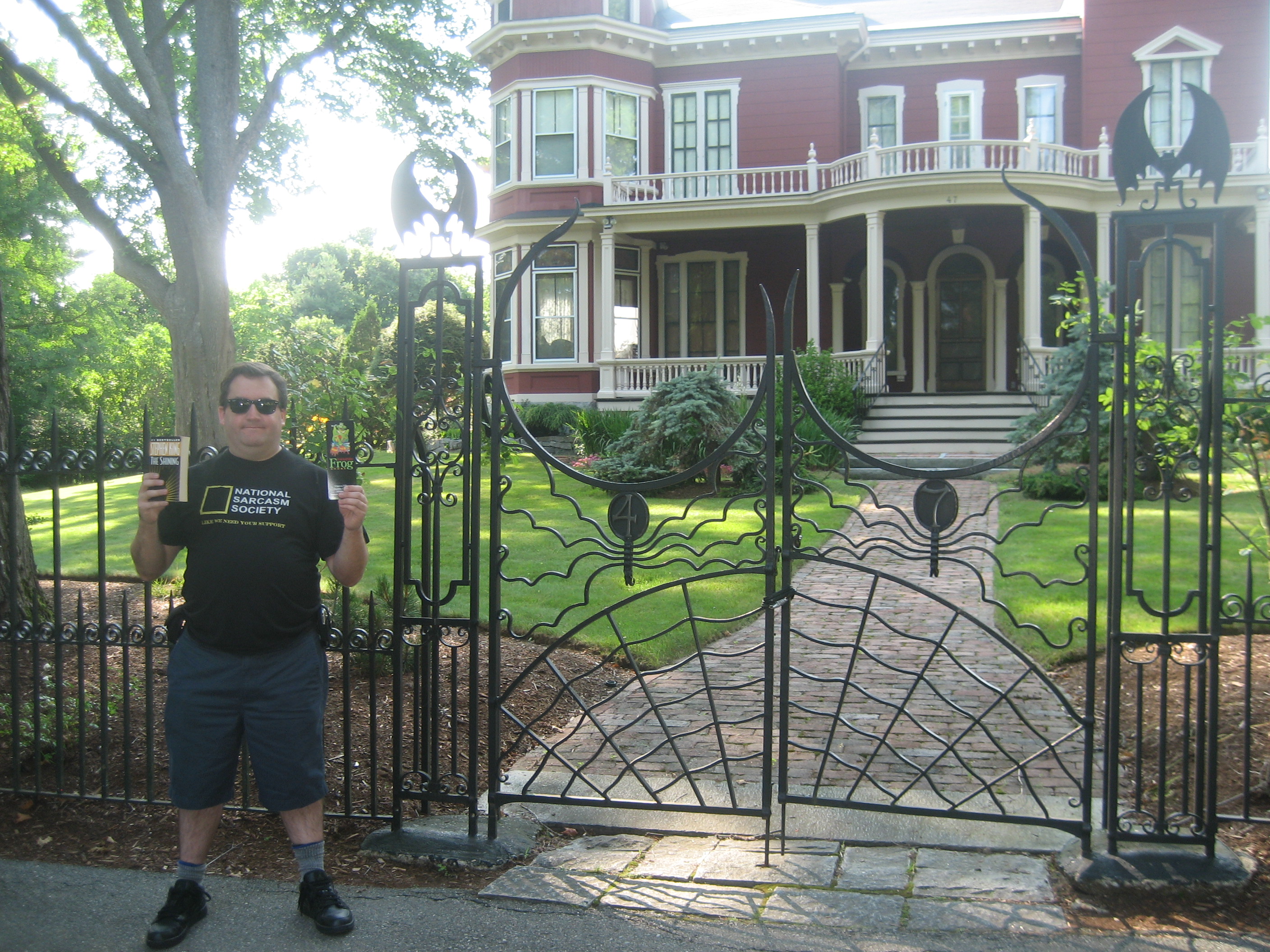
One of my other favorite features of The Frog is this display they have of customers who have displayed travel photos including the store’s bookmark. Those fans have shown off their bookmarks in such places as Australia, Rome, London, Mexico and Los Angeles, which for some probably is a far-off destination. As for myself, I found the perfect place to show off my Four-Eyed Frog bookmark:
Joel has said that the goal of Four Eyed Frog Books is to be “a responsive, involved, interested and interesting community bookstore.” It is safe to say he has long since succeeded in making the store just that. The selection they offer reflects what its customers often purchase, and they continue to serve the town of Gualala very well. They are also very happy to place special orders for you, and they can get that book you desperately want out delivered to you as ordering from Amazon can be severely overrated.

Taking this all into account, there is much more to this small independent bookstore than meets the eye. I will most definitely continue to support The Frog whenever I visit Gualala. Joel still knows my family and was quick to recognize me even though I only come to this town just once a year. I very much enjoy the friendly atmosphere the bookstore provides, and it is always a pleasure to walk through the doors. Even though I still have dozens of books waiting to be read, I always find myself buying something because leaving empty handed, especially in an independent bookstore, feels quite criminal.

If you are ever driving through Gualala on your way to Mendocino, I strongly recommend you check Four Eyed Frog Books out. Trust me, it is worth the time, and you will find a book you like. Small Business Saturday may be gone, but the memory lingers on.

‘Jaws’ – Peter Benchley’s Novel vs Steven Spielberg’s Film

Peter Benchley’s novel “Jaws” is much darker in tone as the main characters come across as unhappy and have harsh tempers which constantly get the best of them. There are also a number of subplots that bring out the negative sides of each character throughout. When it came to turning “Jaws” into a movie, Spielberg worked with different screenwriters to make the characters more likable, and he eliminated many of the novel’s subplots. In the process, he changed much of the story to where the movie focused on the terror the shark wreaks on the helpless townspeople and tourists, and on the last act where Brody, Hooper and Quint go on a hunt to destroy it.

The movie has the married couple of Martin and Ellen Brody more or less settled on Amity Island, and Ellen seems to be happier than Martin about their relocation from New York City to their current residence as her husband has a big fear of the water. Benchley’s novel, however, has them at odds with one another to where they argue most of the time, and it is Ellen who is more dissatisfied with the move to Amity Island as she misses her former life in the city.

One major subplot which did not transfer over to the movie is when Ellen Brody has an affair with marine biologist Matt Hooper (played by Richard Dreyfuss). It turns out she used to date Matt’s older brother and being with Matt vividly reminds her of the life she used to have. While Spielberg’s film portrays Matt and Martin as being friends, Benchley’s novel has them becoming enemies as Martin struggles with getting older along with his envy of Hooper who represents the man he used to be.

Quint, who was unforgettably portrayed by Robert Shaw, is described much differently and barely speaks at all. Suffice to say, his speech about being on board the USS Indianapolis when it sank is not in the book. Even Quint’s death is different as, instead of him being eaten by the shark after it jumps on board the Orca, he gets his foot caught in a rope attached to the great white and drowns after he is pulled underwater.

As for Hooper, who survived his ordeal in the shark cage in the Spielberg movie, he is killed off in the book as well. Perhaps it is karmic justice as Benchley portrays him as an obnoxious man who Martin almost chokes to death at one point.

Another subplot which did not carry over from the book is when Mayor Vaughn is found to be seriously in debt to the mafia, hence his strong need to keep the beaches of Amity open despite the shark attack. Spielberg’s movie, however, has him resisting Martin’s urges to close the beaches as Amity Island is seriously dependent on tourist dollars during the summer for its very existence.

When it comes to the ending of “Jaws,” Martin Brody does not kill the shark by shooting a bullet into the air tank stuck in its mouth which causes it to explode. In the book, he is helplessly stuck in the water after the Orca sinks, and the shark heads straight for him. In the process of Brody accepting his fate, the shark ends up passing away just mere inches away from him. After battling these men for several days while having barrels stuck in it and suffering from blood loss, the shark just gives in and dies which makes for a rather anti-climactic ending.

Many of the changes came about because Spielberg set out to make an audience pleasing movie, and he didn’t want the main characters battling one another as they battled the shark. But for those who have seen the movie hundreds of times, it is worth reading the book as Peter Benchley uses the shark as a metaphor for Martin Brody’s realization of his mortality and how it comes to affect his actions on the job and in his marriage.

Despite its differences, Benchley’s novel remains a riveting tale of suspense and terror worth reading while you sit on the beach and getting a nice suntan.

‘Jurassic Park’ – Michael Crichton’s Novel vs Steven Spielberg’s Film

Michael Crichton’s book “Jurassic Park” served as a cautionary tale on scientists’ tampering with biology as they bring dinosaurs back to life without thinking about the consequences of their actions. When Steven Spielberg adapted it to the silver screen in what turned out to be a genuinely thrilling movie, much of it was changed and details were omitted to make it the kind of audience pleasing movie he was best known for making at the time. He doesn’t delve as much into the darker side of Crichton’s characters and made them more likable, and the changes proved impossible to miss.

Working with David Koepp, who got screenwriting credit along with Crichton, Spielberg developed the cartoon the main characters watch during the park tour to remove much of the exposition found in the book. Crichton goes into extensive detail about how dinosaurs were recreated using their DNA which ends up being found in mosquitoes trapped in fossilized tree resin. Despite many scientists saying it is impossible to create dinosaurs in this way, it still makes for a very compelling story.

Koepp also cut out a sequence from the book which had Grant and Hammond’s grandchildren being chased down the river by the Tyrannosaurus. This was done for budgetary reasons, but this dinosaur would later appear in “Jurassic Park III.”

The book also had a sub-plot about young children getting attacked by small theropod dinosaurs, but Spielberg cut this out because he found it too horrific. However, that same sub-plot would be used to start off the movie version of “Jurassic Park: The Lost World.”

When it came to the characters, some of the biggest changes occurred with John Hammond, the curator of Jurassic Park. The book describes him as a ruthless businessman who is arrogant, deceptive, utterly disrespectful, and thoughtlessly rude. Even though he eventually comes to see the consequences of his experiments, he still moves ahead with his plans in the name of profit. He is even willing to sacrifice his grandchildren to the dinosaurs if that’s what it takes.

In the movie where Hammond is portrayed by Sir Richard Attenborough, he is instead an eccentric and friendly old man who is caught up in the wonder of what he has helped bring to life. However, he eventually realizes he cannot control the dinosaurs and is desperate to see his grandchildren brought back safely. This change came about because Spielberg very much related to Hammond’s obsession with showmanship.

Dr. Alan Grant, played by Sam Neil, is shown to like kids and enjoys being around them in the book. However, the movie has him being not the least bit fond of them. This change was made to give Grant more room for character development as he comes to be the father figure Hammond’s grandchildren lack when things go wrong.

Ellie Sattler, played by Laura Dern, is described as a 23-year old graduate student of Grant’s who is planning to get married to someone other than him. In the movie, she is Grant’s love interest and hopes he will one day be open to having children with her.

Jeff Goldblum gave a scene stealing performance as chaos theorist Ian Malcolm, and he gives Spielberg’s film the bulk of its comic relief. Crichton, however, wrote Malcolm as being more serious, philosophical, and at times downright condescending. Unlike the movie, Malcolm is killed off at the end of the book, but in the follow-up book “The Lost World” he is revealed to have survived.

One character that got drastically downsized was Dr. Henry Wu who is played by B.D. Wong. Crichton has him providing much of the detail about how the dinosaurs are cloned, and he stays on the island and is eventually killed off while the movie has him heading off to the mainland where he survives, and he was the only actor from this movie to appear in “Jurassic World.”

The lawyer Donald Gennaro, one of the movie’s greediest and thoughtless characters, comes across as rather likable in the way Crichton writes him. While he becomes something of a scapegoat towards the end, he is the one most insistent on the island being destroyed to protect the rest of the world from these dinosaurs. But in the movie, he is ever so eager to exploit the park’s profit potential any which way he can.

Then there are Hammond’s grandchildren, Lex and Tim, who are along for the tour of the island as well. In the book, Tim is the oldest of two at 11 years old and is good with computers while Lex is only 7 and more into sports. Spielberg switched these characters around to where Lex was the oldest, and he did this in order to cast Joseph Mazzello as Tim. Ariana Richards plays Lex, and she’s the more into computers and helps save the main characters in one critical scene.

Looking back at “Jurassic Park” the movie, it was the last time Spielberg adapted a book and changed the characters to where they were likable and easier for audiences to spend time with. His next movie was “Schindler’s List” which had him exploring one of the darkest periods of human history, and making it had a major effect on the movies he directed afterwards. When it came to turning “The Lost World” into a movie, Spielberg was more willing to embrace the darker aspects Crichton explored intensely in his books, and this was something readers wished he had done with the first movie.